


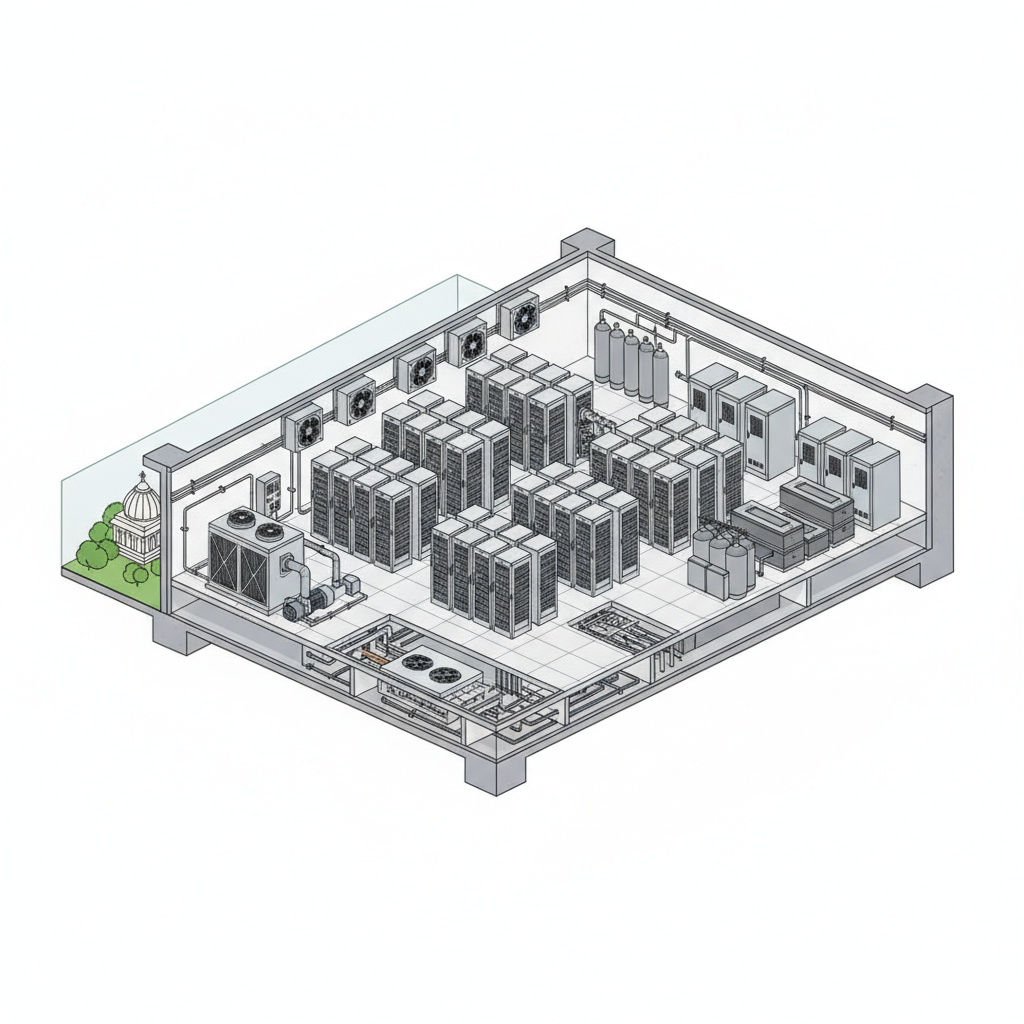
10 Sep AP High Court Scrutinizes Land Allotment for Google Data Centre in Eco-Sensitive Zone
✎ The Andhra Pradesh High Court’s scrutiny of the data centre land allotment highlights the need for strict adherence to environmental laws, lease regulations for religious lands, and the Environmental Impact Assessment (EIA)…
Subject Relevance — Where This Topic Fits
- GS Paper II — Governance, Constitution and Polity | GS Paper III — Environment and Disaster Management | GS Paper III — Infrastructure and Industrial Development
- Prelims: Eco-Sensitive Zones (ESZs), National Green Tribunal (NGT), Endowment lands, Data localisation, Lease and License Rules, 2003, Simhachalam Devasthanam, Kambalakonda Wildlife Sanctuary, Hyperscale data centres
- Essay: Balancing economic development with environmental conservation: A case study of land use in Andhra Pradesh, Judicial oversight in governance: Ensuring compliance with environmental and constitutional norms
Quick Revision: The Andhra Pradesh High Court’s scrutiny of the data centre land allotment highlights the need for strict adherence to environmental laws, lease regulations for religious lands, and the Environmental Impact Assessment (EIA) Notification, 2006, particularly for projects in Eco-Sensitive Zones (ESZs).
Why is this in the news?
The Andhra Pradesh High Court on September 9, 2026, took cognisance of a Public Interest Litigation (PIL) challenging the allotment of temple lands in an Eco-Sensitive Zone (ESZ) to a hyperscale data centre project promoted by Google in Visakhapatnam and Anakapalli districts. The court raised critical questions regarding the validity of the land lease, environmental clearances, and compliance with statutory norms, underscoring the intersection of industrial development, religious property rights, and ecological protection in governance.
Background
- The Simhachalam Devasthanam, a religious endowment, owns lands in Visakhapatnam and Anakapalli districts, which were leased to Vizag Hyperscale Data Center Park Limited—a subsidiary of Google Inc.—for establishing a hyperscale data centre.
- The project site lies within one kilometre of the Kambalakonda Wildlife Sanctuary, designated as an Eco-Sensitive Zone (ESZ) under the Environment Protection Act, 1986, necessitating stringent environmental safeguards.
- The State government’s claim of a 30-year lease period for the land has been disputed, with the court directing a detailed examination of the lease documents and allotment process.
- The case also raises concerns over data localisation norms, water and electricity consumption by data centres, and the project’s categorisation under the Environmental Impact Assessment (EIA) Notification, 2006, as a ‘B category’ project despite its proximity to an ESZ.
- The National Green Tribunal (NGT) is already seized of three related matters, highlighting overlapping jurisdictions and the need for coordinated judicial and administrative oversight.
What is the legal and ecological framework governing land allotment for industrial projects in Eco-Sensitive Zones (ESZs)?
- Eco-Sensitive Zones (ESZs): Designated under the Environment Protection Act, 1986, ESZs are areas around protected forests, wildlife sanctuaries, and national parks where developmental activities are regulated to minimise ecological impact. Activities in ESZs are classified into ‘A’, ‘B’, or ‘C’ categories based on their environmental sensitivity, with stricter norms for Category-A projects.
- Environmental Impact Assessment (EIA) Notification, 2006: Mandates prior environmental clearance for projects based on their potential impact. Projects are categorised into A, B1, or B2, with Category-A requiring appraisal by the Expert Appraisal Committee (EAC) and Category-B projects assessed by State-level authorities.
- Endowment Lands and Religious Institutions: Governed by state-specific laws such as the Andhra Pradesh Charitable and Hindu Religious Institutions and Endowments Act, 1987, which regulates the management, lease, and utilisation of lands owned by religious institutions. Lease periods for such lands are typically capped, with extensions requiring statutory approvals.
- National Green Tribunal (NGT): A specialised judicial body established under the National Green Tribunal Act, 2010, to handle environmental disputes, including those related to ESZs, EIA violations, and ecological damage. The NGT’s jurisdiction often overlaps with civil courts, necessitating careful coordination.
- Data Centre Regulations: While India lacks a dedicated data centre policy, projects are subject to general environmental, land-use, and sectoral regulations. Concerns include high water and energy consumption, land acquisition norms, and compliance with data localisation policies under the Information Technology Act, 2000.
- Judicial Oversight in Governance: Courts play a pivotal role in ensuring that executive actions comply with constitutional and statutory provisions, particularly in matters involving public interest, environmental protection, and fundamental rights. The principle of ‘public trust doctrine’ underscores the state’s obligation to protect natural resources for future generations.
Key Features
| Feature | Significance |
|---|---|
| Lease tenure dispute (11 years vs 30 years) | Raises questions on the legality of land allotment duration and adherence to State lease regulations for endowment lands. |
| Location within Eco-Sensitive Zone (ESZ) | Triggers compliance requirements under the Environment Protection Act, 1986, and the Wildlife (Protection) Act, 1972, for projects in ESZs. |
| Data localisation concerns | Highlights the intersection of digital infrastructure projects with national data governance frameworks and judicial precedents. |
| Jurisdictional overlap (High Court vs NGT) | Examines the principle of judicial hierarchy in environmental litigation and the doctrine of forum conveniens. |
| Endowment land utilisation | Invokes the legal framework governing the use of temple lands under the Andhra Pradesh Charitable and Hindu Religious Institutions and Endowments Act, 1987. |
Why it Matters
Economic/Strategic
- The project represents a critical component of India’s digital infrastructure expansion, aligning with the National Data Centre Policy, 2020, aimed at enhancing data sovereignty and technological self-reliance.
- Foreign direct investment in hyperscale data centres can catalyse job creation, ancillary industries, and regional economic development in Visakhapatnam and Anakapalli districts.
- The case underscores the balance between attracting global technology investments and safeguarding domestic environmental and cultural assets.
Environmental
- The project’s proximity to the Kambalakonda Wildlife Sanctuary (ESZ) necessitates rigorous compliance with the Environmental Impact Assessment (EIA) Notification, 2006, and the Wildlife (Protection) Act, 1972.
- Concerns over water and electricity consumption for data centres highlight the need for sustainable resource management in ecologically sensitive regions.
- The case exemplifies the tension between industrial development and biodiversity conservation, a recurring theme in India’s environmental jurisprudence.
Legal/Constitutional
- The dispute raises questions about the constitutional validity of land allotment to non-religious entities for commercial purposes, invoking the doctrine of public trust and the right to cultural heritage under Article 29(1) of the Constitution.
- The case tests the application of the National Green Tribunal Act, 2010, and the jurisdiction of specialised environmental tribunals versus civil courts.
- The lease terms and their compliance with state-specific regulations (e.g., Andhra Pradesh Lease & License Rules, 2003) are central to the judicial scrutiny.
Challenges
1. Jurisdictional ambiguity in environmental litigation
- Overlap between the jurisdiction of the High Court and the National Green Tribunal (NGT) creates procedural delays and legal uncertainty.
- The doctrine of forum conveniens must be applied to determine the most appropriate forum for adjudicating environmental disputes.
UPSC Link: GS-II: Judiciary and Tribunals
2. Balancing economic development with environmental conservation
- The project’s environmental impact assessment must reconcile the need for digital infrastructure with the preservation of biodiversity in ESZs.
- The case highlights the challenge of enforcing sustainable development principles under the National Environment Policy, 2006.
UPSC Link: GS-III: Environmental Conservation
3. Adherence to lease and endowment regulations
- The dispute over lease tenure (11 years vs 30 years) questions the legality of land utilisation for non-religious purposes under the Andhra Pradesh Charitable and Hindu Religious Institutions and Endowments Act, 1987.
- The absence of a registered lease deed raises concerns about transparency and accountability in land allotment processes.
UPSC Link: GS-II: Government Policies and Interventions
4. Data localisation and national security concerns
- The project’s association with a foreign entity (Google) necessitates scrutiny of data localisation norms under the Personal Data Protection Bill, 2019 (pending enactment), and existing judicial precedents.
- The case underscores the need for a robust regulatory framework to govern cross-border data flows and digital sovereignty.
UPSC Link: GS-III: Science and Technology
5. Sustainable resource management
- Data centres require substantial water and electricity, posing risks to local ecosystems and resource availability in water-scarce regions.
- The case highlights the need for integrated water and energy policies to mitigate industrial impacts on ESZs.
UPSC Link: GS-III: Resource Management
Challenges — UPSC Perspective
| Issue | Concern |
|---|---|
| Dual jurisdiction (High Court vs NGT) | Procedural delays and legal uncertainty in environmental litigation. |
| Endowment land utilisation | Potential violation of state regulations governing temple lands. |
| Environmental compliance in ESZ | Risk of biodiversity loss and non-compliance with wildlife protection laws. |
| Data localisation norms | Ambiguity in regulatory frameworks governing foreign-owned data centres. |
| Resource sustainability | High water and electricity consumption threatening local ecosystems. |
| Lease deed registration | Lack of transparency in land allotment processes. |
Way Forward
- Conduct a comprehensive environmental impact assessment (EIA) in strict compliance with the EIA Notification, 2006, and the Wildlife (Protection) Act, 1972.
- Clarify the jurisdiction of the High Court versus the National Green Tribunal to avoid procedural conflicts in environmental disputes.
- Ensure strict adherence to the Andhra Pradesh Lease & License Rules, 2003, and the Andhra Pradesh Charitable and Hindu Religious Institutions and Endowments Act, 1987, in land allotment processes.
- Develop a robust regulatory framework for data localisation and cross-border data flows to address national security concerns.
- Implement sustainable water and energy management practices for hyperscale data centres to mitigate environmental impacts.
- Strengthen transparency in land allotment by mandating the registration of lease deeds and public disclosure of terms.
- Establish a multi-stakeholder committee comprising environmentalists, legal experts, and industry representatives to oversee the project’s compliance with environmental and legal norms.
UPSC Value Addition
Keywords for Mains Answer-Writing
Eco-Sensitive Zone (ESZ) · Environmental Impact Assessment (EIA) · National Green Tribunal (NGT) · Data Centre Policy · Temple Lands (Endowment) · Lease and Licence Rules · Hyperscale Data Centres · Land Allotment Policy · Constitutional Provisions for Environmental Protection · Judicial Review of Executive Actions · Data Localisation · Public Interest Litigation (PIL) · Andhra Pradesh Industrial Infrastructure Corporation (APIIC) · Kambalakonda Wildlife Sanctuary · Forest (Conservation) Act, 1980 · Wildlife (Protection) Act, 1972
Constitutional & Policy Linkages
- Article 29(1): Right to conserve cultural and religious heritage.
- Article 48A: Directive Principle of State Policy on environmental protection.
- Article 51A(g): Fundamental Duty to protect and improve the natural environment.
Concept Flow
Land allotment for hyperscale data centre in ESZ of Kambalakonda Wildlife Sanctuary → Dispute over lease tenure (11 years vs 30 years) and compliance with state endowment laws → Environmental concerns raised due to project location and resource consumption → Jurisdictional overlap between High Court and National Green Tribunal → Legal scrutiny of data localisation norms and foreign ownership implications → Judicial intervention to balance economic development with environmental conservation → Potential policy reforms in land utilisation, environmental compliance, and data governance
Prelims Practice Questions
Q1. Consider the following statements regarding the Eco-Sensitive Zones (ESZs) in India:
1. ESZs are notified under the provisions of the Environment (Protection) Act, 1986.
2. Activities such as felling of trees, setting up of industries, and commercial mining are prohibited in ESZs.
3. The width of ESZs around Protected Areas is uniformly prescribed as 10 km by the Ministry of Environment, Forest and Climate Change.
4. The National Green Tribunal (NGT) has the jurisdiction to adjudicate disputes related to ESZs.
How many of the above statements are correct?
- Only one
- Only two
- Only three
- All four
Answer: Only three — Statements 1 and 4 are correct. ESZs are notified under the Environment (Protection) Act, 1986, and the NGT has jurisdiction over environmental disputes. Statement 2 is partially correct as some activities are regulated rather than outright prohibited. Statement 3 is incorrect as the width of ESZs is not uniformly prescribed and varies based on ecological sensitivity.
Q2. Assertion (A): The National Green Tribunal (NGT) has original jurisdiction over all civil cases involving substantial questions relating to the environment.
Reason (R): The NGT Act, 2010, empowers the tribunal to adjudicate disputes arising under the Water (Prevention and Control of Pollution) Act, 1974, and the Air (Prevention and Control of Pollution) Act, 1981.
- Both A and R are true, and R is the correct explanation of A
- Both A and R are true, but R is NOT the correct explanation of A
- A is true, but R is false
- A is false, but R is true
Answer: Both A and R are true, but R is NOT the correct explanation of A — The NGT Act, 2010, grants the tribunal original jurisdiction over civil cases involving substantial environmental questions. The tribunal also has jurisdiction over the Water and Air Acts, making both the assertion and reason correct, with the reason providing the correct explanation.
Q3. Match the following pairs related to environmental governance in India:
Column I (Institution/Act) | Column II (Function/Purpose)
—————————|—————————
A. Forest (Conservation) Act, 1980 | 1. Regulates the diversion of forest land for non-forest purposes
B. Wildlife (Protection) Act, 1972 | 2. Provides for the protection and management of wildlife
C. Environmental Impact Assessment (EIA) Notification, 2006 | 3. Mandates prior environmental clearance for certain projects
D. National Green Tribunal (NGT) | 4. Adjudicates environmental disputes and enforces environmental laws
Select the correct match:
- A-1, B-2, C-3, D-4
- A-2, B-1, C-4, D-3
- A-3, B-4, C-1, D-2
- A-4, B-3, C-2, D-1
Answer: A-1, B-2, C-3, D-4 — The correct matches are: A-1 (Forest (Conservation) Act, 1980 regulates diversion of forest land), B-2 (Wildlife (Protection) Act, 1972 protects wildlife), C-3 (EIA Notification, 2006 mandates environmental clearance), and D-4 (NGT adjudicates environmental disputes).
Mains Practice Question
✍ The allotment of temple lands in an Eco-Sensitive Zone (ESZ) for a hyperscale data centre raises complex issues intersecting land governance, environmental law, and constitutional principles. Critically examine the legal and environmental dimensions of such allotments in India. Also, analyse the role of the judiciary in ensuring compliance with environmental norms. (15 Marks)
Approach: MODEL-ANSWER SKELETON:
1. **Introduction (2 marks)**: Define Eco-Sensitive Zones (ESZs) and their legal basis (Environment (Protection) Act, 1986; EIA Notification, 2006). Highlight the significance of temple lands in India and their governance under state endowment laws (e.g., Andhra Pradesh Charitable and Hindu Religious Institutions and Endowments Act, 1987).
2. **Legal Framework for Land Allotment (4 marks)**:
– Examine the constitutional provisions governing land use (Article 31A, 31B, Directive Principles of State Policy under Article 48A and 51A(g)).
– Discuss the role of state agencies like the Andhra Pradesh Industrial Infrastructure Corporation (APIIC) in land allotment.
– Analyse the Lease and Licence Rules, 2003 (Andhra Pradesh) and their implications for lease durations and extensions.
– Highlight the conflict between state land governance and environmental protection norms.
3. **Environmental Concerns and Regulatory Gaps (4 marks)**:
– Outline the environmental risks associated with hyperscale data centres (water consumption, energy use, e-waste).
– Discuss the applicability of the Forest (Conservation) Act, 1980 and Wildlife (Protection) Act, 1972 in ESZs.
– Examine the role of the National Green Tribunal (NGT) and its jurisdiction over environmental disputes (NGT Act, 2010).
– Critique the categorisation of projects (Category A vs. B) under the EIA Notification and its implications for compliance.
4. **Judicial Role and Precedents (3 marks)**:
– Analyse the judicial scrutiny of executive actions in environmental matters (e.g., recent High Court and Supreme Court judgments on land allotments in ESZs).
– Discuss the doctrine of public trust and its application in cases involving temple lands and environmental protection.
– Highlight the significance of the Andhra Pradesh High Court’s observations in the present case regarding lease durations and environmental compliance.
5. **Conclusion (2 marks)**:
– Emphasise the need for a balanced approach that harmonises economic development with environmental sustainability.
– Suggest measures such as stricter adherence to EIA norms, independent environmental impact assessments, and greater transparency in land allotment processes.
Source: The Hindu
Generated by AanyaAi for educational purpose.
Related guides on our sites
- Anthropology VS PSIR
- Best PSIR optional coaching
- Best PSIR optional coaching online
- Best PSIR optional teacher

- सीबीएसई तीन भाषा नीति: कक्षा 6 के विद्यार्थियों को मिल सकती है राहत, जानिए क्या है पूरा मामला - September 10, 2026
- Supreme Court’s Relief for Class 6 Students in CBSE’s 3-Language Policy - September 10, 2026
- सुप्रीम कोर्ट ने अबू सलेम के 25 साल बाद रिहाई के प्रयास को किया खारिज - September 10, 2026

No Comments