


23 Feb Artificial Intelligence: Powering India’s Inclusive Transformation
This article covers “Daily Current Affairs” and From Artificial Intelligence: Powering India’s Inclusive Transformation
SYLLABUS MAPPING
GS-3- Science and technology- Artificial Intelligence: Powering India’s Inclusive Transformation
FOR PRELIMS
How can Artificial Intelligence support rural governance in India?
FOR MAINS
What are the major ethical concerns associated with AI deployment in welfare schemes?
Why in the News?
Historical & Technological Background
AI refers to the capability of machines to perform cognitive tasks typically associated with human intelligence, such as learning, reasoning, and decision-making. AI serves as the backbone of the 4th Industrial Revolution, merging the physical, digital, and biological spheres. In India, this manifests through the integration of AI into Digital Public Infrastructure (DPI) to enhance transparency and service delivery.
Global and Indian Context
The evolution of AI has shifted from experimental laboratory use to large-scale deployment. Globally, AI evolved through phases of symbolic AI to the current data-driven deep learning era. In India, the ecosystem is characterised by a social-purpose framework. The technological backbone relies on:
Data: Platforms like AI-Kosh provide over 7,500 datasets and 273 models to lower entry barriers for developers.
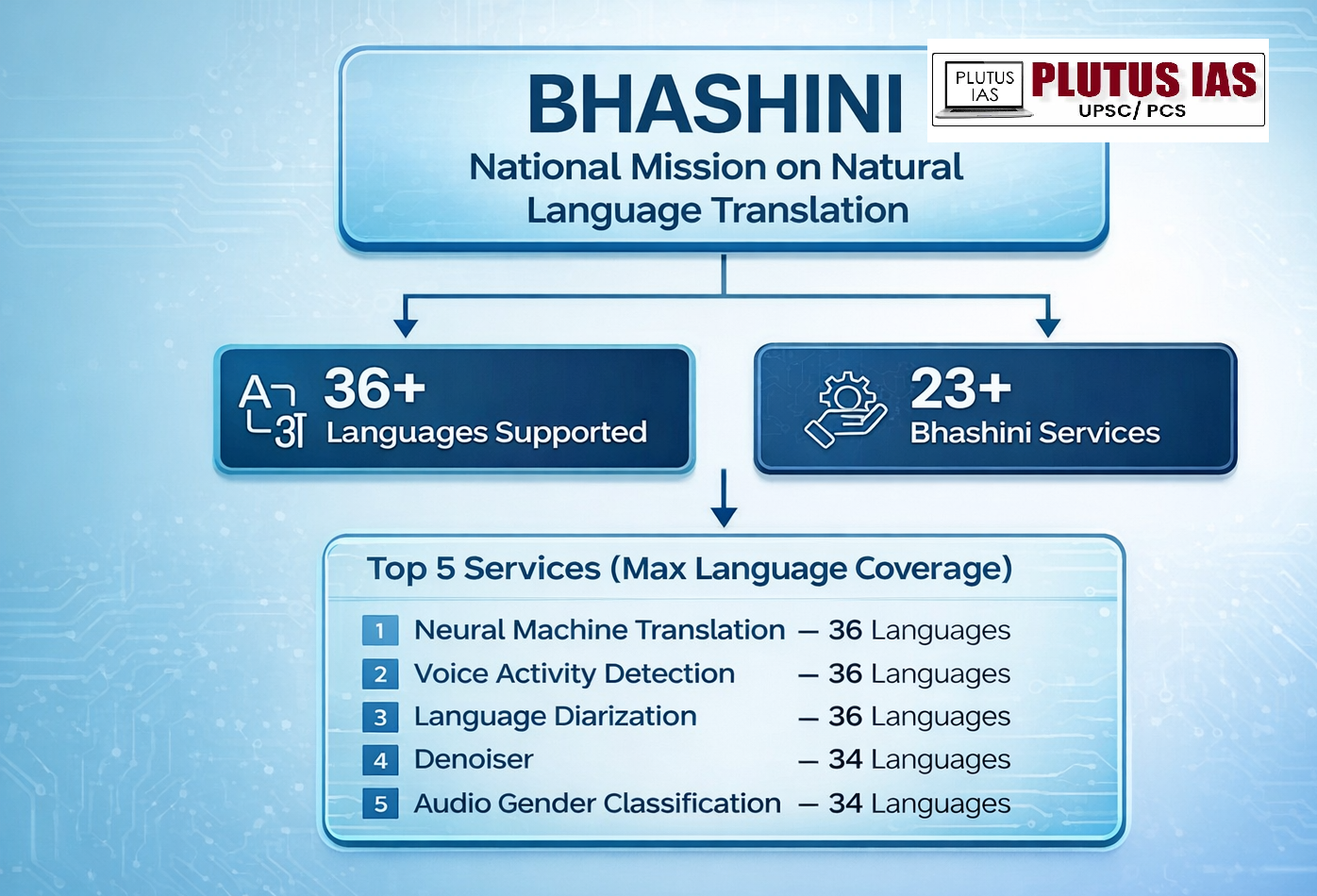
Algorithms: Focus on multilingualism to address India’s diversity (e.g., BHASHINI supports 36+ languages).
Computing Power: Facilitated through the IndiaAI Mission and academic-government collaborations.
Agriculture: AI acts as a decision-support system for weather forecasting, pest detection (National Pest Surveillance System), and irrigation schedules. Kisan e-Mitra provides a virtual assistant for government schemes.
Healthcare: AI enhances last-mile outreach through tools like the Suman Sakhi WhatsApp chatbot, providing maternal health info in rural areas.
Education: The DIKSHA platform uses AI for keyword video search and read-aloud tools for visually impaired students.
Governance
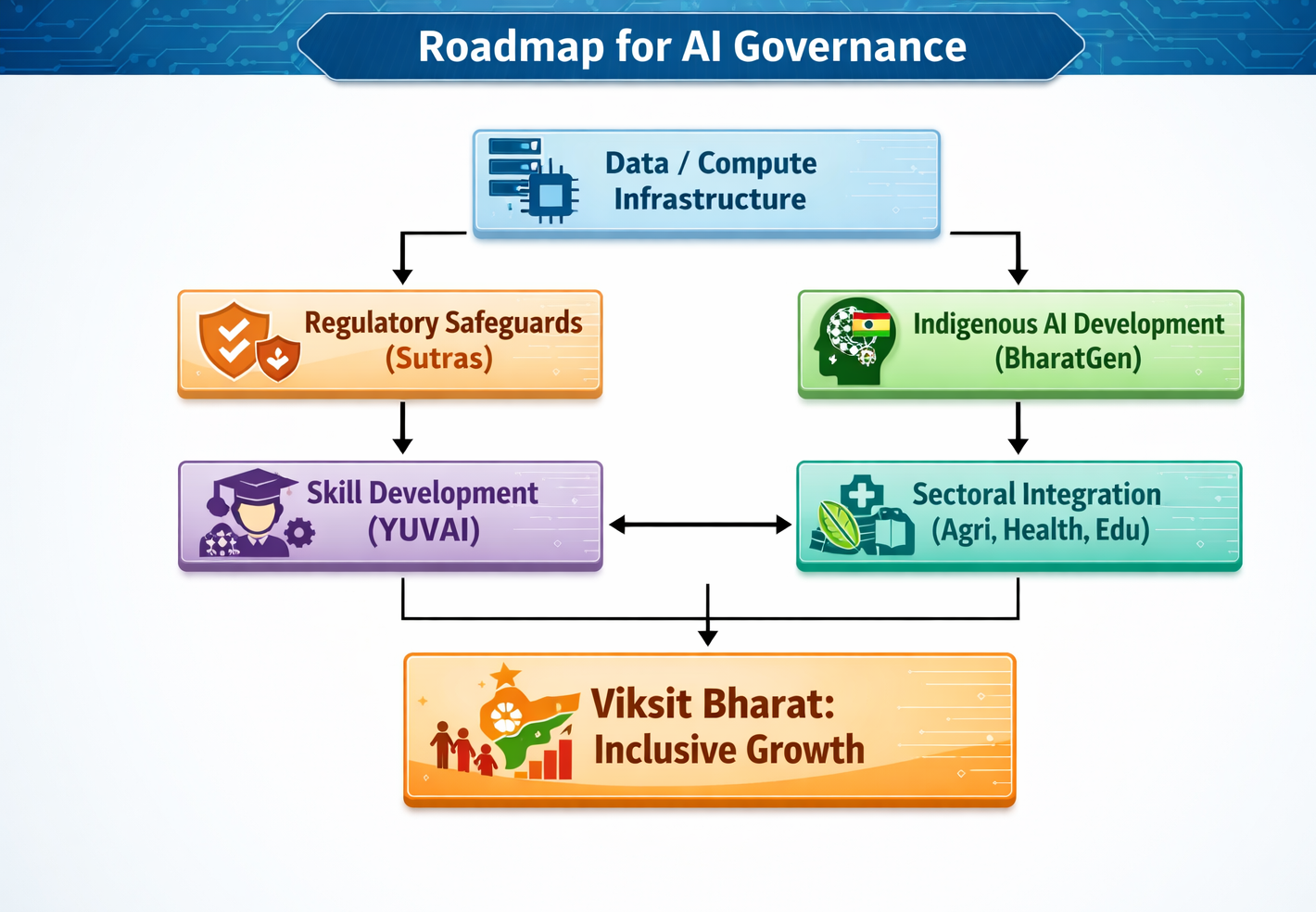
Sabha Saar automates documentation for Panchayats. e-Gram Swaraj and Gram Manchitra use GIS and AI for budgeting, asset mapping, and spatial planning.
Rural Asset Management: Bhu-PRAHARI integrates AI and geospatial data to monitor MGNREGA assets and water bodies (Amrit Sarovars).
Informal Sector: Digital Shram Setu Mission deploys AI to support livelihood and service delivery for informal workers.
Benefits for India
Economic Growth: AI facilitates inclusive participation through decentralised skilling and digital work opportunities.
Job Creation: The strategy emphasizes augmentation of human labour (farmers, teachers, health workers) rather than displacement.
Digital Governance: Systems like e-GramSwaraj have onboarded over 2.53 lakh Gram Panchayats, enhancing transparency in payments and monitoring.
Inclusion: BHASHINI and Adi Vaani break language barriers, allowing tribal and rural populations to access governance in their native dialects.
Challenges & Concerns
Data Privacy: Addressed through “privacy by design” in Digital Public Infrastructure.
Algorithmic Bias: Risks of exclusion in welfare delivery if automated tools are opaque.
Job Displacement: A concern mitigated by India’s focus on AI as a support system for frontline workers.
Ethical Issues: Need for India-specific risk assessments, as global models may not fit the domestic socio-economic context.
AI Divide: The “Global North vs South” divide is addressed by India developing its own sovereign AI stack (Bharat-Gen) to ensure technological independence.
Ethical & Governance Dimension
India’s Responsible AI framework is built on:
Seven Guiding Principles (Sutras): Focusing on fairness, accountability, and transparency.
Human Oversight: Positioning AI to augment human capacity, ensuring administrators and local officials remain central to decision-making.
Accountability: Establishing grievance redressal mechanisms and institutional preparedness to prevent “administrative harm”.
Government Initiatives & Global Cooperation
National Language Translation Mission (BHASHINI): Integrates voice-based interfaces into 23+ government services.
Bharat Gen: The first government-funded, multimodal LLM built on India-centric datasets.
Adi Vaani: Dedicated to preserving tribal languages and oral traditions through digitisation.
Collaborative Ecosystem: Partnerships with 50+ ministries, startups, and academic institutions like IIT Delhi.
Way Forward
Skill Development: Expanding programs like YUVAI to ensure a future-ready workforce.
Public-Private Partnership: Scaling proven use-cases through start up innovation and government scaling.
Indigenous AI: Reducing dependence on foreign models by strengthening the domestic AI stack.
Conclusion
Prelims question:
Q. With reference to India’s approach towards Artificial Intelligence (AI) for rural development, consider the following statements:
1.BHASHINI aims to promote multilingual access to digital services by enabling AI-driven language translation across Indian languages.
2.Bhu-PRAHARI is an AI-enabled platform used for monitoring rural assets such as MGNREGA works and water bodies.
3.Bharat Gen is a privately funded foreign large language model adopted by India for governance purposes.
Which of the statements given above is/are correct?
(a) 1 and 2 only
(b) 2 and 3 only
(c) 1 and 3 only
(d) 1, 2 and 3
Answer: (a) 1 and 2 only
Mains Question:
“Artificial Intelligence is emerging as a new instrument of socio-economic transformation in rural India.” In the context of India’s vision of Viksit Bharat@2047, critically examine. ( 250 Words)

- Artemis II: Humanity’s Return to Lunar Space and India’s Place in the New Moon Race - April 2, 2026
- A Missed Opportunity to Guarantee Minimum Wages - March 31, 2026
- ‘India’s Growth Claims, A Clash with Data Reality’. - March 30, 2026

No Comments