


08 Aug Bike Taxi Drivers Demand Policy Clarity Amid Karnataka Crackdown
✎ Bike taxis in Karnataka operate in a regulatory grey area due to the absence of a state-specific framework for their commercialisation, despite the Motor Vehicles (Amendment) Act, 2019, which overlooks their classification.
Subject Relevance — Where This Topic Fits
- GS Paper II — Governance, Transparency and Accountability | GS Paper III — Infrastructure, Transport and Services
- Prelims: Bike taxi, Gig economy, Regional Transport Office (RTO), Commercial permit, Karnataka High Court, Namma Bike Taxi Association, White-board vs yellow-board registration, Joint Commissioner of Transport
- Essay: The ethical imperative of balancing technological disruption with worker welfare in the gig economy, Regulatory governance: The challenge of creating adaptive policy frameworks in fast-evolving sectors
Quick Revision: Bike taxis in Karnataka operate in a regulatory grey area due to the absence of a state-specific framework for their commercialisation, despite the Motor Vehicles (Amendment) Act, 2019, which overlooks their classification.
Why is this in the news?
The Namma Bike Taxi Association has petitioned the Karnataka government to halt enforcement actions against bike taxi operators, citing the absence of a legal compliance framework despite a Karnataka High Court order. The association, representing over one lakh gig workers, alleges that transport authorities have failed to provide guidelines on registration, permits, and safety norms, leading to arbitrary penalties and vehicle seizures. This impasse highlights systemic regulatory gaps in integrating informal transport services into formal urban mobility systems.
Background
- The Karnataka High Court’s recent order prompted the state’s transport authorities to initiate enforcement drives against bike taxis operating without commercial permits.
- Bike taxis, a prominent feature of Bengaluru’s informal transport ecosystem, operate predominantly on white-board motorcycles, which are not legally permitted for commercial passenger transport under the Motor Vehicles Act, 1988.
- The Motor Vehicles (Amendment) Act, 2019, introduced provisions for aggregator-based mobility services but did not explicitly address bike taxis, leaving a regulatory vacuum.
- Karnataka’s transport department has historically relied on the Motor Vehicles Act and state-specific rules for regulating commercial transport, but these frameworks are ill-suited for the gig economy’s dynamic nature.
- The Namma Bike Taxi Association represents over 100,000 drivers, underscoring the scale of informal employment in Bengaluru’s mobility sector.
What are bike taxis and their regulatory challenges?
- Bike taxis are two-wheeler-based on-demand passenger transport services, typically operating via mobile apps, offering last-mile connectivity in urban areas.
- They function as part of the gig economy, where drivers are classified as independent contractors rather than formal employees, complicating labour and social security protections.
- Under the Motor Vehicles Act, 1988, commercial passenger transport requires yellow-board registration and commercial permits, which bike taxis currently lack, rendering their operations technically illegal.
- The Motor Vehicles (Amendment) Act, 2019, introduced Section 93A to regulate aggregators but did not clarify the status of bike taxis, creating ambiguity in enforcement.
- State governments are empowered under the Motor Vehicles Act to frame rules for non-aggregator-based transport services, but Karnataka has not yet notified such rules for bike taxis.
- The absence of a conversion mechanism for white-board motorcycles to yellow-board commercial vehicles forces drivers into a Catch-22: operate illegally or face livelihood loss.
- Karnataka’s transport department has not established safety norms, fare regulations, or insurance mandates specific to bike taxis, exacerbating regulatory uncertainty.
- The gig economy’s rapid growth has outpaced traditional regulatory frameworks, necessitating adaptive policy measures to integrate informal services into formal mobility ecosystems.
Key Features
| Feature | Significance |
|---|---|
| Legal ambiguity in bike taxi operations | Lack of clear regulatory framework for registration, permits, and safety norms creates uncertainty for gig workers and transport authorities alike. |
| Enforcement drives without compliance mechanisms | Penalising drivers for non-compliance when no legal pathway exists to achieve compliance undermines procedural fairness and economic stability. |
| Gig worker representation in policy formulation | Inclusion of unions in stakeholder consultations ensures policy reflects ground realities and mitigates livelihood disruptions. |
| Regional Transport Office (RTO) inspections | Enforcement actions, such as vehicle seizures, disrupt operations and exacerbate financial hardship for informal transport providers. |
| High Court intervention in transport regulation | Judicial scrutiny of transport policies highlights gaps between statutory provisions and ground-level implementation challenges. |
Why it Matters
Economic
- Bike taxis constitute a significant segment of the gig economy, employing over one lakh workers in Karnataka, whose livelihoods are directly impacted by regulatory uncertainty and enforcement actions.
- The absence of a legal framework for commercial conversion of private vehicles into commercial ones (e.g., white to yellow number plates) stifles formalisation and tax revenue generation.
- Unregulated operations risk market distortions, where compliant operators face unfair competition from unregistered providers, undermining fair trade practices.
Social
- Gig workers, often from marginalised socio-economic backgrounds, face disproportionate hardship due to sudden enforcement drives without prior notice or guidance.
- The demand for transparent compliance mechanisms reflects broader concerns about the rights and protections of informal sector workers in India’s rapidly evolving digital economy.
- Policy inaction risks exacerbating urban mobility challenges by discouraging the participation of informal transport providers in regulated public transport networks.
Governance
- The Karnataka High Court’s role in highlighting regulatory gaps underscores the judiciary’s function in ensuring administrative accountability in transport governance.
- The Transport Department’s silence on repeated representations indicates systemic inefficiencies in inter-departmental coordination and policy implementation.
- The demand for stakeholder consultations aligns with principles of participatory governance, ensuring policies are both practical and equitable.
Legal
- The absence of a statutory framework for bike taxis creates a legal vacuum, leaving enforcement actions vulnerable to challenges on grounds of procedural impropriety.
- The High Court’s intervention suggests potential conflicts between existing motor vehicle laws (e.g., Motor Vehicles Act, 1988) and the operational realities of app-based transport services.
- The demand for a clear conversion mechanism reflects the need to harmonise private vehicle regulations with commercial transport norms under the Motor Vehicles Act.
Challenges
1. Regulatory Vacuum in Gig Economy
- Absence of a dedicated legal framework for bike taxis under the Motor Vehicles Act, 1988, leading to ad-hoc enforcement and legal uncertainty.
- Transport authorities’ failure to issue guidelines for converting private vehicles into commercial ones, despite repeated requests from stakeholders.
- Risk of judicial intervention if enforcement continues without addressing the root cause of regulatory ambiguity.
UPSC Link: GS-II: Government Policies & Interventions
2. Enforcement Without Compliance Pathways
- Penalising drivers for non-compliance when no legal mechanism exists to achieve compliance violates principles of natural justice and procedural fairness.
- Sudden enforcement drives disrupt livelihoods, particularly for gig workers who lack resources to navigate bureaucratic hurdles.
- Potential for backlash from informal transport providers, leading to protests or non-cooperation with regulatory authorities.
UPSC Link: GS-II: Welfare Schemes for Vulnerable Sections
3. Urban Mobility and Informal Transport Integration
- Unregulated bike taxi operations may exacerbate traffic congestion and safety risks in urban areas due to lack of standardised operational norms.
- Failure to formalise informal transport providers undermines the integration of such services into broader public transport networks.
- Risk of market monopolisation by unregistered operators, leading to unfair competition and reduced consumer choice.
UPSC Link: GS-III: Infrastructure & Urban Development
4. Stakeholder Exclusion in Policy Formulation
- Exclusion of bike taxi unions from consultations violates principles of participatory governance and risks policy outcomes that are impractical or inequitable.
- Lack of industry input may result in regulations that are either too restrictive or too lenient, failing to balance safety, economic viability, and consumer demand.
- Potential for policy reversals or legal challenges if stakeholders perceive the process as opaque or exclusionary.
UPSC Link: GS-II: Role of Civil Society in Governance
5. Judicial Scrutiny and Policy Paralysis
- High Court interventions highlight systemic failures in policy implementation, risking judicial overreach in areas traditionally under executive purview.
- Administrative inaction in the face of judicial directives may erode public trust in governance institutions.
- Risk of policy paralysis if the executive and judiciary are perceived as being in conflict over regulatory priorities.
UPSC Link: GS-II: Judiciary and Executive Relations
Challenges — UPSC Perspective
| Issue | Concern |
|---|---|
| Lack of statutory recognition for bike taxis | Creates legal ambiguity and exposes drivers to arbitrary enforcement actions. |
| No conversion mechanism for private to commercial vehicles | Prevents formalisation of informal transport providers, stifling economic growth. |
| Sudden enforcement drives without prior notice | Disrupts livelihoods and violates principles of natural justice. |
| Exclusion of gig worker unions from consultations | Undermines participatory governance and risks inequitable policy outcomes. |
| Judicial intervention due to regulatory gaps | Highlights systemic failures but risks judicial overreach in executive functions. |
| Urban mobility challenges due to unregulated operations | May exacerbate traffic congestion and safety risks in cities. |
Way Forward
- The Karnataka government must immediately issue a notification suspending enforcement actions against bike taxis until a clear compliance framework is established.
- Convene a multi-stakeholder consultation involving bike taxi unions, RTOs, transport experts, and consumer representatives to draft a dedicated policy for bike taxis under the Motor Vehicles Act.
- Formulate a transparent process for converting private vehicles into commercial ones, including eligibility criteria, safety standards, and fee structures, in alignment with existing motor vehicle regulations.
- Establish a grievance redressal mechanism for gig workers to address enforcement-related disputes and ensure procedural fairness.
- Integrate bike taxis into the broader urban transport policy framework, ensuring coordination with public transport authorities to enhance last-mile connectivity.
- Conduct a pilot project in Bengaluru to test the proposed regulatory framework, with provisions for scaling up based on outcomes and stakeholder feedback.
- Strengthen inter-departmental coordination between the Transport Department, RTOs, and local authorities to ensure consistent enforcement and policy implementation.
- Undertake a public awareness campaign to educate gig workers and consumers about the new regulatory framework once it is notified.
UPSC Value Addition
Keywords for Mains Answer-Writing
Gig economy regulation · Bike taxi policy framework · Karnataka High Court order on bike taxis · Regional Transport Offices (RTOs) compliance · Commercial vehicle registration norms · Gig workers’ livelihood rights · Transport policy and enforcement · Public transport integration · Regulatory ambiguity in emerging sectors · State transport department governance
Constitutional & Policy Linkages
- [‘Article 14: Equality before law and equal protection of laws’, ‘Ensures non-arbitrary enforcement actions against gig workers.’]
- [‘Article 19(1)(g): Right to practise any profession’, ‘Protects the livelihoods of bike taxi drivers from excessive regulatory restrictions.’]
- [‘Article 21: Right to livelihood’, ‘Guarantees protection against indiscriminate penalisation without due process.’]
Concept Flow
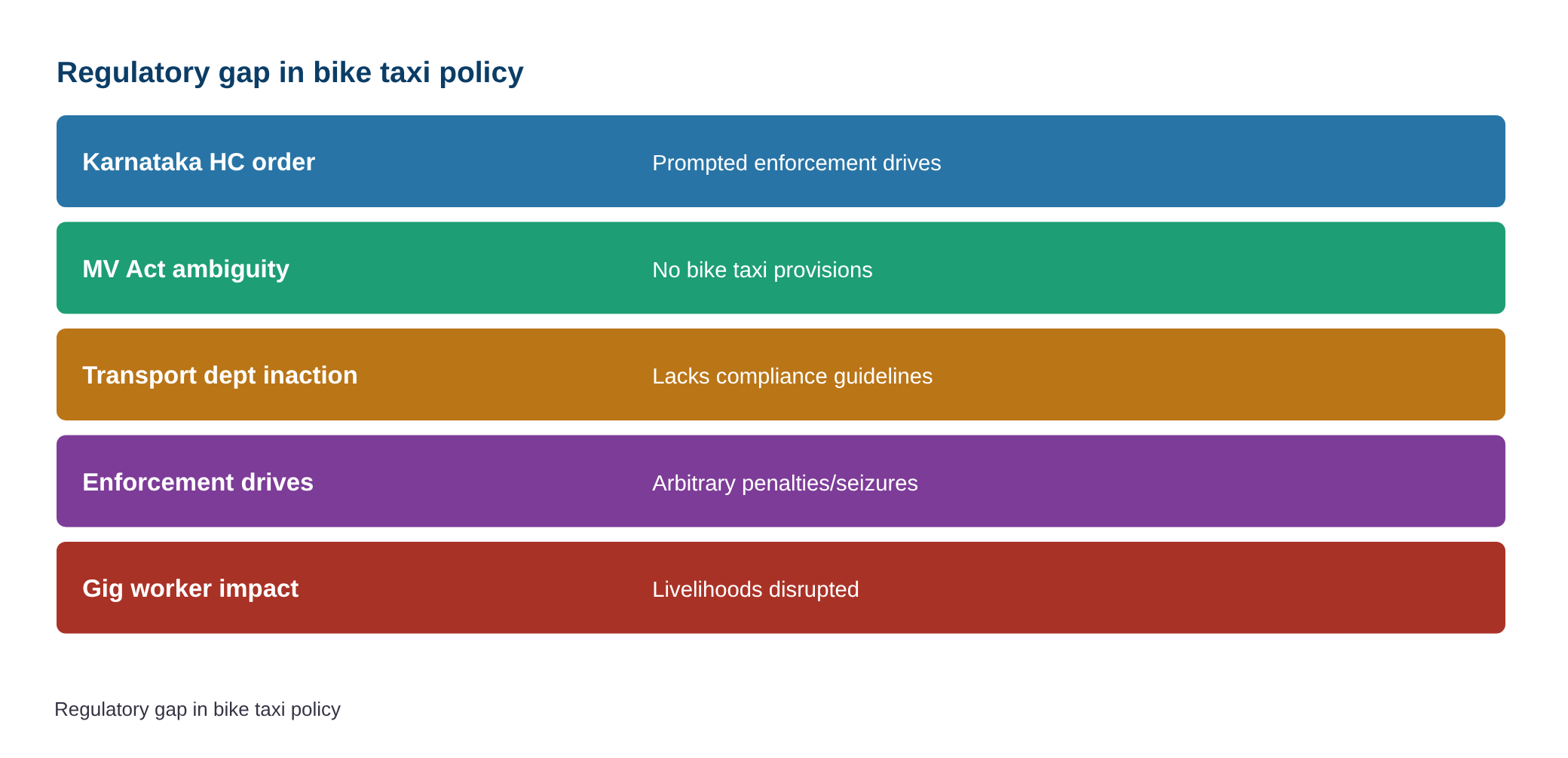
Karnataka High Court order on transport regulation → Ambiguity in Motor Vehicles Act for bike taxis → Transport Department’s inaction on compliance guidelines → Enforcement drives without legal pathways → Disruption of gig worker livelihoods → Association’s demand for policy framework → Government’s response to regulatory vacuum.
Prelims Practice Questions
Q1. Consider the following statements regarding the regulation of bike taxis in India:
1. Bike taxis operate under the Motor Vehicles Act, 1988, and require commercial permits for legal operation.
2. The Karnataka High Court has recently directed the state government to frame a clear policy for bike taxis.
3. The Namma Bike Taxi Association represents over one lakh drivers and gig workers in Karnataka.
4. The Regional Transport Offices (RTOs) in Karnataka have issued detailed guidelines for converting white-board motorcycles into commercial yellow-board vehicles.
How many of the above statements are correct?
- Only one
- Only two
- Only three
- All four
Answer: Only three — Statements 1, 2, and 3 are correct. Statement 4 is incorrect as the RTOs have not issued any guidelines for conversion despite repeated requests.
Q2. Assertion (A): The gig economy in India is governed by a uniform regulatory framework across all states.
Reason (R): The Motor Vehicles Act, 1988, empowers state governments to frame rules for commercial vehicle operations, including bike taxis.
Options:
A. Both A and R are true, and R is the correct explanation of A.
B. Both A and R are true, but R is not the correct explanation of A.
C. A is true, but R is false.
D. A is false, but R is true.
Answer: ? — Assertion (A) is false because the gig economy lacks a uniform regulatory framework across states. Reason (R) is true as the Motor Vehicles Act, 1988, empowers state governments to frame rules for commercial vehicles.
Q3. Match the following columns:
Column I (Policy/Regulatory Framework)
1. Motor Vehicles Act, 1988
2. Karnataka High Court order on bike taxis
3. Regional Transport Offices (RTOs) in Karnataka
4. Namma Bike Taxi Association
Column II (Description)
A. Issued directives to the state government for framing a clear policy for bike taxis
B. Governs the registration and operation of motor vehicles, including commercial permits
C. Represents over one lakh bike taxi drivers and gig workers in Karnataka
D. Responsible for enforcement and compliance of transport regulations
Options:
A. 1-B, 2-A, 3-D, 4-C
B. 1-A, 2-B, 3-C, 4-D
C. 1-C, 2-D, 3-A, 4-B
D. 1-D, 2-C, 3-B, 4-A
Answer: ? — Correct matching: 1-B (Motor Vehicles Act, 1988 governs registration and operation), 2-A (Karnataka High Court order directed policy framing), 3-D (RTOs enforce transport regulations), 4-C (Namma Bike Taxi Association represents drivers).
Mains Practice Question
✍ The absence of a clear policy framework for bike taxis in Karnataka has led to regulatory ambiguity and livelihood threats for gig workers. Critically examine the challenges in regulating emerging sectors like bike taxis within the existing legal and institutional framework. Also, suggest measures to balance regulatory compliance with the protection of gig workers’ rights. (15 Marks)
Approach: MODEL-ANSWER SKELETON:
1. **Contextual Background (2 marks)**
– Briefly explain the gig economy and its growth in India, with a focus on bike taxis.
– Highlight the Karnataka High Court order and the Namma Bike Taxi Association’s plea.
2. **Regulatory Challenges (5 marks)**
– **Legal Ambiguity**: Lack of specific provisions for bike taxis under the Motor Vehicles Act, 1988, and state transport laws.
– **Institutional Gaps**: RTOs’ failure to provide compliance guidelines despite repeated requests.
– **Enforcement Disparities**: Arbitrary crackdowns and seizures without a transparent framework.
– **Safety and Standardisation**: Absence of norms for vehicle modifications, insurance, and driver training.
– **Federalism Issues**: State-level variations in policy approaches and enforcement.
3. **Protection of Gig Workers’ Rights (4 marks)**
– **Livelihood Threats**: Impact of enforcement actions on drivers’ income and social security.
– **Right to Work**: Article 21 (right to livelihood) and Article 19(1)(g) (freedom to practice any profession).
– **Social Security**: Need for inclusion in schemes like PM-SYM or state-level welfare measures.
– **Collective Bargaining**: Role of unions like the Namma Bike Taxi Association in policy formulation.
4. **Suggested Measures (4 marks)**
– **Policy Framework**: Draft a state-specific policy for bike taxis, aligning with the Motor Vehicles Act and local needs.
– **Stakeholder Consultations**: Include gig workers, unions, and civil society in policy formulation.
– **Gradual Compliance**: Provide a transition period for drivers to meet safety and registration norms.
– **Alternative Dispute Resolution**: Establish grievance redressal mechanisms for enforcement-related disputes.
– **Data-Driven Regulation**: Use technology (e.g., GPS tracking) to monitor compliance and ensure transparency.
Source: The Hindu
Generated by AanyaAi for educational purpose.

- विदेश मंत्री जयशंकर की यूरोप के चार विदेश मंत्रियों से द्विपक्षीय वार्ता, भारत-ईयू एफटीए पर चर्चा - September 24, 2026
- मद्रास उच्च न्यायालय ने अनामलाई के खिलाफ मामले को रद्द किया: राजनीतिक टिप्पणियों पर न्यायिक फैसला - September 24, 2026
- Madras HC quashes case against Annamalai over Thevar remarks: UPSC Polity Analysis - September 24, 2026

No Comments