


08 Aug Bill in Parliament: Social Media & Gaming Accounts for Minors Under 13 Banned?
✎ The SHIELD Bill, 2025, proposes mandatory age verification, parental consent for minors under 13, and prohibits personalised advertising targeting children.
Subject Relevance — Where This Topic Fits
- GS Paper II — Governance, Constitution, Polity, Social Justice and International Relations (Digital Governance and Child Protection) | GS Paper III — Science and Technology (Digital Infrastructure, Cybersecurity, and Ethical AI)
- Prelims: Digital Personal Data Protection Act 2023, Information Technology (Intermediary Guidelines and Digital Media Ethics Code) Rules 2021, Section 69A of IT Act, UN Convention on the Rights of the Child, Parental consent mechanisms, Age verification systems, Personalised advertising restrictions, Online gaming regulations, Pornography and extremist content moderation
- Essay: Digital Ethics and Child Welfare: Balancing Innovation with Protection, The Role of Parliament in Regulating Emerging Technologies
Quick Revision: The SHIELD Bill, 2025, proposes mandatory age verification, parental consent for minors under 13, and prohibits personalised advertising targeting children.
Why is this in the news?
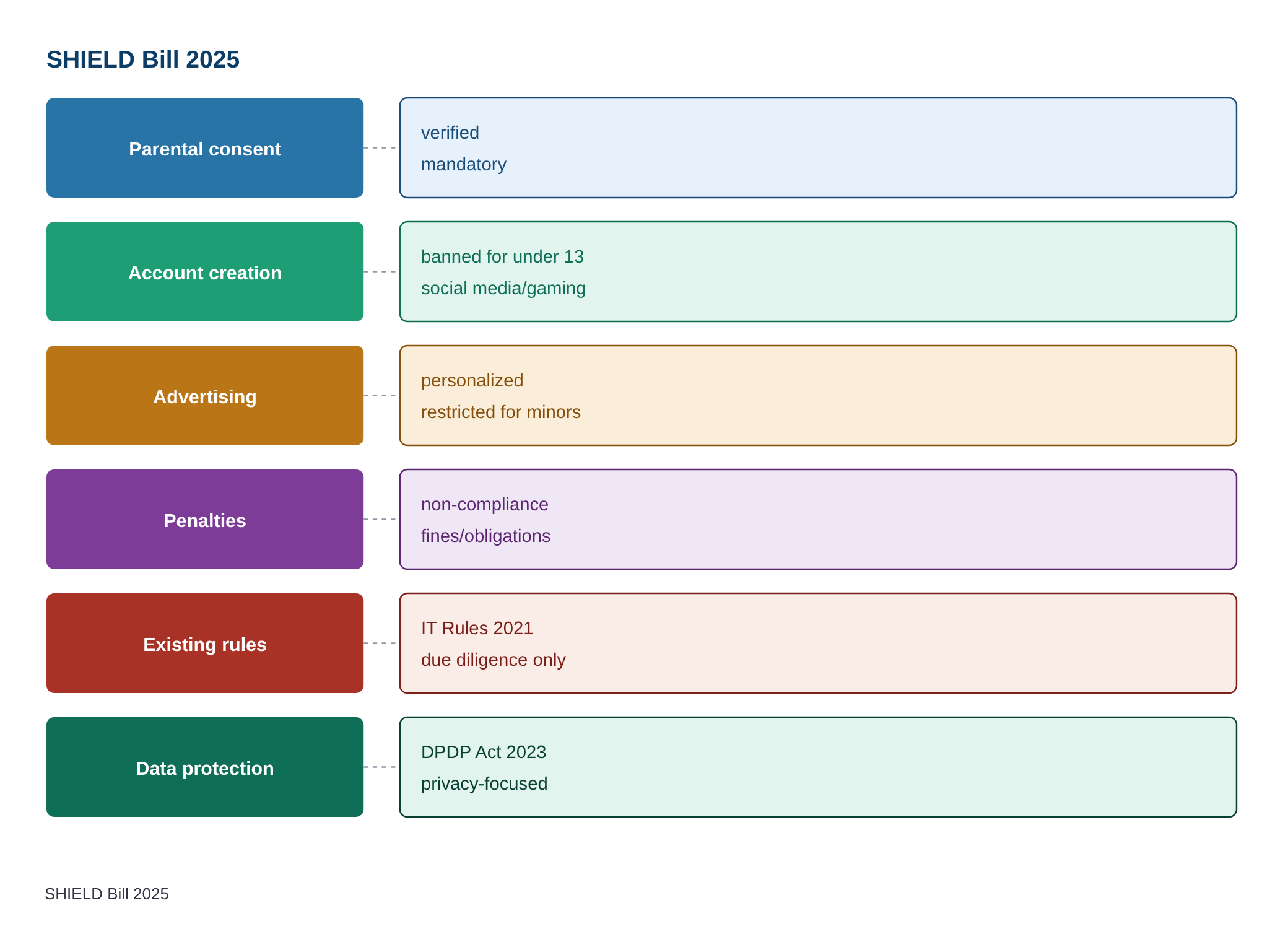
A private member’s bill titled the Safeguarding Healthy Internet Environments for Little Digital-Natives (SHIELD) Bill, 2025, has been proposed in Parliament to prohibit children under 13 from creating accounts on social media and online gaming platforms without verified parental consent. Additionally, the bill seeks to restrict personalised advertising targeting minors and impose penalties on platforms failing to comply with child safety obligations, reflecting growing legislative concerns over digital harms to children.
Background
- The exponential growth of social media and online gaming platforms has raised concerns about the exposure of minors to harmful content, including pornography, extremist material, and gambling-related content.
- Existing regulatory frameworks such as the Information Technology (Intermediary Guidelines and Digital Media Ethics Code) Rules, 2021, mandate due diligence by intermediaries but lack specific provisions for child protection.
- The Digital Personal Data Protection Act, 2023, addresses data privacy but does not comprehensively regulate the digital environment for minors.
- International frameworks like the UN Convention on the Rights of the Child (1989) emphasise the state’s obligation to protect children from all forms of harm, including digital harms.
- Private member’s bills in India rarely become law, with fewer than a dozen having been enacted since Independence, highlighting the procedural challenges in legislative adoption.
- The proposed bill aligns with global trends, such as the UK’s Age Appropriate Design Code and the EU’s Digital Services Act, which impose stricter obligations on digital platforms to safeguard minors.
What is the SHIELD Bill, 2025?
- The Safeguarding Healthy Internet Environments for Little Digital-Natives (SHIELD) Bill, 2025, is a private member’s bill introduced by BJP MP Baijayant Panda to regulate the digital environment for minors in India.
- The bill defines a ‘child’ as any individual below 18 years of age, extending protections beyond the commonly cited threshold of 13 years.
- It proposes mandatory age-verification systems for platforms accessible to minors, ensuring that only verified users can create accounts.
- Parental consent must be obtained for minors under 13 to create accounts, with platforms required to provide parental-control dashboards for monitoring activity, managing privacy settings, and restricting screen time.
- The bill prohibits platforms from tracking, profiling, or targeting minors with personalised advertising, aligning with principles of data minimisation and privacy-by-design.
- Platforms must implement measures to prevent exposure to harmful content, including pornography, gambling, violent or extremist material, and drug-related content.
- The bill also seeks to establish a regulatory framework for monitoring and enforcing child safety obligations across social media, gaming, and other digital intermediaries.
UPSC Value Addition
Keywords for Mains Answer-Writing
Digital Personal Data Protection Act 2023 · Children’s online safety · Parental consent mechanisms · Personalised advertising restrictions · Age verification systems · Information Technology (Intermediary Guidelines and Digital Media Ethics Code) Rules 2021 · Right to Privacy under Article 21 · UN Convention on the Rights of the Child · Section 69A of the IT Act · Digital intermediaries regulation · Protective discrimination for minors · Data localisation and cross-border data flows · Misinformation and harmful content regulation
Prelims Practice Questions
Q1. Consider the following statements regarding the proposed SHIELD Bill, 2025:
1. The bill seeks to prohibit social media platforms from tracking or profiling children below 13 years without parental consent.
2. It mandates age-verification systems for all digital platforms accessible to minors.
3. The bill defines a child as anyone below 18 years of age.
4. Platforms violating the proposed law could face penalties up to ₹5 crore.
How many of the above statements are correct?
- Only one
- Only two
- Only three
- All four
Answer: Only three — Statements 1 and 3 are correct. Statement 2 is incorrect as the bill mandates age-verification systems only for platforms accessible to minors, not all digital platforms. Statement 4 is incorrect as the proposed penalty is up to ₹10 crore, not ₹5 crore.
Q2. Assertion (A): The SHIELD Bill, 2025, proposes to prohibit personalised advertising for children below 13 years.
Reason (R): Personalised advertising relies on tracking and profiling, which the bill seeks to restrict for minors.
Options:
A. Both A and R are true, and R is the correct explanation of A.
B. Both A and R are true, but R is NOT the correct explanation of A.
C. A is true, but R is false.
D. A is false, but R is true.
Answer: ? — Both Assertion (A) and Reason (R) are true, and Reason (R) correctly explains Assertion (A). The bill explicitly prohibits tracking, profiling, and personalised advertising for children below 13 years.
Q3. Match the following provisions of the proposed SHIELD Bill, 2025, with their respective descriptions:
Column I (Provision)
1. Parental consent requirement
2. Age-verification systems
3. Prohibition on personalised advertising
4. Penalties for violations
Column II (Description)
A. Mandatory for platforms accessible to minors
B. Up to ₹10 crore for violations
C. Required for account creation by children below 13
D. Restricted for children below 13 years
Answer: ? —
Mains Practice Question
✍ The proposed SHIELD Bill, 2025, seeks to create a protective legal framework for children in the digital ecosystem by imposing stringent obligations on social media and gaming platforms. Critically examine the constitutional and statutory foundations of this bill, its alignment with the Digital Personal Data Protection Act, 2023, and the challenges in its effective implementation. (15 Marks)
Approach: MODEL-ANSWER SKELETON:
1. **Constitutional Foundations**:
– Right to Privacy under Article 21 (Puttaswamy judgment, 2017) and Right to Education (Article 21A) as the basis for protecting children’s digital rights.
– Directive Principles of State Policy (Article 39(f)) emphasizing the protection of children’s moral and material interests.
2. **Statutory Alignment**:
– **Digital Personal Data Protection Act, 2023 (DPDP Act)**: Overlap with provisions on data fiduciaries, parental consent for minors, and restrictions on processing personal data of children.
– **Information Technology (Intermediary Guidelines and Digital Media Ethics Code) Rules, 2021**: Existing framework for intermediaries, but lacks specific provisions for children.
– **UN Convention on the Rights of the Child (UNCRC)**: India’s obligations under Article 16 (right to privacy) and Article 17 (protection from harmful content).
3. **Key Provisions of SHIELD Bill**:
– Definition of ‘child’ as below 18 years (vs. DPDP Act’s below 18 for data protection but below 13 for account creation in the bill).
– Mandatory age-verification systems and parental consent dashboards.
– Prohibition on tracking, profiling, and personalised advertising for children.
– Penalties up to ₹10 crore and potential blocking under Section 69A of the IT Act for violations.
4. **Challenges in Implementation**:
– **Technological Feasibility**: Effectiveness of age-verification systems (e.g., biometric verification, government-issued IDs) and potential privacy risks.
– **Jurisdictional Issues**: Cross-border data flows and enforcement against foreign platforms.
– **Balancing Rights**: Tension between children’s right to access information and protection from harm (e.g., educational platforms vs. social media).
– **Enforcement Mechanisms**: Role of self-regulatory bodies (e.g., Digital India Act proposals) vs. statutory oversight.
5. **Comparative Perspective**:
– **Global Models**: EU’s Digital Services Act (DSA) and Children’s Code (Age Appropriate Design Code), UK’s Online Safety Bill, and US COPPA (Children’s Online Privacy Protection Act).
– **Indian Precedents**: Section 67B of the IT Act (punishment for publishing or transmitting child pornography) and POCSO Act (Protection of Children from Sexual Offences).
6. **Way Forward**:
– Harmonisation with DPDP Act to avoid regulatory overlap.
– Pilot testing of age-verification systems and parental consent mechanisms.
– Multi-stakeholder consultations with platforms, civil society, and child rights organisations.
– Strengthening of grievance redressal mechanisms under the proposed Digital India Act.
Source: Hindustan Times
Generated by AanyaAi for educational purpose.

- विदेश मंत्री जयशंकर की यूरोप के चार विदेश मंत्रियों से द्विपक्षीय वार्ता, भारत-ईयू एफटीए पर चर्चा - September 24, 2026
- मद्रास उच्च न्यायालय ने अनामलाई के खिलाफ मामले को रद्द किया: राजनीतिक टिप्पणियों पर न्यायिक फैसला - September 24, 2026
- Madras HC quashes case against Annamalai over Thevar remarks: UPSC Polity Analysis - September 24, 2026

No Comments