


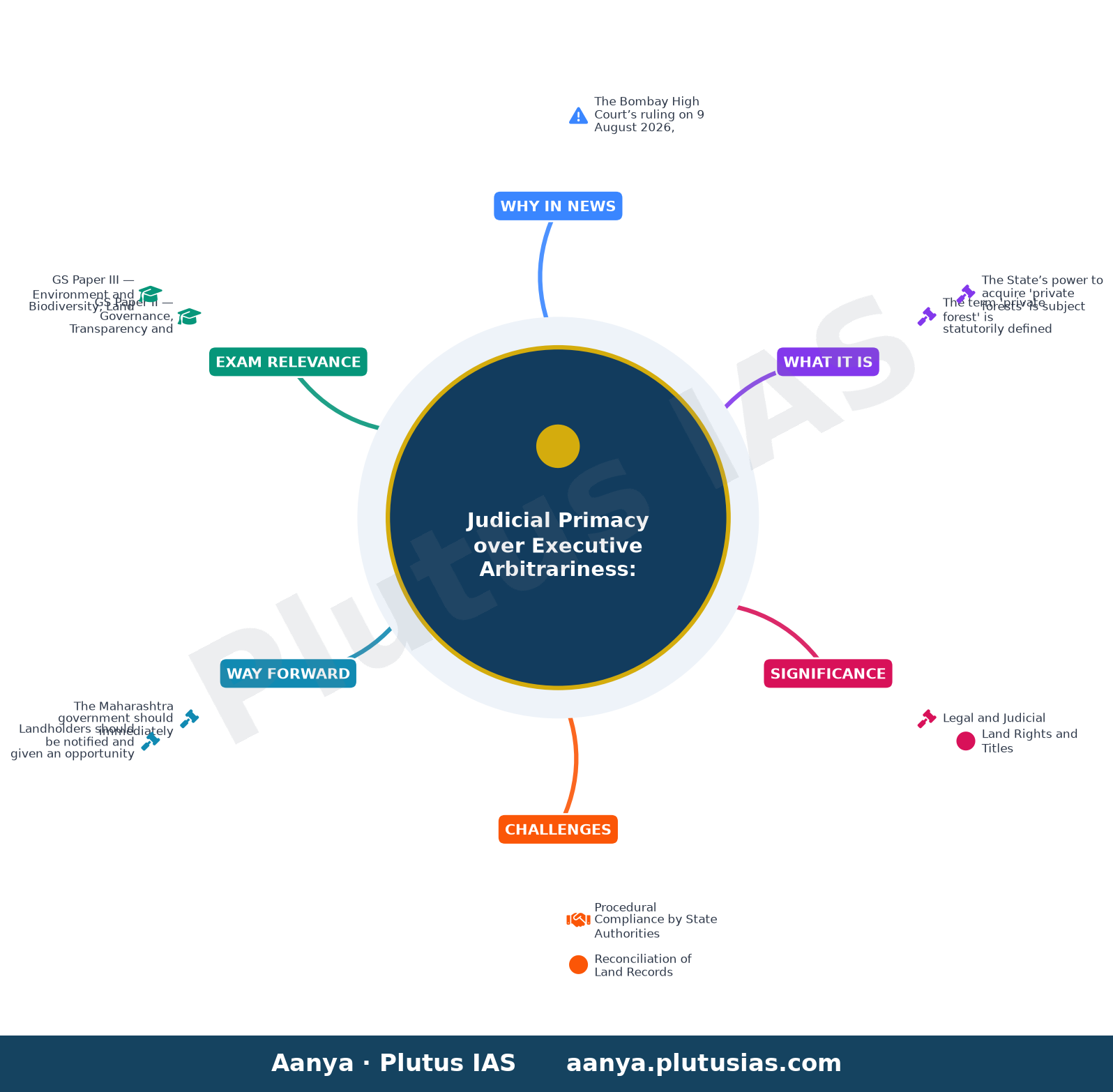
09 Aug Bombay HC Ruling: No Automatic Private Forest Declaration in Maharashtra
✎ The Bombay High Court has unequivocally held that the Maharashtra government cannot declare private lands as 'private forests' under the 1975 Act without following the statutory procedure of notice, hearing, and consideration of…
Subject Relevance — Where This Topic Fits
- GS Paper II — Governance, Transparency and Accountability | GS Paper III — Environment and Biodiversity, Land Reforms
- Prelims: Maharashtra Private Forests (Acquisition) Act, 1975, Section 2(f) of the Maharashtra Private Forests Act, Forest Rights Act, 2006, Doctrine of Pith and Substance, Procedural Due Process, Vesting of Property Rights, Revenue Records and Land Titles, Supreme Court’s Forest Case Jurisprudence
- Essay: The tension between conservation imperatives and individual property rights: A case study from Maharashtra, Judicial activism in environmental governance: Balancing development and ecological preservation
Quick Revision: The Bombay High Court has unequivocally held that the Maharashtra government cannot declare private lands as ‘private forests’ under the 1975 Act without following the statutory procedure of notice, hearing, and consideration of objections, thereby protecting landholders from arbitrary executive action.
Why is this in the news?
The Bombay High Court’s ruling on 9 August 2026, delivered by Justices Bharati H Dangre and Manjusha A Deshpande, has established that the Maharashtra government cannot unilaterally declare private lands as ‘private forests’ under the Maharashtra Private Forests (Acquisition) Act, 1975, without adhering to the statutory procedure of notice, hearing, and consideration of objections. This decision directly challenges the executive’s practice of automatic vesting and has significant implications for hundreds of landholders across Maharashtra whose titles have been clouded by such declarations.
Background
- The Maharashtra Private Forests (Acquisition) Act, 1975, was enacted with the objective of acquiring privately owned forest lands for conservation, vesting them in the State, and extinguishing existing rights and titles.
- The State government had historically interpreted the Act to allow automatic vesting of lands meeting certain criteria, leading to widespread disputes and litigation.
- The Supreme Court, in multiple judgments (e.g., *T.N. Godavarman Thirumulpad v. Union of India* and *Wildlife Trust of India v. State of Maharashtra*), has consistently held that executive action cannot bypass procedural safeguards in land acquisition or forest declarations.
- The Bombay High Court’s ruling aligns with the Supreme Court’s jurisprudence, emphasising the need for strict adherence to due process in matters affecting property rights.
- The judgment comes amid broader debates on land reform, conservation policies, and the balance between ecological protection and individual property rights in India.
What is a ‘private forest’ under the Maharashtra Private Forests (Acquisition) Act, 1975?
- The term ‘private forest’ is statutorily defined under Section 2(f) of the Maharashtra Private Forests (Acquisition) Act, 1975, and does not encompass every privately owned land with trees.
- The State’s power to acquire ‘private forests’ is subject to the procedural safeguards prescribed under the Act, including the issuance of notices, the opportunity for objections, and the consideration of such objections by a designated committee.
- The Act’s objective is conservation-driven, but its implementation must comply with constitutional and statutory due process requirements to avoid arbitrary deprivation of property rights.
- The Bombay High Court’s ruling reaffirms that the State cannot bypass these procedural requirements, even in the name of conservation.
Key Features
| Feature | Significance |
|---|---|
| Automatic vesting under the 1975 Act | The Maharashtra government’s practice of declaring private lands as ‘private forests’ automatically under the Maharashtra Private Forests (Acquisition) Act, 1975, without following due process, was struck down by the Bombay High Court as legally untenable. |
| Statutory procedure under Section 2(f) | The court emphasised that vesting of private lands as ‘private forests’ requires adherence to the procedure prescribed under the Act, including notice to landholders and consideration of objections by the committee. |
| Scope of Section 2(f)(iii) | The litigation specifically concerns lands that may fall under Section 2(f)(iii) of the Act, which includes lands against which action had been initiated under the Indian Forest Act, 1927, but not all privately owned lands with trees. |
| Judicial review of executive action | The ruling underscores the judiciary’s role in curbing arbitrary executive action and ensuring adherence to the rule of law in land acquisition and forest conservation matters. |
| Impact on land titles and litigation | The judgment provides clarity on land titles for hundreds of landholders across Maharashtra, potentially reducing litigation and uncertainty arising from disputed forest claims. |
Why it Matters
Legal and Judicial
- The ruling reaffirms the principle that executive actions must conform to statutory procedures, reinforcing the separation of powers and judicial oversight of administrative decisions.
- It aligns with the Supreme Court’s earlier rulings that automatic vesting of private lands as forests is unconstitutional, ensuring consistency in judicial interpretation.
- The judgment sets a precedent for future cases involving land disputes under forest conservation laws, particularly in states with similar legislative frameworks.
Land Rights and Titles
- Landholders, including individuals, housing societies, and developers, gain legal certainty regarding ownership of lands previously claimed as ‘private forests’ by the state.
- The ruling may lead to the restoration of titles to landholders whose lands were wrongly classified, subject to verification under the Act’s procedures.
- It highlights the need for states to conduct thorough due diligence before declaring lands as forests to avoid disputes and litigation.
Forest Conservation Policy
- The judgment does not dilute the objective of forest conservation but ensures that such conservation is pursued through legally sound and procedurally fair methods.
- It underscores the importance of balancing conservation goals with the rights of landowners, as mandated by the Forest Rights Act, 2006, and other relevant laws.
- States may need to revisit their forest conservation strategies to align with judicial interpretations and statutory requirements.
Economic Implications
- Clarity on land titles can facilitate investment in real estate, agriculture, and infrastructure projects in Maharashtra, particularly in regions like Raigad, Pune, and Thane.
- Reduction in litigation may ease the burden on the judiciary and reduce transaction costs for land transactions.
- The ruling may also impact the valuation of lands previously classified as ‘private forests’, potentially increasing their market value.
Challenges
1. Procedural Compliance by State Authorities
- The Maharashtra government must now ensure strict adherence to the prescribed procedure under the 1975 Act for declaring lands as ‘private forests’, which may require significant administrative reforms.
- Failure to follow due process could lead to further litigation and undermine the state’s conservation efforts.
- The state may face challenges in identifying and notifying landholders, particularly in cases where land records are outdated or disputed.
UPSC Link: GS Paper 2: Judiciary and Executive
2. Reconciliation of Land Records
- The ruling necessitates a comprehensive review of land records to rectify erroneous classifications of lands as ‘private forests’, which may be time-consuming and resource-intensive.
- Discrepancies between revenue records and actual land use may pose challenges in determining the true status of lands.
- The process of reconciling records could lead to disputes among landholders, the state, and other stakeholders.
UPSC Link: GS Paper 2: Government Policies and Interventions
3. Balancing Conservation and Land Rights
- The state must balance its conservation objectives with the rights of landholders, ensuring that forest protection does not infringe upon legitimate land use rights.
- The Forest Rights Act, 2006, and other laws must be harmonised with the 1975 Act to avoid conflicts and ensure equitable outcomes.
- Engaging with local communities and landholders will be crucial to address grievances and foster cooperation in conservation efforts.
UPSC Link: GS Paper 3: Environment and Biodiversity
4. Judicial Backlog and Case Management
- The ruling may lead to a surge in petitions from landholders seeking to challenge past forest declarations, potentially exacerbating the backlog in the judiciary.
- Efficient case management and alternative dispute resolution mechanisms will be essential to address the influx of litigation.
- The judiciary may need to prioritise these cases to ensure timely justice and reduce uncertainty for landholders.
UPSC Link: GS Paper 2: Judiciary and Executive
5. Implementation of Forest Conservation Laws
- The judgment highlights the need for states to adopt a more nuanced and legally sound approach to forest conservation, avoiding blanket declarations that infringe upon private rights.
- States may need to revisit their forest conservation policies to ensure compliance with judicial interpretations and statutory requirements.
- Training and capacity-building for forest and revenue officials will be critical to implement the 1975 Act effectively.
UPSC Link: GS Paper 3: Environment and Biodiversity
Challenges — UPSC Perspective
| Issue | Concern |
|---|---|
| Automatic vesting of private lands | The state’s practice of declaring private lands as ‘private forests’ without following due process undermines land rights and leads to litigation. |
| Procedural non-compliance | Failure to adhere to the prescribed procedure under the 1975 Act renders forest declarations legally unsustainable and invites judicial scrutiny. |
| Reconciliation of land records | Erroneous classifications of lands as ‘private forests’ necessitate a comprehensive review, which is resource-intensive and prone to disputes. |
| Balancing conservation and land rights | The state must ensure that forest conservation efforts do not infringe upon the rights of landholders, as mandated by the Forest Rights Act, 2006. |
| Judicial backlog | The ruling may lead to a surge in litigation, exacerbating the backlog in the judiciary and delaying justice for landholders. |
| Implementation challenges | States face significant administrative and operational challenges in implementing the 1975 Act effectively and in compliance with judicial interpretations. |
Way Forward
- The Maharashtra government should immediately constitute a high-level committee to review all notifications declaring lands as ‘private forests’ and ensure compliance with the 1975 Act.
- Landholders should be notified and given an opportunity to present their objections before any forest declaration is made, in line with the court’s directives.
- The state should undertake a comprehensive audit of land records to rectify erroneous classifications and reconcile discrepancies between revenue and forest records.
- Capacity-building programmes should be organised for forest and revenue officials to ensure proper implementation of the 1975 Act and adherence to judicial interpretations.
- Alternative dispute resolution mechanisms, such as mediation or conciliation, should be explored to resolve land disputes efficiently and reduce judicial backlog.
- The state should engage with local communities and landholders to foster cooperation in forest conservation efforts and address grievances proactively.
- Judicial authorities should prioritise cases related to forest declarations to ensure timely justice and reduce uncertainty for landholders.
- A national-level framework may be considered to harmonise forest conservation laws across states and ensure consistency in their implementation.
UPSC Value Addition
Keywords for Mains Answer-Writing
Bombay High Court · Maharashtra Private Forests (Acquisition) Act, 1975 · Private forests · Vesting of forest lands · Due process of law · Supreme Court rulings on forest rights · Land title disputes · Procedural justice · Forest conservation laws · Judicial review of executive actions · Statutory compliance · Landholder rights · Forest rights legislation
Constitutional & Policy Linkages
- [‘Article 300A: Right to Property’, ‘Protects landholders from arbitrary deprivation of property.’]
- [‘Article 226: Writs by High Courts’, ‘Empowers the Bombay High Court to issue writs to enforce fundamental rights.’]
Concept Flow
Enactment of Maharashtra Private Forests (Acquisition) Act, 1975 → State’s practice of automatic vesting of private lands as ‘private forests’ → Supreme Court rulings holding automatic vesting unconstitutional → Bombay High Court’s ruling on procedural non-compliance by the state → Judicial review of executive action and restoration of land rights → Implementation of due process and reconciliation of land records → Balancing forest conservation with land rights and judicial oversight
Prelims Practice Questions
Q1. Consider the following statements regarding the Maharashtra Private Forests (Acquisition) Act, 1975:
1. The Act vests all privately owned forest lands in the State government automatically upon its enactment.
2. Section 2(f)(iii) of the Act defines ‘private forest’ to include lands covered by pending forest proceedings under the Indian Forest Act, 1927.
3. The Act empowers the State to extinguish all rights, titles, and interests of landowners without any notice or hearing.
How many of the above statements are correct?
- Only one
- Only two
- All three
- None
Answer: Only two — Statement 1 is incorrect because the Act does not vest lands automatically; it requires a statutory process. Statement 2 is correct as per Section 2(f)(iii). Statement 3 is incorrect because the Act mandates due process, including notice and consideration of objections.
Q2. Assertion (A): The Bombay High Court ruled that the Maharashtra government cannot automatically declare private lands as ‘private forests’ without following due process under the Maharashtra Private Forests (Acquisition) Act, 1975.
Reason (R): The Supreme Court has repeatedly held that vesting of private lands as forests must comply with the principles of natural justice and statutory procedure.
Options:
A. Both A and R are true, and R is the correct explanation of A.
B. Both A and R are true, but R is not the correct explanation of A.
C. A is true, but R is false.
D. A is false, but R is true.
Answer: ? — Both the Assertion (A) and Reason (R) are true, and R correctly explains A as the Supreme Court’s rulings have consistently emphasized procedural compliance in such matters.
Q3. Match the following columns with reference to the Maharashtra Private Forests (Acquisition) Act, 1975:
Column I (Provisions)
1. Section 2(f) – Definition of ‘private forest’
2. Vesting of lands in the State
3. Due process requirements
4. Extinguishment of rights
Column II (Description)
A. Requires notice to landholders and consideration of objections
B. Extinguishes all rights, titles, and interests of owners
C. Lists categories of lands qualifying as ‘private forest’
D. Lands vest in the State only after statutory compliance
Options:
A. 1-C, 2-D, 3-A, 4-B
B. 1-A, 2-B, 3-C, 4-D
C. 1-D, 2-C, 3-B, 4-A
D. 1-B, 2-A, 3-D, 4-C
Answer: ? — The correct match is: 1-C (Section 2(f) defines ‘private forest’), 2-D (lands vest in the State only after statutory compliance), 3-A (due process requires notice and objections), 4-B (extinguishment of rights).
Mains Practice Question
✍ The Bombay High Court has held that the Maharashtra government cannot automatically treat private lands as ‘private forests’ without following the due process prescribed under the Maharashtra Private Forests (Acquisition) Act, 1975. Critically examine the implications of this ruling for landholder rights and forest conservation policies in India. (15 Marks)
Approach: MODEL-ANSWER SKELETON:
1. **Introduction (2 Marks)**: Briefly define ‘private forests’ under the Maharashtra Private Forests (Acquisition) Act, 1975, and the significance of the Bombay High Court’s ruling in the context of landholder rights and forest conservation.
2. **Legal Framework and Procedural Justice (4 Marks)**:
– Explain the statutory process under Section 2(f) and other relevant provisions of the Act.
– Discuss the principle of ‘due process’ and its constitutional underpinnings (Article 21, natural justice).
– Reference the Supreme Court’s rulings (e.g., T.N. Godavarman Thirumulpad v. Union of India) emphasizing procedural compliance in forest-related matters.
3. **Impact on Landholder Rights (4 Marks)**:
– Analyze how the ruling restores legal certainty for landholders (individuals, societies, developers) whose lands were wrongly declared as ‘private forests’.
– Discuss the consequences of automatic vesting: extinguishment of rights, title disputes, and economic losses.
– Highlight the role of judicial review in protecting property rights under Article 300A.
4. **Forest Conservation Policies (3 Marks)**:
– Examine the balance between conservation goals and landholder rights.
– Discuss how the ruling aligns with the Forest Rights Act, 2006, and the need for participatory forest governance.
– Critique the Maharashtra government’s ‘defiant approach’ and its implications for policy coherence.
5. **Conclusion (2 Marks)**:
– Summarize the ruling’s significance in upholding the rule of law and judicial independence.
– Offer a balanced view: the ruling strengthens procedural safeguards but may pose challenges for large-scale forest conservation efforts if due process is not followed.
Source: The Indian Express
Generated by AanyaAi for educational purpose.

- डीडीयू-जीकेवाई 2.0: ग्रामीण युवाओं को कौशल एवं रोजगार से जोड़ने की केंद्र सरकार की पहल - September 24, 2026
- DDU-GKY 2.0: UPSC Focused Guide on Rural Skill Scheme for 2026-27 - September 24, 2026
- यूपीएससी/पीसीएस: 25 सितंबर 2026 को सरकारी प्रतिभूतियों की बोली प्रक्रिया, ₹34,000 करोड़ का पुनर्प्रस्ताव - September 24, 2026

No Comments