


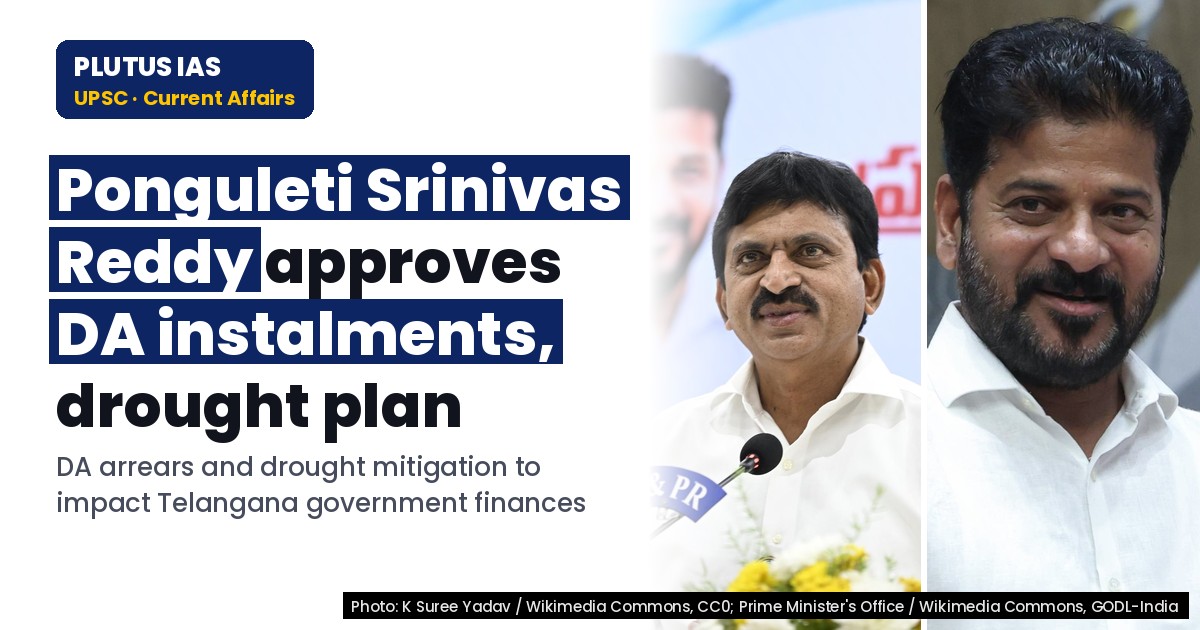
01 Oct Cabinet Approves DA Instalments, Drought Mitigation Measures in Telangana
✎ Dearness Allowance (DA) is a cost-of-living adjustment for government employees, linked to the Consumer Price Index for Industrial Workers (CPI-IW), and is a key component of public expenditure management in India.
Subject Relevance — Where This Topic Fits
- GS Paper II — Constitutional, Administrative and Financial Aspects of Governance | GS Paper III — Issues related to Direct and Indirect Farm Subsidies and Minimum Support Prices | GS Paper III — Public Distribution System — Objectives, Functioning, Limitations, Revamping
- Prelims: Dearness Allowance (DA), El Niño, Monsoon Deficit, Minimum Support Price (MSP), Power Purchase Agreements (PPAs), Renewable Energy Purchase Obligations (RPO), State Finance Commission, Fiscal Deficit, Kharif Season, Integrated Fruit Market, EPC Model, Battery Energy Storage Systems (BESS)
- Essay: Governance challenges in balancing fiscal prudence and social welfare during climate-induced crises, The interplay between fiscal federalism and agricultural resilience in India
Quick Revision: Dearness Allowance (DA) is a cost-of-living adjustment for government employees, linked to the Consumer Price Index for Industrial Workers (CPI-IW), and is a key component of public expenditure management in India.
Why is this in the news?
The Telangana State Cabinet’s approval of two instalments of Dearness Allowance (DA) for government employees and pensioners, coupled with a comprehensive drought mitigation strategy in response to a 17% monsoon deficit and El Niño conditions, exemplifies the intersection of fiscal policy, public finance management, and climate-resilient governance. This decision underscores the State’s commitment to social security while navigating the fiscal constraints imposed by climate variability, making it a critical case study for UPSC aspirants preparing for topics related to public expenditure, agricultural distress, and intergovernmental fiscal relations.
Background
- Monsoon variability is a recurring challenge in India, with El Niño events historically associated with deficient rainfall, particularly in regions like Telangana.
- The Government of India’s recommendations under the National Disaster Management Authority (NDMA) guidelines emphasize proactive measures to mitigate drought impacts, including financial relief, agricultural support, and infrastructure resilience.
- Dearness Allowance (DA) is a cost-of-living adjustment mechanism for government employees and pensioners, linked to the Consumer Price Index for Industrial Workers (CPI-IW), and is a standard component of the Union and State government pay structures.
- The fiscal burden of DA releases, estimated at ₹2,500 crore annually for Telangana, highlights the trade-offs between social welfare commitments and fiscal sustainability, especially in the context of climate-induced revenue shortfalls.
- The Constitution of India, under Article 293, empowers State governments to borrow within specified limits, subject to fiscal discipline norms prescribed by the Finance Commission and the Union government.
- State governments often seek Central assistance under the National Disaster Response Fund (NDRF) or State Disaster Response Fund (SDRF) for drought relief, as outlined in the Disaster Management Act, 2005.
What is the significance of the Cabinet’s decisions in Telangana?
- **Release of Dearness Allowance (DA) Instalments**: The State Cabinet approved the release of two pending DA instalments for government employees and pensioners, retroactive to 2024, to address cost-of-living adjustments. DA is calculated based on the CPI-IW and is a recurring expenditure item in State budgets.
- **Drought Mitigation Strategy**: In response to a 17% monsoon deficit and El Niño conditions, the Cabinet constituted a sub-committee to examine immediate relief measures, including consultations with farmers’ associations and experts.
- **Procurement of Paddy**: The Cabinet decided to arrange procurement of paddy during the kharif season, likely leveraging the Minimum Support Price (MSP) mechanism to ensure farmer income security.
- **Power Sector Measures**: To address increased electricity demand (peak demand of 19,892 MW vs. 16,613 MW last year), the Cabinet approved procurement of additional power and expansion of renewable energy capacity, including 7,800 MW of new projects (3,000 MW solar, 4,000 MW battery storage, and 800 MW wind). This underscores the State’s commitment to energy security and climate adaptation.
- **Integrated Fruit Market**: The approval of a world-class integrated fruit market at Koheda, Rangareddy district, with full government funding, aims to enhance agricultural marketing infrastructure, reduce post-harvest losses, and improve farmer incomes.
- **Review of EPC Projects**: The Cabinet suspended 10 incomplete irrigation projects under the Engineering, Procurement, and Construction (EPC) model, highlighting the need for rigorous project monitoring and fiscal discipline in public infrastructure development.
- **Fiscal Federalism**: The decision to seek Central assistance for drought-affected areas and the financial implications of DA releases (₹2,500 crore annually) illustrate the fiscal challenges faced by States in balancing social welfare with fiscal prudence.
- **Climate Resilience**: The measures reflect a broader trend of States integrating climate adaptation into governance, including drought preparedness, renewable energy expansion, and agricultural support systems.
Key Features
| Feature | Significance |
|---|---|
| Release of two DA instalments | Provides immediate financial relief to government employees and pensioners, enhancing disposable income and supporting demand in the economy. |
| El Niño impact assessment | Enables evidence-based policy formulation to address climate-induced agricultural stress and water scarcity. |
| All-party consultations & farmer associations | Ensures inclusive decision-making and leverages local knowledge for effective drought mitigation strategies. |
| Drought area declaration request to Centre | Facilitates access to central schemes such as National Disaster Response Fund (NDRF) and additional financial assistance. |
| Power procurement and renewable energy push | Addresses rising electricity demand during drought conditions while promoting sustainable energy transition. |
| Suspension of incomplete EPC irrigation projects | Rationalises public expenditure by cancelling non-performing projects and reallocating resources to critical needs. |
Why it Matters
Economic Implications
- The ₹2,500 crore annual burden from DA release reflects the State’s commitment to fiscal prudence while honouring wage commitments, balancing employee welfare with fiscal sustainability.
- Increased electricity demand (19,892 MW peak) during drought underscores the need for resilient power infrastructure and energy storage solutions to prevent supply disruptions.
- Renewable energy projects (7,800 MW capacity) align with India’s climate commitments under the Paris Agreement and reduce long-term dependence on monsoon-dependent hydroelectricity.
Agricultural & Rural Governance
- A 17% monsoon deficit necessitates proactive measures such as paddy procurement to safeguard farmer incomes and food security, particularly in rain-fed regions.
- Consultations with farmers’ associations ensure policies are grounded in ground realities, reducing implementation gaps and enhancing agricultural resilience.
- Expedited establishment of integrated fruit markets (e.g., Koheda) can reduce post-harvest losses and improve market access for horticulture producers.
Institutional & Policy Process
- The Cabinet’s multi-stakeholder approach (all-party meeting, expert consultations) demonstrates a consultative governance model, enhancing policy legitimacy and effectiveness.
- Cancellation of incomplete EPC projects highlights the need for rigorous project monitoring and adherence to timelines to avoid cost overruns and resource wastage.
- State-Centre coordination for drought area declaration exemplifies cooperative federalism in disaster management.
Climate & Disaster Resilience
- El Niño-induced droughts are recurring phenomena; proactive planning (e.g., renewable energy, water conservation) is essential to mitigate climate vulnerability.
- The focus on battery energy storage systems (4,000 MW) addresses grid stability challenges posed by intermittent renewable energy sources.
Challenges
1. Fiscal Constraints
- The State faces a trade-off between honouring wage commitments (DA release) and allocating resources to drought mitigation, necessitating careful prioritisation.
- Long-term revenue shortfalls due to climate-induced agricultural stress may constrain future welfare expenditures.
UPSC Link: GS III: Indian Economy – Fiscal Policy
2. Climate-Induced Agricultural Stress
- Erratic monsoons and El Niño events disrupt crop cycles, threatening food security and farmer livelihoods, particularly in rain-fed areas.
- Over-reliance on paddy cultivation in drought-prone regions exacerbates water scarcity and soil degradation.
UPSC Link: GS III: Agriculture – Climate Change
3. Energy Supply-Demand Mismatch
- Rising peak demand (19,892 MW) during drought conditions risks power shortages, highlighting the need for demand-side management and grid resilience.
- High dependence on thermal power during peak demand periods increases carbon emissions and operational costs.
UPSC Link: GS III: Environment – Energy Security
4. Project Implementation Bottlenecks
- Cancellation of incomplete EPC projects indicates systemic issues in project planning, tendering, and execution, leading to resource misallocation.
- Delays in infrastructure projects (e.g., integrated fruit markets) undermine economic efficiency and investor confidence.
UPSC Link: GS II: Governance – E-Governance & Transparency
5. Federal Coordination Gaps
- Dependence on Centre’s drought area declaration for financial assistance may delay relief measures, exacerbating localised crises.
- Asymmetric resource distribution between States and Centre can hinder equitable disaster response.
UPSC Link: GS II: Federalism – Centre-State Relations
Challenges — UPSC Perspective
| Issue | Concern |
|---|---|
| Monsoon Deficit (17%) | Threatens kharif crop yields, farmer incomes, and food security, particularly for rain-fed regions. |
| El Niño Conditions | Increases likelihood of prolonged droughts, exacerbating water scarcity and agricultural stress. |
| Peak Power Demand (19,892 MW) | Risks grid instability and power cuts, necessitating emergency procurement and demand management. |
| Incomplete EPC Projects | Leads to financial losses, delays in infrastructure development, and erosion of public trust in governance. |
| Fiscal Burden of DA Release | Strains State finances, limiting resources for drought mitigation and other developmental priorities. |
Government Initiatives — Must-Memorise for Prelims
- State Disaster Response Fund (SDRF) – Central assistance for drought relief (if declared).
- National Mission for Sustainable Agriculture (NMSA) – Climate-resilient agricultural practices.
- Pradhan Mantri Kisan Samman Nidhi (PM-KISAN) – Direct income support to farmers (if eligible).
Way Forward
- Constitute a high-powered committee with agricultural scientists, economists, and farmer representatives to design region-specific drought mitigation strategies.
- Accelerate the procurement of renewable energy projects (7,800 MW) to diversify the energy mix and reduce dependence on monsoon-dependent hydroelectricity.
- Enhance real-time monitoring of soil moisture, rainfall, and crop health using remote sensing and AI to enable early warning systems.
- Strengthen State-Centre coordination for timely drought area declarations and access to central funds under SDRF and NDRF.
- Rationalise irrigation projects by prioritising water-efficient crops and technologies (e.g., drip irrigation) in drought-prone districts.
- Expand battery energy storage systems to stabilise the grid and integrate intermittent renewable energy sources effectively.
- Institutionalise post-harvest infrastructure (e.g., integrated fruit markets) to reduce losses and improve market linkages for horticulture producers.
UPSC Value Addition
Keywords for Mains Answer-Writing
Dearness Allowance (DA) · Government employees and pensioners · El Niño conditions · Drought mitigation measures · State finances and fiscal burden · Agricultural procurement policies · Renewable energy capacity addition · Peak electricity demand management · Integrated fruit market development · EPC irrigation projects suspension · All-party meetings and stakeholder consultations · Centre-State fiscal relations · Kharif season procurement · Rainfall deficit and monsoon variability · Power sector reforms and energy transition
Constitutional & Policy Linkages
- Article 297 – State ownership of natural resources (water, land) and their regulation.
- Article 301 – Freedom of trade and commerce (market access for agricultural produce).
- Seventh Schedule – State List (Entry 14: Agriculture; Entry 18: Land) and Concurrent List (Entry 27: Economic and Social Planning).
Concept Flow
Monsoon deficit (17%) → El Niño conditions → Agricultural stress (kharif crops) → Farmer income decline → Increased power demand (irrigation, cooling) → Grid instability risks. → State Cabinet approves DA release → Fiscal burden on exchequer → Reduced resources for drought mitigation → Need for central assistance. → El Niño impact assessment → Consultations with farmers & experts → Policy formulation → Drought area declaration request → Access to SDRF/NDRF funds. → Rising peak power demand → Emergency procurement → Renewable energy push (7,800 MW) → Grid stabilisation and climate resilience. → Incomplete EPC projects → Cancellation → Resource reallocation → Focus on critical infrastructure (e.g., integrated fruit markets).
Prelims Practice Questions
Q1. Consider the following statements regarding the Dearness Allowance (DA) in India:
1. DA is granted to government employees and pensioners to offset the impact of inflation.
2. The DA is calculated based on the Consumer Price Index (CPI) for Industrial Workers.
3. The release of DA imposes a direct burden on the State exchequer and is not reimbursed by the Central government.
How many of the above statements are correct?
- Only one
- Only two
- All three
- None
Answer: All three — Statements 1 and 2 are correct as DA is indeed granted to offset inflation and is calculated using CPI-IW. Statement 3 is incorrect because DA is a State subject and the financial burden is borne entirely by the State government without central reimbursement.
Q2. Assertion (A): The El Niño phenomenon is associated with below-normal rainfall in India during the southwest monsoon season.
Reason (R): El Niño refers to the warming of sea surface temperatures in the central and eastern tropical Pacific Ocean, which disrupts global weather patterns.
Options:
A. Both A and R are true, and R is the correct explanation of A.
B. Both A and R are true, but R is not the correct explanation of A.
C. A is true, but R is false.
D. A is false, but R is true.
Answer: ? — Both A and R are true. El Niño is linked to deficient monsoon rainfall in India, and R correctly explains the mechanism behind this association. Hence, R is the correct explanation of A.
Q3. Match the following pairs related to drought mitigation measures in India:
Column I (Institution/Body) Column II (Role/Function)
1. National Disaster Management Authority (NDMA) A. Declares drought-affected areas
2. State Revenue Department B. Implements relief measures and provides input subsidies
3. Ministry of Agriculture and Farmers’ Welfare C. Coordinates disaster response and preparedness
4. Cabinet Committee on Economic Affairs (CCEA) D. Approves financial assistance for drought relief
Options:
A. 1-A, 2-B, 3-C, 4-D
B. 1-C, 2-B, 3-D, 4-A
C. 1-C, 2-D, 3-B, 4-A
D. 1-B, 2-C, 3-A, 4-D
Answer: ? — Correct matches: 1-C (NDMA coordinates disaster response), 2-B (State Revenue Department implements relief measures), 3-D (Ministry of Agriculture approves financial assistance), 4-A (CCEA declares drought-affected areas).
Mains Practice Question
✍ The State Cabinet of Telangana has approved the release of two pending instalments of Dearness Allowance (DA) to government employees and pensioners, despite an estimated annual financial burden of ₹2,500 crore, citing commitments to employee unions. In this context, critically examine the constitutional and fiscal implications of DA releases by State governments in India. Also, analyse how such fiscal decisions interact with Centre-State financial relations and long-term macroeconomic stability. (15 Marks)
Approach: MODEL-ANSWER SKELETON:
1. **Definition and Purpose of DA**: DA is an allowance granted to government employees and pensioners to neutralise the impact of inflation. It is calculated based on the All-India Consumer Price Index for Industrial Workers (CPI-IW) and is a State subject under the Seventh Schedule (List II, Entry 44).
2. **Constitutional and Fiscal Implications**:
– **Article 309**: DA is governed by rules framed under this Article, which empowers State legislatures to regulate conditions of service.
– **Fiscal Responsibility and Budget Management (FRBM) Act**: DA releases increase the revenue expenditure, potentially straining State finances and complicating fiscal consolidation efforts.
– **Inter-generational Equity**: DA releases benefit current employees but may impose a burden on future taxpayers, raising questions about inter-generational equity.
3. **Centre-State Financial Relations**:
– **Cooperative Federalism**: DA releases are a State subject, but the Centre may influence fiscal decisions through conditionalities for centrally sponsored schemes or loans.
– **GST Compensation**: States rely on GST compensation, which may be affected by their fiscal decisions, including DA releases.
– **Fiscal Deficit Targets**: DA releases contribute to the fiscal deficit, which must align with the Centre’s fiscal consolidation targets under the FRBM Act.
4. **Macroeconomic Stability**:
– **Inflation Dynamics**: DA releases increase money supply in the hands of government employees, which could fuel demand-pull inflation if supply does not keep pace.
– **Interest Rates**: Increased government borrowing to finance DA releases may lead to higher interest rates, crowding out private investment.
– **Investor Confidence**: Frequent DA releases without corresponding revenue augmentation may erode investor confidence in State finances.
5. **Balancing Act**:
– **Employee Welfare vs. Fiscal Prudence**: States must balance employee welfare with fiscal prudence to avoid compromising developmental expenditure.
– **Alternative Mechanisms**: States may explore indexed allowances or phased releases to mitigate fiscal shocks.
6. **Recent Trends and Judicial Precedents**:
– **Judicial Scrutiny**: Courts have upheld the legality of DA releases but have emphasised the need for transparency and adherence to fiscal rules (e.g., *State of Kerala v. Union of India*, 2020).
– **Comptroller and Auditor General (CAG) Reports**: CAG audits often highlight fiscal risks associated with DA releases, particularly in States with high debt-to-GSDP ratios.
7. **Conclusion**: DA releases are a legitimate tool for employee welfare but must be balanced with fiscal discipline to ensure long-term macroeconomic stability. States should adopt a phased and transparent approach to DA releases, aligning them with revenue augmentation strategies.
Source: The Hindu
Generated by AanyaAi for educational purpose.
Related guides on our sites
- Current affairs for upsc 2026
- How to prepare for GS paper 1 for UPSC CSE mains exam
- Best UPSC coaching for IFOS exam
- Best mentorship programme for upsc

- Pradhan Mantri Samajik Sahayata Yojana: Key Features & UPSC Relevance - October 22, 2026
- स्ट्रेट ऑफ होर्मुज में भारतीयों से भरे तेल टैंकर पर प्रक्षेपास्त्र हमला, चालक दल सुरक्षित - October 22, 2026
- Rajya Sabha Bypoll on November 12: Key Dates & Process Explained - October 22, 2026

No Comments