


27 Jul Centre Introduces Anti-Paper Leak Bill in Lok Sabha: Key Provisions Explained
Relevance for UPSC & State PCS: Polity
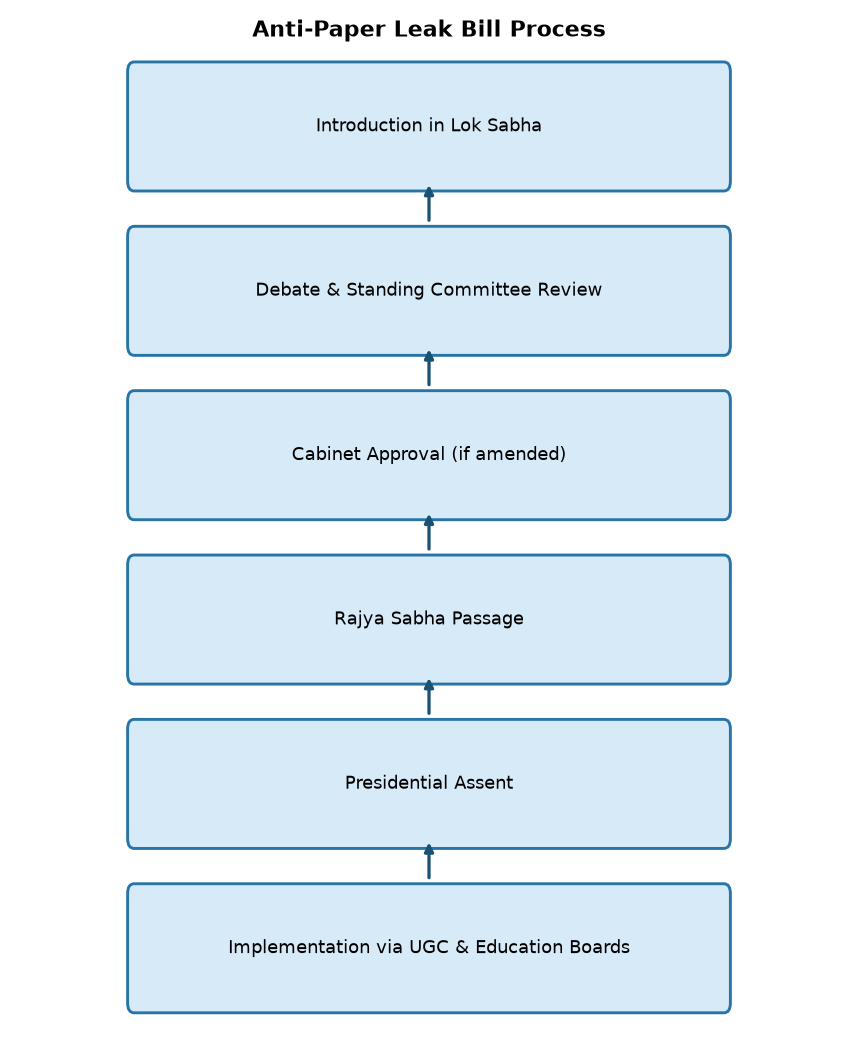
The Union government has introduced a stringent anti-paper leak Bill in the Lok Sabha, proposing severe penalties, including imprisonment of up to 10 years, to curb malpractices in competitive examinations. The proposed legislation, titled the *Public Examinations (Prevention of Unfair Means) Bill, 2024*, aims to address the growing menace of question paper leaks and other unfair practices that have plagued exams like the JEE, NEET, and UPSC Civil Services Prelims in recent years. The Bill seeks to establish a comprehensive legal framework to penalize not only candidates involved in cheating but also organized gangs, examination authorities, and other stakeholders found guilty of facilitating or benefiting from such malpractices. By introducing this Bill, the Centre underscores its commitment to ensuring transparency and fairness in examinations, which are critical for merit-based recruitment and admissions.
For UPSC and State PCS aspirants, this Bill holds significant relevance as it directly impacts the integrity of the examination process they are preparing for. The Bill’s provisions, if enacted, would deter unethical practices that often disrupt the careers of deserving candidates and undermine the credibility of public examinations. Aspirants must stay informed about the Bill’s progress, as its implementation could lead to stricter invigilation, digital surveillance, and legal consequences for malpractices, thereby enhancing the fairness of competitive exams. Additionally, the Bill’s focus on penalizing examination authorities for negligence highlights the need for aspirants to be aware of their rights and the recourse available in case of examination irregularities.
The Bill also aligns with broader governance reforms aimed at reducing corruption and malfeasance in public institutions. For State PCS aspirants, who often rely on state-conducted examinations for recruitment, the Bill’s stringent measures could serve as a model for state-level legislation to combat paper leaks. The proposed penalties, including fines and imprisonment, send a strong message to potential offenders, reinforcing the government’s zero-tolerance policy toward examination fraud. Aspirants should monitor the Bill’s trajectory in Parliament, as its eventual passage could reshape the examination landscape, making it more secure and reliable for future candidates.
From a polity perspective, the introduction of this Bill reflects the Centre’s proactive approach to addressing systemic issues in public examinations. For UPSC aspirants, who are preparing for one of India’s most prestigious exams, the Bill’s emphasis on accountability and deterrence is particularly pertinent. It underscores the importance of ethical conduct in examinations and the need for aspirants to uphold integrity in their preparation and participation. State PCS aspirants, too, should recognize the Bill’s potential to create a more level playing field in state-level exams, ensuring that merit remains the sole criterion for selection. The Bill’s passage could thus be a landmark development in India’s examination governance, with far-reaching implications for aspirants across the country.
Source: Business Standard
Practice Questions
Q1. What is the primary objective of the ‘anti-paper leak Bill’ recently introduced in the Lok Sabha?
- To provide financial assistance to students appearing for competitive exams
- To impose stricter penalties on individuals involved in paper leaks and malpractices in examinations
- To establish a new regulatory body for conducting all government exams
- To mandate the use of digital platforms for all competitive exams
Answer
To impose stricter penalties on individuals involved in paper leaks and malpractices in examinations — The anti-paper leak Bill aims to curb malpractices in examinations by introducing tougher penalties for those involved in paper leaks and other examination-related frauds.
Q2. Which legislative body introduced the ‘anti-paper leak Bill’?
- Rajya Sabha
- Lok Sabha
- President of India
- Supreme Court
Answer
Lok Sabha — The Bill was introduced in the Lok Sabha, which is the lower house of the Indian Parliament.
Generated by AanyaAi for educational purpose.

- उत्तराखंड राज्यपाल के 5 वर्ष: पांच मिशन और AI क्रांति का लेखा-जोखा - September 15, 2026
- UPSC Focus: Uttarakhand Governor’s 5-Year Journey & 5 Key Missions Explained - September 15, 2026
- AI का वादा और खतरा: क्या मानवता के लिए खतरा है कृत्रिम बुद्धिमत्ता? - September 15, 2026

No Comments