


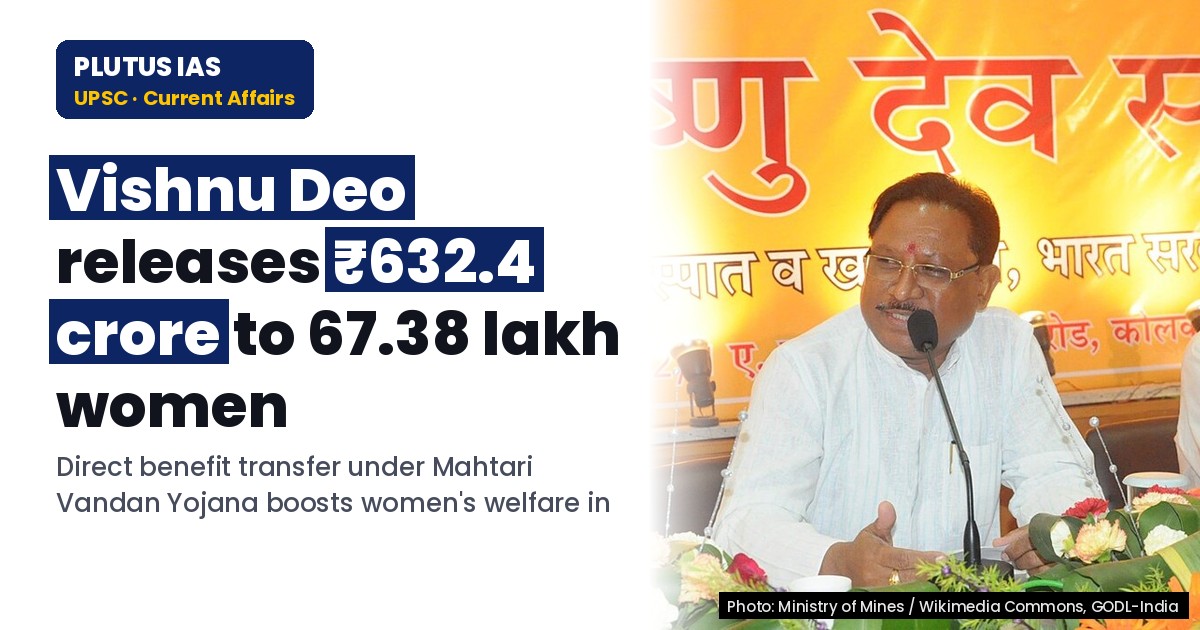
08 Oct Chhattisgarh CM Releases 32nd Installment of Mahtari Vandan Yojana
✎ Mahatari Vandana Yojana is a flagship DBT scheme in Chhattisgarh providing monthly financial assistance to married women aged 21+, enhancing financial inclusion and gender equity through Aadhaar-enabled payments.
Subject Relevance — Where This Topic Fits
- GS Paper II — Governance, Welfare Schemes for Vulnerable Sections of the Population | GS Paper III — Issues Relating to Poverty and Hunger, Government Budgeting and Financial Inclusion
- Prelims: Direct Benefit Transfer (DBT), Mahatari Vandana Yojana, Chhattisgarh, Women’s Empowerment, Financial Inclusion, Aadhaar-enabled Payment System (AePS)
- Essay: Economic Empowerment of Women as a Catalyst for National Development, Role of Direct Benefit Transfers in Reducing Poverty and Enhancing Social Equity
Quick Revision: Mahatari Vandana Yojana is a flagship DBT scheme in Chhattisgarh providing monthly financial assistance to married women aged 21+, enhancing financial inclusion and gender equity through Aadhaar-enabled payments.
Why is this in the news?
The release of the 32nd instalment of the Mahatari Vandana Yojana by the Chief Minister of Chhattisgarh marks a significant milestone in the state’s ongoing efforts to ensure financial autonomy and social dignity for women. This direct benefit transfer scheme exemplifies the convergence of welfare policy, digital governance, and gender-sensitive budgeting, providing a model for other states to emulate in addressing multidimensional poverty among women.
Background
- Chhattisgarh, a state with a substantial tribal and rural population, has historically faced challenges in achieving gender parity and economic inclusion for women.
- The Mahatari Vandana Yojana was launched on 1 March 2024 by the Government of Chhattisgarh to address the economic vulnerabilities faced by married women aged 21 years and above.
- The scheme is part of a broader policy framework aimed at reducing poverty, improving nutrition, and enhancing educational outcomes for women and children.
- The initiative aligns with the National Mission for Financial Inclusion (PMJDY) and the Sustainable Development Goals (SDGs), particularly SDG 1 (No Poverty), SDG 5 (Gender Equality), and SDG 10 (Reduced Inequalities).
- The scheme leverages the Direct Benefit Transfer (DBT) mechanism, which has been instrumental in reducing leakages and ensuring timely delivery of welfare benefits across India.
- Chhattisgarh’s commitment to women’s empowerment is reflected in its budgetary allocations, with significant funds earmarked for social welfare schemes targeting marginalised communities.
What is Mahatari Vandana Yojana?
- Mahatari Vandana Yojana is a Direct Benefit Transfer (DBT) scheme introduced by the Government of Chhattisgarh to provide monthly financial assistance to married women aged 21 years and above.
- The scheme is designed to enhance women’s decision-making power within households, particularly in matters related to health, education, and nutrition for children.
- As of October 2026, the 32nd instalment of the scheme is being disbursed, with ₹632.40 crore transferred to 67,38,217 women across the state.
- The scheme operates through the Aadhaar-enabled Payment System (AePS), ensuring transparency, minimising leakages, and enabling real-time tracking of transactions.
- The financial assistance is intended to support essential household expenditures, including children’s education, healthcare, nutritional needs, and small-scale entrepreneurial activities.
- The scheme is complemented by other welfare initiatives in Chhattisgarh, such as the Rajiv Gandhi Kisan Nyay Yojana and the Godhan Nyay Yojana, which collectively aim to uplift rural and tribal communities.
- The implementation of the scheme has contributed to a measurable reduction in poverty among beneficiary households, as evidenced by improved nutritional indicators and school enrolment rates.
Key Features
| Feature | Significance |
|---|---|
| Direct Benefit Transfer (DBT) Mechanism | Ensures transparent, leakage-proof transfer of financial assistance directly to beneficiaries’ bank accounts, reducing intermediaries and enhancing accountability. |
| Monthly Financial Assistance of ₹1,000 | Provides a stable income stream to eligible women, contributing to household financial resilience and economic security. |
| Eligibility Criteria (Women aged ≥21 years) | Targets married women, addressing gender-specific economic vulnerabilities and promoting financial inclusion. |
| State-Level Implementation | Demonstrates sub-national governance in social welfare delivery, aligning with the constitutional principle of cooperative federalism. |
| Multi-Sectoral Impact | Supports education, health, nutrition, and micro-enterprise, reflecting an integrated approach to women’s empowerment. |
Why it Matters
Economic Empowerment
- Enhances household purchasing power, particularly in rural and tribal regions of Chhattisgarh, where women face higher economic marginalisation.
- Contributes to reducing income inequality by providing a regular, predictable income source to women-headed households.
- Stimulates local economies through increased consumption of essential goods and services.
Social Empowerment
- Promotes financial independence among women, fostering decision-making autonomy within households.
- Encourages higher participation of women in education and healthcare decisions, improving intergenerational outcomes.
- Challenges traditional gender norms by recognising women as economic stakeholders in family welfare.
Governance & Policy
- Showcases the efficacy of state-led welfare schemes in addressing gender-specific developmental gaps.
- Illustrates the role of Direct Benefit Transfer (DBT) in improving the efficiency of welfare delivery systems.
- Highlights the integration of social welfare with broader developmental goals, such as poverty alleviation and gender equity.
Sustainability & Scalability
- Demonstrates a scalable model for women-centric welfare schemes, adaptable to other states with similar socio-economic profiles.
- Provides a template for leveraging digital infrastructure (Aadhaar-linked DBT) to enhance welfare delivery.
- Serves as a case study for evidence-based policymaking in social welfare.
Challenges
1. Financial Sustainability
- Long-term fiscal viability of the scheme depends on state budgetary allocations and revenue generation.
- Risk of fiscal strain if the scheme expands without corresponding economic growth or revenue augmentation.
- Need for periodic review to balance welfare expenditure with developmental priorities.
UPSC Link: GS3: Fiscal Policy
2. Inclusion & Exclusion Errors
- Ensuring accurate identification of eligible beneficiaries to prevent exclusion of deserving women or inclusion of ineligible individuals.
- Addressing gaps in Aadhaar seeding and bank account linkages, particularly in remote tribal areas.
- Mitigating delays in fund disbursement due to technical or administrative bottlenecks.
UPSC Link: GS2: Welfare Schemes
3. Social & Cultural Barriers
- Overcoming patriarchal norms that may restrict women’s control over financial resources.
- Ensuring the scheme does not inadvertently reinforce dependency but fosters agency and entrepreneurship.
- Addressing intra-household conflicts arising from the introduction of additional income sources.
UPSC Link: GS1: Social Empowerment
4. Monitoring & Evaluation
- Lack of robust monitoring mechanisms to assess the scheme’s impact on women’s empowerment and household welfare.
- Need for third-party evaluations to measure outcomes beyond financial disbursement, such as changes in decision-making power.
- Ensuring transparency in fund utilisation and preventing misuse or diversion of resources.
UPSC Link: GS4: Ethics in Governance
5. Digital Divide & Infrastructure Gaps
- Limited digital literacy among beneficiaries, particularly in rural and tribal regions, may hinder effective utilisation of funds.
- Dependence on digital payment systems risks excluding women without access to bank accounts or smartphones.
- Need for last-mile connectivity and digital infrastructure to ensure seamless fund transfers.
UPSC Link: GS3: Science & Technology
Challenges — UPSC Perspective
| Issue | Concern |
|---|---|
| Fiscal Constraints | Risk of budgetary strain due to long-term commitment to the scheme. |
| Aadhaar-Bank Linkage Gaps | Exclusion of eligible beneficiaries due to incomplete or outdated Aadhaar-seeded bank accounts. |
| Patriarchal Resistance | Cultural barriers that may limit women’s autonomy in utilising the financial assistance. |
| Monitoring Lacunae | Absence of real-time tracking systems to measure the scheme’s impact on women’s empowerment. |
| Digital Literacy Deficit | Low digital literacy among rural women, affecting their ability to access and utilise funds. |
| Inter-State Coordination | Need for harmonised policies to prevent duplication or exclusion in migrant beneficiary cases. |
Government Initiatives — Must-Memorise for Prelims
- Mahatari Vandan Yojana (Chhattisgarh)
Way Forward
- Strengthen Aadhaar-seeding and bank account linkages to minimise exclusion errors and ensure seamless DBT transfers.
- Conduct periodic socio-economic impact assessments to evaluate the scheme’s effectiveness in empowering women and improving household welfare.
- Expand digital literacy programmes in rural and tribal regions to enhance beneficiaries’ ability to utilise financial assistance effectively.
- Integrate the scheme with other welfare initiatives (e.g., PM Matru Vandana Yojana, Ujjwala Yojana) to create a comprehensive support system for women.
- Establish a robust grievance redressal mechanism to address beneficiary complaints and ensure transparency in fund utilisation.
- Promote women-led micro-enterprises by linking the financial assistance to skill development and entrepreneurship programmes.
- Collaborate with civil society organisations to monitor the scheme’s implementation and address social and cultural barriers.
- Explore public-private partnerships to enhance last-mile connectivity and digital infrastructure in remote areas.
UPSC Value Addition
Keywords for Mains Answer-Writing
Direct Benefit Transfer (DBT), Mahatari Vandan Yojana, women’s economic empowerment, fiscal federalism, Direct Benefit Transfer architecture, gender budgeting, social security schemes, fiscal devolution, poverty alleviation, women-led development, Direct Benefit Transfer mechanism, fiscal decentralisation · Chhattisgarh socio-economic policies, women’s financial inclusion, fiscal transfers to women, social justice, inclusive growth · Mahatari Vandan Yojana eligibility, fiscal transfers to women, women’s autonomy, fiscal empowerment · Direct Benefit Transfer (DBT), fiscal federalism, gender-responsive budgeting, women’s economic security · Chhattisgarh fiscal policy, women-centric welfare schemes, fiscal devolution to states, social sector expenditure · Direct Benefit Transfer architecture, fiscal federalism, women’s financial inclusion, fiscal decentralisation · Mahatari Vandan Yojana, women’s economic empowerment, fiscal transfers, gender-responsive governance · Direct Benefit Transfer (DBT), fiscal federalism, gender budgeting, women’s financial autonomy
Concept Flow
State government identifies gender-specific economic vulnerabilities among married women aged ≥21 years. → Policy formulation: Design of Mahatari Vandan Yojana with monthly ₹1,000 financial assistance via DBT. → Implementation: Aadhaar-seeded bank accounts enable direct transfer of funds to beneficiaries. → Impact: Enhanced household financial resilience, improved access to education and healthcare, and increased women’s decision-making power. → Challenges: Fiscal sustainability, inclusion errors, digital divide, and social barriers emerge as critical bottlenecks. → Way Forward: Strengthen monitoring, expand digital literacy, and integrate with other welfare schemes to maximise impact.
Prelims Practice Questions
Q1. Consider the following statements regarding the Direct Benefit Transfer (DBT) mechanism in India:
1. DBT is a scheme that transfers subsidies and welfare benefits directly into the bank accounts of beneficiaries.
2. The DBT architecture is implemented by the Ministry of Finance in collaboration with the Reserve Bank of India.
3. The Mahatari Vandan Yojana in Chhattisgarh is a flagship DBT-based scheme for women’s economic empowerment.
4. The DBT mechanism ensures zero leakage of funds by eliminating intermediaries in the transfer process.
How many of the above statements are correct?
- Only one
- Only two
- Only three
- All
Answer: Only three — Statements 1 and 3 are correct as DBT transfers subsidies directly to beneficiaries and Mahatari Vandan Yojana is a DBT-based scheme. Statement 2 is incorrect because the DBT architecture is implemented by the DBT Mission under the Department of Expenditure, Ministry of Finance, in collaboration with banks and post offices. Statement 4 is incorrect because while DBT reduces leakage, it does not eliminate it entirely due to issues like dormant accounts or Aadhaar seeding gaps.
Q2. Assertion (A): The Mahatari Vandan Yojana in Chhattisgarh is a Direct Benefit Transfer (DBT) scheme that provides monthly financial assistance to married women aged 21 years and above.
Reason (R): The scheme aims to promote women’s financial inclusion and reduce gender disparities in economic participation.
In the context of the above two statements, which of the following is correct?
- Both A and R are true, and R is the correct explanation of A
- Both A and R are true, but R is not the correct explanation of A
- A is true, but R is false
- A is false, but R is true
Answer: A is true, but R is false — Assertion (A) is true as Mahatari Vandan Yojana is a DBT scheme providing ₹1,000 monthly to eligible women. Reason (R) is also true as the scheme aims to enhance women’s financial inclusion and economic participation. However, R is not the correct explanation of A because the DBT mechanism is the operational tool, while the purpose is women’s empowerment.
Q3. Match the following pairs related to fiscal transfers and women-centric welfare schemes in India:
Column I
A. Mahatari Vandan Yojana
B. Direct Benefit Transfer (DBT)
C. Gender Budgeting
D. Fiscal Federalism
Column II
1. Mechanism for transferring welfare benefits directly to beneficiaries
2. Scheme providing financial assistance to married women in Chhattisgarh
3. Framework for distributing fiscal resources between Centre and States
4. Process of allocating resources with a focus on gender equality
Select the correct match:
- A-2, B-1, C-4, D-3
- A-1, B-2, C-3, D-4
- A-3, B-4, C-1, D-2
- A-4, B-3, C-2, D-1
Answer: A-2, B-1, C-4, D-3 — The correct matches are: A-2 (Mahatari Vandan Yojana is a women-centric scheme in Chhattisgarh), B-1 (DBT is the mechanism for direct transfers), C-4 (Gender budgeting focuses on gender equality in resource allocation), and D-3 (Fiscal federalism governs Centre-State fiscal relations).
Mains Practice Question
✍ The Mahatari Vandan Yojana in Chhattisgarh exemplifies the convergence of Direct Benefit Transfer (DBT) architecture and gender-responsive fiscal policy. Critically examine the scheme’s contribution to women’s economic empowerment while also evaluating its limitations in achieving substantive gender equality. (15 Marks)
Approach: MODEL-ANSWER SKELETON:
1. **Introduction (2 Marks)**
– Define Mahatari Vandan Yojana: A DBT-based monthly unconditional cash transfer of ₹1,000 to married women aged 21+ in Chhattisgarh, implemented since March 2024.
– Contextualise within broader women-centric welfare schemes (e.g., PM-KISAN, Ujjwala Yojana) and India’s fiscal federalism.
2. **Contribution to Women’s Economic Empowerment (5 Marks)**
– **Financial Inclusion**: Enhances women’s control over household resources, reducing dependency on male members (cite NSSO data on women’s bank account ownership).
– **Autonomy and Agency**: Enables women to meet essential needs (education, health, nutrition) and pursue micro-enterprises, aligning with Sen’s capability approach.
– **Social Security**: Acts as a safety net, mitigating poverty and vulnerability, particularly in rural and tribal regions of Chhattisgarh.
– **Fiscal Federalism**: Demonstrates state-level innovation in leveraging DBT to address local socio-economic challenges, complementing central schemes.
3. **Limitations and Critiques (5 Marks)**
– **Substantive vs. Formal Empowerment**: Cash transfers may improve material conditions but do not necessarily challenge structural gender inequalities (e.g., land ownership, labour market discrimination).
– **Conditionalities and Exclusions**: Eligibility criteria (married women aged 21+) exclude unmarried women, widows, and transgender persons, raising questions of equity.
– **Implementation Gaps**: Challenges in Aadhaar seeding, dormant bank accounts, and last-mile delivery in remote areas (cite Comptroller and Auditor General reports on DBT leakages).
– **Scalability and Sustainability**: Long-term fiscal viability depends on state revenue buoyancy and Centre-State fiscal transfers under Article 275.
4. **Way Forward (3 Marks)**
– **Gender-Responsive Budgeting**: Integrate the scheme with gender budgeting frameworks to monitor outcomes beyond financial inclusion.
– **Complementary Policies**: Pair with skill development (e.g., PMKVY), land rights reforms, and anti-discrimination laws to address root causes of gender inequality.
– **Inclusive Design**: Expand eligibility to unmarried women and gender minorities, and strengthen grievance redressal mechanisms under the DBT architecture.
**Balanced Conclusion**: The scheme is a progressive step toward women’s economic security but requires deeper structural reforms for substantive empowerment.
Source: amarujala.com
Chhattisgarh PCS (CGPSC) — State PCS Practice
Prelims: Which of the following statements about the ‘Maatari Vandana Yojana’ launched by the Chhattisgarh government is correct?
- A. It is a scheme exclusively for the financial empowerment of women in Chhattisgarh.
- B. The 32nd installment of the scheme will be released by Chief Minister Vishnu Deo Sai on a specific date.
- C. The scheme provides a one-time financial assistance of ₹10,000 to all married women in the state.
- D. The scheme is implemented under the National Rural Livelihood Mission (NRLM).
Answer: B. The 32nd installment of the scheme will be released by Chief Minister Vishnu Deo Sai on a specific date. — The 32nd installment of ‘Maatari Vandana Yojana’ will be released by Chief Minister Vishnu Deo Sai as per the given news.
Mains: Discuss the significance of the ‘Maatari Vandana Yojana’ for the socio-economic empowerment of women in Chhattisgarh. Also, analyze how such schemes contribute to the state’s development goals.
Generated by AanyaAi for educational purpose.
Related guides on our sites
- Current affairs for upsc 2026
- Best PSIR optional coaching for upsc
- Best PSIR optional teacher for upsc
- Best teacher of PSIR optional for upsc

- Pradhan Mantri Samajik Sahayata Yojana: Key Features & UPSC Relevance - October 22, 2026
- स्ट्रेट ऑफ होर्मुज में भारतीयों से भरे तेल टैंकर पर प्रक्षेपास्त्र हमला, चालक दल सुरक्षित - October 22, 2026
- Rajya Sabha Bypoll on November 12: Key Dates & Process Explained - October 22, 2026

No Comments