


01 Sep Chhattisgarh Launches ‘E-Sand Sangwari’ Portal for PM Awas Yojana Beneficiaries
✎ The ‘E-Sand Sangwari’ portal exemplifies the convergence of welfare schemes and digital governance, aiming to reduce construction costs and accelerate housing delivery under PMAY-G through transparent, technology-driven…
Subject Relevance — Where This Topic Fits
- GS Paper II — Governance, Transparency and Accountability | GS Paper III — Infrastructure and Rural Development
- Prelims: Pradhan Mantri Awas Yojana-Gramin (PMAY-G), Digital Public Infrastructure (DPI), Sand mining policy, Direct Benefit Transfer (DBT), E-governance in welfare delivery
- Essay: Digital transformation in public service delivery: Opportunities and challenges
Quick Revision: The ‘E-Sand Sangwari’ portal exemplifies the convergence of welfare schemes and digital governance, aiming to reduce construction costs and accelerate housing delivery under PMAY-G through transparent, technology-driven procurement of sand.
Why is this in the news?
The launch of the ‘E-Sand Sangwari’ portal by the Chief Minister of Chhattisgarh represents a significant intervention in streamlining the delivery of construction materials under the Pradhan Mantri Awas Yojana-Gramin (PMAY-G). By digitising the procurement and distribution of sand, the portal aims to reduce transaction costs, enhance transparency, and accelerate the construction of affordable housing in rural areas. This initiative is particularly relevant in the context of India’s broader digital governance agenda and the challenges of last-mile delivery in welfare schemes.
Background
- The Pradhan Mantri Awas Yojana-Gramin (PMAY-G), launched in 2016, aims to provide pucca houses to all eligible rural households by 2022, with a target of 2.95 crore houses. The scheme is implemented through a convergence of Central and State resources.
- Construction of pucca houses under PMAY-G requires essential materials such as sand, cement, and bricks. The cost of these materials constitutes a significant portion of the total expenditure for beneficiaries.
- Sand is a critical construction material, but its procurement often involves bureaucratic hurdles, middlemen, and delays, leading to increased costs and underutilisation of the scheme’s benefits.
- Chhattisgarh, a mineral-rich state, has been proactive in leveraging digital tools to improve governance, particularly in welfare delivery and resource management.
- The ‘E-Sand Sangwari’ portal aligns with the broader national push for Digital India and the use of technology to enhance transparency and efficiency in public service delivery.
What is the ‘E-Sand Sangwari’ Portal?
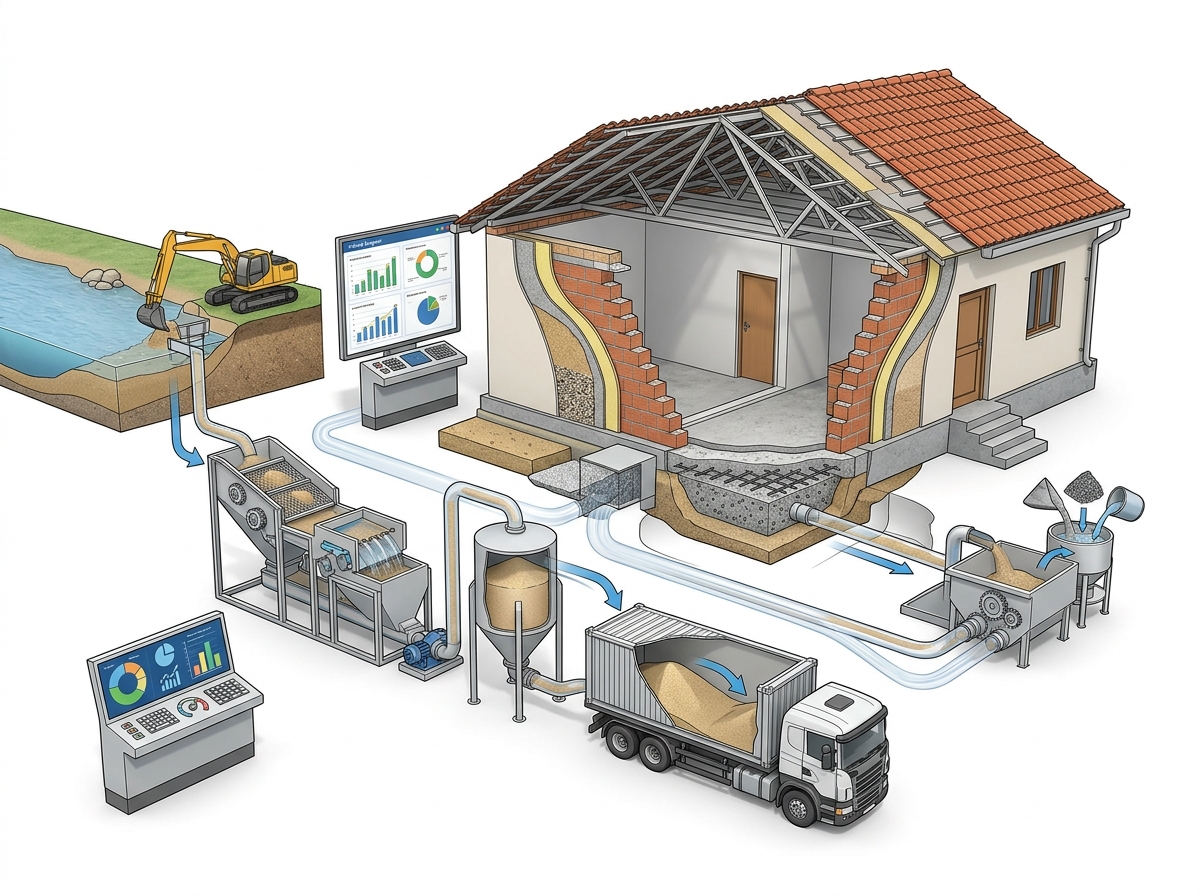
- The ‘E-Sand Sangwari’ portal is a digital platform launched by the Government of Chhattisgarh to facilitate the online procurement and distribution of sand to eligible beneficiaries under the PMAY-G scheme.
- The portal enables beneficiaries to register their demand for sand, track the status of their application, and receive the material directly at the construction site, thereby reducing logistical and administrative delays.
- The initiative ensures that sand is provided free of cost to PMAY-G beneficiaries, thereby reducing the financial burden on rural households and accelerating the pace of house construction.
- The portal is designed to enhance transparency by digitising the entire process, from demand registration to material delivery, and by integrating with the state’s digital governance infrastructure.
- The ‘E-Sand Sangwari’ portal is part of a broader effort to integrate digital public infrastructure (DPI) with welfare schemes, ensuring that technology serves as an enabler for inclusive development.
- The portal leverages the state’s existing digital governance frameworks, such as the ‘Chhattisgarh State Wide Area Network (CSWAN)’ and the ‘Bhuiyan’ land records system, to ensure seamless integration and data accuracy.
- The initiative is expected to reduce the incidence of black marketing and corruption in the sand supply chain by eliminating intermediaries and ensuring direct delivery to beneficiaries.
- The portal also aligns with the principles of Direct Benefit Transfer (DBT), where subsidies or benefits are directly transferred to the intended beneficiaries, minimising leakages and inefficiencies.
Key Features
| Feature | Significance |
|---|---|
| E-रेत संगवारी पोर्टल | Digitizes the entire process of sand procurement for PM Awas Yojana-Gramin beneficiaries, eliminating physical interface and reducing delays. |
| निःशुल्क रेत उपलब्धता | Directly reduces the financial burden on economically weaker sections by eliminating the cost of sand, a critical construction material. |
| ऑनलाइन आवेदन एवं स्वीकृति | Ensures transparency, traceability, and accountability in the allocation of sand to eligible beneficiaries. |
| मांग-आपूर्ति एकीकरण | Links beneficiary demand with real-time sand availability from designated sources, optimizing resource allocation. |
| पारदर्शिता एवं भ्रष्टाचार-निरोध | Digital trail of transactions minimizes discretionary powers, reducing scope for rent-seeking and leakage. |
Why it Matters
Economic
- Lowers construction cost for PM Awas Yojana-Gramin beneficiaries, accelerating the pace of house completion and reducing the number of incomplete dwellings.
- Enhances disposable income for rural households by eliminating a significant input cost in housing construction.
- Stimulates local economies by ensuring timely availability of construction materials, indirectly supporting allied sectors like transport and masonry.
Governance & Administration
- Demonstrates the integration of digital public infrastructure with welfare schemes to improve service delivery and reduce bureaucratic friction.
- Sets a precedent for leveraging technology to streamline resource allocation in rural development programs.
- Strengthens the implementation framework of PM Awas Yojana-Gramin by addressing a critical supply-side constraint.
Social Inclusion
- Prioritizes economically weaker sections by providing a key construction input free of cost, thereby enhancing housing equity.
- Reduces disparities in access to essential resources between rural and urban areas in the context of housing development.
Environmental
- Promotes regulated sand mining through formal channels, potentially reducing illegal and environmentally harmful extraction practices.
Challenges
1. Supply Chain Bottlenecks
- Risk of inadequate sand supply due to limited quarrying capacity or logistical constraints, especially during peak construction seasons.
- Dependence on local sand sources may lead to regional disparities in availability, disadvantaging distant beneficiaries.
UPSC Link: GS-III: Resource Mobilisation
2. Digital Divide & Accessibility
- Limited digital literacy among rural beneficiaries may hinder effective use of the portal, necessitating alternative access channels.
- Internet connectivity issues in remote areas could disrupt the application and monitoring process.
UPSC Link: GS-II: Governance
3. Monitoring & Accountability
- Ensuring that sand is delivered to the intended beneficiaries without diversion or leakage requires robust tracking mechanisms.
- Need for periodic audits to prevent misuse of the system by intermediaries or officials.
UPSC Link: GS-IV: Ethics
4. Environmental Compliance
- Balancing increased sand demand with sustainable mining practices and environmental safeguards remains a challenge.
- Risk of over-exploitation of sand resources if extraction is not strictly regulated.
UPSC Link: GS-III: Conservation
Challenges — UPSC Perspective
| Issue | Concern |
|---|---|
| Regional sand availability | Uneven distribution may lead to shortages in certain districts, delaying construction. |
| Digital literacy gap | Beneficiaries unfamiliar with online portals may face difficulties in availing the facility. |
| Monitoring of sand delivery | Risk of diversion or misallocation necessitates stringent verification systems. |
| Environmental impact | Unregulated sand mining could lead to ecological degradation and soil erosion. |
| Logistical delays | Transport bottlenecks may cause delays in sand delivery to remote areas. |
Way Forward
- Establish a real-time dashboard to monitor sand demand, supply, and delivery across districts.
- Conduct capacity-building programs to enhance digital literacy among rural beneficiaries.
- Introduce a grievance redressal mechanism integrated with the portal for timely resolution of issues.
- Strengthen environmental safeguards by mandating sustainable mining practices and periodic audits.
- Expand sand quarrying capacity in coordination with state and central agencies to meet rising demand.
- Pilot a mobile application version of the portal to improve accessibility in areas with limited internet connectivity.
- Collaborate with local self-help groups and cooperatives to facilitate sand distribution in remote areas.
- Conduct periodic reviews to assess the scheme’s impact on housing completion rates and beneficiary satisfaction.
UPSC Value Addition
Keywords for Mains Answer-Writing
E-Sand Sangwari portal · Pradhan Mantri Awas Yojana-Gramin · free sand supply · affordable housing · digital governance · transparency in resource allocation · rural housing schemes · construction material logistics · Chhattisgarh government initiatives · online service delivery · housing for all · sustainable housing infrastructure
Constitutional & Policy Linkages
- Article 21 (Right to Life) — Ensures dignified living conditions through access to housing.
- Directive Principles of State Policy (Article 39(b)) — Guides state policy to secure economic justice for weaker sections.
Concept Flow
PM Awas Yojana-Gramin identifies eligible beneficiaries → Beneficiaries require sand for construction → Sand is a critical but costly input → Free sand reduces financial burden → Digital portal streamlines procurement → Transparent allocation enhances governance → Faster house completion improves living conditions.
Prelims Practice Questions
Q1. Consider the following statements regarding the ‘E-Sand Sangwari’ portal launched in Chhattisgarh:
1. The portal aims to provide free sand to beneficiaries of the Pradhan Mantri Awas Yojana-Gramin.
2. It is designed to streamline the process of sand procurement for housing construction.
3. The portal mandates physical verification of beneficiaries at district offices.
4. The initiative is part of the state government’s digital governance reforms.
How many of the above statements are correct?
- Only one
- Only two
- Only three
- All
Answer: All — Statements 1, 2, and 4 are correct. Statement 3 is incorrect as the portal is designed for online processing without mandatory physical verification at district offices.
Q2. Assertion (A): The E-Sand Sangwari portal in Chhattisgarh is a digital platform for transparent allocation of sand to housing beneficiaries.
Reason (R): Digital platforms enhance efficiency and reduce corruption in resource allocation by automating processes and maintaining audit trails.
Codes:
A. Both A and R are true, and R is the correct explanation of A.
B. Both A and R are true, but R is not the correct explanation of A.
C. A is true, but R is false.
D. A is false, but R is true.
- A
- B
- C
- D
Answer: B — Both the assertion and reason are true. The portal’s digital nature ensures transparency and efficiency, making R the correct explanation of A.
Q3. Which of the following is NOT a feature of the E-Sand Sangwari portal?
A. Online application for sand allocation
B. Physical verification of beneficiaries at district offices
C. Transparent allocation process
D. Integration with Pradhan Mantri Awas Yojana-Gramin
- A
- B
- C
- D
Answer: B — Physical verification at district offices is not a feature of the E-Sand Sangwari portal, which is designed for online processing.
Mains Practice Question
✍ The introduction of the ‘E-Sand Sangwari’ portal in Chhattisgarh represents a significant step toward digital governance in resource allocation for rural housing. Critically examine the potential of such digital platforms in enhancing transparency, efficiency, and equity in the implementation of welfare schemes like the Pradhan Mantri Awas Yojana-Gramin. Also, discuss the challenges that may impede their effective functioning. (15 Marks)
Approach: MODEL-ANSWER SKELETON:
1. **Introduction**: Define digital governance and its relevance in welfare schemes. Contextualise the E-Sand Sangwari portal within the Pradhan Mantri Awas Yojana-Gramin.
2. **Potential Benefits**:
– **Transparency**: Automated processes reduce discretionary allocations and corruption (cite Transparency International India reports or similar).
– **Efficiency**: Online portals streamline procurement, reducing delays (reference NITI Aayog’s Digital India initiatives).
– **Equity**: Digital inclusion ensures marginalised groups access benefits (link to Aadhaar-based Direct Benefit Transfer systems).
– **Accountability**: Audit trails and real-time tracking enhance oversight (cite Comptroller and Auditor General of India’s emphasis on e-governance).
3. **Challenges**:
– **Digital Divide**: Rural areas may lack internet access or digital literacy (reference Census 2011 data on rural internet penetration).
– **Last-Mile Delivery**: Ensuring last-mile connectivity for sand distribution (cite Logistics Performance Index or similar).
– **Data Privacy**: Risks of data breaches in online portals (reference Personal Data Protection Bill, 2019).
– **Monitoring Gaps**: Lack of real-time monitoring mechanisms (cite examples from other states like Jharkhand’s e-KYC failures).
4. **Comparative Analysis**: Contrast with traditional offline systems (e.g., manual sand allocation in other states) to highlight advantages.
5. **Conclusion**: Summarise the transformative potential of digital platforms while acknowledging the need for complementary offline measures to ensure inclusivity.
Source: amarujala.com
Generated by AanyaAi for educational purpose.
Related guides on our sites
- Anthropology VS PSIR
- Best PSIR optional coaching
- Best PSIR optional coaching online
- Best PSIR optional teacher

- Kerala HC rules delay cannot quash Domestic Violence Act proceedings - September 20, 2026
- नासा-इसरो सहयोग: अंतरिक्ष अनुसंधान में नया मोड़, जानिए क्या है अगला कदम? - September 20, 2026
- NASA highlights ISRO partnership for future space missions in UPSC focus - September 20, 2026

No Comments