


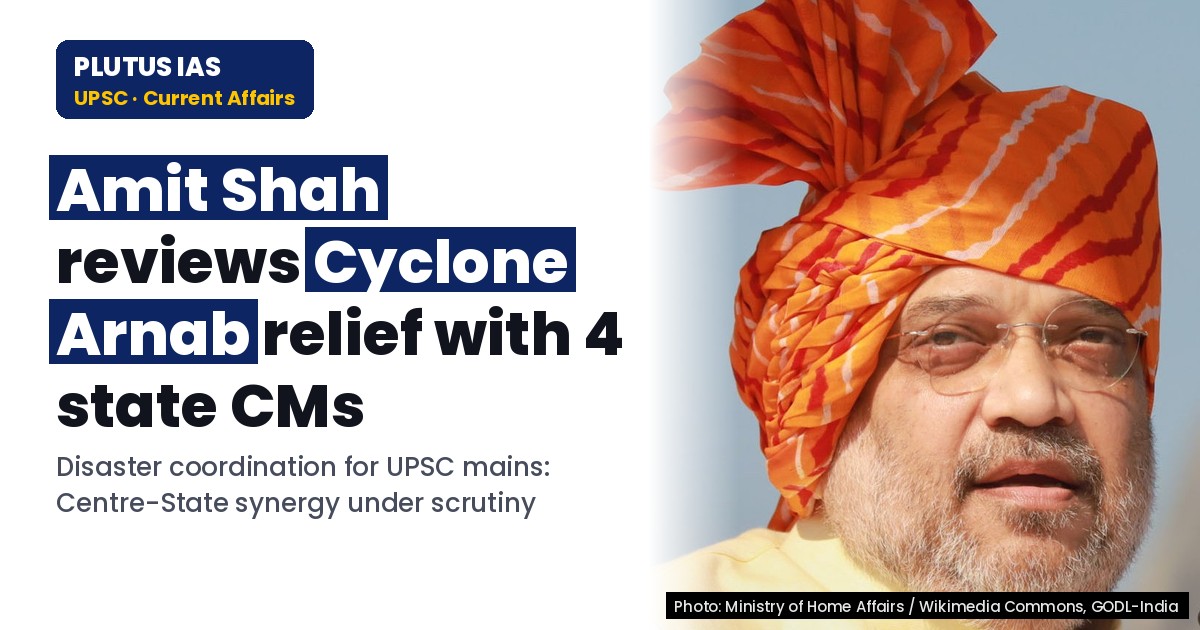
29 Oct Cyclone Arnab: Union Home Minister Coordinates Relief with 4 States
✎ The Disaster Management Act, 2005, mandates a three-tier institutional framework (NDMA, SDMAs, DDMAs) and financial mechanisms (NDRF, SDRF) for systematic disaster response, with the Union Home Ministry as the nodal authority for…
Subject Relevance — Where This Topic Fits
- GS Paper II — Functions and Responsibilities of the Union and the States, Issues and Challenges Pertaining to the Federal Structure | GS Paper III — Disaster and Disaster Management
- Prelims: National Disaster Management Authority (NDMA), State Disaster Management Authority (SDMA), National Disaster Response Fund (NDRF), Cyclone warning systems, Disaster Management Act, 2005
Quick Revision: The Disaster Management Act, 2005, mandates a three-tier institutional framework (NDMA, SDMAs, DDMAs) and financial mechanisms (NDRF, SDRF) for systematic disaster response, with the Union Home Ministry as the nodal authority for coordination.
Why is this in the news?
The Union Home Minister and Minister of Cooperation held a high-level review with the Chief Ministers of Andhra Pradesh, Puducherry, Odisha, and Chhattisgarh following Cyclone Arnab, underscoring the constitutional and statutory framework for intergovernmental coordination in disaster response. This interaction highlights the operationalisation of the National Disaster Management Act, 2005, and the institutional mechanisms for real-time crisis management.
Background
- India’s disaster management architecture is governed by the Disaster Management Act, 2005, which establishes a three-tier institutional framework: National Disaster Management Authority (NDMA), State Disaster Management Authorities (SDMAs), and District Disaster Management Authorities (DDMAs).
- The National Disaster Response Force (NDRF) and National Disaster Response Fund (NDRF) are critical instruments for immediate relief and rehabilitation under the Act.
- Cyclones are classified under ‘natural disasters’ in the Disaster Management Act, 2005, and trigger automatic relief measures under the State Disaster Response Fund (SDRF) and NDRF.
- The Union Home Ministry, as the nodal ministry for disaster management, coordinates with state governments to ensure timely deployment of resources, financial assistance, and logistical support.
What is the National Disaster Management Act, 2005?
- The Disaster Management Act, 2005, enacted in January 2006, provides the legal and institutional framework for disaster management in India, replacing the earlier ad-hoc relief-centric approach with a proactive, multi-hazard risk reduction strategy.
- It establishes the National Disaster Management Authority (NDMA) under the Chairmanship of the Prime Minister, the State Disaster Management Authorities (SDMAs) under Chief Ministers, and District Disaster Management Authorities (DDMAs) under District Collectors.
- The Act defines ‘disaster’ broadly to include natural, man-made, and environmental hazards, ensuring comprehensive coverage of risks.
- It mandates the preparation of National Disaster Management Plans (NDMP) and State Disaster Management Plans (SDMP) for systematic risk assessment, mitigation, preparedness, response, and recovery.
- The Act empowers the NDMA to lay down policies, guidelines, and norms for disaster management, while the National Executive Committee (NEC) oversees implementation.
- Financial mechanisms include the National Disaster Response Fund (NDRF) for severe disasters and the State Disaster Response Fund (SDRF) for immediate relief, with the Union providing 75% of NDRF and 90% of SDRF for general category states.
- The Act also provides for the constitution of the National Disaster Mitigation Fund (NDMF) for long-term mitigation projects, though its operationalisation remains limited.
- The NDMA, in collaboration with the India Meteorological Department (IMD), ensures early warning systems for cyclones, floods, and other hazards, enabling timely evacuation and preparedness.
Key Features
| Feature | Significance |
|---|---|
| Inter-State Coordination | Facilitates unified disaster response by aligning state-level actions with national protocols under the Disaster Management Act, 2005. |
| Real-Time Assessment | Enables rapid evaluation of cyclone impact across multiple states to prioritise resource allocation and relief operations. |
| Centralised Command Structure | Reinforces the role of the Union Home Ministry as the nodal authority for crisis management under the National Disaster Management Authority (NDMA) framework. |
| Cooperative Federalism | Demonstrates the constitutional principle of cooperative federalism (Article 263) in addressing cross-border disasters. |
| Multi-Hazard Preparedness | Highlights the integration of cyclone response with broader disaster risk reduction strategies under the Sendai Framework for Disaster Risk Reduction. |
Why it Matters
Governance & Institutional
- Reinforces the Union Home Ministry’s constitutional mandate (Article 355) to protect states against external aggression and internal disturbances, including natural disasters.
- Demonstrates the operationalisation of the National Disaster Management Plan (NDMP) 2019, which mandates multi-tiered coordination for cyclones.
- Validates the effectiveness of the National Disaster Response Force (NDRF) in pre-emptive deployment and post-impact assessment under Section 44 of the Disaster Management Act, 2005.
Policy & Legal
- Illustrates compliance with the Disaster Management Act, 2005, which empowers the Union Government to issue directions to states during disasters (Section 6).
- Aligns with the National Cyclone Risk Mitigation Project (NCRMP), a centrally sponsored scheme aimed at reducing cyclone vulnerability in coastal states.
- Demonstrates adherence to the National Policy on Disaster Management (2009), which emphasises proactive risk reduction and community-based preparedness.
Strategic & Operational
- Showcases the integration of satellite-based early warning systems (e.g., INSAT-3D) with ground-level response mechanisms for cyclones.
- Highlights the role of the India Meteorological Department (IMD) in providing accurate and timely cyclone forecasts under the IMD Act, 1975.
- Reinforces the importance of pre-positioning relief materials in cyclone-prone districts under the State Disaster Response Fund (SDRF) and National Disaster Response Fund (NDRF).
Socio-Economic
- Underscores the economic impact of cyclones on agriculture, infrastructure, and livelihoods in coastal and inland states, necessitating coordinated rehabilitation efforts.
- Emphasises the need for gender-sensitive disaster response, given the disproportionate vulnerability of women and children during cyclones.
- Demonstrates the role of cooperatives (e.g., in fisheries and agriculture) in post-cyclone recovery and resilience-building.
Challenges
1. Inter-State Coordination Gaps
- Delays in information-sharing between states and the Union Government due to bureaucratic or technological bottlenecks.
- Divergent state-level priorities in resource allocation may lead to uneven relief distribution.
- Lack of standardised protocols for cross-border disaster response, particularly in union territories like Puducherry.
UPSC Link: GS-II: Disaster Management
2. Inadequate Infrastructure
- Limited cyclone shelters and evacuation routes in vulnerable districts, particularly in Odisha and Andhra Pradesh.
- Shortage of medical facilities and personnel for post-cyclone healthcare, including mental health support.
- Insufficient pre-positioned relief materials in high-risk zones due to funding constraints or logistical delays.
UPSC Link: GS-III: Infrastructure
3. Climate Change Amplification
- Increased frequency and intensity of cyclones (e.g., Cyclone Arnab) due to global warming, exacerbating existing vulnerabilities.
- Rising sea levels threaten coastal communities, necessitating long-term adaptation strategies.
- Uncertainty in cyclone trajectories and landfall points complicates pre-emptive planning.
UPSC Link: GS-III: Environment
4. Community Preparedness
- Low awareness among local communities about cyclone warning systems and evacuation procedures.
- Cultural and socio-economic barriers to adopting disaster-resilient practices (e.g., mangrove conservation, elevated housing).
- Inadequate participation of marginalised groups (e.g., tribal communities, fishermen) in disaster preparedness and response.
UPSC Link: GS-II: Governance
5. Resource Mobilisation
- Delays in release of funds from the National Disaster Response Fund (NDRF) or State Disaster Response Fund (SDRF) due to procedural bottlenecks.
- Over-reliance on centralised funding mechanisms, leading to delays in disbursement to local governments.
- Competing fiscal priorities (e.g., development projects) may divert resources from disaster risk reduction.
UPSC Link: GS-III: Economy
Challenges — UPSC Perspective
| Issue | Concern |
|---|---|
| Bureaucratic Delays | Slow clearance of funds or approvals for relief operations. |
| Technological Gaps | Inadequate real-time data sharing platforms between states and the Union Government. |
| Funding Shortfalls | Insufficient allocation to SDRF/NDRF for post-cyclone rehabilitation. |
| Infrastructure Deficits | Lack of cyclone-resistant housing and critical infrastructure in vulnerable regions. |
| Community Engagement | Low participation of local communities in disaster preparedness and response. |
| Climate Vulnerability | Increased cyclone intensity due to climate change, outpacing mitigation efforts. |
Government Initiatives — Must-Memorise for Prelims
- National Disaster Management Plan (NDMP) 2019
- National Cyclone Risk Mitigation Project (NCRMP)
- State Disaster Response Fund (SDRF)
- National Policy on Disaster Management (2009)
Way Forward
- Strengthen inter-state coordination mechanisms by establishing a dedicated disaster response cell under the Union Home Ministry.
- Enhance real-time data-sharing platforms by integrating state-level disaster management systems with the National Disaster Management Authority (NDMA).
- Fast-track the release of funds from SDRF/NDRF by streamlining approval processes and reducing bureaucratic delays.
- Expand the coverage of cyclone shelters and evacuation routes in high-risk districts, particularly in Odisha and Andhra Pradesh.
- Promote community-based disaster preparedness through awareness campaigns and capacity-building programmes in vulnerable regions.
- Integrate climate change adaptation strategies into cyclone risk mitigation, including mangrove restoration and coastal zone management.
- Leverage cooperatives (e.g., in fisheries and agriculture) for post-cyclone recovery and resilience-building.
- Conduct regular mock drills and simulations to test the effectiveness of disaster response protocols at the state and district levels.
UPSC Value Addition
Keywords for Mains Answer-Writing
Disaster Management Act, 2005 · National Disaster Management Authority (NDMA) · State Disaster Management Authority (SDMA) · Cyclone Arnab · Inter-State Coordination in Disaster Response · Union Home Ministry · Ministry of Cooperation · Cyclone Preparedness and Mitigation · Disaster Risk Reduction (DRR) · National Disaster Response Force (NDRF) · Cyclone Warning and Early Warning Systems · Climate Change and Extreme Weather Events · Constitutional Provisions for Disaster Management (Article 21, Directive Principles of State Policy) · Inter-State Council (ISC)
Constitutional & Policy Linkages
- Article 355: Duty of the Union to protect states against external aggression and internal disturbances.
- Article 263: Provision for inter-state councils to facilitate coordination between states and the Union Government.
- Article 298: Power of the Union and states to carry on trade or business and acquire property for the purposes of the Constitution.
Concept Flow
Cyclone formation and landfall in coastal regions (e.g., Bay of Bengal) triggers early warning systems by the India Meteorological Department (IMD). → IMD issues cyclone alerts to the National Disaster Management Authority (NDMA) and state governments. → Union Home Ministry coordinates with affected states (Andhra Pradesh, Odisha, etc.) to assess impact and prioritise relief operations. → National Disaster Response Force (NDRF) and state agencies deploy rescue and relief teams to affected areas. → Central funds (NDRF/SDRF) are released to states for immediate relief and rehabilitation. → Post-cyclone assessment is conducted to identify gaps in infrastructure, funding, and community preparedness. → Long-term measures (e.g., cyclone-resistant housing, mangrove restoration) are integrated into state disaster management plans.
Prelims Practice Questions
Q1. Consider the following statements regarding the National Disaster Management Authority (NDMA):
1. The NDMA is a statutory body established under the Disaster Management Act, 2005.
2. The Prime Minister of India chairs the NDMA.
3. The NDMA is responsible for laying down policies, plans, and guidelines for disaster management in India.
4. The NDMA has the power to declare a national disaster.
How many of the above statements are correct?
- Only one
- Only two
- Only three
- All
Answer: Only three — Statements 1, 2, and 3 are correct. The NDMA is a statutory body under the Disaster Management Act, 2005, chaired by the Prime Minister, and is responsible for policy formulation. Statement 4 is incorrect as the power to declare a national disaster lies with the Union Government, not the NDMA.
Q2. Which of the following is NOT a function of the National Disaster Response Force (NDRF)?
- Conducting rescue operations during disasters
- Providing immediate relief to affected populations
- Laying down policies for disaster management
- Training and capacity-building for disaster response
Answer: Laying down policies for disaster management — The NDRF is responsible for rescue operations, immediate relief, and training, but laying down policies is the function of the NDMA, not the NDRF.
Q3. Assertion (A): The Disaster Management Act, 2005 empowers the State Disaster Management Authority (SDMA) to coordinate disaster response within the state.
Reason (R): The SDMA is chaired by the Chief Secretary of the state and includes key officials for inter-departmental coordination.
Options:
A. Both A and R are true, and R is the correct explanation of A.
B. Both A and R are true, but R is not the correct explanation of A.
C. A is true, but R is false.
D. A is false, but R is true.
Answer: ? — Both A and R are true. The Disaster Management Act, 2005 empowers the SDMA to coordinate disaster response within the state, and the SDMA is chaired by the Chief Secretary, ensuring inter-departmental coordination.
Mains Practice Question
✍ The Union Home Ministry’s proactive coordination with state governments in the aftermath of Cyclone Arnab underscores the critical role of inter-state collaboration in disaster management. Critically examine the institutional framework governing disaster management in India, highlighting the roles of the National Disaster Management Authority (NDMA), State Disaster Management Authorities (SDMAs), and the National Disaster Response Force (NDRF). Also, assess the challenges in achieving seamless coordination among these institutions. (15 Marks)
Approach: MODEL-ANSWER SKELETON:
1. **Institutional Framework**:
– **NDMA**: Statutory body under the Disaster Management Act, 2005; chaired by the Prime Minister; responsible for policy formulation, planning, and guidelines.
– **SDMAs**: Established in each state; chaired by the Chief Minister; responsible for state-level disaster management planning and coordination.
– **NDRF**: Specialized force for rescue and relief operations; deployed under the NDMA’s operational control.
– **Constitutional Basis**: Article 21 (Right to Life) and Directive Principles of State Policy (Article 38, 39A, 41, 47) mandate state responsibility for disaster management.
2. **Role in Cyclone Arnab**:
– Highlight the Union Home Ministry’s coordination with affected states (Andhra Pradesh, Puducherry, Odisha, Chhattisgarh) as a case study of inter-state collaboration.
– Emphasize early warning systems, evacuation protocols, and resource allocation (e.g., NDRF deployment, relief materials).
3. **Challenges in Coordination**:
– **Federalism vs. Centralization**: Tension between state autonomy and central oversight; delays in fund release or resource mobilization.
– **Institutional Gaps**: Overlapping mandates, lack of standardized SOPs, and inadequate capacity at the state level.
– **Data and Technology**: Gaps in real-time data sharing, early warning systems, and last-mile connectivity.
– **Funding and Resource Constraints**: Delayed disbursement of State Disaster Response Fund (SDRF) and National Disaster Response Fund (NDRF).
4. **Way Forward**:
– Strengthening SDMAs with adequate staffing, training, and financial resources.
– Leveraging technology (e.g., AI, satellite imagery) for predictive disaster modeling.
– Enhancing inter-state cooperation through the Inter-State Council (ISC) and regional disaster management frameworks.
– Ensuring timely disbursement of funds and transparent auditing of disaster expenditures.
5. **Balanced View**:
– Acknowledge successes (e.g., NDRF’s rapid response) while critiquing systemic gaps (e.g., delayed fund releases, lack of standardized protocols).
– Cite examples of past cyclones (e.g., Fani, Amphan) to illustrate lessons learned and areas needing improvement.
Source: PIB (Press Information Bureau)
Andhra Pradesh PCS (APPSC) — State PCS Practice
Prelims: Which of the following states was NOT part of the video conference chaired by Union Home Minister and Minister of Cooperation Shri Amit Shah, as mentioned in the topic?
- Andhra Pradesh
- Puducherry
- Odisha
- West Bengal
Answer: West Bengal — The video conference included Andhra Pradesh, Puducherry, Odisha, and Chhattisgarh, as explicitly stated in the topic.
Mains: Discuss the significance of the Union Home Minister’s interaction with the Chief Ministers of Andhra Pradesh, Puducherry, Odisha, and Chhattisgarh in the context of cooperative federalism and the role of Andhra Pradesh in India’s federal structure.
Generated by AanyaAi for educational purpose.
Related guides on our sites
- Current affairs for upsc 2026
- How to prepare for GS paper 1 for UPSC CSE mains exam
- Best UPSC coaching for IFOS exam
- Best geography optional coaching

- पर्यावरण मंत्री ने वायु प्रदूषण नियंत्रण के लिए PAVAN-I3C केंद्र का दौरा किया - October 30, 2026
- Self-Reliance in Defence: Key to Viksit Bharat Vision - October 30, 2026
- डीआरडीओ ने अगली पीढ़ी के सेमीकंडक्टर्स पर ESTIC 2026 में प्रदर्शित किया तकनीकी नवाचार - October 30, 2026

No Comments