


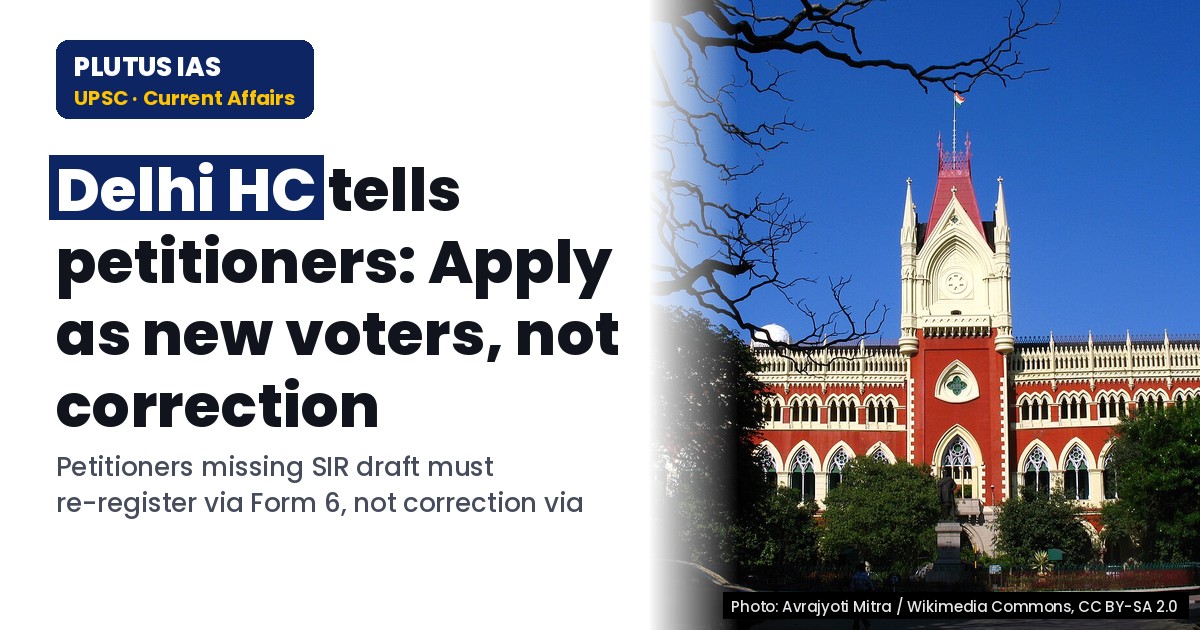
17 Oct Delhi HC: Missing from SIR Draft? Apply as New Voters, Not Correction
✎ The Special Intensive Revision (SIR) is a statutory process under the Representation of the People Act, 1951, where electors excluded from draft rolls must apply as fresh voters via Form 6, not through corrections in Form 8.
Subject Relevance — Where This Topic Fits
- GS Paper II — Constitutional and Non-Constitutional Bodies (Election Commission of India) | GS Paper III — Electoral Reforms and Governance
- Prelims: Special Intensive Revision (SIR), Form 6, Form 8, Electoral Registration Officer (ERO), Section 22 of the Representation of the People Act, 1951, Section 23 of the Representation of the People Act, 1951
- Essay: Electoral integrity and the role of judicial oversight in democratic processes, The balance between procedural efficiency and citizen-centric governance in electoral reforms
Quick Revision: The Special Intensive Revision (SIR) is a statutory process under the Representation of the People Act, 1951, where electors excluded from draft rolls must apply as fresh voters via Form 6, not through corrections in Form 8.
Why is this in the news?
The Delhi High Court, in a recent judgment, clarified the procedural recourse available to electors who missed the Special Intensive Revision (SIR) exercise for updating electoral rolls in Delhi. The court ruled that such electors must apply as fresh voters via Form 6, rather than seeking corrections through Form 8, thereby reinforcing the statutory framework governing electoral roll revisions. This decision underscores the procedural strictures embedded in the Representation of the People Act, 1951, and the Election Commission of India’s (ECI) guidelines for maintaining accurate electoral rolls.
Background
- The Special Intensive Revision (SIR) is a periodic exercise conducted by the Election Commission of India to update and rectify electoral rolls, ensuring accuracy and inclusivity.
- The Representation of the People Act, 1951, mandates the preparation and revision of electoral rolls under Sections 22 and 23, which outline the procedures for inclusion, deletion, and correction of entries.
- Form 6 is the statutory application for fresh registration of electors who are not already enrolled, while Form 8 is used for correction or transposition of existing entries in the electoral rolls.
- The petitioners in the case had relocated during the SIR timeline, leading to their exclusion from the draft rolls, prompting them to seek inclusion without re-registering as fresh voters.
- The Election Commission of India (ECI) contends that Form 6 is the appropriate mechanism for such cases, as the SIR process effectively treats the new roll as a fresh enumeration for the purpose of inclusion.
What is the Special Intensive Revision (SIR) and the associated electoral procedures?
- The Special Intensive Revision (SIR) is a time-bound, door-to-door enumeration exercise conducted by the Election Commission of India to update electoral rolls, typically ahead of general elections or major electoral events.
- The SIR aims to ensure that electoral rolls are accurate, inclusive, and free from errors such as duplicate entries, missing electors, or incorrect details like addresses or age.
- Under the Representation of the People Act, 1951, the ECI is empowered to revise electoral rolls periodically, with the SIR being a critical component of this process to address gaps identified in routine revisions.
- Form 6 is the prescribed application for fresh registration of electors who are not already enrolled in the electoral rolls, including those who have been inadvertently excluded or have relocated without updating their details.
- Form 8 is used for corrections or transpositions in existing entries, such as changes in address, name, age, or other demographic details, but is not applicable to electors who have been excluded from the rolls.
- The Electoral Registration Officer (ERO) is the designated authority responsible for the preparation, revision, and maintenance of electoral rolls within a constituency, acting under the supervision of the ECI.
- The ECI’s guidelines for the SIR process emphasize the importance of public participation, with electors encouraged to verify their entries and submit corrections or inclusions within the stipulated timeline.
- Judicial interventions in electoral roll disputes often revolve around the interpretation of statutory provisions governing inclusion, deletion, and correction, ensuring adherence to the rule of law.
Key Features
| Feature | Significance |
|---|---|
| Special Intensive Revision (SIR) | A periodic revision of electoral rolls to ensure accuracy, completeness, and deletion of ineligible entries, conducted under Section 21 of the Representation of the People Act, 1951. |
| Form 6 | Statutory form for fresh registration of new voters or those not included in the electoral rolls, as per Rule 13 of the Registration of Electors Rules, 1960. |
| Form 8 | Statutory form for correction, transposition, or deletion of entries in existing electoral rolls, as per Rule 14 of the Registration of Electors Rules, 1960. |
| Delhi High Court’s directive | Judicial interpretation of electoral procedures, ensuring adherence to statutory forms while addressing procedural gaps in voter enumeration. |
| Electoral Registration Officer (ERO) | Designated authority responsible for preparing and revising electoral rolls, functioning under the Election Commission of India (ECI). |
Why it Matters
Electoral Governance
- Ensures the integrity and accuracy of electoral rolls, a foundational requirement for free and fair elections under Article 324 of the Constitution.
- Highlights the procedural safeguards embedded in the Representation of the People Act, 1951, and allied rules to maintain electoral democracy.
- Demonstrates the role of the judiciary in interpreting electoral laws to resolve procedural ambiguities without compromising statutory compliance.
Citizen Rights & Procedural Justice
- Reinforces the principle that electoral rolls must reflect the current residence of voters, preventing disenfranchisement due to administrative lapses.
- Clarifies the distinction between correction of existing entries (Form 8) and fresh registration (Form 6), ensuring citizens are not penalised for procedural errors.
- Upholds the right to vote by providing a clear pathway for inclusion, even when initial enumeration is missed due to relocation.
Institutional Coordination
- Showcases the collaborative role of the judiciary and the Election Commission of India in interpreting and implementing electoral laws.
- Illustrates the hierarchical structure of electoral governance, where the ERO operates under the ECI, with judicial oversight where necessary.
Challenges
1. Procedural Ambiguity in Enumeration
- Citizens may face disenfranchisement due to missed enumeration during SIR exercises, particularly when relocating.
- Potential for misinterpretation of statutory forms (Form 6 vs. Form 8) leading to incorrect applications or false declarations.
UPSC Link: RP Act 1951, Section 21
2. Administrative Delays in Roll Revision
- Large-scale revisions like SIR may inadvertently exclude eligible voters due to logistical or informational gaps.
- Need for robust awareness campaigns to ensure citizens participate in enumeration exercises.
UPSC Link: Conduct of Elections Rules, 1961
3. Judicial Interpretation of Statutory Forms
- Courts must balance strict adherence to statutory procedures with equitable outcomes for citizens.
- Risk of conflicting interpretations of electoral laws, necessitating clarity in judicial directives.
UPSC Link: Article 324(1)
Challenges — UPSC Perspective
| Issue | Concern |
|---|---|
| Missed Enumeration | Citizens relocating during SIR may be excluded from electoral rolls, risking disenfranchisement. |
| Form Misapplication | Confusion between Form 6 (fresh registration) and Form 8 (correction) may lead to incorrect applications. |
| Administrative Gaps | Logistical or informational deficiencies in SIR exercises may exclude eligible voters. |
| Judicial Scrutiny | Courts must ensure electoral laws are interpreted without undermining procedural justice. |
| Citizen Awareness | Lack of awareness about enumeration timelines may result in missed opportunities for inclusion. |
Way Forward
- Clarify and publicise the distinction between Form 6 and Form 8 through multi-lingual campaigns, especially during SIR exercises.
- Strengthen coordination between EROs and local authorities to ensure seamless enumeration and voter inclusion.
- Conduct pre-SIR awareness drives in relocation-prone areas (e.g., urban centres, migrant hubs) to minimise disenfranchisement.
- Leverage digital platforms (e.g., voter helplines, mobile apps) for real-time updates on electoral roll status.
- Encourage EROs to adopt flexible timelines for form submission in cases of genuine procedural delays.
- Enhance grievance redressal mechanisms for voters facing exclusion, with time-bound resolution protocols.
- Mandate periodic audits of electoral rolls to identify and rectify systemic gaps in enumeration.
UPSC Value Addition
Keywords for Mains Answer-Writing
Electoral Rolls · Special Intensive Revision (SIR) · Form 6 and Form 8 · Electoral Registration Officer (ERO) · Delhi High Court · Election Commission of India (ECI) · Constitutional provisions on electoral rolls · Statutory forms in voter registration · Voter enfranchisement · Electoral reforms in India
Constitutional & Policy Linkages
- Article 324(1) — Superintendence, direction, and control of elections vested in the ECI.
- Article 325 — Prohibition of discrimination in electoral rolls on grounds of religion, race, caste, or sex.
Concept Flow
Relocation of citizens during SIR exercise → Missed enumeration → Deletion from electoral rolls → Petition for inclusion → Judicial interpretation of Forms 6 and 8 → Direction to apply via Form 6 → Processing as per statutory procedure.
Prelims Practice Questions
Q1. Consider the following statements regarding the Special Intensive Revision (SIR) of electoral rolls in India: 1. SIR is a statutory process conducted by the Election Commission of India (ECI) to update electoral rolls. 2. Form 6 is used for the correction of entries in existing electoral rolls. 3. Form 8 is the statutory form for fresh registration of first-time voters. How many of the above statements are correct?
- Only one
- Only two
- All three
- None
Answer: Only two — Statement 1 is correct: SIR is a statutory process under the Representation of the People Act, 1950. Statement 2 is incorrect: Form 6 is for fresh registration, while Form 8 is for correction of existing entries. Statement 3 is incorrect: Form 8 is for correction, while Form 6 is for fresh registration.
Q2. Assertion (A): The Election Commission of India (ECI) has the power to direct the inclusion of names in electoral rolls through Form 6, even if the applicant has previously voted. Reason (R): Form 6 is designed for first-time voters and requires a declaration that the applicant has never voted before.
- Both A and R are true, and R is the correct explanation of A
- Both A and R are true, but R is NOT the correct explanation of A
- A is true, but R is false
- A is false, but R is true
Answer: A is false, but R is true — Assertion (A) is true: ECI can direct inclusion via Form 6. Reason (R) is false: Form 6 does not require a declaration of never having voted; it is used for fresh registration in the new roll being prepared during SIR.
Q3. Match the following electoral forms with their correct purpose: Column I: A. Form 6, B. Form 7, C. Form 8. Column II: 1. Application for inclusion in electoral roll as a new voter, 2. Application for deletion of name from electoral roll, 3. Application for correction of entries in electoral roll. Select the correct match:
- A-1, B-2, C-3; A-2, B-1, C-3; A-3, B-1, C-2; A-1, B-3, C-2
- answer_mapper_indexes_to_options_indexes_list_of_correct_pairs_only_inside_answer_field_0_based_index_of_options_array
- answer_list_indexes_of_correct_pairs_only_inside_answer_field_0_based_index_of_options_array
- answer_list_indexes_of_correct_pairs_only_inside_answer_field_0_based_index_of_options_array
Answer: ? — Form 6 is for new voter registration (A-1), Form 7 is for deletion of a name (B-2), and Form 8 is for correction of entries (C-3).
Mains Practice Question
✍ The Special Intensive Revision (SIR) of electoral rolls is a critical process for maintaining accurate and inclusive voter lists. In this context, critically examine the role of statutory forms (Form 6 and Form 8) in ensuring voter enfranchisement and the challenges faced by electors who miss the SIR timeline due to shifting residences. Also, analyse the judicial response to such grievances with reference to constitutional provisions and recent judicial precedents. (15 Marks)
Approach: MODEL-ANSWER SKELETON:
1. **Introduction (2 marks)**: Define SIR and its statutory basis under the Representation of the People Act, 1950 and the Conduct of Elections Rules, 1961. Highlight the objective of SIR: to update, purify, and include all eligible electors.
2. **Statutory Forms and Their Roles (4 marks)**:
– **Form 6**: Purpose (fresh registration for first-time voters), statutory basis (Rule 13 of the Conduct of Elections Rules, 1961), and declaration requirements.
– **Form 8**: Purpose (correction of entries in existing rolls), statutory basis (Rule 14), and its role in maintaining accuracy without requiring fresh registration.
– Contrast between Form 6 and Form 8: why Form 6 is not suitable for electors who have previously voted but missed SIR.
3. **Challenges Faced by Electors (4 marks)**:
– Reasons for missing SIR: shifting residences, lack of awareness, administrative delays.
– Consequences: deletion from rolls, disenfranchisement, and the need for recourse.
– Reference to the Delhi High Court case: petitioners’ argument (fear of false declaration in Form 6) and ECI’s counter (Form 6 as first-time voter for new roll).
4. **Judicial Response and Constitutional Provisions (3 marks)**:
– Judicial interpretation of Articles 325 and 326 (Constitution of India): universal adult franchise and preparation of electoral rolls.
– Reference to the Delhi High Court’s observation (October 14, 2026): Form 6 can be processed as per law, and the apprehension of false declaration is misplaced.
– Role of the Election Commission of India (ECI) as a constitutional body under Article 324.
5. **Conclusion (2 marks)**:
– Balancing voter enfranchisement with statutory compliance.
– Recommendations: awareness campaigns, simplification of forms, and grievance redressal mechanisms for electors facing administrative hurdles.
Source: The Indian Express
Delhi PCS (DSSSB) — State PCS Practice
Prelims: As per the recent Delhi High Court directive, which of the following is the correct procedure for individuals who were not included in the Special Intensive Revision (SIR) draft of the electoral rolls in Delhi?
- They can directly approach the Election Commission of India for inclusion without any prior petition.
- They must file a petition before the Delhi High Court, which will then direct the Election Commission to consider their inclusion.
- They can submit a fresh application to the local Electoral Registration Officer (ERO) for inclusion in the next revision cycle.
- They need to wait for the next general electoral roll revision to submit their application.
Answer: They can submit a fresh application to the local Electoral Registration Officer (ERO) for inclusion in the next revision cycle. — The Delhi High Court directed petitioners who were not included in the SIR draft to submit fresh applications to the local Electoral Registration Officer (ERO) for inclusion in the electoral rolls.
Mains: Critically analyze the role of the Delhi High Court in ensuring electoral inclusivity for voters in Delhi, especially in the context of the recent directive regarding the Special Intensive Revision (SIR) draft. Discuss the implications of this judicial intervention on the electoral process and the functioning of the Election Commission of India in Delhi.
Generated by AanyaAi for educational purpose.
Related guides on our sites
- Current affairs for upsc 2026
- Best PSIR optional coaching in delhi for UPSC
- Best PSIR optional coaching for upsc
- Best PSIR optional teacher for upsc

- विशाखापट्टनम में उच्च जोखिम गर्भावस्था की निगरानी बढ़ाने पर कलेक्टर का निर्देश, जानिए पूरी जानकारी - October 21, 2026
- National Unity Day 2026: Key Preparations & Significance for UPSC - October 21, 2026
- 14वां इंडिया केम 2026: मुंबई में वैश्विक रसायन उद्योग का महाकुंभ - October 21, 2026

No Comments