


17 Sep DFSB’s Special Campaign 6.0: Key Achievements & UPSC Relevance (2026)
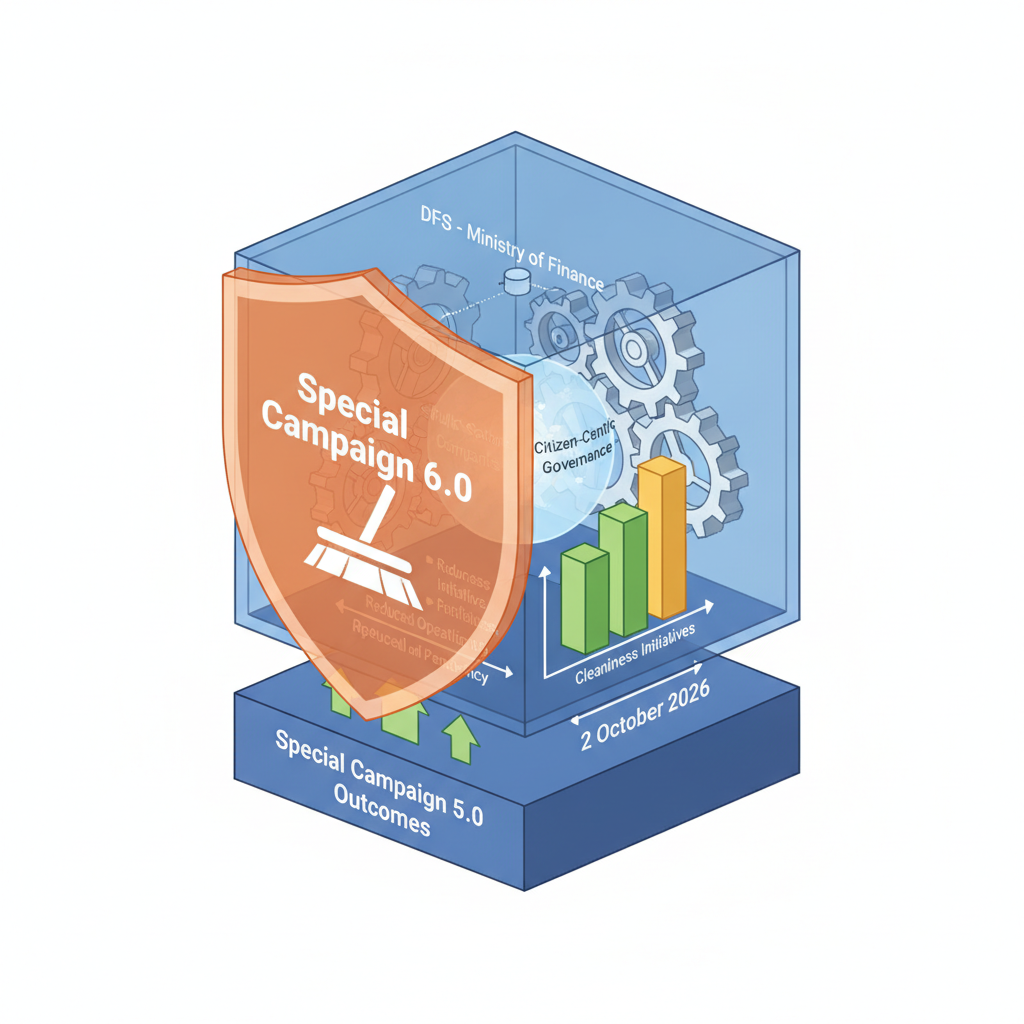
✎ Special Campaign 6.0, launched by the Department of Financial Services on 2 October 2026, is a mission-mode initiative to institutionalise cleanliness, reduce operational pendency, and generate revenue through systematic waste…
Subject Relevance — Where This Topic Fits
- GS Paper II — Governance, Transparency and Accountability | GS Paper III — Indian Economy and Issues relating to Planning, Mobilisation of Resources, Growth, Development and Employment
- Prelims: Special Campaign 6.0, Department of Financial Services (DFS), Swachhata Hi Seva, Pendency reduction, SCDPM portal
- Essay: The role of institutional initiatives in enhancing governance and public service delivery, Sustainable development through administrative reforms
Quick Revision: Special Campaign 6.0, launched by the Department of Financial Services on 2 October 2026, is a mission-mode initiative to institutionalise cleanliness, reduce operational pendency, and generate revenue through systematic waste management in public financial institutions.
Why is this in the news?
The Department of Financial Services (DFS), under the Ministry of Finance, has announced its readiness to launch Special Campaign 6.0 from 2 October 2026, aimed at institutionalising cleanliness and reducing operational pendency across its offices, subordinate organisations, and public sector financial institutions. This initiative builds on the outcomes of Special Campaign 5.0, which achieved significant results in cleanliness drives and disposal of pending matters, demonstrating the government’s sustained commitment to administrative efficiency and citizen-centric governance.
Background
- The Department of Financial Services (DFS) functions under the Ministry of Finance and oversees public sector banks, insurance companies, and other financial institutions in India.
- Special Campaigns are time-bound, mission-mode initiatives launched by the Government of India to promote cleanliness, reduce pendency, and improve operational efficiency across government offices.
- Special Campaign 5.0, conducted from 2 October to 31 October 2025, achieved all targeted parameters, including cleaning over 41,000 locations and generating revenue of ₹3.20 crore from waste disposal.
- The DFS has continued its cleanliness and pendency reduction efforts from November 2025 to August 2026, monitoring progress monthly through the Special Campaign Dashboard and Portal (SCDPM).
- The initiative aligns with the broader national movement ‘Swachhata Hi Seva’ and the government’s emphasis on ‘Minimum Government, Maximum Governance’.
- Public sector financial institutions, including banks and insurance companies, are integral to India’s financial inclusion and economic growth strategies.
What is Special Campaign 6.0?
- Special Campaign 6.0 is a government-led initiative under the Department of Financial Services (DFS) to institutionalise cleanliness and reduce operational pendency across its offices, subordinate organisations, and public sector financial institutions.
- The campaign is scheduled to commence on 2 October 2026 and will focus on systematic cleanliness drives, disposal of pending matters, and revenue generation from waste management.
- The DFS has finalised a detailed roadmap for the campaign, incorporating lessons learned from Special Campaign 5.0, which achieved all targeted parameters.
- Progress under the campaign is monitored through the Special Campaign Dashboard and Portal (SCDPM), enabling real-time tracking of cleanliness drives, pendency reduction, and revenue generation.
- The campaign aims to enhance administrative efficiency, improve service delivery, and foster a culture of cleanliness and accountability in public financial institutions.
- Special Campaign 6.0 will involve active participation from all field offices, banks, and financial institutions under the DFS’s administrative control, ensuring a unified and coordinated approach.
- The initiative is part of the government’s broader strategy to promote transparency, reduce bureaucratic delays, and enhance the ease of doing business in India.
- Revenue generated from waste disposal and other cleanliness drives will be utilised for further administrative improvements and public welfare initiatives.
Key Features
| Feature | Significance |
|---|---|
| Special Campaign 6.0 (October 2026–August 2027) | Institutionalises cleanliness and operational efficiency across DFS-linked offices, subordinate organisations, and public-sector financial institutions through a structured, time-bound action plan. |
| Monthly Monitoring via SCDPM Portal | Enables real-time tracking of progress in sanitation drives, waste disposal, and grievance redressal, ensuring accountability and transparency in implementation. |
| Grievance Redressal (14,590 cases) | Demonstrates citizen-centric governance by systematically addressing public complaints, reducing administrative pendency in financial services. |
| Waste-to-Revenue Model (₹1.02 lakh) | Converts waste management into a revenue-generating activity, aligning environmental sustainability with fiscal prudence. |
| Field Office Engagement | Ensures uniform implementation across 41,000+ locations through dedicated video conferences and formal communications, fostering inter-departmental coordination. |
Why it Matters
Governance & Administrative Efficiency
- Advances the Union Government’s ‘Special Campaign for Disposal of Pending Matters’ by embedding cleanliness and pendency reduction as permanent administrative functions.
- Promotes a culture of zero-waste and zero-pendency in public financial institutions, enhancing service delivery and public trust.
- Demonstrates measurable outcomes in sanitation (968 sites cleaned) and grievance redressal, reinforcing the efficacy of time-bound campaigns.
Economic & Fiscal Impact
- Generates direct revenue through waste disposal (₹1.02 lakh), illustrating how environmental compliance can contribute to fiscal health.
- Reduces operational bottlenecks in public-sector banks and financial institutions, potentially lowering transaction costs and improving financial inclusion metrics.
- Aligns with the broader objective of ‘Litter-Free India’ under the Swachh Bharat Mission, contributing to macroeconomic externalities like reduced healthcare costs.
Citizen-Centric Public Service Delivery
- Addresses 14,590 public grievances, demonstrating responsiveness in financial services such as banking, insurance, and pensions.
- Enhances transparency by making progress data publicly accessible via the SCDPM portal, enabling citizen oversight.
- Reduces pendency in appeals (3,987 cases), ensuring timely justice in administrative disputes related to financial services.
Institutional Capacity Building
- Strengthens the administrative capacity of DFS-linked entities to manage sanitation and pendency proactively, rather than reactively.
- Fosters inter-departmental synergy between DFS, public-sector banks, and financial institutions, creating a unified governance framework.
- Sets a precedent for scalable, replicable models in other ministries/sectors, particularly those with large field operations.
Challenges
1. Sustaining Momentum Beyond Campaign Periods
- Risk of administrative fatigue once the campaign concludes, leading to a relapse into pre-campaign practices.
- Requires institutional mechanisms (e.g., performance-linked incentives) to ensure long-term adherence to cleanliness and pendency norms.
UPSC Link: GS-II: Governance, Transparency & Accountability
2. Resource Allocation & Logistics
- Ensuring adequate manpower, equipment, and funds for sanitation drives across 41,000+ locations, especially in remote areas.
- Balancing waste-to-revenue initiatives with environmental safeguards to prevent exploitative practices.
UPSC Link: GS-III: Resource Mobilisation, Environment & Ecology
3. Data Integrity & Monitoring Gaps
- Maintaining the accuracy and timeliness of data reported on the SCDPM portal to avoid misreporting or delays.
- Addressing discrepancies between ground-level implementation and portal records, which could undermine credibility.
UPSC Link: GS-II: E-Governance, Digital Divide
4. Cultural & Behavioral Resistance
- Overcoming institutional inertia where cleanliness and pendency reduction are not prioritised in day-to-day operations.
- Training and sensitising staff across hierarchical levels to adopt a proactive, rather than reactive, approach.
UPSC Link: GS-IV: Ethics in Governance, Human Resource Management
5. Scalability to Diverse Geographies
- Adapting the campaign’s framework to urban, semi-urban, and rural contexts, each with distinct sanitation and pendency challenges.
- Ensuring inclusivity for differently-abled individuals in sanitation drives and grievance redressal mechanisms.
UPSC Link: GS-II: Inclusive Growth, Regional Disparities
Challenges — UPSC Perspective
| Issue | Concern |
|---|---|
| Administrative Fatigue | Risk of reverting to pre-campaign practices post-implementation due to lack of sustained incentives. |
| Resource Constraints | Insufficient manpower or funds to execute sanitation drives uniformly across all DFS-linked locations. |
| Data Accuracy | Potential discrepancies between ground-level progress and portal-reported data, affecting monitoring efficacy. |
| Cultural Inertia | Resistance to change in organisational culture, where cleanliness and pendency reduction are not embedded in SOPs. |
| Geographical Diversity | Varied sanitation and pendency challenges across urban, semi-urban, and rural regions requiring tailored approaches. |
| Stakeholder Coordination | Ensuring seamless collaboration between DFS, public-sector banks, and financial institutions for unified implementation. |
Way Forward
- Institutionalise the campaign’s framework by integrating cleanliness and pendency reduction into the annual performance reviews of DFS-linked entities.
- Develop a performance-linked incentive system for field offices to sustain momentum beyond campaign periods.
- Expand the SCDPM portal’s functionalities to include predictive analytics for identifying high-pendency areas and prioritising interventions.
- Conduct quarterly third-party audits to validate ground-level progress and data accuracy reported on the portal.
- Launch targeted capacity-building programmes for staff at all levels, focusing on behavioural change and operational efficiency.
- Establish a grievance redressal dashboard with real-time tracking to enhance transparency and citizen engagement.
- Pilot region-specific sanitation models (e.g., waste-to-energy in urban clusters, composting in rural areas) to address geographical diversity.
- Formalise partnerships with NGOs and local bodies to leverage community participation in sanitation drives.
UPSC Value Addition
Keywords for Mains Answer-Writing
Special Campaign 6.0 · Department of Financial Services (DFS) · Swachhata Abhiyan · Public Grievance Redressal · Administrative Efficiency · SCDPM Portal · Ministry of Finance · Public Sector Financial Institutions · Institutional Cleanliness · Operational Pendency Reduction
Constitutional & Policy Linkages
- [‘Article 51A(g) – Fundamental Duties’, ‘Promotes environmental protection and sanitation as a civic responsibility.’]
- [‘Article 48A – Directive Principles’, ‘Aligns with the constitutional mandate to improve public health and environment.’]
Concept Flow
Public grievances and operational pendency in financial services → Government launches Special Campaigns (5.0 & 6.0) to address backlogs → DFS implements structured sanitation and redressal drives across 41,000+ locations → Real-time monitoring via SCDPM portal ensures transparency → Waste-to-revenue model generates fiscal benefits → Long-term institutionalisation through performance-linked incentives → Sustained improvement in governance and service delivery.
Prelims Practice Questions
Q1. Consider the following statements regarding the Special Campaign 6.0 launched by the Department of Financial Services (DFS):
1. The campaign aims to institutionalise cleanliness and reduce operational pendency across all administrative levels.
2. The progress of the campaign is monitored through the SCDPM portal.
3. The campaign includes disposal of public grievances and appeals.
4. The campaign is limited to the headquarters of DFS and does not extend to field offices or public sector financial institutions.
How many of the above statements are correct?
- Only one
- Only two
- Only three
- All four
Answer: Only three — Statements 1, 2, and 3 are correct as per the official release. Statement 4 is incorrect because the campaign extends to all field offices, subordinate organisations, and public sector financial institutions under DFS.
Q2. Assertion (A): The Special Campaign 6.0 by the Department of Financial Services (DFS) is part of a broader government effort to institutionalise cleanliness and reduce operational pendency.
Reason (R): The campaign includes disposal of public grievances, cleanliness drives, and revenue generation from waste disposal.
Code:
- Both A and R are true, and R is the correct explanation of A.
- Both A and R are true, but R is NOT the correct explanation of A.
- A is true, but R is false.
- A is false, but R is true.
Answer: Both A and R are true, but R is NOT the correct explanation of A. — Both the assertion and reason are true. The campaign’s objectives include institutionalising cleanliness and reducing pendency (A), and the activities such as grievance disposal, cleanliness drives, and revenue generation (R) are part of the campaign’s implementation, making R the correct explanation of A.
Q3. Match the following initiatives with their respective objectives:
Column I (Initiative) | Column II (Objective)
1. Special Campaign 6.0 | A. Institutionalise cleanliness and reduce operational pendency
2. SCDPM Portal | B. Monitor monthly progress of cleanliness and pendency reduction
3. Public Grievance Redressal | C. Disposal of public grievances and appeals
4. Waste Disposal Revenue Generation | D. Generate revenue from waste management activities
Select the correct match:
- 1-A, 2-B, 3-C, 4-D
- 1-B, 2-A, 3-D, 4-C
- 1-C, 2-D, 3-A, 4-B
- 1-D, 2-C, 3-B, 4-A
Answer: 1-A, 2-B, 3-C, 4-D — The correct matching is: 1-A (Special Campaign 6.0 aims to institutionalise cleanliness and reduce pendency), 2-B (SCDPM Portal monitors progress), 3-C (Public Grievance Redressal involves disposal of grievances), and 4-D (Waste Disposal Revenue Generation aims to generate revenue).
Mains Practice Question
✍ The Department of Financial Services (DFS) has institutionalised cleanliness and reduced operational pendency through the Special Campaign 6.0. In this context, critically examine the significance of such campaigns for public sector governance in India. Also, discuss the role of technology in enhancing the efficacy of these campaigns. (15 Marks)
Approach: MODEL-ANSWER SKELETON:
1. **Introduction (2 marks)**: Define institutional cleanliness and operational pendency in public sector governance. Briefly introduce Special Campaign 6.0 and its objectives.
2. **Significance of Cleanliness and Pendency Reduction (5 marks)**:
– **Administrative Efficiency**: Reduction in pendency improves service delivery and citizen satisfaction (cite examples like passport services, banking grievances).
– **Institutional Discipline**: Cleanliness drives foster a culture of accountability and transparency in public offices (link to Swachh Bharat Mission).
– **Revenue Generation**: Waste management and disposal of scrap can generate additional revenue for government departments (cite DFS example of ₹102,344 revenue).
– **Public Trust**: Timely disposal of grievances builds trust in public institutions (reference to 14,590 grievances disposed).
3. **Role of Technology (5 marks)**:
– **SCDPM Portal**: Explain how the portal enables real-time monitoring, data-driven decision-making, and transparency in progress tracking (cite its role in Special Campaign 6.0).
– **Digital Grievance Redressal**: Highlight the use of digital platforms for lodging and tracking grievances (reference to public grievance redressal mechanisms under DFS).
– **Data Analytics**: Discuss how data analytics can identify bottlenecks in pendency reduction and optimise resource allocation.
– **Automation**: Mention the role of automation in streamlining repetitive tasks and reducing human error.
4. **Challenges and Limitations (3 marks)**:
– **Scalability**: Challenges in extending such campaigns to all field offices and PSUs uniformly.
– **Sustainability**: Ensuring long-term adherence to cleanliness and pendency norms beyond campaign periods.
– **Digital Divide**: Addressing the digital divide in accessing grievance redressal mechanisms.
5. **Conclusion (2 marks)**: Summarise the transformative potential of such campaigns for public sector governance. Emphasise the need for integrating technology and institutionalising best practices.
Source: PIB (Press Information Bureau)
Generated by AanyaAi for educational purpose.
Related guides on our sites
- Current affairs for upsc 2026
- Best PSIR optional coaching for upsc
- Best PSIR optional teacher for upsc
- Best teacher of PSIR optional for upsc

- DFSB’s Special Campaign 6.0: Key Achievements & UPSC Relevance (2026) - September 17, 2026
- राजस्थान निकाय चुनावों में ओबीसी आरक्षण: सरकार ने उच्च न्यायालय में प्रस्तुत किए तर्क - September 17, 2026
- Rajasthan OBC Reservation in Local Body Polls: HC Arguments Explained for UPSC - September 17, 2026

No Comments