


21 Feb Empowering a Made-in-India AI Revolution: Towards a Viksit Bharat
This article covers “Daily Current Affairs” and From Empowering a Made-in-India AI Revolution: Towards a Viksit Bharat
SYLLABUS MAPPING
GS- 3- Science and technology – Empowering a Made-in-India AI Revolution: Towards a Viksit Bharat
FOR PRELIMS
What is meant by AI stack?
FOR MAINS
What is the significance of compute infrastructure in AI development?
Why in the News?
India is positioning itself as a global digital power by fostering a sovereign AI ecosystem. A significant recent milestone is the India AI Mission, which has selected indigenous organisations like Sarvam AI under its Innovation Centre pillar, providing financial and compute support amounting to ₹246.72 crore to develop foundational models.
Background and Context
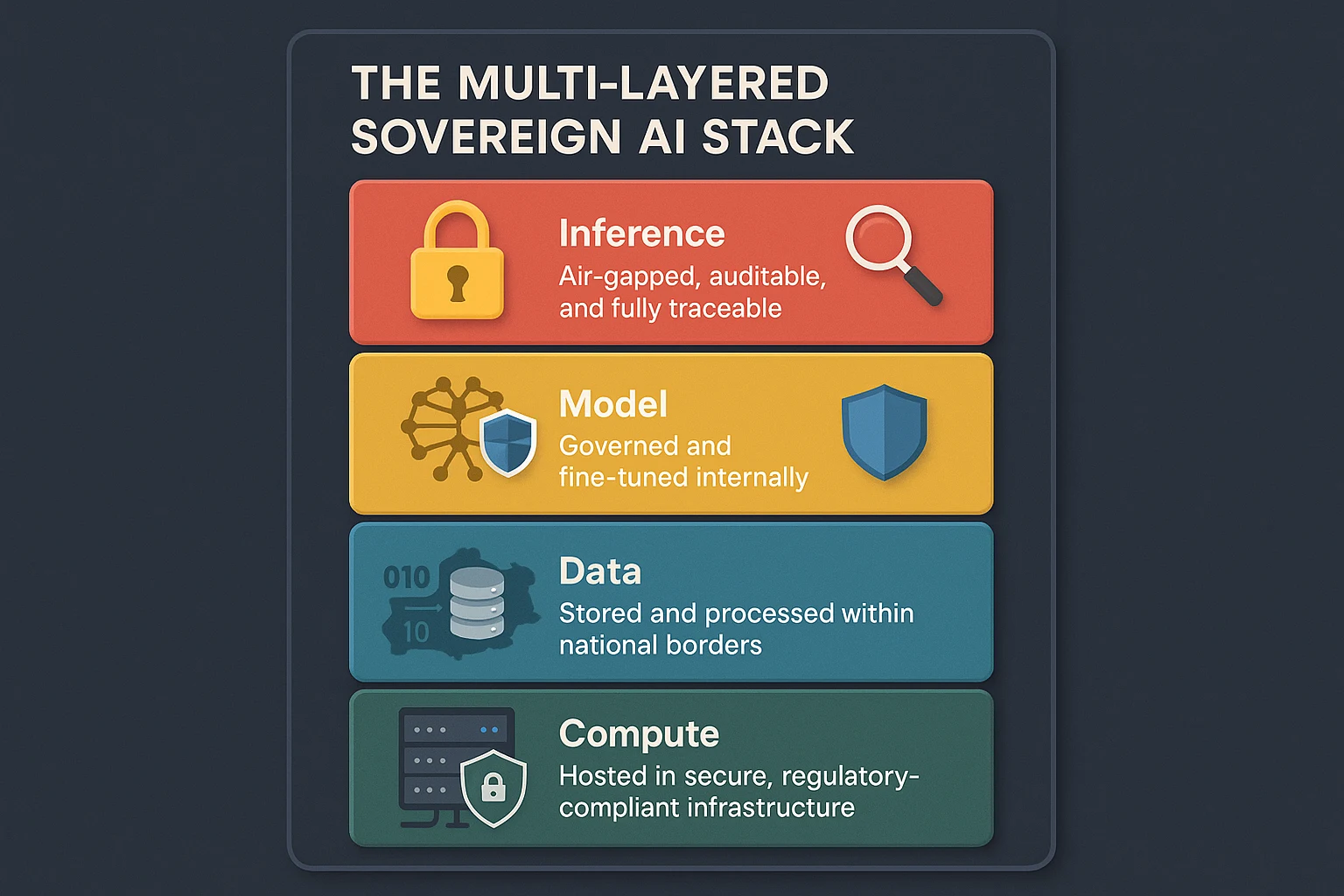
Artificial Intelligence (AI) refers to computer programs trained on vast amounts of data to recognize patterns, make predictions, or generate new content, acting essentially as a “digital brain”. As the core driver of the 4th Industrial Revolution, AI is reshaping governance, industry, and citizen engagement, making technological sovereignty a national priority. To understand the AI landscape, it is essential to distinguish between its various layers:
AI Model: A program that simulates human intelligence to perform tasks.
AI Stack: The complete set of tools and systems (infrastructure, models, platforms) required to build and run AI applications.
Generative AI (Gen AI): A subset of AI that can create new content (text, speech, images).
Difference between Artificial intelligence (AI) Machine learning (ML) and Deep Learning (DL)
| Feature | Artificial Intelligence (AI) | Machine Learning (ML) | Deep Learning (DL) |
| Scope | Broadest concept: machines acting “smart.” | Subset of AI: machines learning from data without explicit programming. | Subset of ML: using multi-layered neural networks. |
| Data Requirement | Variable (can be rule-based). | Medium to Large. | Very Large (Big Data). |
| Complexity | Basic to Advanced. | Statistical and Algorithmic. | Highly Complex (Neural Networks). |
| Human Effort | High (for defining rules/logic). | Moderate (requires feature engineering). | Low (features are learned by the model). |
Challenges & Concerns
India AI Mission: A government initiative to build a robust AI ecosystem, including compute capacity and foundational models.
NITI Aayog AI Strategy & Global Partnership on AI (GPAI): While the sources emphasize domestic implementation, these are key external frameworks for national strategy and international cooperation.
UNESCO AI Ethics Framework: Provides the global standard for the “Responsible AI” mentioned in Indian policy goals.
Historical & Technological Background
The evolution of AI in India has shifted from consuming foreign technology to building a sovereign AI ecosystem. This is driven by:
Data: Training models on Indian languages and local real-world contexts to ensure relevance.
Algorithms: Developing indigenous Large Language and Speech Models (LLMs) like Bulbul (Text-to-Speech) and Saaras (Speech-to-Text).
Computing Power: Establishing dedicated hubs, such as the 50MW AI-optimized Sovereign AI Capacity Hub in Odisha, to serve as a national compute backbone.
Applications of AI
AI is being integrated across sectors to drive public value:
Governance: UIDAI is using Gen AI for voice-driven Aadhaar services, real-time fraud detection, and multilingual support.
Healthcare & Finance: Advanced systems are being used for diagnostics and fraud detection respectively.
Education/Skilling: AI is being applied to local language skilling (e.g., Odia-language skilling).
Industry & Security: Use cases include mining safety in Odisha and national compute grids for strategic autonomy.
Multilingual Accessibility: Models like Vision understand documents in over 22 Indian languages, including mixed scripts and handwritten text.
Benefits for India
Economic Growth: AI platforms are achieving up to 10x ROI for enterprises.
Job Creation: Indigenous innovation fosters a startup ecosystem and research parks like Digital Sangam.
Digital Governance: Enhances public service delivery through voice-based interfaces and compact “Edge Intelligence” for real-time assistants.
Inclusion: Reducing linguistic barriers ensures technology reaches every citizen, regardless of their language.
Challenges & Concerns
Dependence on Foreign Infrastructure: Historically, India has relied on external AI systems, which can limit strategic autonomy.
Data Privacy & Security: Moving AI models to secure, on-premise infrastructure (as seen with UIDAI) is necessary to mitigate risks.
Ethical Issues: The need for Responsible AI frameworks to address algorithmic bias and transparency.
AI Divide: Ensuring that advanced AI does not create a gap between those with access to high-compute resources and those without.
Ethical & Governance Dimension
Responsible AI governance involves:
Human Oversight: Ensuring innovation serves as a “trusted ally” to empower people.
Accountability & Transparency: Building open-source ecosystems to strengthen transparency in how models are developed.
Sovereign Control: Developing a full-stack ecosystem (compute to application) within India to ensure alignment with national regulatory frameworks.
Government Initiatives & Global Cooperation
Innovation Centre Pillar (India AI Mission): Funding indigenous foundational models.
Public-Private Partnerships: Collaborations between the Central government, state governments (Odisha, Tamil Nadu), and research institutions like IIT Madras.
Sovereign AI Research Parks: Establishing hubs like Digital Sangam to integrate compute, research, and startup incubation.
Way Forward
To sustain this momentum, India must focus on:
Indigenous AI Development: Continuing to build models tailored to India’s unique linguistic and enterprise requirements.
Skill Development: Using AI as a tool for large-scale skilling in local languages.
Regulatory Frameworks: Deploying AI responsibly while ensuring global competitiveness.
Conclusion
The development of a homegrown, multilingual AI ecosystem is a critical pillar for a Viksit Bharat. By aligning innovation with constitutional values of inclusion and equity, India is ensuring that technology serves as a tool for “AI for All,” reducing reliance on foreign systems while establishing a scalable digital backbone for the future.
Prelims question:
Q. With reference to the “India AI Mission” and recent developments in India’s AI ecosystem, consider the following statements:
1. The Innovation Centre pillar of the India AI Mission provides financial and compute support specifically for the development of indigenous foundational models.
2. Saaras is an indigenous AI model developed for high-quality text-to-speech conversion across all 22 scheduled languages of India.
3. Digital Sangam is India’s first Sovereign AI Research Park, established through a collaboration between the Government of Tamil Nadu, IIT Madras, and private partners.
Which of the statements given above are correct?
A) 1 and 2 only
B) 2 and 3 only
C) 1 and 3 only
D) 1, 2, and 3
Answer: C) 1 and 3 only
Mains Question:
Q. “The development of a sovereign, full-stack AI ecosystem is a critical prerequisite for achieving the vision of ‘Viksit Bharat’ and ensuring digital self-reliance.” In light of this statement, discuss how indigenous AI models can transform public service delivery in India. (250 Words, 15 Marks).

- Artemis II: Humanity’s Return to Lunar Space and India’s Place in the New Moon Race - April 2, 2026
- A Missed Opportunity to Guarantee Minimum Wages - March 31, 2026
- ‘India’s Growth Claims, A Clash with Data Reality’. - March 30, 2026

No Comments