


24 Feb Export Promotion Mission: Revolutionising India’s Export Ecosystem for MSMEs
This article covers “Daily Current Affairs” and From Export Promotion Mission: Revolutionising India’s Export Ecosystem for MSMEs
SYLLABUS MAPPING
GS-3- Indian economy – Export Promotion Mission: Revolutionising India’s Export Ecosystem for MSMEs.
FOR PRELIMS
What is the Export Promotion Mission (EPM)?
FOR MAINS
Discuss the impact of EPM on India’s export competitiveness.
Why in the News?
The Export Promotion Mission (EPM), approved by the Government of India in November 2025, marks a transformative, mission-mode approach to strengthening India’s global trade presence. With a total financial outlay of ₹25,060 crore for the period FY 2025–26 to FY 2030–31, the EPM is designed to provide a unified, digitally driven framework that converges multiple export-support measures into a single institutional pathway.
What is Export Promotion Mission (EPM)
The EPM was conceived to address the fragmentation in India’s export support architecture. By adopting a “whole-of-government” approach, the mission integrates policy support, trade finance, market readiness, and market linkages. It specifically targets Micro, Small, and Medium Enterprises (MSMEs), first-time exporters, and labour-intensive sectors to ensure that India’s growth is inclusive and export-led.
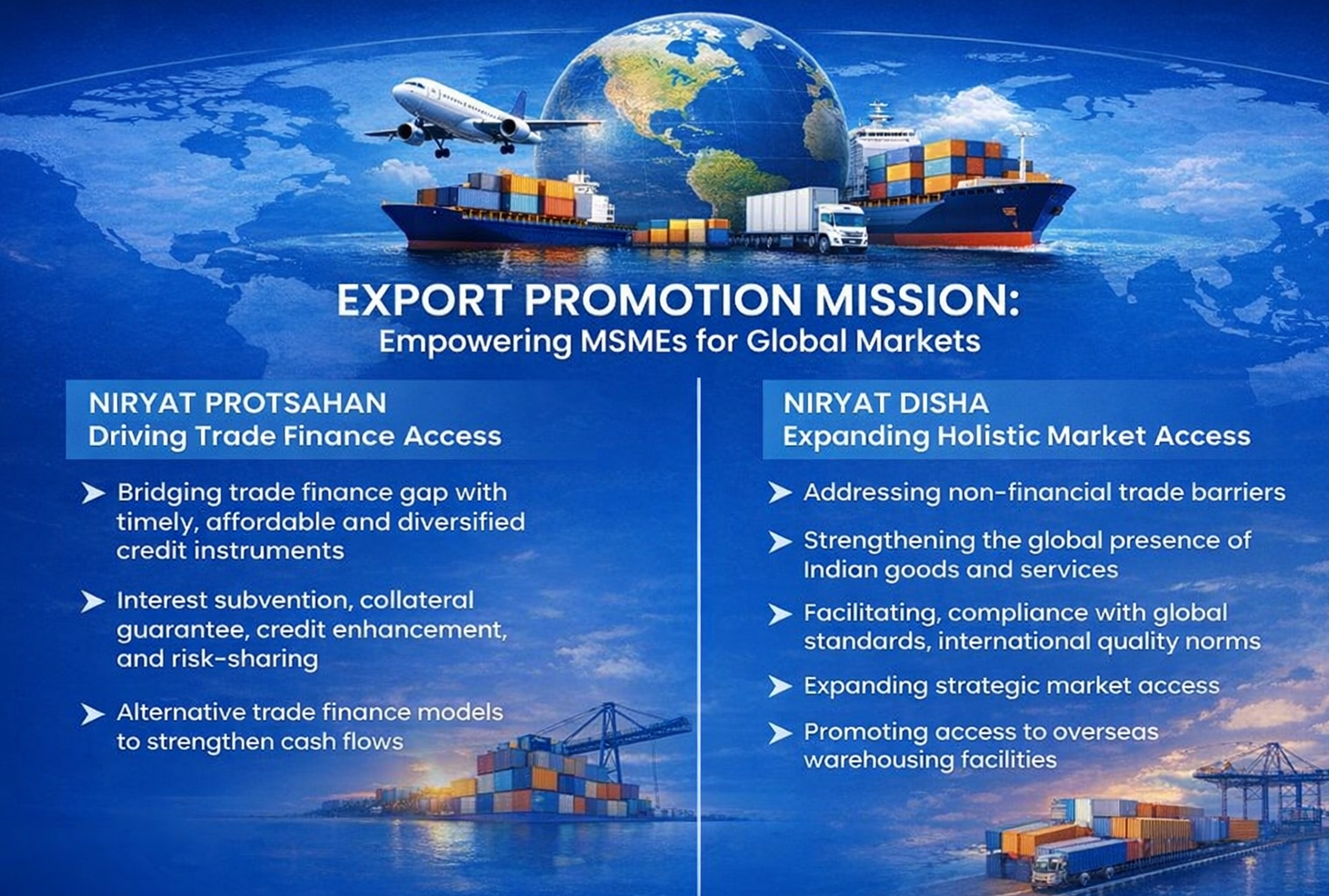
Key Features and Components of EPM
The Mission is implemented through two integrated sub-schemes: Niryat Protsahan (Financial Enablers) and Niryat Disha (Non-Financial Enablers). Currently, 10 interventions are operational under the EPM.
A. Niryat Protsahan Financial Enablers This sub-scheme addresses credit constraints through various instruments:
Support for Export Factoring: Provides immediate cash to exporters by selling receivables. It offers an interest subvention of 2.75% on factoring costs, capped at ₹50 lakh per IEC.
Credit for E-Commerce Exporters: Supports MSMEs using postal or courier channels. It offers 90% guarantee coverage for direct credit (capped at ₹50 lakh) and 75% coverage for overseas inventory credit (capped at ₹5 crore). Eligible exporters also receive a 2.75% interest subvention.
Emerging Export Opportunities: A risk-sharing model covering 10% to 90% of transaction values to help MSMEs enter high-risk markets.
Interest Subvention for Pre/Post-Shipment Credit: A continuing intervention providing 2.75% subvention (max ₹50 lakh) to improve working capital liquidity.
Collateral Support: Offers credit guarantee coverage of 85% for micro/small enterprises and 65% for medium enterprises, with a credit limit of up to ₹10 crore.
B. Niryat Disha – Non-Financial and Market Access Enablers This sub-scheme focuses on compliance, logistics, and global visibility:
TRACE (Trade Regulations, Accreditation and Compliance Enablement): Assists MSMEs in meeting international standards. It provides 60% to 75% financial assistance for certification costs, capped at ₹25 lakh annually.
LIFT (Logistics Interventions for Freight and Transport): Reduces the cost of transporting goods from hinterland districts to ports. It covers up to 30% of actual costs, capped at ₹20 lakh per year.
INSIGHT (Integrated Support for Trade Intelligence): Addresses information gaps. Private entities can receive up to 50% support, while government entities may receive 100% for trade analytics and capacity building.
FLOW (Facilitating Logistics, Overseas Warehousing and Fulfilment): Supports overseas storage. Assistance includes up to ₹10 crore for warehouses and ₹5 lakh/month for fulfilment arrangements.
Market Access Support (MAS): Funds participation in trade fairs and buyer-seller meets, with support up to ₹5 crore (regular events) or ₹10 crore (reverse meets).
Significance: Economy, MSMEs, and GVCs
The EPM’s significance lies in its ability to bridge the gap between local production and global demand:
MSME Empowerment: By reducing the cost of finance and compliance, it enables small units to scale up and sustain global participation.
Employment and Inclusive Growth: Focus on labour-intensive sectors ensures that export growth translates into job creation and decentralised development.
Global Value Chain (GVC) Integration: Interventions like TRACE and FLOW ensure Indian products meet the quality and delivery timelines required for GVC integration.
Economic Resilience: Diversifying markets through the “Emerging Export Opportunities” intervention mitigates over-dependence on traditional trade partners.
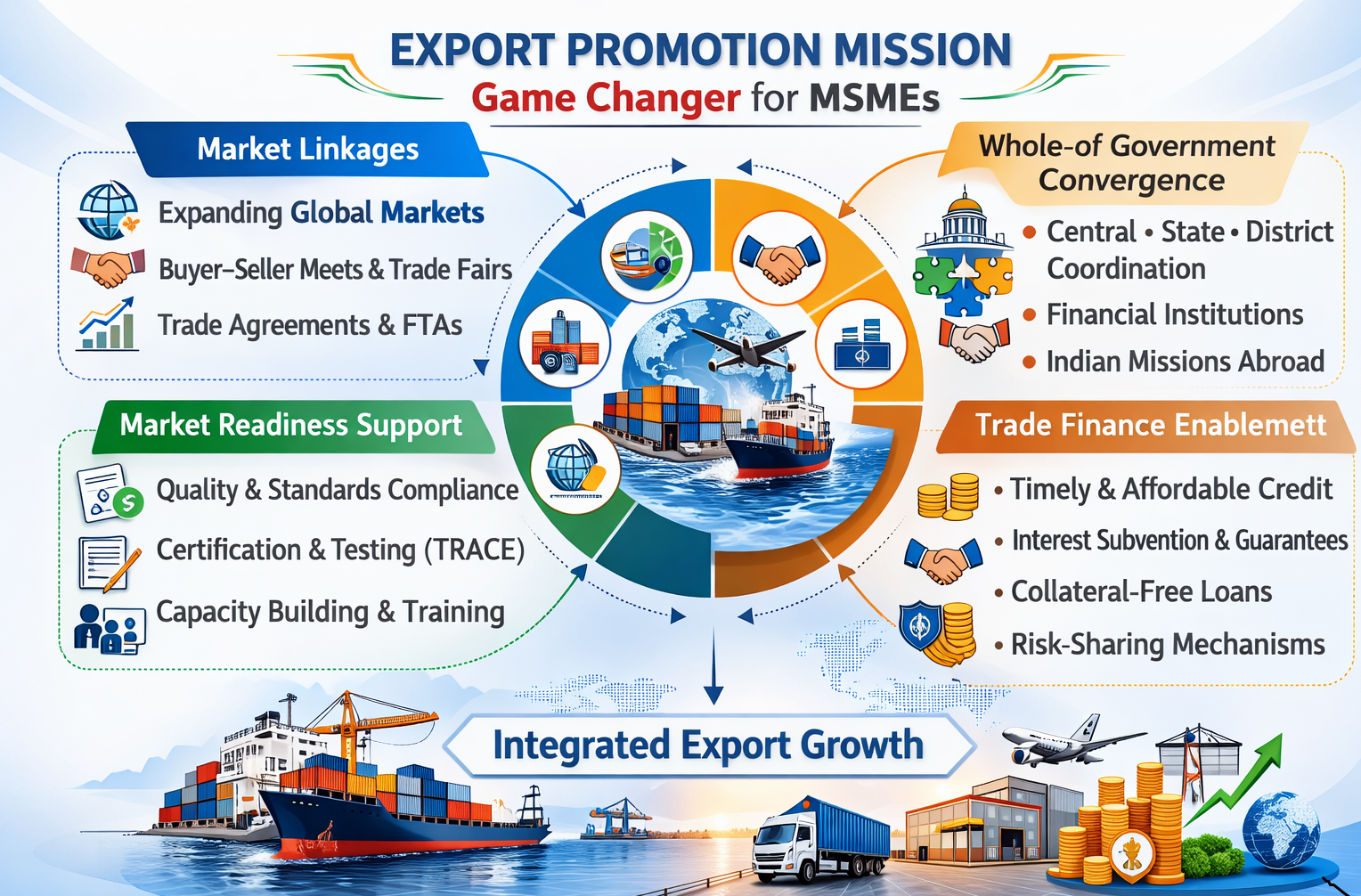
Challenges and Limitations
While EPM is robust, several challenges remain:
Implementation Complexity: Coordinating between Central Ministries, State authorities, and Indian Missions abroad requires high levels of institutional synergy.
Risk Management: The shared-risk models have strict exposure caps (e.g., 15% country-wise cap), which might limit large-scale expansion in specific volatile markets.
Awareness Gaps: As of early 2026, registration numbers are still growing (e.g., 3,000 for interest subvention; 60 for collateral support), indicating a need for broader outreach among MSMEs.
Global Risks (External Context): Rising protectionism, geopolitical tensions affecting shipping routes, and varying international carbon standards (like CBAM) pose external threats not fully mitigated by domestic financial support.
Way Forward
To maximise the EPM’s impact, the following steps are essential:
Digitalisation: Full transition to the dgft.gov.in and trade.gov.in portals for all claims and approvals to ensure a paperless, transparent process.
Institutional Strengthening: Using the INSIGHT intervention to build district-level export hubs and improve trade intelligence at the grassroots.
Policy Convergence: Aligning the EPM with the “Districts as Export Hubs” initiative and the Production Linked Incentive (PLI) schemes to create a seamless “Make in India for the World” pipeline.
Conclusion
Prelims question:
With reference to the Export Promotion Mission (EPM), consider the following statements:
1. It is a flagship initiative with a total outlay of over ₹25,000 crore for the period ending in FY 2030–31.
2. The Niryat Protsahan sub-scheme focuses exclusively on non-financial enablers such as quality standards and logistics.
3. Under the TRACE intervention, MSME exporters can receive financial assistance for international testing and certification.
Which of the statements given above is/are correct?
A) 1 and 2 only
B) 1 and 3 only
C) 3 only
D) 1, 2, and 3
Answer – B) 1 and 3 only
Mains Question:
“The Export Promotion Mission (EPM) represents a shift from fragmented support to a coordinated ecosystem for Indian exporters.” Discuss the role of EPM in enhancing the competitiveness of MSMEs and its potential impact on India’s integration into Global Value Chains (GVCs).
(250 Words)

- Artemis II: Humanity’s Return to Lunar Space and India’s Place in the New Moon Race - April 2, 2026
- A Missed Opportunity to Guarantee Minimum Wages - March 31, 2026
- ‘India’s Growth Claims, A Clash with Data Reality’. - March 30, 2026

No Comments