


08 Aug FCRA Violations: Manappat Foundation Under Scrutiny in Kerala’s Punarjani Case
✎ Rule 19 of the FCRA mandates NGOs to maintain meticulous records of foreign contributions and their utilisation, failing which they are liable for legal action under the Act and the Prevention of Corruption Act, 1988.
Subject Relevance — Where This Topic Fits
- GS Paper II — Governance, Transparency and Accountability | GS Paper III — Issues relating to NGO sector, Foreign Contributions, and Regulatory Frameworks
- Prelims: Foreign Contribution (Regulation) Act, 2010, Rule 19 of FCRA, Vigilance and Anti-Corruption Bureau (VACB), Prevention of Corruption Act, 1988, Prohibition of Benami Property Transactions Act, 1988, Prevention of Money Laundering Act, 2002, Central Bureau of Investigation (CBI), Public servant under PCA, FCRA account, Punishment for FCRA violations
- Essay: Role of NGOs in disaster rehabilitation: Ethical obligations and regulatory compliance, Balancing transparency and accountability in public fundraising: A case for stringent regulatory oversight
Quick Revision: Rule 19 of the FCRA mandates NGOs to maintain meticulous records of foreign contributions and their utilisation, failing which they are liable for legal action under the Act and the Prevention of Corruption Act, 1988.
Why is this in the news?
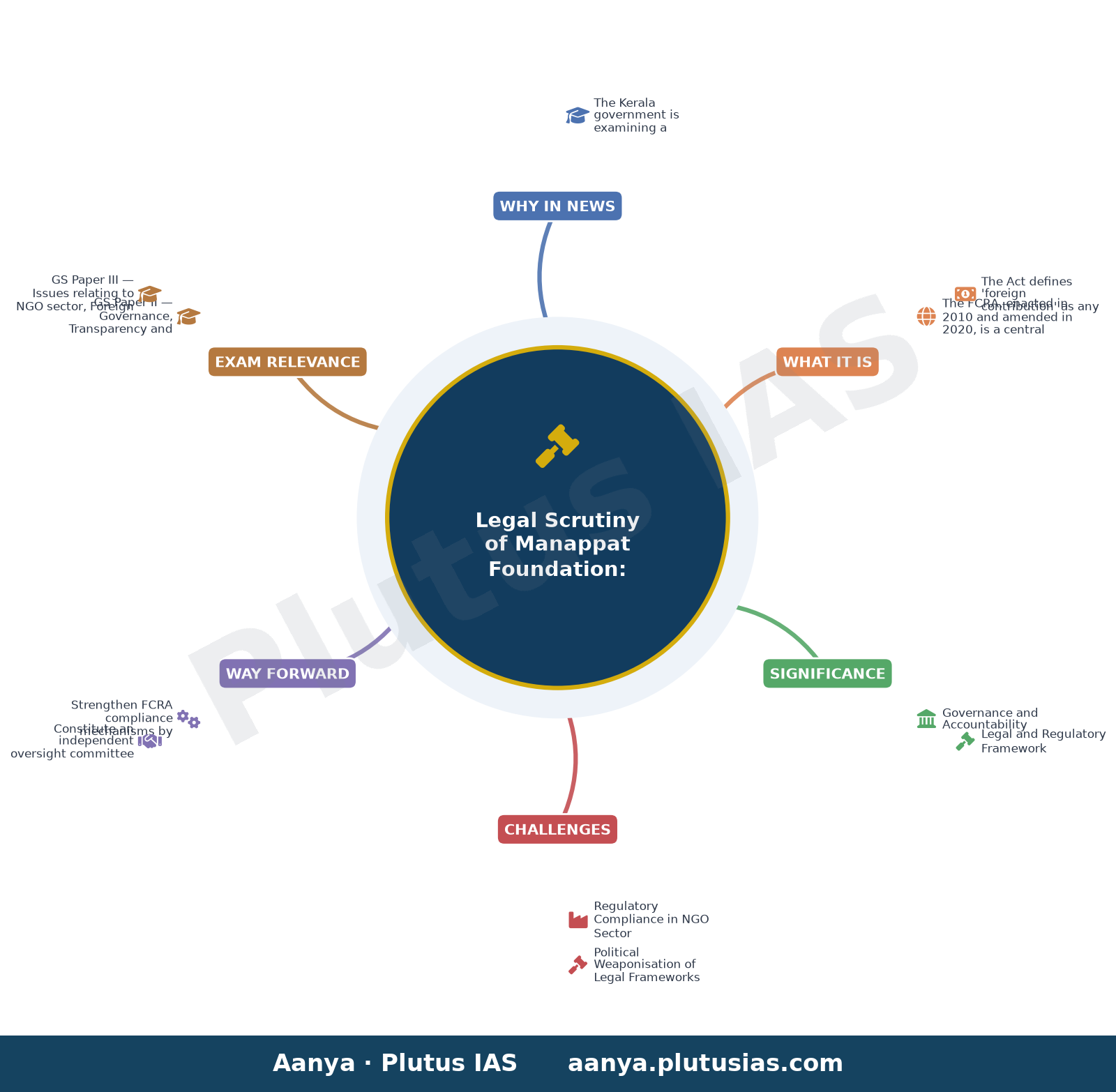
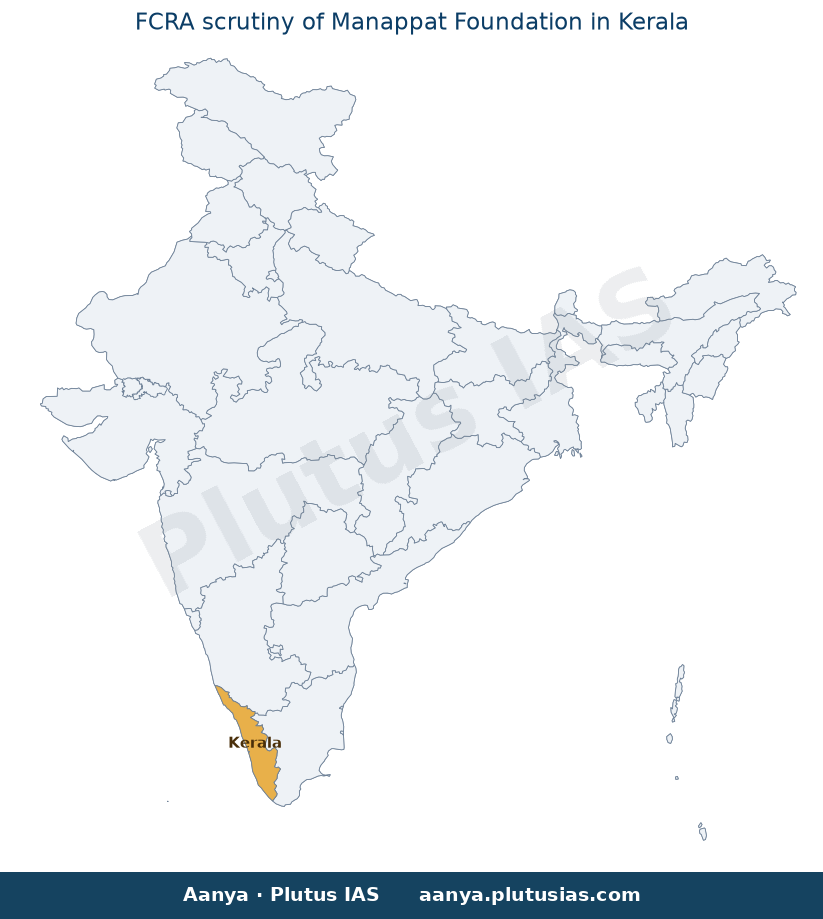
The Kerala government is examining a Vigilance and Anti-Corruption Bureau (VACB) report alleging that the Manappat Foundation, which mobilised foreign funds for the Punarjani flood rehabilitation scheme, violated Rule 19 of the Foreign Contribution (Regulation) Act (FCRA) by failing to maintain records of foreign donations and their utilisation. The report also recommends a CBI inquiry into suspicious transactions amounting to ₹1.22 crore, raising questions about the legal and ethical implications of foreign funding in disaster relief and the potential misuse of public office.
Background
- The Punarjani scheme was launched by Kerala’s Leader of the Opposition, V.D. Satheesan, to provide flood rehabilitation for constituents in Paravoor, Ernakulam, following the devastating floods in Kerala in 2018 and subsequent years.
- Manappat Foundation, a non-governmental organisation (NGO), was the primary mobiliser of foreign funds for the Punarjani scheme, allegedly receiving donations from abroad for disaster relief.
- The Foreign Contribution (Regulation) Act (FCRA), 2010, regulates the acceptance and utilisation of foreign contributions by NGOs and individuals in India, with strict provisions to ensure transparency and accountability.
- Rule 19 of the FCRA mandates NGOs to maintain detailed records of foreign donations, including their receipt and utilisation, failing which they are liable for legal action under the Act and other relevant laws.
- The Vigilance and Anti-Corruption Bureau (VACB) of Kerala submitted a report to the Home Department in 2025, flagging alleged violations of FCRA by Manappat Foundation, including the failure to maintain records and suspicious financial transactions.
- The case has political overtones, with the Congress party terming the scrutiny as a ‘political witch-hunt’ against V.D. Satheesan, while the government seeks legal opinions on the applicability of the Prevention of Corruption Act (PCA).
What is the Foreign Contribution (Regulation) Act (FCRA), 2010?
- The FCRA, enacted in 2010 and amended in 2020, is a central legislation that regulates the acceptance and utilisation of foreign contributions by individuals, associations, and NGOs in India to ensure transparency and prevent misuse.
- The Act defines ‘foreign contribution’ as any donation, subscription, or transfer of funds from a foreign source, including donations in kind, and mandates that such contributions must be received only through designated banks and accounts.
- Rule 19 of the FCRA specifies that every person receiving foreign contributions must maintain a separate account in a scheduled bank for such contributions and furnish annual returns to the government, detailing the receipt and utilisation of funds.
- Violations of FCRA provisions, including failure to maintain records or utilise funds for the stated purpose, are punishable with imprisonment, fines, or cancellation of registration, and may attract provisions of the Prevention of Corruption Act (PCA) if public servants are involved.
- The FCRA applies to all NGOs, including those engaged in disaster relief, social welfare, and public service, and requires them to register with the Ministry of Home Affairs (MHA) and renew their registration periodically.
- The Act empowers the government to prohibit the acceptance of foreign contributions if it deems such contributions detrimental to public interest or sovereignty of India.
- Recent amendments to the FCRA in 2020 introduced stricter provisions, including a ban on sub-granting foreign funds by NGOs and mandatory use of designated bank accounts for receiving and utilising foreign contributions.
- The FCRA is enforced by the Ministry of Home Affairs, with the Central Bureau of Investigation (CBI) and other agencies empowered to investigate violations and prosecute offenders.
Key Features
| Feature | Significance |
|---|---|
| FCRA Rule 19 Violation | Mandates maintenance of records of foreign contributions and their utilisation; non-compliance constitutes an offence under the Prevention of Corruption Act (PCA) if linked to public servants. |
| VACB Investigation | State anti-corruption agency’s report highlights suspicious transactions (₹1.22 crore) and lack of documentation, recommending CBI inquiry against NGO chairperson and potential PCA charges. |
| Punarjani Scheme | Flood rehabilitation initiative in Kerala, mobilised foreign funds through Manappat Foundation, now under scrutiny for alleged FCRA violations. |
| CBI Recommendation | VACB suggests CBI investigation into alleged FCRA violations, including potential misuse of foreign funds by public servants under PCA. |
| Political Undertones | Allegations framed as political witch-hunt by Congress, while government seeks legal opinion on further action, including PMLA and Benami Act implications. |
Why it Matters
Governance and Accountability
- Exposes systemic gaps in NGO accountability, particularly in utilisation of foreign contributions for public welfare projects.
- Highlights the role of vigilance agencies (VACB) in detecting financial irregularities in politically sensitive contexts.
- Demonstrates the intersection of electoral politics and charitable activities, raising questions about transparency in fund mobilisation.
Legal and Regulatory Framework
- FCRA violations under Rule 19 can attract penal provisions under PCA, especially if public servants are involved, underscoring the need for strict compliance.
- Potential invocation of PMLA and Benami Act suggests cross-sectoral legal scrutiny, reflecting the complexity of financial offences.
- CBI’s role in investigating FCRA violations highlights the centralised oversight mechanism for serious financial irregularities.
Public Trust and Transparency
- Erosion of public trust in NGOs managing foreign funds, particularly when linked to elected representatives or public figures.
- Emphasises the necessity of audited financial records and third-party verification for NGOs engaged in disaster relief or rehabilitation.
- Raises ethical questions about the solicitation of foreign funds for domestic welfare, including compliance with FCRA and domestic laws.
Challenges
1. Regulatory Compliance in NGO Sector
- Lack of stringent record-keeping mechanisms for foreign contributions, leading to allegations of financial mismanagement.
- Ambiguity in the definition of ‘public servant’ under PCA, complicating prosecution in cases involving indirect involvement.
- Delayed legal proceedings due to multi-agency coordination (VACB, CBI, Home Department), delaying justice for affected communities.
UPSC Link: GS-II: Role of NGOs in governance
2. Political Weaponisation of Legal Frameworks
- Risk of allegations being used for political gains, undermining the credibility of investigations.
- Challenges in distinguishing genuine welfare activities from politically motivated fund mobilisation.
- Need for independent oversight bodies to prevent misuse of regulatory powers.
UPSC Link: GS-II: Transparency and accountability in public life
3. Financial Transparency in Disaster Relief
- Ensuring real-time tracking of foreign funds in relief operations to prevent diversion or misuse.
- Strengthening audit mechanisms for NGOs engaged in disaster management to align with global best practices.
- Balancing international aid with domestic regulatory frameworks to avoid jurisdictional conflicts.
UPSC Link: GS-III: Disaster management and financial accountability
4. Cross-Border Financial Transactions
- Monitoring of foreign donations to prevent money laundering or terror financing under PMLA.
- Addressing discrepancies in fund utilisation across jurisdictions, particularly in cases involving diaspora contributions.
- Ensuring compliance with both FCRA and domestic tax laws for foreign-sourced funds.
UPSC Link: GS-III: Money laundering and financial crimes
Challenges — UPSC Perspective
| Issue | Concern |
|---|---|
| FCRA Non-Compliance | Failure to maintain records of foreign donations and utilisation, leading to legal and financial penalties. |
| Political Interference | Allegations of witch-hunt raise concerns about the impartiality of investigations. |
| Multi-Agency Coordination | Delays in legal proceedings due to overlapping jurisdictions of VACB, CBI, and Home Department. |
| Public Trust Erosion | Loss of credibility in NGOs and elected representatives managing foreign funds. |
| Financial Diversion Risks | Potential misuse of funds under Punarjani scheme, impacting flood-affected communities. |
| Legal Ambiguity | Unclear definition of ‘public servant’ under PCA complicates prosecution in FCRA violations. |
Way Forward
- Strengthen FCRA compliance mechanisms by mandating real-time digital record-keeping for NGOs receiving foreign funds.
- Constitute an independent oversight committee to audit NGO activities, particularly those engaged in disaster relief or rehabilitation.
- Clarify the definition of ‘public servant’ under PCA to ensure accountability in cases involving indirect involvement in FCRA violations.
- Enhance coordination between state vigilance agencies (VACB) and central investigating bodies (CBI) to expedite legal proceedings.
- Promote transparency in fund mobilisation by NGOs through mandatory disclosure of donor identities and utilisation reports.
- Conduct capacity-building programmes for NGOs on FCRA compliance and financial auditing to prevent future violations.
- Review the Punarjani scheme’s operational framework to ensure strict adherence to legal and financial norms.
- Establish a grievance redressal mechanism for communities affected by alleged mismanagement of foreign funds.
UPSC Value Addition
Keywords for Mains Answer-Writing
Foreign Contribution (Regulation) Act, 2010 · Rule 19 of FCRA · Punarjani scheme · Manappat Foundation · Vigilance and Anti-Corruption Bureau (VACB) · Prevention of Corruption Act (PCA) · Central Bureau of Investigation (CBI) · Prohibition of Benami Property Transactions Act, 1988 · Prevention of Money Laundering Act (PMLA) · FCRA violations and public servants · Nexus between NGOs and political figures · Transparency in utilisation of foreign funds · Judicial scrutiny of FCRA compliance · Political accountability in NGO governance
Concept Flow
Foreign donations solicited for Punarjani scheme → NGOs (Manappat Foundation) receive funds → Alleged failure to maintain FCRA records → VACB investigation → Suspicious transactions (₹1.22 crore) detected → CBI recommendation for inquiry → Potential PCA/PMLA charges → Political allegations and legal scrutiny → Government seeks legal opinion → Broader implications for NGO accountability.
Prelims Practice Questions
Q1. Consider the following statements regarding the Foreign Contribution (Regulation) Act (FCRA), 2010:
1. Rule 19 of FCRA mandates NGOs to maintain records of foreign donations and their utilisation.
2. Violation of Rule 19 can attract provisions under the Prevention of Corruption Act (PCA) if the contravention involves a public servant.
3. The FCRA does not apply to NGOs receiving funds from foreign sources for purely charitable purposes.
4. The CBI can investigate FCRA violations without prior approval from the Union Home Ministry.
How many of the above statements are correct?
- Only one
- Only two
- Only three
- All four
Answer: Only three — Statements 1 and 2 are correct as per Rule 19 of FCRA and Section 13 of the PCA. Statement 3 is incorrect because FCRA applies to all NGOs receiving foreign funds, regardless of purpose. Statement 4 is incorrect as CBI requires prior approval for FCRA-related investigations.
Q2. Assertion (A): The Vigilance and Anti-Corruption Bureau (VACB) in Kerala has recommended a CBI inquiry against the Manappat Foundation for alleged FCRA violations.
Reason (R): The VACB found that the foundation failed to maintain records of foreign donations and their utilisation, violating Rule 19 of the FCRA.
Options:
A. Both A and R are true, and R is the correct explanation of A.
B. Both A and R are true, but R is not the correct explanation of A.
C. A is true, but R is false.
D. A is false, but R is true.
Answer: ? — Both the Assertion (A) and Reason (R) are true, and R correctly explains A as the VACB’s recommendation for a CBI inquiry stems directly from the violation of Rule 19.
Q3. Match the following Acts with their primary objectives:
Column I
1. Foreign Contribution (Regulation) Act, 2010
2. Prevention of Corruption Act (PCA), 1988
3. Prohibition of Benami Property Transactions Act, 1988
4. Prevention of Money Laundering Act (PMLA), 2002
Column II
A. Regulates receipt and utilisation of foreign contributions by NGOs
B. Prohibits and penalises benami transactions to curb black money
C. Criminalises corruption and abuse of public office
D. Prevents money laundering and confiscates proceeds of crime
Options:
1-A, 2-C, 3-B, 4-D
1-B, 2-A, 3-D, 4-C
1-D, 2-C, 3-A, 4-B
1-C, 2-D, 3-B, 4-A
Answer: ? — The correct matches are: 1-A (FCRA regulates foreign contributions), 2-C (PCA criminalises corruption), 3-B (Benami Act prohibits benami transactions), 4-D (PMLA prevents money laundering).
Mains Practice Question
✍ The utilisation of foreign funds by NGOs, particularly in the context of disaster relief and rehabilitation, has increasingly come under judicial and statutory scrutiny. Critically examine the legal and institutional framework governing the receipt and utilisation of foreign contributions in India, with particular reference to the FCRA, 2010, and its interplay with the Prevention of Corruption Act (PCA), 1988. Also, discuss the implications of alleged FCRA violations by NGOs on political accountability and governance in India. (15 Marks)
Approach: MODEL-ANSWER SKELETON:
1. **Introduction (2 marks)**: Define FCRA, 2010, and its objectives (regulating foreign contributions to NGOs/associations). State the context of the Punarjani scheme and the allegations against Manappat Foundation.
2. **Legal Framework under FCRA, 2010 (4 marks)**:
– Key provisions: Section 3(1) (prohibition on acceptance of foreign contributions by certain entities), Section 7 (utilisation of foreign contributions), Rule 19 (record-keeping obligations).
– Registration and reporting requirements under FCRA.
– Role of the Ministry of Home Affairs (MHA) in monitoring compliance.
3. **Interplay with Prevention of Corruption Act (PCA), 1988 (4 marks)**:
– Section 13 of PCA: Criminalises abuse of position by public servants.
– Definition of ‘public servant’ under Section 2(c) of PCA (includes individuals holding public office or exercising public functions).
– Judicial precedents: Landmark judgments such as *Common Cause v. Union of India* (2013) on FCRA compliance and accountability.
– How alleged FCRA violations by NGOs involving public figures (e.g., V.D. Satheesan) could attract PCA provisions.
4. **Institutional Mechanisms for Scrutiny (3 marks)**:
– Role of VACB, CBI, and Enforcement Directorate (ED) in investigating FCRA violations.
– Powers under the Prohibition of Benami Property Transactions Act, 1988, and PMLA, 2002, in tracing illicit funds.
– Judicial scrutiny: Reference to recent Supreme Court judgments on FCRA compliance (e.g., *Indian Social Action Forum (INSAF) v. Union of India*, 2018).
5. **Political Accountability and Governance Implications (2 marks)**:
– Nexus between NGOs and political figures: Risks of politicisation of foreign funds.
– Transparency and accountability deficits in utilisation of funds for disaster relief.
– Need for stricter due diligence and audits to prevent misuse.
– Role of civil society in ensuring ethical governance.
6. **Conclusion (2 marks)**: Summarise the need for a balanced regulatory framework that ensures transparency without stifling legitimate humanitarian efforts. Emphasise the importance of judicial and statutory oversight in maintaining public trust.
Source: The Hindu
Generated by AanyaAi for educational purpose.

- मद्रास उच्च न्यायालय ने अनामलाई के खिलाफ मामले को रद्द किया: राजनीतिक टिप्पणियों पर न्यायिक फैसला - September 24, 2026
- Madras HC quashes case against Annamalai over Thevar remarks: UPSC Polity Analysis - September 24, 2026
- डीडीयू-जीकेवाई 2.0: ग्रामीण युवाओं को कौशल एवं रोजगार से जोड़ने की केंद्र सरकार की पहल - September 24, 2026

No Comments