


08 Aug Government Signs MoUs to Boost Startup Ecosystem: Key for UPSC & PCS 2026
✎ DPIIT’s MoUs with Cashfree Payments, Darwin Dynamics, Walter Private Limited, Cars24, and Council for Startup India aim to strengthen India’s startup ecosystem by integrating digital payments, cloud infrastructure, AI mobility…
Subject Relevance — Where This Topic Fits
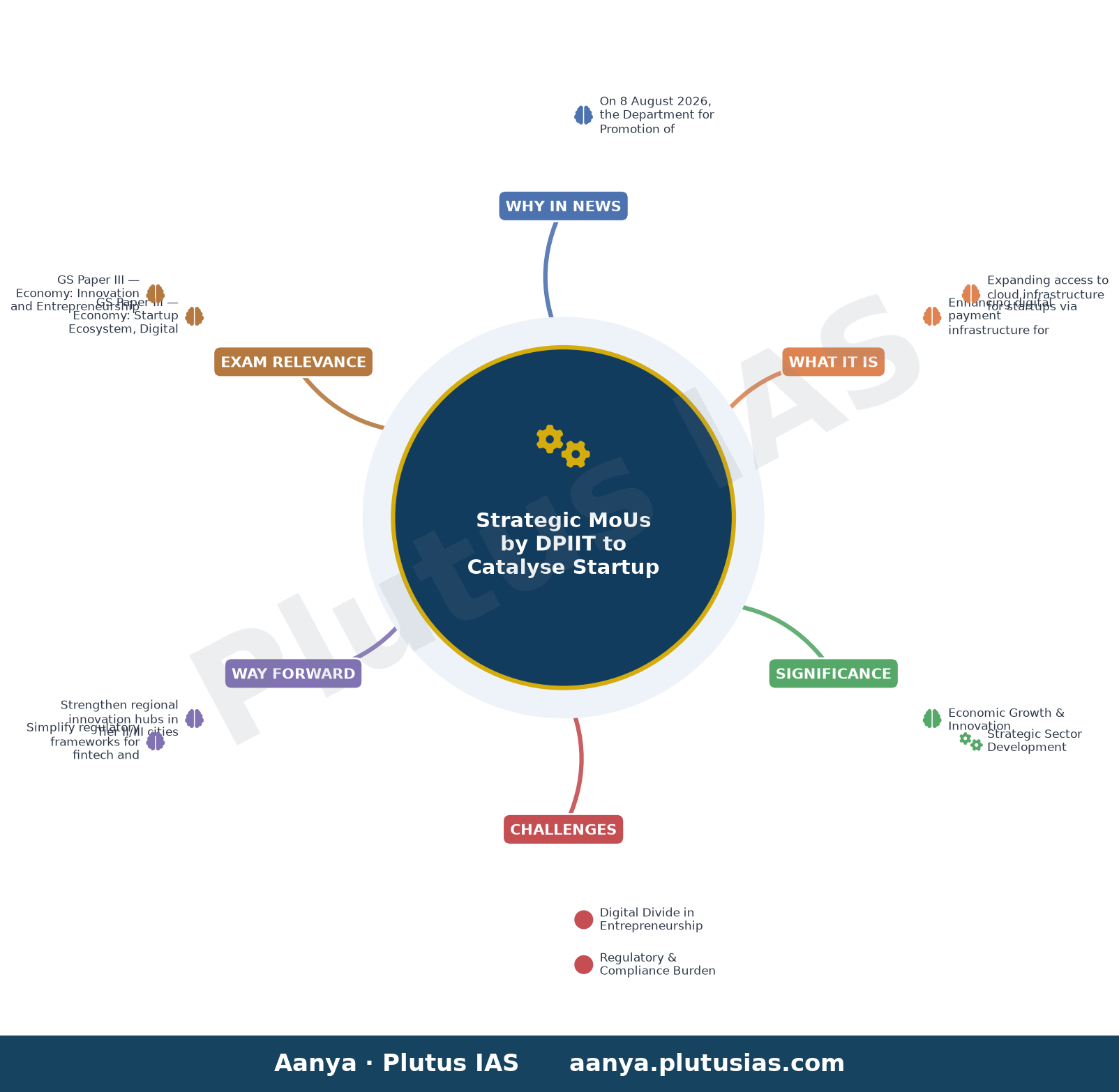
- GS Paper III — Economy: Startup Ecosystem, Digital Infrastructure, Fintech, MSMEs | GS Paper III — Economy: Innovation and Entrepreneurship | GS Paper II — International Relations: Global Competitiveness of Indian Startups | GS Paper II — International Relations: India’s Export Promotion and Ease of Doing Business
- Prelims: Startup India initiative, DPIIT (Department for Promotion of Industry and Internal Trade), Fintech, Digital Public Infrastructure (DPI), Deep-Tech, Green Hydrogen, AI in Mobility, KYC norms, Cross-border transactions, Tier II/III cities entrepreneurship, Women entrepreneurs, First-generation entrepreneurs
- Essay: Role of technology in fostering inclusive economic growth: Lessons from India’s startup ecosystem, Public-private partnerships as catalysts for national innovation systems
Quick Revision: DPIIT’s MoUs with Cashfree Payments, Darwin Dynamics, Walter Private Limited, Cars24, and Council for Startup India aim to strengthen India’s startup ecosystem by integrating digital payments, cloud infrastructure, AI mobility innovations, and inclusive entrepreneurship, thereby enhancing global competitiveness and regional inclusivity.
Why is this in the news?
On 8 August 2026, the Department for Promotion of Industry and Internal Trade (DPIIT), Ministry of Commerce and Industry, Government of India, signed multiple strategic Memoranda of Understanding (MoUs) with leading industry players and ecosystem enablers—Cashfree Payments, Darwin Dynamics LLP, Walter Private Limited, Cars24 Services Private Limited, and Council for Startup India—to strengthen the startup ecosystem through digital infrastructure support, fintech integration, deep-tech innovation, and inclusive entrepreneurship across Tier II/III cities and rural areas. These partnerships aim to enhance DPIIT-recognised startups’ access to digital payment solutions, cloud infrastructure, AI-driven mobility innovations, and global market linkages, thereby reinforcing India’s position as a competitive, innovation-led economy.
Background
- The Startup India initiative, launched in 2016, seeks to build a robust ecosystem for nurturing innovation and startups in India, with DPIIT as the nodal department for implementation and policy coordination.
- India ranks third globally in the number of startups, with over 1.2 lakh DPIIT-recognised entities as of 2026, spanning sectors such as fintech, SaaS, electric mobility, and climate tech.
- Digital Public Infrastructure (DPI) has emerged as a critical enabler for startups, facilitating seamless digital payments, identity verification, and regulatory compliance through frameworks like UPI and Aadhaar-based KYC.
- Fintech adoption in India has surged, with digital payment transactions exceeding ₹140 lakh crore in FY 2025-26, underscoring the need for scalable, secure, and compliant payment solutions for startups.
- Deep-Tech sectors—including AI, green hydrogen, advanced manufacturing, and climate technologies—are identified as high-growth areas under India’s innovation strategy, with targeted support needed for regional and rural entrepreneurs.
- Global competitiveness of Indian startups hinges on access to cloud infrastructure, AI tools, and international market linkages, which are being addressed through public-private partnerships.
What are the key objectives and components of the DPIIT’s strategic MoUs with industry partners?
- Enhancing digital payment infrastructure for DPIIT-recognised startups through partnerships with fintech firms like Cashfree Payments, enabling secure, scalable, and compliant payment and payout solutions.
- Expanding access to cloud infrastructure for startups via collaborations with technology providers such as Walter Private Limited, facilitating deployment of AI-driven applications and scalable digital services.
- Promoting AI-driven mobility innovation and entrepreneurship through MoUs with firms like Cars24 Services, focusing on next-generation mobility solutions and ecosystem development.
- Strengthening inclusive entrepreneurship by partnering with Darwin Dynamics LLP to extend startup support to Tier II/III cities and rural areas, with emphasis on women entrepreneurs, first-generation founders, and youth innovators.
- Facilitating capacity-building through mentorship programs, bootcamps, and hackathons, aligned with DPIIT’s Startup India initiative.
- Supporting strategic sectors such as green hydrogen, climate technologies, advanced manufacturing, and AI, in line with India’s net-zero commitments and industrial policy priorities.
- Enhancing global competitiveness by linking Indian startups with international markets, investors, and policy research networks through partnerships with entities like the Council for Startup India.
- Ensuring regulatory compliance and fraud prevention in digital transactions via integrated KYC, risk management, and cross-border transaction frameworks provided by fintech partners.
Key Features
| Feature | Significance |
|---|---|
| Strategic MOUs with industry leaders | Formalises public-private collaboration to strengthen start-up ecosystem through shared resources and expertise. |
| Digital payment infrastructure (Cashfree Payments) | Provides DPIIT-recognised start-ups with secure, scalable payment and payout solutions, KYC, fraud prevention, and cross-border transaction capabilities. |
| Cloud infrastructure support (Walter India) | Enables start-ups to leverage scalable, enterprise-grade cloud resources for product development and deployment. |
| AI-driven mobility innovation (Car24 Services) | Facilitates start-ups in AI-powered mobility solutions, fostering technological advancement in a high-growth sector. |
| Inclusive entrepreneurship (Darwin Dynamics) | Expands start-up reach to Tier II/III cities and rural areas, with focus on youth, women, and first-generation founders. |
Why it Matters
Economic Growth & Innovation
- Enhances India’s position as a global innovation hub by integrating start-ups with advanced digital, financial, and cloud infrastructure.
- Accelerates commercialisation of deep-tech solutions in strategic sectors such as AI, clean energy, and green hydrogen.
- Promotes job creation and economic diversification through scalable start-up ventures.
Strategic Sector Development
- Strengthens India’s digital sovereignty by reducing dependency on foreign payment gateways and cloud providers.
- Supports the ‘Aatmanirbhar Bharat’ vision by fostering indigenous technological solutions.
- Aligns with the ‘Startup India’ initiative to create a self-sustaining innovation ecosystem.
Inclusivity & Regional Development
- Bridges the urban-rural divide by empowering entrepreneurs in Tier II/III cities and rural areas.
- Encourages participation from underrepresented groups, including women and first-generation founders.
- Promotes equitable access to mentorship, funding, and market opportunities across geographies.
Challenges
1. Digital Divide in Entrepreneurship
- Limited access to digital infrastructure and mentorship in Tier II/III cities and rural areas restricts start-up growth.
- Low digital literacy among aspiring entrepreneurs hinders adoption of advanced technologies.
UPSC Link: GS3: Digital divide and its impact on start-ups
2. Regulatory & Compliance Burden
- Complex regulatory frameworks for fintech and deep-tech start-ups can delay innovation and market entry.
- Stringent KYC and fraud prevention norms may increase operational costs for early-stage start-ups.
UPSC Link: GS2: Regulatory challenges in start-up ecosystem
3. Scalability & Funding Gaps
- Access to venture capital and angel funding remains concentrated in metropolitan hubs, limiting regional growth.
- Scalability challenges in cloud and AI infrastructure can pose financial and technical barriers for start-ups.
UPSC Link: GS3: Start-up funding and scalability challenges
4. Talent Acquisition & Retention
- Competition for skilled AI, cloud, and fintech professionals from global corporations affects start-up talent pipelines.
- High attrition rates in the tech sector due to better compensation packages in MNCs.
UPSC Link: GS1: Human resource development in start-up ecosystem
Challenges — UPSC Perspective
| Issue | Concern |
|---|---|
| Digital infrastructure access | Unequal availability of high-speed internet and cloud resources across regions. |
| Regulatory complexity | Overlapping compliance requirements for fintech and deep-tech start-ups. |
| Funding concentration | Disproportionate allocation of venture capital in Tier I cities. |
| Talent shortage | Limited pool of specialised professionals in AI, cloud computing, and fintech. |
| Market reach barriers | Difficulty in accessing global markets for regional start-ups. |
| Mentorship gaps | Lack of structured guidance for first-generation founders in non-metro areas. |
Way Forward
- Strengthen regional innovation hubs in Tier II/III cities through targeted government grants and tax incentives.
- Simplify regulatory frameworks for fintech and deep-tech start-ups, including sandbox testing environments.
- Expand digital literacy programs to enhance adoption of advanced technologies among entrepreneurs.
- Facilitate cross-border market access for start-ups through bilateral trade agreements and export promotion schemes.
- Establish a centralised mentorship network connecting industry experts with aspiring founders.
- Increase funding allocation for start-ups in strategic sectors like AI, clean energy, and green hydrogen.
- Promote public-private partnerships to develop shared cloud and AI infrastructure for start-ups.
UPSC Value Addition
Keywords for Mains Answer-Writing
Startup India initiative · Department for Promotion of Industry and Internal Trade (DPIIT) · Digital Public Infrastructure (DPI) · Fintech ecosystem · Deep-tech innovation · Cloud infrastructure for startups · AI-driven mobility solutions · Global competitiveness of Indian startups · Inclusive entrepreneurship · Public-Private Partnership (PPP) in innovation
Concept Flow
Government recognises start-ups as engines of economic growth and innovation. → DPIIT formalises partnerships with industry leaders to provide digital, financial, and cloud infrastructure. → Start-ups gain access to scalable solutions, mentorship, and market opportunities. → Innovation in AI, fintech, and green technology accelerates commercialisation. → Regional inclusivity improves, reducing urban-rural disparities in entrepreneurship. → India’s global competitiveness in innovation-based economy strengthens.
Prelims Practice Questions
Q1. Consider the following statements regarding the Department for Promotion of Industry and Internal Trade (DPIIT):
1. DPIIT is a nodal agency under the Ministry of Commerce and Industry, Government of India.
2. DPIIT is responsible for the implementation of the Startup India initiative.
3. DPIIT has recently signed MoUs with Cashfree Payments, Darwin Dynamics LLP, and Walter India Private Limited to enhance digital and financial infrastructure for startups.
4. DPIIT operates under the administrative control of the NITI Aayog.
How many of the above statements are correct?
- Only one
- Only two
- Only three
- All
Answer: Only three — Statements 1, 2, and 3 are correct. Statement 4 is incorrect as DPIIT functions under the Ministry of Commerce and Industry, not NITI Aayog.
Q2. Assertion (A): The Startup India initiative aims to foster innovation-driven growth and global competitiveness among Indian startups.
Reason (R): DPIIT has entered into strategic MoUs with industry leaders to strengthen digital, financial, and technological infrastructure for startups.
Options:
A. Both A and R are true, and R is the correct explanation of A.
B. Both A and R are true, but R is not the correct explanation of A.
C. A is true, but R is false.
D. A is false, but R is true.
- A
- B
- C
- D
Answer: A — Both Assertion (A) and Reason (R) are true. The Startup India initiative explicitly aims to enhance innovation and global competitiveness, and the MoUs signed by DPIIT directly support this by improving infrastructure and ecosystem support for startups.
Q3. Match the following DPIIT partnerships with their stated objectives:
Column I (Partnership) | Column II (Objective)
— | —
1. Cashfree Payments | A. Strengthening cloud infrastructure for startups
2. Darwin Dynamics LLP | B. Enhancing AI-driven mobility innovation
3. Walter India Private Limited | C. Promoting inclusive entrepreneurship and deep-tech innovation
4. Cars24 Services Private Limited | D. Expanding digital payment infrastructure and fintech capabilities
Options:
A. 1-D, 2-C, 3-A, 4-B
B. 1-A, 2-B, 3-C, 4-D
C. 1-C, 2-D, 3-B, 4-A
D. 1-B, 2-A, 3-D, 4-C
- A
- B
- C
- D
Answer: A — 1-D: Cashfree Payments focuses on digital payment infrastructure and fintech capabilities. 2-C: Darwin Dynamics LLP aims to promote inclusive entrepreneurship and deep-tech innovation. 3-A: Walter India Private Limited strengthens cloud infrastructure for startups. 4-B: Cars24 Services Private Limited enhances AI-driven mobility innovation.
Mains Practice Question
✍ The Government of India has recently entered into strategic MoUs with leading industry players and ecosystem partners to bolster support for startups under the Startup India initiative. Critically examine the significance of these partnerships in enhancing the digital, financial, and technological infrastructure for Indian startups. Also, assess the potential challenges in translating these collaborations into tangible outcomes for grassroots innovators. (15 Marks)
Approach: MODEL-ANSWER SKELETON:
1. **Context and Rationale for MoUs** (2 marks):
– Brief on the Startup India initiative and DPIIT’s role.
– Need for digital, financial, and technological infrastructure support for startups.
2. **Analysis of Key Partnerships** (6 marks):
– **Cashfree Payments**: Expansion of digital payment infrastructure, fintech capabilities, and risk management for startups.
– **Darwin Dynamics LLP**: Focus on inclusive entrepreneurship, deep-tech innovation, and capacity-building in Tier II/III cities and rural areas.
– **Walter India Private Limited**: Enhancing cloud infrastructure for scalability and innovation.
– **Cars24 Services Private Limited**: AI-driven mobility innovation and ecosystem development.
– **Council for Startup India**: Global competitiveness and market access for Indian startups.
3. **Significance of These Partnerships** (4 marks):
– Bridging gaps in infrastructure (digital payments, cloud, AI).
– Promoting inclusivity (women, youth, first-generation entrepreneurs).
– Enhancing global competitiveness through fintech, AI, and deep-tech integration.
– Strengthening the startup ecosystem via mentorship, funding, and market access.
4. **Challenges and Potential Roadblocks** (3 marks):
– **Implementation Gaps**: Ensuring equitable access to benefits across regions and demographics.
– **Regulatory Hurdles**: Compliance with data privacy laws (e.g., DPDP Act 2023) and fintech regulations.
– **Sustainability**: Long-term viability of partnerships and scalability of initiatives.
– **Awareness and Outreach**: Ensuring startups, especially in tier-II/III cities, are aware of and can leverage these opportunities.
5. **Way Forward** (2 marks):
– Strengthening monitoring and evaluation mechanisms.
– Encouraging more PPP models in innovation and infrastructure.
– Aligning with national priorities like Atmanirbhar Bharat and Digital India.
Source: PIB (Press Information Bureau)
Generated by AanyaAi for educational purpose.

- मद्रास उच्च न्यायालय ने अनामलाई के खिलाफ मामले को रद्द किया: राजनीतिक टिप्पणियों पर न्यायिक फैसला - September 24, 2026
- Madras HC quashes case against Annamalai over Thevar remarks: UPSC Polity Analysis - September 24, 2026
- डीडीयू-जीकेवाई 2.0: ग्रामीण युवाओं को कौशल एवं रोजगार से जोड़ने की केंद्र सरकार की पहल - September 24, 2026

No Comments