


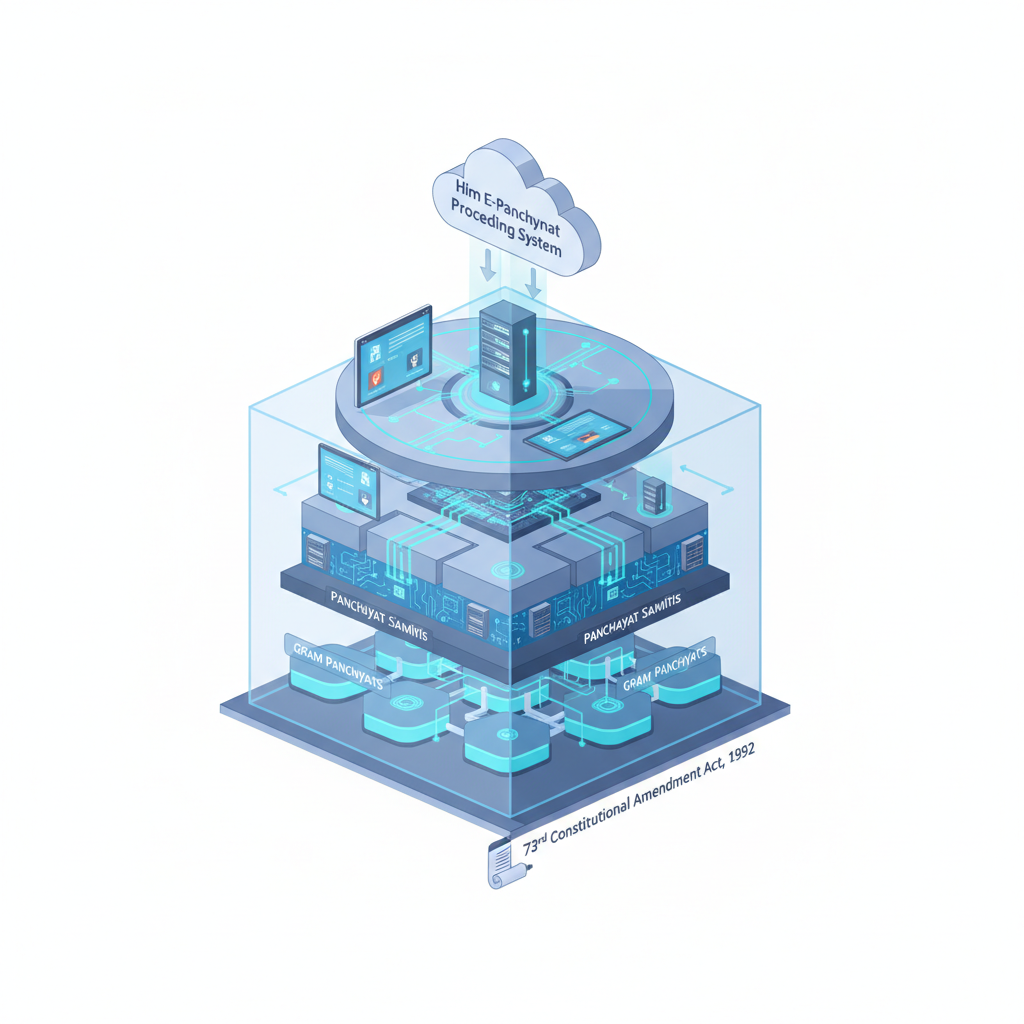
25 Sep Himachal Pradesh Launches Online Panchayat Proceedings System: First in India
✎ Himachal Pradesh has pioneered the digitisation of Panchayati Raj Institution meetings through the 'Him E-Panchayat Proceeding System', ensuring transparency, accountability, and compliance with constitutional provisions for…
Subject Relevance — Where This Topic Fits
- GS Paper II — Governance, Transparency and Accountability | GS Paper III — E-governance and Digital Infrastructure for Rural Development
- Prelims: Panchayati Raj System, 73rd Constitutional Amendment Act, E-governance, Digital Public Infrastructure, Panchayat Level Planning, Transparency in Governance, e-Gram Swaraj Portal
- Essay: Role of Technology in Strengthening Grassroots Democracy, Good Governance and Rural Development: The Digital Imperative
Quick Revision: Himachal Pradesh has pioneered the digitisation of Panchayati Raj Institution meetings through the ‘Him E-Panchayat Proceeding System’, ensuring transparency, accountability, and compliance with constitutional provisions for local self-government.
Why is this in the news?
Himachal Pradesh has become the first state in India to digitise the proceedings of Panchayati Raj Institution (PRI) meetings by launching the ‘Him E-Panchayat Proceeding System’ portal. This initiative enables online recording of agendas, attendance, meeting details, and proceedings for Gram Panchayats, Panchayat Samitis (Block Development Committees), and Zila Parishads, thereby enhancing transparency, accountability, and efficiency in rural governance.
Background
- The 73rd Constitutional Amendment Act, 1992, mandated the establishment of a three-tier Panchayati Raj System (Gram Panchayat at village level, Panchayat Samiti at block level, and Zila Parishad at district level) to decentralise governance and empower local communities.
- Panchayats are constitutionally recognised as institutions of self-government, responsible for planning and implementation of rural development schemes, including those funded by the central and state governments.
- Digital governance initiatives in India have gained momentum under the ‘Digital India’ programme, with a focus on leveraging technology to improve service delivery, transparency, and citizen participation in governance.
- The ‘e-Gram Swaraj’ portal, launched by the Ministry of Panchayati Raj, serves as a single-window platform for planning, monitoring, and accounting of Gram Panchayat activities across India.
- Himachal Pradesh, with approximately 90% of its area classified as rural, faces unique challenges in ensuring effective grassroots governance, making digital solutions critical for inclusive development.
- The state has previously implemented initiatives such as ‘Himachal Pradesh e-Governance Mission Mode Project’ to digitise land records and other administrative processes.
What is the Him E-Panchayat Proceeding System?
- The Him E-Panchayat Proceeding System is a state-specific digital platform designed to record and store the proceedings of meetings held by Gram Panchayats, Panchayat Samitis, and Zila Parishads in an online, tamper-proof manner.
- The system enables the digital documentation of meeting agendas, attendance registers, quorum status, discussion points, decisions taken, and resolutions passed, ensuring a comprehensive and auditable record.
- It incorporates an e-signature feature for authenticating meeting minutes, reducing reliance on physical records and mitigating risks of tampering or loss of documents.
- The portal integrates with the state’s existing digital infrastructure, including the ‘Him Access’ login system, to provide seamless access for officials across administrative levels.
- The system is designed to enforce compliance with statutory procedures and rules governing PRI meetings, thereby reducing disputes arising from procedural irregularities or non-compliance.
- Citizens can access the proceedings of PRI meetings through the portal, enhancing transparency and enabling public scrutiny of decision-making processes at the grassroots level.
- The initiative aligns with the broader objectives of the ‘Digital India’ programme and the ‘e-Gram Swaraj’ portal, which aim to create a robust digital ecosystem for rural governance.
- By digitising PRI proceedings, the state seeks to improve the efficiency of fund utilisation under centrally sponsored schemes such as the ‘Mahatma Gandhi National Rural Employment Guarantee Scheme (MGNREGS)’ and ‘Pradhan Mantri Gram Sadak Yojana (PMGSY)’.
Key Features
| Feature | Significance |
|---|---|
| Online recording of meeting proceedings | Ensures real-time, tamper-proof documentation of panchayat, panchayat samiti (BDC), and zila parishad meetings, reducing reliance on physical records. |
| Digital attendance tracking | Automates attendance recording for Pradhans, Up-Pradhans, ward members, and gram sabha members, ensuring compliance with quorum requirements. |
| E-signature facility post-meeting | Digitally authenticates proceedings, enhancing legal validity and reducing disputes over meeting records. |
| Centralised portal integration (Him Access) | Unifies multiple portals into a single login system, streamlining access for officials across panchayat to state levels. |
| Public access to proceedings | Enables citizens to view meeting agendas, attendance, and minutes online, fostering transparency and participatory governance. |
Why it Matters
Institutional Governance
- Establishes a precedent for digital transformation in rural local governance, aligning with the 73rd Constitutional Amendment’s emphasis on transparency and accountability.
- Strengthens the institutional capacity of panchayats by automating compliance with procedural norms, reducing errors in budget utilisation and decision-making.
- Facilitates evidence-based oversight by state and central authorities, enabling data-driven audits of panchayat fund utilisation.
Administrative Efficiency
- Reduces administrative overhead by eliminating manual record-keeping and physical file management, particularly in geographically challenging terrains.
- Standardises meeting protocols across all tiers of rural local bodies, minimising procedural deviations and associated disputes.
- Enables faster dissemination of meeting outcomes to stakeholders, accelerating implementation of development plans.
Citizen Empowerment
- Democratises access to governance processes by providing a transparent, auditable record of decisions, fostering trust in rural institutions.
- Encourages informed participation in gram sabha meetings through pre-meeting agenda visibility and post-meeting review mechanisms.
- Reduces information asymmetry between citizens and local authorities, enabling grievance redressal through verifiable records.
Technological Integration
- Demonstrates the scalability of e-governance solutions in rural contexts, leveraging existing digital infrastructure (e.g., e-Gram Swaraj portal).
- Lays groundwork for future AI/ML applications in panchayat governance, such as predictive analytics for fund utilisation or automated compliance alerts.
- Serves as a model for other states to replicate, particularly those with similar demographic and geographical challenges.
Challenges
1. Digital Divide and Accessibility
- Risk of excluding marginalised communities, including the elderly, illiterate, and those without internet access, from participating in or monitoring panchayat proceedings.
- Dependence on reliable internet connectivity in remote hilly regions, which may lead to data gaps or delays in recording proceedings.
- Need for multi-lingual support and user-friendly interfaces to ensure accessibility across diverse linguistic groups.
UPSC Link: GS-II: Governance, transparency and challenges
2. Data Security and Privacy
- Vulnerability to cyber threats, including hacking or data breaches, which could compromise sensitive information such as attendance records or financial details.
- Requirement for robust encryption and authentication protocols to safeguard against unauthorised access or tampering.
- Need for clear data retention and deletion policies to comply with privacy laws (e.g., Digital Personal Data Protection Act, 2023).
UPSC Link: GS-III: Cybersecurity and data governance
3. Capacity Building and Training
- Inadequate training of panchayat functionaries, including Pradhans and ward members, on using the digital system, leading to underutilisation or errors.
- Resistance to change among traditional bureaucratic structures, requiring sustained change management initiatives.
- Need for periodic refresher programmes to keep officials updated on system upgrades and best practices.
UPSC Link: GS-II: Human resource development in governance
4. Legal and Procedural Compliance
- Ensuring that digital records meet the evidentiary standards required under the Indian Evidence Act, 1872, for legal disputes.
- Aligning the system with the Panchayati Raj (Extension to the Scheduled Areas) Act, 1996, and state-specific panchayat laws to avoid jurisdictional conflicts.
- Addressing ambiguity in the admissibility of e-signed documents in courts, necessitating legislative clarity.
UPSC Link: GS-II: Constitutional and legal frameworks
5. Sustainability and Scalability
- High initial costs for infrastructure, training, and maintenance, which may strain state budgets, particularly for smaller panchayats.
- Risk of system obsolescence without continuous updates, necessitating long-term funding commitments.
- Need for interoperability with other e-governance platforms (e.g., MGNREGA, PM-KISAN) to avoid siloed data management.
UPSC Link: GS-III: Public expenditure and fiscal federalism
Challenges — UPSC Perspective
| Issue | Concern |
|---|---|
| Bridging the digital divide | Ensuring equitable access to the system for all socio-economic groups to prevent exclusion. |
| Cybersecurity threats | Protecting sensitive data from breaches, hacking, or unauthorised alterations. |
| Training and capacity gaps | Addressing skill deficits among panchayat officials to ensure effective system utilisation. |
| Legal admissibility of digital records | Clarifying evidentiary value of e-signed documents in judicial proceedings. |
| Interoperability with existing systems | Integrating the portal with other e-governance initiatives to avoid duplication. |
Way Forward
- Conduct district-wise training programmes for panchayat functionaries on using the Him e-Panchayat Proceeding System, with a focus on remote and tribal areas.
- Develop a multi-lingual user interface (Hindi, English, and regional languages) to enhance accessibility for diverse linguistic groups.
- Establish a dedicated cybersecurity cell within the Panchayati Raj Department to monitor threats and conduct periodic audits.
- Integrate the portal with the e-Gram Swaraj platform to enable seamless data sharing between panchayats and higher tiers of governance.
- Introduce a grievance redressal mechanism for citizens to report discrepancies or technical issues in recorded proceedings.
- Pilot a mobile application version of the portal to improve accessibility for officials and citizens in areas with limited internet access.
- Collaborate with academic institutions (e.g., IITs, IIMs) to develop AI-driven tools for predictive analytics in panchayat fund utilisation.
- Formulate a state-specific data governance policy to define data retention, sharing, and privacy standards in compliance with national laws.
UPSC Value Addition
Keywords for Mains Answer-Writing
Panchayati Raj System · Digital Governance · E-Panchayat Portal · Grama Sabha · Panchayat Meetings · Transparency in Local Governance · Panchayat Proceeding System · Decentralisation of Power · Rural Development · Constitutional Provisions under 73rd Amendment Act · E-Governance in Panchayats · Participatory Democracy · Accountability in Local Self-Government
Constitutional & Policy Linkages
- {‘article’: ’73rd Constitutional Amendment Act, 1992′, ‘note’: ‘Empowers panchayats and mandates transparency’}
- {‘article’: ‘Article 243G’, ‘note’: ‘Duties of panchayats in rural development’}
- {‘article’: ‘Article 243ZD’, ‘note’: ‘Constitutional status of district planning committees’}
Concept Flow
Panchayati Raj Institutions (PRIs) face challenges in transparency and accountability due to manual record-keeping and procedural deviations. → Digital transformation of meeting proceedings is proposed to standardise processes and enhance compliance with constitutional mandates. → Himachal Pradesh launches the Him e-Panchayat Proceeding System, enabling online recording of agendas, attendance, and minutes. → The portal integrates attendance tracking, e-signatures, and public access, reducing reliance on physical records. → Citizens gain real-time visibility into governance processes, fostering participatory democracy and reducing information asymmetry. → State and central authorities utilise digital records for audits, improving fund utilisation and minimising disputes. → Lessons learned are scaled to other states, contributing to nationwide digital governance in rural local bodies.
Prelims Practice Questions
Q1. Consider the following statements regarding the 73rd Constitutional Amendment Act, 1992:
1. It mandates the establishment of a three-tier Panchayati Raj system in every state.
2. It provides for the reservation of seats for women up to one-third of the total seats in Panchayats.
3. It empowers Panchayats to levy, collect, and appropriate taxes, duties, tolls, and fees.
4. It prohibits the State Election Commission from conducting elections to the Panchayats.
How many of the above statements are correct?
- Only one
- Only two
- Only three
- All four
Answer: Only three — Statements 1, 2, and 3 are correct as per the 73rd Amendment Act. Statement 4 is incorrect because the State Election Commission is responsible for conducting elections to Panchayats as per Article 243K.
Q2. Assertion (A): The E-Panchayat Proceeding System launched by Himachal Pradesh aims to digitise the proceedings of Panchayat meetings.
Reason (R): Digitisation enhances transparency, accountability, and efficiency in local governance.
Options:
A. Both A and R are true, and R is the correct explanation of A.
B. Both A and R are true, but R is NOT the correct explanation of A.
C. A is true, but R is false.
D. A is false, but R is true.
Answer: ? — Both Assertion (A) and Reason (R) are true, and Reason (R) correctly explains Assertion (A). The digitisation of Panchayat proceedings directly contributes to enhanced transparency, accountability, and efficiency.
Q3. Match the following pairs related to Panchayati Raj institutions in India:
Column I (Institution) | Column II (Function)
— | —
A. Gram Sabha | 1. Coordinates development plans at the block level
B. Panchayat Samiti | 2. Executes plans and provides essential services at the village level
C. Zila Parishad | 3. Approves plans and budgets at the district level
D. Gram Panchayat | 4. Mobilises community participation at the village level
Options:
A. A-4, B-1, C-3, D-2
B. A-2, B-3, C-1, D-4
C. A-4, B-2, C-1, D-3
D. A-1, B-3, C-2, D-4
- A
- B
- C
- D
Answer: A — The correct match is: A-4 (Gram Sabha mobilises community participation), B-1 (Panchayat Samiti coordinates development plans at the block level), C-3 (Zila Parishad approves plans and budgets at the district level), and D-2 (Gram Panchayat executes plans and provides essential services at the village level).
Mains Practice Question
✍ The digitisation of Panchayat proceedings through the E-Panchayat Proceeding System represents a transformative step in local governance. Critically examine the potential benefits and challenges of such digital initiatives in enhancing transparency, accountability, and participatory democracy in rural India. Also, analyse how these initiatives align with the constitutional framework of the Panchayati Raj System. (15 Marks)
Approach: MODEL-ANSWER SKELETON:
1. **Introduction (2 Marks)**: Define the Panchayati Raj System and its constitutional basis under the 73rd Amendment Act, 1992. Briefly introduce the E-Panchayat Proceeding System as a digital governance initiative.
2. **Benefits of Digitalisation (5 Marks)**:
– **Transparency**: Real-time availability of meeting agendas, proceedings, and attendance records (e.g., Himachal Pradesh’s portal).
– **Accountability**: Reduces manipulation of records and enhances scrutiny by citizens and higher authorities.
– **Efficiency**: Streamlines administrative processes and reduces delays in decision-making.
– **Participatory Democracy**: Facilitates greater citizen engagement through online access to proceedings.
– **Reduction of Corruption**: Minimises opportunities for misuse of funds and nepotism in local governance.
3. **Challenges (5 Marks)**:
– **Digital Divide**: Rural areas may lack internet access or digital literacy, excluding marginalised sections.
– **Data Security**: Risks of data breaches or tampering with sensitive information.
– **Implementation Gaps**: Inadequate training of officials or resistance to change in traditional systems.
– **Legal and Procedural Hurdles**: Ensuring compliance with the 73rd Amendment Act and other local laws.
– **Sustainability**: Long-term funding and maintenance of digital infrastructure.
4. **Alignment with Constitutional Framework (3 Marks)**:
– **Article 243G**: Empowers Panchayats to prepare plans for economic development and social justice.
– **Article 243J**: Mandates maintenance of accounts and audits, which digital records can facilitate.
– **Article 243ZD**: Ensures participation of women and marginalised groups, which digital platforms can enhance.
– **Directive Principles of State Policy (Article 40)**: Encourages decentralisation of power, which digital governance supports.
5. **Conclusion (2 Marks)**: Summarise the transformative potential of digital initiatives while acknowledging the need for inclusive and sustainable implementation. Highlight the role of state governments in replicating such models.
Source: amarujala.com
Himachal Pradesh PCS (HPPSC (HAS)) — State PCS Practice
Prelims: Which Indian state became the first to conduct Panchayat meetings online, as per the recent initiative launched in 2023?
- A. Kerala
- B. Himachal Pradesh
- C. Tamil Nadu
- D. Karnataka
Answer: B. Himachal Pradesh — Himachal Pradesh launched online Panchayat meetings in 2023, making it the first state in India to do so.
Mains: Discuss the significance of Himachal Pradesh becoming the first state in India to conduct Panchayat meetings online. Highlight its potential benefits for rural governance and challenges in implementation.
Generated by AanyaAi for educational purpose.
Related guides on our sites
- Current affairs for upsc 2026
- Best PSIR optional coaching for upsc
- Best PSIR optional teacher for upsc
- Best teacher of PSIR optional for upsc

- Element of Surprise, Technological Superiority & Jointness key to enhancing operational readiness against emerging threats: Raksha Mantri at Air Force Commanders’ Conference - November 12, 2026
- TDB-DST & Astrome Partner for AI-ELINT Constellation - November 12, 2026
- आंध्र प्रदेश: वैश्विक निवेश हब और व्यापार सुगमता पर जोर - November 12, 2026

No Comments