


12 Sep How UPI Revolutionized Financial Inclusion: Insights from Former RBI Governor
✎ UPI is a real-time, interoperable, and open digital payment infrastructure that has revolutionized financial inclusion in India by enabling instant, low-cost, and secure transactions across bank accounts using a single identifier.
Subject Relevance — Where This Topic Fits
- GS Paper III — Indian Economy: Issues relating to Planning, Mobilization of Resources, Growth, Development and Employment | GS Paper III — Technology Missions and their Economic Impact
- Prelims: UPI, NPCI, Financial Inclusion, Digital Public Infrastructure, Payment Systems, Reserve Bank of India (RBI), National Payments Corporation of India (NPCI), Digital India, Jan Dhan Yojana, Aadhaar Enabled Payment System (AePS)
- Essay: The Role of Digital Public Infrastructure in India’s Development Trajectory, Technology as an Enabler of Inclusive Growth: Lessons from UPI
Quick Revision: UPI is a real-time, interoperable, and open digital payment infrastructure that has revolutionized financial inclusion in India by enabling instant, low-cost, and secure transactions across bank accounts using a single identifier.
Why is this in the news?
The former Governor of the Reserve Bank of India (RBI), D. Subbarao, highlighted the transformative impact of the Unified Payments Interface (UPI) on financial inclusion and private innovation in India during the launch of the book *Cashless Nation: How UPI Changed Everything*. This underscores UPI’s evolution from a payment product to a foundational public digital infrastructure, marking a decade since its inception and its global recognition as a model for inclusive digital finance.
Background
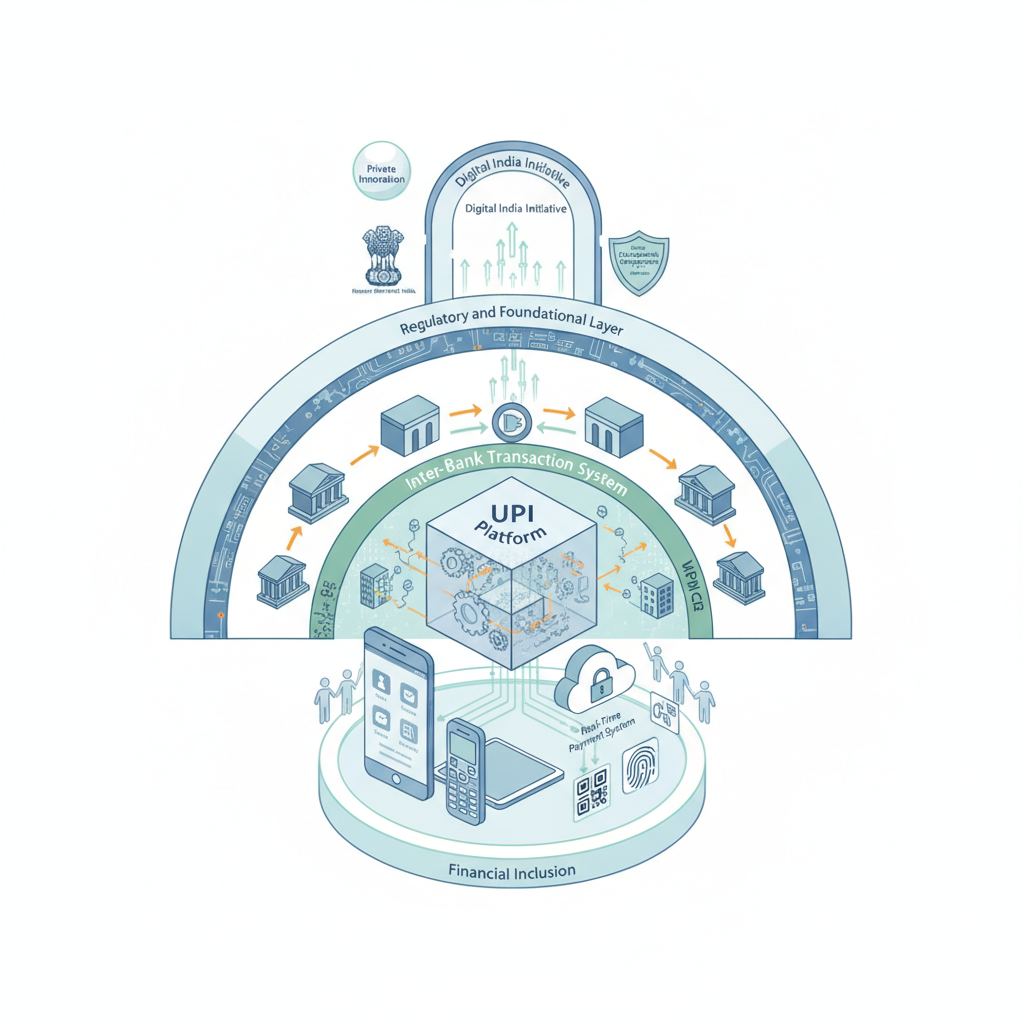
- The UPI was launched in 2016 by the National Payments Corporation of India (NPCI) under the aegis of the RBI, as part of the broader Digital India initiative.
- UPI operates as a real-time payment system that facilitates inter-bank transactions through a single identifier, eliminating the need for traditional payment instruments like cheques or demand drafts.
- The system is built on an open architecture, enabling seamless integration with multiple banks and third-party applications, thereby fostering competition and innovation.
- India’s push for financial inclusion, exemplified by the Pradhan Mantri Jan Dhan Yojana (PMJDY), provided a foundational customer base for UPI’s adoption.
- The Aadhaar Enabled Payment System (AePS) and the JAM trinity (Jan Dhan, Aadhaar, Mobile) further complemented UPI’s role in expanding access to financial services.
- UPI’s success has positioned India as a global leader in digital payments, with cross-border adoption and interest from other developing economies.
What is the Unified Payments Interface (UPI)?
- UPI is a real-time interbank payment system developed by the National Payments Corporation of India (NPCI) to enable seamless, instant, and secure fund transfers between bank accounts using a single identifier (e.g., Virtual Payment Address or VPA).
- It operates as an open, interoperable public infrastructure, allowing any bank or third-party application to integrate with the system without proprietary restrictions.
- UPI supports multiple transaction types, including person-to-person (P2P), person-to-merchant (P2M), and merchant-to-merchant (M2M) payments, as well as bill payments and recurring transactions.
- The system leverages India’s digital identity infrastructure (Aadhaar) and mobile penetration to extend financial services to underserved and unbanked populations.
- UPI’s architecture is built on the Immediate Payment Service (IMPS) framework, ensuring 24/7 availability, low transaction costs, and near-instant settlement.
- The NPCI, a not-for-profit organization regulated by the RBI, acts as the umbrella entity for retail payment systems in India, including UPI, Bharat Interface for Money (BHIM), and the National Electronic Toll Collection (NETC) system.
- UPI’s success has spurred the development of ancillary services such as UPI Lite (for small-value offline transactions), UPI 123PAY (for feature phone users), and cross-border UPI transactions.
- The system’s scalability and adaptability have made it a model for other countries exploring digital public infrastructure for financial inclusion.
Key Features
| Feature | Significance |
|---|---|
| Open and Interoperable Architecture | Enables seamless transactions across banks and payment service providers without proprietary constraints, fostering competition and innovation. |
| Real-Time Settlement | Facilitates instant fund transfers, reducing latency in financial transactions and enhancing user convenience. |
| Low-Cost Infrastructure | Minimizes transaction costs for users and merchants, particularly benefiting small businesses and the unbanked population. |
| API-Based Integration | Allows third-party developers to build applications on top of UPI, accelerating ecosystem growth and user adoption. |
| Public Good Model | Operates as a public infrastructure under NPCI, ensuring equitable access and reducing dependence on private payment gateways. |
Why it Matters
Economic Transformation
- UPI has significantly reduced the cost of digital payments, making financial services accessible to low-income and rural populations.
- Enhanced financial inclusion by enabling instant, low-cost transactions without the need for physical bank branches.
- Stimulated growth in the fintech sector, with over 300 third-party applications (TPAPs) leveraging UPI for payments and financial services.
Strategic and Global Leadership
- Positioned India as a global leader in digital payments, with UPI being adopted or studied by countries such as Singapore, UAE, and Japan.
- Demonstrated the scalability of public digital infrastructure, serving as a model for other nations seeking to modernize their payment systems.
Technological and Institutional Innovation
- Showcased the role of public institutions (e.g., NPCI, RBI) in driving technological innovation while maintaining regulatory oversight.
- Highlighted the importance of collaboration between government, regulators, and the private sector in building robust digital ecosystems.
Social and Developmental Impact
- Facilitated direct benefit transfers (DBTs) and subsidies, reducing leakages and improving the efficiency of welfare schemes.
- Empowered small merchants and street vendors by providing them with a low-cost, secure payment acceptance mechanism.
Challenges
1. Cybersecurity and Fraud Risks
- Increased reliance on digital payments exposes users to risks such as phishing, identity theft, and unauthorized transactions.
- Need for robust cybersecurity frameworks and user awareness programs to mitigate fraud and ensure trust in the system.
UPSC Link: GS3: Cyber Security
2. Digital Divide and Accessibility
- Rural and low-income populations may face barriers due to limited internet connectivity, smartphone access, or digital literacy.
- Ensuring inclusive growth requires targeted interventions such as subsidized devices, offline payment solutions, and localized awareness campaigns.
UPSC Link: GS2: Social Justice
3. Regulatory and Compliance Burden
- Rapid innovation in fintech necessitates dynamic regulatory frameworks to balance growth with consumer protection and financial stability.
- Harmonizing regulations across sectors (e.g., banking, telecom, and data privacy) remains a persistent challenge.
UPSC Link: GS3: Regulatory Reforms
4. Interoperability and Standardization
- Ensuring seamless interoperability between UPI and other payment systems (e.g., cards, wallets) is critical for universal adoption.
- Standardization of APIs and transaction protocols is essential to prevent fragmentation and ensure a cohesive ecosystem.
UPSC Link: GS3: Digital Infrastructure
5. Data Privacy and Sovereignty
- The aggregation of financial data raises concerns about privacy, ownership, and cross-border data flows.
- Strengthening data localization norms and enforcing strict consent-based data sharing are imperative.
UPSC Link: GS2: Fundamental Rights
Challenges — UPSC Perspective
| Issue | Concern |
|---|---|
| Fraud and Cybersecurity | Rising incidents of phishing, UPI frauds, and identity theft threaten user trust and system integrity. |
| Digital Literacy Gaps | Low awareness among rural and elderly populations hinders effective adoption and utilization of UPI. |
| Infrastructure Bottlenecks | Limited internet connectivity and smartphone penetration in remote areas restrict UPI’s reach. |
| Regulatory Lag | Evolving fintech landscape outpaces regulatory adaptations, creating compliance uncertainties. |
| Data Privacy Risks | Centralized financial data repositories pose risks of unauthorized access and misuse. |
Way Forward
- Strengthen cybersecurity protocols and establish a dedicated fraud reporting and redressal mechanism for UPI users.
- Expand digital literacy programs through partnerships with NGOs, educational institutions, and local bodies to bridge the knowledge gap.
- Invest in rural digital infrastructure, including last-mile connectivity and subsidized access to smartphones and UPI-enabled devices.
- Enhance interoperability by standardizing APIs and transaction protocols to ensure seamless integration with other payment systems.
- Develop a comprehensive data governance framework to protect user privacy while enabling innovation in financial services.
- Promote public-private partnerships to scale UPI adoption in underserved regions and sectors, such as agriculture and MSMEs.
- Establish a regulatory sandbox to test and refine fintech innovations while ensuring compliance with consumer protection norms.
UPSC Value Addition
Keywords for Mains Answer-Writing
Unified Payments Interface · financial inclusion · digital public infrastructure · National Payments Corporation of India · RBI governance · payment ecosystem · cashless economy · digital public goods · interoperable infrastructure · financial innovation · NPCI’s role · digital superpower · public-private partnership in payments
Concept Flow
Policy Vision (2012-2016): RBI and Government envision a cashless economy with interoperable, low-cost digital payments. → Institutional Setup: NPCI develops UPI as a public infrastructure, leveraging existing banking networks and Aadhaar-Enabled Payment System (AEPS). → Technological Innovation: UPI’s API-based architecture enables real-time, interoperable transactions across banks and third-party apps. → Regulatory Framework: RBI establishes guidelines for UPI operations, ensuring security, interoperability, and consumer protection. → Ecosystem Growth: Rapid adoption by banks, fintechs, and merchants, coupled with government schemes (e.g., DBTs), drives financial inclusion. → Global Recognition: UPI’s success positions India as a leader in digital payments, inspiring adoption in other countries. → Challenges and Adaptation: Addressing cybersecurity, digital divide, and regulatory gaps to sustain growth and trust.
Prelims Practice Questions
Q1. Consider the following statements regarding the Unified Payments Interface (UPI):
1. UPI is an open, interoperable public infrastructure managed by the National Payments Corporation of India (NPCI).
2. UPI transactions require the use of a bank account linked to a mobile number.
3. UPI enables real-time inter-bank transactions without the need for net-banking credentials.
4. UPI is regulated directly by the Ministry of Finance, Government of India.
How many of the above statements are correct?
- Only one
- Only two
- Only three
- All
Answer: Only three — Statements 1, 2, and 3 are correct. Statement 4 is incorrect as UPI is regulated by the Reserve Bank of India (RBI), not the Ministry of Finance.
Q2. Assertion (A): The Reserve Bank of India (RBI) is the sole regulator of the Unified Payments Interface (UPI) ecosystem in India.
Reason (R): The NPCI operates UPI under the regulatory oversight of the RBI, which ensures systemic stability and consumer protection.
In the context of the above two statements, which one of the following is correct?
- Both A and R are true, and R is the correct explanation of A.
- Both A and R are true, but R is not the correct explanation of A.
- A is true, but R is false.
- A is false, but R is true.
Answer: Both A and R are true, but R is not the correct explanation of A. — The RBI is the primary regulator of UPI, and the NPCI operates the platform under RBI’s oversight, making both statements true with R correctly explaining A.
Q3. Match the following entities with their respective roles in the UPI ecosystem:
Entity | Role
— | —
A. National Payments Corporation of India (NPCI) | 1. Regulates UPI and payment systems in India
B. Reserve Bank of India (RBI) | 2. Operates and manages the UPI platform
C. Payment Service Providers (PSPs) | 3. Facilitates UPI transactions through mobile apps and banks
D. Banks | 4. Provide the underlying infrastructure for UPI transactions
Choose the correct match:
- A-2, B-1, C-3, D-4
- A-1, B-2, C-3, D-4
- A-3, B-4, C-1, D-2
- A-4, B-1, C-2, D-3
Answer: A-2, B-1, C-3, D-4 — A-2 (NPCI operates UPI), B-1 (RBI regulates UPI), C-3 (PSPs enable transactions via apps), D-4 (Banks provide infrastructure).
Mains Practice Question
✍ The emergence of the Unified Payments Interface (UPI) as a global exemplar of digital public infrastructure has redefined financial inclusion in India. Critically examine the institutional, technological, and regulatory foundations that enabled this transformation. Also, evaluate the extent to which UPI has succeeded in bridging the digital divide in India. (15 Marks)
Approach: A well-structured answer must cover the following dimensions:
1. **Institutional Foundations**:
– Role of the Reserve Bank of India (RBI) in regulating UPI as a public good under the Payment and Settlement Systems Act, 2007.
– The National Payments Corporation of India (NPCI) as the operator of UPI, ensuring interoperability and scalability.
– Public-private partnership models that facilitated innovation while maintaining public oversight.
2. **Technological Innovations**:
– Open architecture of UPI enabling seamless integration across banks and third-party apps.
– Real-time settlement and low transaction costs as key enablers of mass adoption.
– Interoperability with other digital payment systems (e.g., Bharat Interface for Money, Aadhaar Enabled Payment System).
3. **Regulatory and Governance Framework**:
– RBI’s guidelines on data localization, cybersecurity, and consumer protection in UPI transactions.
– The role of the NPCI in ensuring fair competition and preventing monopolistic practices.
– Grievance redressal mechanisms under the RBI’s Integrated Ombudsman Scheme.
4. **Impact on Financial Inclusion**:
– Expansion of digital payment access to rural and semi-urban areas through UPI-enabled services.
– Reduction in cash dependency and increased transparency in transactions.
– Challenges in last-mile connectivity, digital literacy, and exclusion of marginalized groups.
5. **Critical Evaluation**:
– Success in democratizing access to financial services versus persistent digital divide.
– Role of UPI in enabling micro-entrepreneurship and financial empowerment.
– Limitations such as cybersecurity risks, data privacy concerns, and dependence on smartphone penetration.
Balance the narrative with both achievements and constraints, citing data or reports where possible (e.g., RBI’s Financial Inclusion Index, NPCI’s transaction volumes). Conclude with a balanced assessment of UPI’s contribution to India’s journey toward a cashless economy.
Source: The Hindu
Generated by AanyaAi for educational purpose.
Related guides on our sites
- Best economics services coaching
- Best economics optional coaching
- Best economics optional coaching for upsc
- best teacher of economics optional

- यूपीआई ने किया वित्तीय समावेशन का क्रांतिकारी बदलाव: पूर्व आरबीआई गवर्नर - September 12, 2026
- How UPI Revolutionized Financial Inclusion: Insights from Former RBI Governor - September 12, 2026
- आंध्र प्रदेश में 10 क्रिटिकल केयर ब्लॉक और 12 आईपीएचएल का उद्घाटन, जानिए कैसे बढ़ेगी स्वास्थ्य सुरक्षा - September 12, 2026

No Comments