


09 Feb India–AI Impact Summit 2026: Leading Global South Collaboration for Responsible and Inclusive AI
This article covers “Daily Current Affairs” and India–AI Impact Summit 2026: Leading Global South Collaboration for Responsible and Inclusive AI
SYLLABUS MAPPING:
GS- 3 – Science and technology – India–AI Impact Summit 2026: Leading Global South Collaboration for Responsible and Inclusive AI
FOR PRELIMS
What are the “Three Sutras” of the India–AI Impact Summit?
FOR MAINS
Explain the role of the “Seven Chakras” in promoting inclusive AI governance.
Why in the News?
India is set to host the India–AI Impact Summit 2026 in New Delhi from February 16–20. This landmark event marks the first-ever global AI summit to be hosted in the Global South, signalling a shift in the global technology discourse from the Global North to more inclusive, development-oriented frameworks.
Defining the Concept
In India, Artificial Intelligence (AI) is regarded not just as a technological innovation, but as a key national enabler aimed at making advanced technology accessible and beneficial to all sections of society.
It is defined by its ability to ensure access, inclusion, and equity at scale, aligning with the national ethos of “Welfare for All, Happiness of All” (Sarvajan Hitaya Sarvajan Sukhaya) and the global principle of “AI for Humanity”.
Background and Context
India has transitioned from being a consumer of technology to a global innovation leader.
Historical Evolution: India has jumped from 81st to 38th in the Global Innovation Index and is now the 6th largest patent filer globally.
Economic Context: National spending on research and development has increased more than twofold over the past decade, reaching ₹1.27 lakh crore in 2020–21.
International Leadership: As a leader in the Global South, India is engaging over 100 countries to shape responsible and inclusive AI norms.
Significance and Importance: The Three Sutras and Seven Chakras
The Summit’s architecture is built upon a unique philosophical and functional framework designed to translate high-level principles into measurable outcomes.
1. The Three Sutras (Core Principles):
People: Focuses on human-centric AI that protects rights and ensures equitable benefits.
Planet: Emphasizes environmentally sustainable AI and energy-efficient systems to support climate resilience.
Progress: Drives inclusive economic growth and capacity building to enhance global productivity.
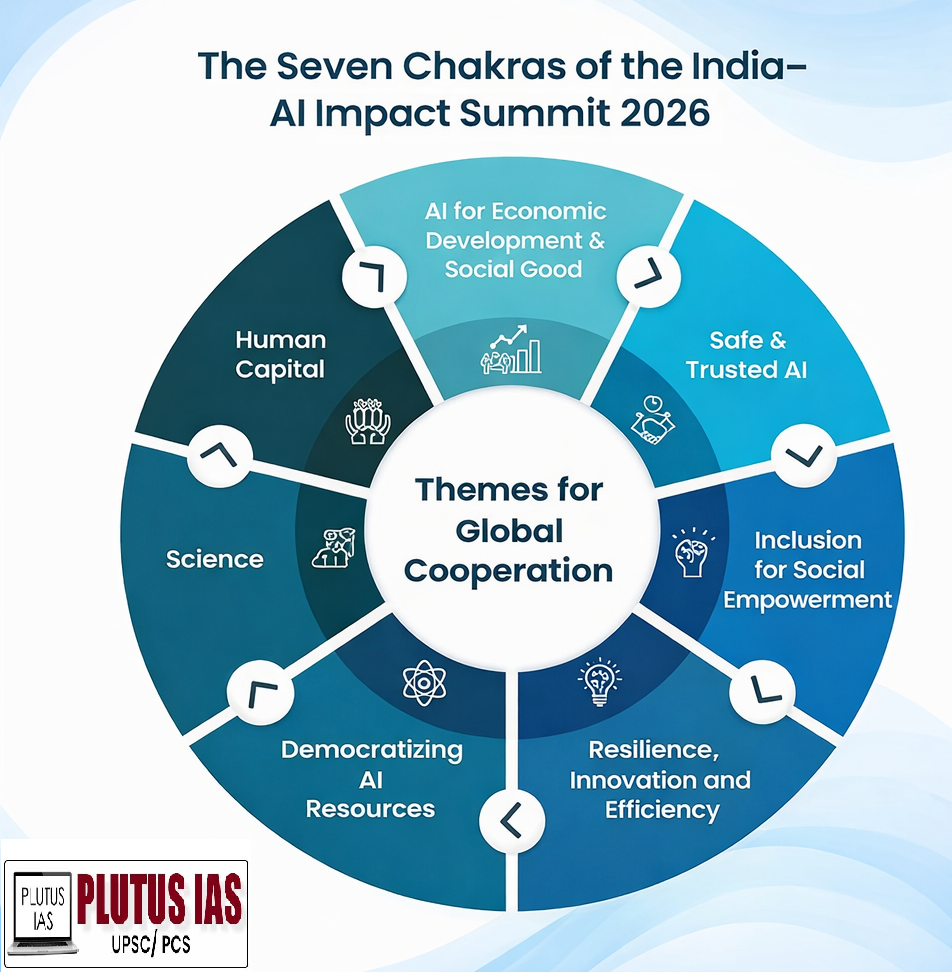
2. The Seven Chakras (Thematic Working Groups):
These working groups foster multilateral collaboration across critical domains:
Human Capital: Equipping the workforce for an AI-enabled future.
Inclusion for Social Empowerment: Designing AI that represents diverse communities.
Safe and Trusted AI: Building transparency and shared safeguards.
Science: Using AI to accelerate frontier scientific breakthroughs.
Resilience, Innovation, and Efficiency: Strengthening sustainable and climate-conscious AI.
Democratizing AI Resources: Ensuring equitable access to compute and data.
AI for Economic Development & Social Good: Scaling AI to enhance productivity across societies.
Key Issues and Challenges
Despite India’s rapid progress, several systemic challenges remain:
Resource Asymmetry: Access to foundational AI resources like high-performance compute and quality datasets remains unevenly distributed across the globe.
Safety and Ethical Risks: As AI scales, issues regarding bias mitigation, transparency, and accountability become central to maintaining public trust.
Infrastructure Demands: The surge in AI adoption requires a massive scaling of data infrastructure, with capacity needing to grow from 960 MW to 9.2 GW by 2030.
Constitutional and Legal Dimensions
Scientific Temper: The “Science Chakra” promotes the development of scientific inquiry, fulfilling the fundamental duty under Article 51A(h) of the Constitution.
Right to Privacy and Safety: India’s focus on “Safe and Trusted AI” and “safeguarding rights” aligns with the principles of the K.S. Puttaswamy judgment, ensuring that technological progress does not compromise individual digital sovereignty.
Institutional Governance: The proposed AI Governance Group (AIGG) and Technology and Policy Expert Committee (TPEC) represent a structured move toward a rule-based AI regime.
Economic, Social, and Environmental Impact
1. Economic Transformation:
The AI-powered technology sector is projected to reach US$ 280 billion in revenue by 2025.
India’s start up ecosystem is heavily AI-driven, with 89% of new start ups in 2024 integrating AI into their products.
The India AI Start ups Global Initiative is positioning Indian innovation on the world stage through partnerships with institutions like Station F in Paris.
2. Social Empowerment and Inclusion:
BHASHINI: A platform supporting 22 voice and 36 text languages, democratising governance through voice-first digital access.
Agriculture: Tools like Kisan e-Mitra (handling 95 lakh queries) and the proposed Bharat-VISTAAR platform are revolutionizing farmer advisory services.
Justice and Education: E-Courts Phase III and the integration of AI into the CBSE curricula through the National Education Policy 2020 are enhancing institutional efficiency and student readiness.
3. Environmental and Scientific Resilience:
The India Meteorological Department (IMD) utilizes hybrid AI models for predicting lightning, fog, and rainfall.
The STELLAR tool aids DISCOMs in energy storage and demand planning, ensuring national energy security through AI.
Governance and Institutional Aspects
India is establishing a robust ecosystem under the IndiaAI Mission:
India-AI Safety Institute (AISI): Tasked with drafting standards, benchmarks, and testing methods to address safety challenges.
Sovereign Compute Infrastructure: Building a secure cluster of 3,000 next-generation GPUs for strategic national applications.
Democratized Access: The IndiaAI Compute Portal provides access to 38,000 GPUs at subsidized rates (under Rs. 100/hour), significantly lower than the global average of Rs. 200/hour.
High-Performance Computing: The National Supercomputing Mission (NSM) has deployed over 40 petaflops of computing power across premier research labs.
Global Comparison and Leadership
India stands as a global leader in AI talent and contribution:
According to the Stanford AI Index Report 2025, India leads in global AI talent acquisition with a 33% annual hiring growth.
India is the second-largestcontributor to public generative AI projects on GitHub as of 2024.
Major global tech giants (Microsoft, Amazon, Google) have committed hundreds of thousands of crores to develop data centres and AI hubs in India, confirming its status as a global AI destination.
Way Forward
To sustain this momentum and lead the Global South, India must focus on:
Grassroots Empowerment: Scaling the AI Data Labs Network to 570 labs across Tier-2 and Tier-3 cities to build skills in data annotation.
Sustained R&D Funding: Effectively utilizing the Anusandhan National Research Foundation (ANRF) budget of ₹50,000 crore (2023–2028) to bridge the gap between research and real-world application.
Ethical Leadership: Strengthening the India AI Safety Institute to collaborate with international standard-setting bodies, ensuring India’s “safe and trusted” model becomes a global benchmark.
Informal Sector Integration: Implementing Mission Digital Shram Setu to ensure AI benefits the 490 million informal workers who form the backbone of the economy.
Conclusion
The India–AI Impact Summit 2026 marks a transition from “dialogue to delivery”. By grounding AI development in the Constitutional values of equity and scientific temper, India is charting a course toward Viksit Bharat 2047. This human-centric approach ensures that AI contributes to inclusive growth, sustainable development, and democratic governance, serving as a scalable model for the global public good. Through the Three Sutras and Seven Chakras, India is not just participating in the AI revolution—it is leading it for the benefit of all humanity.
Mains Questions
“Artificial Intelligence in India functions as a strategic national tool to drive the democratisation of technology, ensuring access, inclusion, and equity at scale.” Discuss this statement in the context of the ‘Three Sutras’ and ‘Seven Chakras’ framework of the India–AI Impact Summit 2026.
(250 words, 15 marks)

- Artemis II: Humanity’s Return to Lunar Space and India’s Place in the New Moon Race - April 2, 2026
- A Missed Opportunity to Guarantee Minimum Wages - March 31, 2026
- ‘India’s Growth Claims, A Clash with Data Reality’. - March 30, 2026

No Comments