


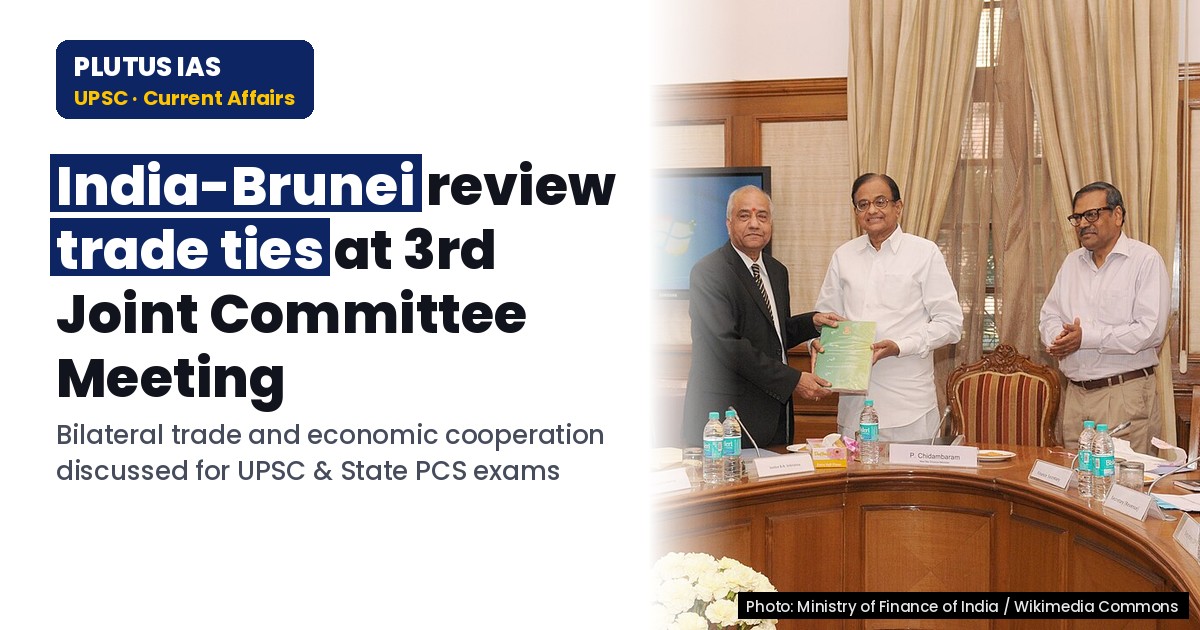
14 Oct India-Brunei Review Trade Ties at 3rd Joint Committee Meeting
✎ The Joint Trade Committee (JTC) between India and Brunei Darussalam is a bilateral mechanism to review and enhance trade and economic cooperation, with a focus on sectors such as pharmaceuticals, IT services, and renewable energy.
Subject Relevance — Where This Topic Fits
- GS Paper II — International Relations (Bilateral, Regional and Global Groupings and Agreements involving India and/or affecting India’s interests) | GS Paper III — Economy (Foreign Trade, Bilateral and Regional Trade Agreements)
- Prelims: ASEAN, Brunei Darussalam, Joint Trade Committee, Bilateral Trade Agreement, ASEAN-India Trade in Goods Agreement (AITIGA), Comprehensive Economic Cooperation Agreement (CECA), Trade and Economic Cooperation, Economic Diplomacy
- Essay: The Role of Economic Diplomacy in India’s Foreign Policy, ASEAN-India Strategic Partnership: Opportunities and Challenges
Quick Revision: The Joint Trade Committee (JTC) between India and Brunei Darussalam is a bilateral mechanism to review and enhance trade and economic cooperation, with a focus on sectors such as pharmaceuticals, IT services, and renewable energy.
Why is this in the news?
The Third Joint Trade Committee Meeting between India and Brunei Darussalam, held recently, underscores the ongoing efforts to enhance bilateral trade and economic cooperation between the two nations. This meeting is significant as it provides a structured platform for reviewing trade relations, identifying new areas of collaboration, and addressing challenges in the economic partnership, particularly in the context of India’s Act East Policy and Brunei’s Vision 2035.
Background
- India and Brunei Darussalam share cordial bilateral relations, rooted in historical and cultural ties, and are both members of ASEAN and the East Asia Summit.
- Brunei Darussalam, a small but resource-rich nation in Southeast Asia, is a key partner for India in the ASEAN region, particularly in sectors such as energy, pharmaceuticals, and information technology.
- India’s Act East Policy, launched in 2014, aims to deepen economic, strategic, and cultural ties with the Asia-Pacific region, including ASEAN countries like Brunei.
- Bilateral trade between India and Brunei has remained modest but has shown potential for growth, particularly in non-oil sectors such as pharmaceuticals, IT services, and agro-processing.
- The Joint Trade Committee (JTC) mechanism was established to provide a structured framework for regular dialogue and cooperation between the two countries.
What is the Joint Trade Committee (JTC) between India and Brunei Darussalam?
- The Joint Trade Committee (JTC) is a bilateral mechanism established to review, promote, and strengthen trade and economic cooperation between India and Brunei Darussalam.
- The primary objectives of the JTC include identifying new areas of trade and investment, addressing trade barriers, and facilitating business-to-business linkages.
- Key sectors discussed in the JTC include pharmaceuticals, IT services, agro-processing, renewable energy, and infrastructure development.
- The JTC also serves as a platform for discussing trade facilitation measures, such as customs cooperation, standards and conformity assessment, and intellectual property rights protection.
- The Third Joint Trade Committee Meeting is the latest in a series of regular dialogues aimed at deepening economic ties and exploring new opportunities for collaboration.
- The outcomes of the JTC meetings are implemented through joint action plans, which are reviewed in subsequent meetings to track progress and address emerging challenges.
Key Features
| Feature | Significance |
|---|---|
| Third Joint Trade Committee Meeting | Provides a structured bilateral forum to assess trade and economic cooperation between India and Brunei Darussalam, enabling policy alignment and identifying new areas of collaboration. |
| Bilateral Trade Review | Facilitates a comprehensive evaluation of existing trade agreements, tariff structures, and non-tariff barriers to enhance market access for goods and services. |
| Economic Cooperation Framework | Aims to strengthen economic ties through investment promotion, technology transfer, and joint ventures in sectors such as energy, infrastructure, and halal products. |
| Institutional Mechanism | Ensures continuity in diplomatic engagement by institutionalising regular high-level consultations, thereby fostering long-term economic partnerships. |
| Sectoral Focus | Highlights key sectors like oil and gas, pharmaceuticals, IT services, and tourism, where both nations can leverage comparative advantages for mutual benefit. |
Why it Matters
Economic Significance
- Bilateral trade between India and Brunei Darussalam, though modest, holds strategic value due to Brunei’s hydrocarbon resources and India’s growing demand for energy and halal products.
- Enhanced economic cooperation can diversify India’s energy import basket, reducing reliance on traditional suppliers and ensuring energy security.
- Promotion of trade in pharmaceuticals and IT services aligns with India’s export competitiveness and Brunei’s healthcare and digital transformation goals.
Strategic Significance
- Strengthens India’s engagement in the ASEAN region, reinforcing its ‘Act East Policy’ and fostering deeper economic integration with Southeast Asian economies.
- Bilateral ties with Brunei, a key player in the ASEAN bloc, can facilitate India’s participation in regional supply chains and infrastructure projects.
- Cooperation in maritime security and counter-terrorism, though not explicitly mentioned, often accompanies economic engagements in the Indo-Pacific region.
Diplomatic Significance
- Reaffirms India’s commitment to strengthening ties with ASEAN member states through structured bilateral mechanisms, enhancing its diplomatic footprint in the region.
- Provides a platform for addressing trade imbalances, non-tariff barriers, and regulatory hurdles that impede smoother economic exchanges.
- Demonstrates India’s proactive approach to engaging with smaller but strategically important economies, complementing its outreach to larger partners.
Challenges
1. Limited Trade Volume
- Bilateral trade between India and Brunei remains modest, with hydrocarbons dominating exports from Brunei and limited high-value imports from India.
- Lack of diversification in trade basket constrains the potential for substantial economic gains from the partnership.
UPSC Link: GS Paper 3: Trade and Commerce
2. Non-Tariff Barriers
- Regulatory divergence in halal certification, sanitary and phytosanitary measures, and technical standards can impede market access for Indian products in Brunei.
- Complex customs procedures and documentation requirements may increase transaction costs for businesses.
UPSC Link: GS Paper 3: WTO and Trade Agreements
3. Geographical and Logistical Constraints
- Long distances and limited direct shipping routes between India and Brunei increase transportation costs and time, affecting the competitiveness of traded goods.
- Dependence on third-country transshipment hubs adds to operational complexities.
UPSC Link: GS Paper 3: Infrastructure and Logistics
4. Limited Investment Flows
- Despite potential sectors like IT, pharmaceuticals, and tourism, actual investment flows remain constrained due to perceived risks and lack of awareness.
- Policy uncertainties and regulatory opacity in either country can deter foreign direct investment (FDI).
UPSC Link: GS Paper 3: FDI and Investment Policies
5. Cultural and Market Differences
- Divergent consumer preferences and business practices in Brunei may pose challenges for Indian exporters targeting the local market.
- Limited cultural exchange and awareness between the two nations can hinder people-to-people ties and business networking.
UPSC Link: GS Paper 2: International Relations
Challenges — UPSC Perspective
| Issue | Concern |
|---|---|
| Trade Imbalance | Brunei’s exports to India (primarily hydrocarbons) far exceed India’s exports to Brunei, leading to a structural trade deficit. |
| Regulatory Divergence | Differences in halal certification, SPS measures, and technical standards create barriers for Indian exporters. |
| Logistical Bottlenecks | Long shipping distances and reliance on transshipment hubs increase costs and reduce competitiveness. |
| Limited Investment | Despite potential sectors, FDI flows remain constrained due to policy uncertainties and lack of awareness. |
| Market Access | Restricted access to Brunei’s niche markets (e.g., halal products, tourism) limits export diversification. |
| Diplomatic Visibility | Limited public awareness and media coverage of the bilateral relationship reduce its strategic impact. |
Way Forward
- Conclude negotiations on a Bilateral Investment Treaty (BIT) to provide legal certainty and protection for investors, thereby boosting FDI flows.
- Harmonise standards and certification processes, particularly for halal products, pharmaceuticals, and IT services, to reduce non-tariff barriers.
- Develop direct shipping routes or logistics partnerships to reduce transportation costs and improve supply chain efficiency.
- Promote sector-specific collaborations in renewable energy, digital infrastructure, and tourism through joint ventures and pilot projects.
- Organise trade fairs, business delegations, and cultural exchanges to enhance mutual awareness and foster people-to-people ties.
- Leverage Brunei’s chairmanship of ASEAN in 2024 to integrate India-Brunei economic cooperation into broader regional initiatives.
- Establish a joint working group to monitor the implementation of agreements and address trade-related grievances in real time.
UPSC Value Addition
Keywords for Mains Answer-Writing
Bilateral trade agreements · Joint Trade Committee · ASEAN-India economic relations · Foreign Trade Policy 2023 · Trade facilitation mechanisms · Economic cooperation frameworks · ASEAN Free Trade Area · India-Brunei strategic partnership · Trade and Investment Promotion · WTO-compliant trade regulations
Concept Flow
India’s ‘Act East Policy’ drives engagement with ASEAN nations, including Brunei, to enhance economic and strategic ties. → The Joint Trade Committee Meeting provides a structured platform for bilateral consultations on trade and economic cooperation. → Review of bilateral trade agreements identifies gaps in market access, non-tariff barriers, and investment opportunities. → Policy recommendations from the meeting aim to diversify trade baskets, reduce regulatory hurdles, and boost FDI flows. → Implementation of agreements requires coordination between ministries (e.g., Commerce, External Affairs) and alignment with WTO rules. → Enhanced economic cooperation strengthens India’s strategic position in the Indo-Pacific and fosters regional integration. → Long-term outcomes include diversified trade, energy security, and deeper economic integration within ASEAN.
Prelims Practice Questions
Q1. Consider the following statements regarding the Joint Trade Committee (JTC) between India and Brunei Darussalam:
1. The JTC is a statutory body established under the provisions of the WTO Agreement on Trade Facilitation.
2. The JTC meetings are co-chaired by the Commerce Ministers of both countries.
3. The JTC primarily focuses on resolving trade disputes between the two nations.
4. The third JTC meeting between India and Brunei Darussalam was held in 2023.
How many of the above statements are correct?
- Only one
- Only two
- Only three
- All
Answer: Only two — Statement 1 is incorrect: The JTC is not a statutory body under the WTO Agreement on Trade Facilitation but is a bilateral mechanism established under a Memorandum of Understanding. Statement 2 is correct: The JTC meetings are typically co-chaired by the Commerce Ministers of both countries. Statement 3 is incorrect: The JTC primarily focuses on reviewing bilateral trade and economic cooperation, not resolving disputes. Statement 4 is correct: The third JTC meeting between India and Brunei Darussalam was held in 2023.
Q2. Assertion (A): The India-Brunei Joint Trade Committee (JTC) meetings are held annually to review bilateral trade and economic cooperation.
Reason (R): The JTC meetings are mandated by the ASEAN-India Free Trade Agreement (AIFTA) to ensure compliance with WTO rules.
In the context of the above two statements, which one of the following is correct?
- Both A and R are true, and R is the correct explanation of A
- Both A and R are true, but R is not the correct explanation of A
- A is true, but R is false
- A is false, but R is true
Answer: A is false, but R is true — Assertion (A) is true: The JTC meetings are indeed held to review bilateral trade and economic cooperation, though not necessarily annually. Reason (R) is false: The JTC is not mandated by the ASEAN-India Free Trade Agreement (AIFTA) but is a bilateral mechanism established under a Memorandum of Understanding between India and Brunei Darussalam.
Mains Practice Question
✍ The Joint Trade Committee (JTC) mechanism is a critical instrument for enhancing bilateral economic cooperation between India and ASEAN member states. Critically examine the role and significance of the JTC in the context of India’s Foreign Trade Policy 2023 and the broader framework of ASEAN-India economic relations. (15 Marks)
Approach: MODEL-ANSWER SKELETON:
1. **Definition and Purpose of JTC**: Briefly define the Joint Trade Committee (JTC) as a bilateral mechanism established under a Memorandum of Understanding (MoU) between India and Brunei Darussalam to review and enhance trade and economic cooperation. Highlight its role in facilitating dialogue and policy coordination.
2. **Alignment with Foreign Trade Policy 2023**: Discuss how the JTC aligns with the objectives of India’s Foreign Trade Policy 2023, particularly its emphasis on trade facilitation, export promotion, and diversification of trade partners. Reference specific provisions such as the focus on ASEAN markets and the ‘ASEAN-India Plan of Action 2021-2025’.
3. **ASEAN-India Economic Relations**: Explain the broader context of ASEAN-India economic relations, including the ASEAN Free Trade Area (AFTA), the Regional Comprehensive Economic Partnership (RCEP), and the India-ASEAN Free Trade Agreement (AIFTA). Discuss how the JTC contributes to strengthening these frameworks.
4. **Trade Facilitation and Regulatory Cooperation**: Highlight the role of the JTC in addressing non-tariff barriers, improving customs procedures, and promoting mutual recognition agreements (MRAs) to facilitate smoother trade flows. Reference the WTO Agreement on Trade Facilitation and its relevance to JTC discussions.
5. **Challenges and Limitations**: Critically examine the challenges faced by the JTC, such as limited market access for certain Indian goods in Brunei, regulatory divergences, and the impact of global geopolitical tensions on trade flows. Discuss the need for more proactive measures to deepen economic ties.
6. **Way Forward**: Suggest measures to enhance the effectiveness of the JTC, such as expanding the scope of cooperation to include digital trade, renewable energy, and healthcare, and leveraging the India-Brunei Strategic Partnership for deeper integration.
7. **Conclusion**: Summarize the significance of the JTC in fostering economic cooperation and its potential to serve as a model for similar mechanisms with other ASEAN member states.
Source: PIB (Press Information Bureau)
Generated by AanyaAi for educational purpose.
Related guides on our sites
- Best PSIR optional coaching for upsc
- Best economics optional coaching for upsc
- Best PSIR optional teacher for upsc
- Best teacher of PSIR optional for upsc

- Supreme Court Extends AP Municipal Poll Deadline to October 25 for YSRCP - October 21, 2026
- सहकारी संघवाद और कानून सुधार पर राष्ट्रीय सम्मेलन आयोजित करेगा विधि आयोग - October 21, 2026
- AI vs Handwritten Notes: Indian Students’ Learning Preferences Explained - October 21, 2026

No Comments