


08 Sep Indian Navy Chief’s Visit to Australia & NZ: Boosting Indo-Pacific Maritime Ties
✎ India’s naval diplomacy with Australia and New Zealand advances the ‘Indo-Pacific Strategy’ by strengthening maritime security cooperation, interoperability, and regional stability through structured frameworks like the ‘Maritime…
Subject Relevance — Where This Topic Fits
- GS Paper II — International Relations: Bilateral, Regional and Global Groupings and Agreements involving India and/or affecting India’s interests | GS Paper III — Security: Challenges to Internal Security through External State and Non-State Actors
- Prelims: Indo-Pacific Strategy, Indian Navy, Royal Australian Navy (RAN), Royal New Zealand Navy (RNZN), Maritime Security Cooperation, Comprehensive Strategic Partnership, Defence Logistics Support Agreement, Exclusive Economic Zone (EEZ), Quadrilateral Security Dialogue (Quad), Malabar Naval Exercise
- Essay: The evolving architecture of maritime security in the Indo-Pacific region, India’s role in fostering regional stability through multilateral engagements
Quick Revision: India’s naval diplomacy with Australia and New Zealand advances the ‘Indo-Pacific Strategy’ by strengthening maritime security cooperation, interoperability, and regional stability through structured frameworks like the ‘Maritime Cooperation Agreement’ and ‘Defence Logistics Support Agreement’.
Why is this in the news?
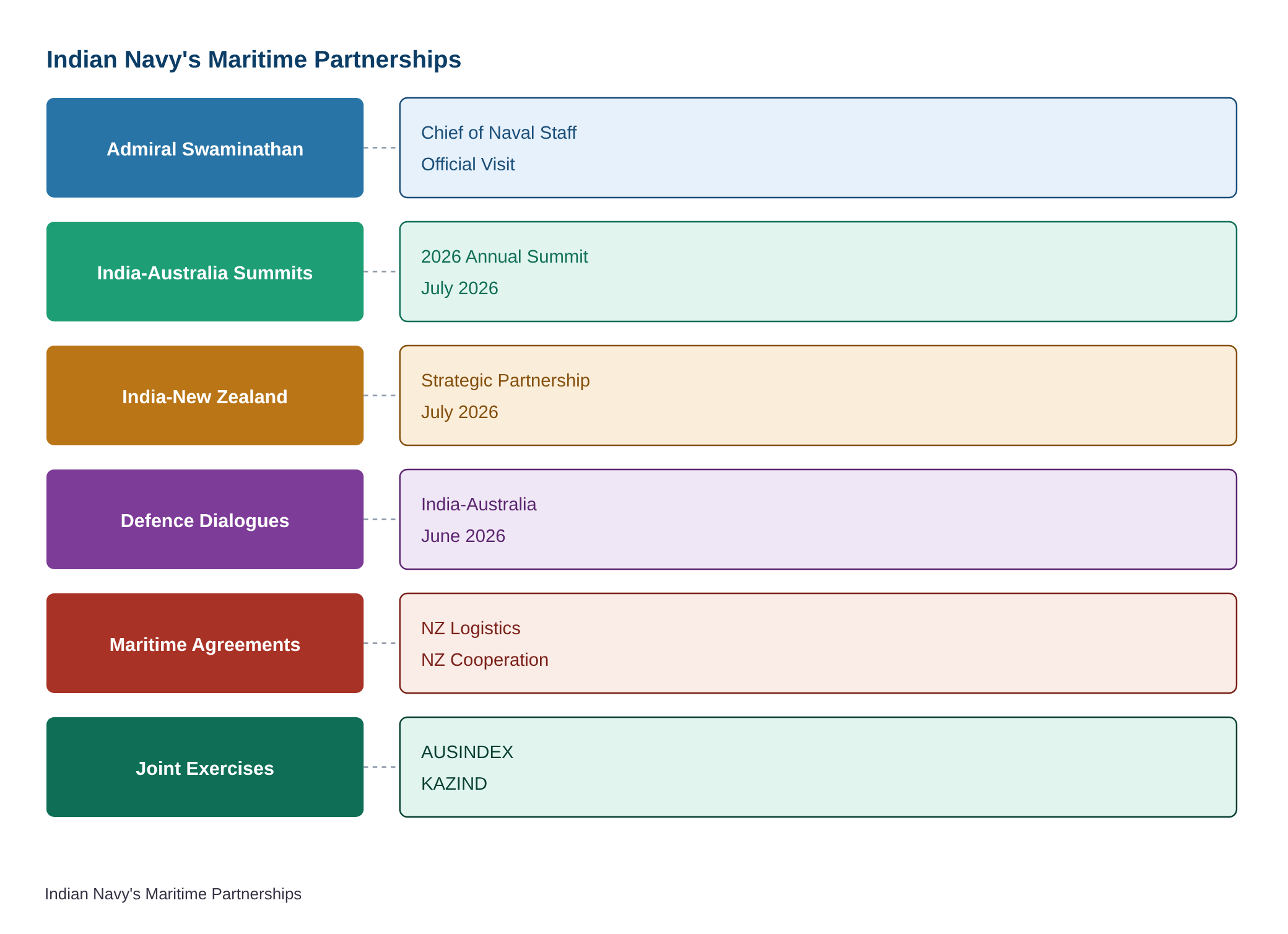
The visit of the Chief of the Naval Staff, Admiral Krishna Swaminathan, to Australia and New Zealand from 09 September 2026, marks a significant step in consolidating India’s maritime partnerships in the Indo-Pacific. This visit follows recent high-level engagements, including the third India-Australia Annual Summit (July 2026) and the second India-Australia Defence Ministers’ Dialogue (June 2026), as well as the elevation of India-New Zealand relations to a strategic partnership during the Prime Minister’s visit to New Zealand in July 2026. The visit underscores India’s commitment to deepening operational cooperation, interoperability, and information-sharing with the naval forces of both countries, thereby contributing to regional maritime security and stability.
Background
- The ‘India-New Zealand Strategic Partnership’ (2026) formalise cooperation in defence, security, and maritime domains.
- The ‘Maritime Cooperation Agreement’ with New Zealand (2026) provide frameworks for logistical and operational collaboration.
What is the significance of the Chief of the Naval Staff’s visit to Australia and New Zealand?
- The visit aims to strengthen bilateral naval cooperation with the Royal Australian Navy (RAN) and the Royal New Zealand Navy (RNZN) through high-level dialogues and operational engagements.
- Key focus areas include maritime security, interoperability, information-sharing, joint training, and professional exchanges to enhance operational readiness.
- The visit follows the signing of the ‘Maritime Cooperation Agreement’ between India and New Zealand in 2026, which provides a structured framework for practical maritime collaboration.
- Discussions will cover emerging technologies to address evolving security challenges.
- The engagements will also focus on joint training programmes and professional military education exchanges.
- The visit underscores India’s role in fostering stability and security in the Indo-Pacific, a region critical to global trade and geopolitical balance.
Key Features
| Feature | Significance |
|---|---|
| Bilateral Naval Engagement | Strengthens operational cooperation, interoperability, and information sharing between the Indian Navy and the Royal Australian Navy (RAN) and Royal New Zealand Navy (RNZN). |
| Strategic Partnership Framework | Builds on the India-Australia Annual Summit (July 2026) and India-New Zealand Strategic Partnership (July 2026) to institutionalise defence and maritime security collaboration. |
| Operational Review Mechanisms | Facilitates structured dialogue on joint exercises, training, and professional exchanges to enhance maritime domain awareness and crisis response capabilities. |
| Technology and Innovation Dialogue | Focuses on emerging maritime technologies, including unmanned systems, AI-driven surveillance, and cyber resilience, to modernise naval capabilities. |
| Maritime Domain Awareness (MDA) | Promotes real-time information sharing on maritime threats, illegal activities, and environmental monitoring to ensure regional stability. |
Why it Matters
Geopolitical and Maritime Security
- Reinforces India’s commitment to a rules-based maritime order in the Indo-Pacific, aligning with the ASEAN Outlook on the Indo-Pacific and the Quad’s maritime security initiatives.
- Demonstrates India’s proactive engagement in the South Pacific and Southern Indian Ocean, countering non-traditional threats such as piracy, illegal fishing, and climate-induced migration.
- Enhances India’s strategic footprint in the Indo-Pacific, complementing partnerships with Japan, France, and the United States under the Indo-Pacific Oceans Initiative (IPOI).
Defence Diplomacy and Capacity Building
- Facilitates joint naval exercises (e.g., AUSINDEX, KAZIND) and port visits, improving interoperability and operational readiness.
- Supports capacity-building initiatives such as the Indian Navy’s Hydrographic Survey and Maritime Domain Awareness training programs for partner nations.
- Strengthens defence industrial cooperation, including co-development of maritime surveillance technologies and logistics support agreements.
Economic and Logistical Synergies
- Promotes collaboration in port infrastructure, shipping corridors, and blue economy sectors, including fisheries and renewable energy.
- Encourages joint research in maritime archaeology, oceanography, and climate-resilient port design to enhance sustainable development.
Institutional and Legal Frameworks
- Advances implementation of the India-Australia Mutual Logistics Support Agreement (MLSA) and the India-New Zealand Maritime Cooperation Agreement (2026).
- Supports adherence to international maritime conventions (e.g., UNCLOS, SOLAS) and regional security architectures like the ASEAN Regional Forum (ARF).
Challenges
1. Geographical and Operational Constraints
- Limited logistical support infrastructure in remote Pacific islands necessitates enhanced port access and refuelling agreements.
- Differences in naval doctrines and interoperability standards may require standardised training protocols and equipment compatibility.
UPSC Link: GS III: Security challenges and their management
2. Non-Traditional Threats and Asymmetric Risks
- Rising piracy, drug trafficking, and illegal fishing in the Indo-Pacific demand coordinated surveillance and enforcement mechanisms.
- Climate change-induced disasters (e.g., cyclones, coral bleaching) require joint disaster response frameworks and resilient port designs.
UPSC Link: GS III: Disaster and disaster management
3. Bureaucratic and Procedural Delays
- Slow ratification of defence agreements (e.g., MLSA) and clearance of joint projects may impede timely implementation.
- Divergent procurement policies and offset requirements can delay defence industrial cooperation.
UPSC Link: GS II: International relations and governance
4. Technological and Cyber Vulnerabilities
- Increased reliance on digital systems exposes naval networks to cyber threats, necessitating robust cybersecurity protocols.
- Rapid advancements in unmanned and autonomous systems require continuous upskilling of naval personnel and standardisation of operational guidelines.
UPSC Link: GS III: Science and Technology in governance
5. Resource Allocation and Budgetary Pressures
- Competing demands for defence modernisation and social sector spending may limit allocations for maritime security initiatives.
- Sustaining long-term naval deployments and exercises requires predictable funding mechanisms and multi-year budgetary commitments.
UPSC Link: GS III: Government budgets and fiscal policies
Challenges — UPSC Perspective
| Issue | Concern |
|---|---|
| Logistical Constraints | Limited port access and refuelling infrastructure in remote Pacific islands hinders sustained naval operations. |
| Doctrinal Differences | Variations in naval doctrines and interoperability standards may impede seamless joint exercises and operations. |
| Non-Traditional Threats | Rising piracy, illegal fishing, and climate-induced disasters demand coordinated yet resource-intensive responses. |
| Bureaucratic Delays | Slow ratification of defence agreements and clearance of joint projects may delay critical initiatives. |
| Cyber Vulnerabilities | Increased digitalisation exposes naval networks to cyber threats, requiring robust safeguards. |
| Budgetary Pressures | Competing demands for defence modernisation and social sector spending may limit maritime security allocations. |
Way Forward
- Establish a dedicated Indo-Pacific Maritime Security Cell within the Ministry of Defence to coordinate policy, training, and logistics support.
- Accelerate the ratification and implementation of the India-Australia Mutual Logistics Support Agreement (MLSA) and India-New Zealand Maritime Cooperation Agreement.
- Develop standardised interoperability protocols for joint naval exercises, including shared communication systems and equipment compatibility.
- Enhance maritime domain awareness through joint surveillance initiatives, including satellite-based monitoring and AI-driven threat detection.
- Invest in port infrastructure and logistics hubs in partner nations to facilitate sustained naval deployments and rapid response capabilities.
- Promote defence industrial cooperation by co-developing maritime technologies and facilitating technology transfers under the ‘Make in India’ initiative.
- Strengthen cybersecurity frameworks for naval networks and conduct regular cyber drills to mitigate asymmetric threats.
- Expand training programs for naval personnel in emerging technologies, including unmanned systems, AI, and cyber resilience.
UPSC Value Addition
Keywords for Mains Answer-Writing
Indo-Pacific security architecture · India-Australia defence cooperation · India-New Zealand strategic partnership · maritime interoperability · defence diplomacy · maritime security framework · operational cooperation · defence exchanges · Regional Maritime Security Initiative · Quadrilateral Security Dialogue · maritime domain awareness · defence logistics support · Indo-Pacific Oceans Initiative · bilateral naval engagements
Concept Flow
India’s maritime security interests in the Indo-Pacific drive strategic partnerships with Australia and New Zealand. → High-level diplomatic engagements (e.g., Annual Summits, Defence Dialogues) institutionalise defence cooperation frameworks. → Naval visits and bilateral dialogues facilitate operational reviews, joint exercises, and technology exchanges. → Implementation of logistics support agreements and maritime cooperation frameworks enhances interoperability. → Collaboration in maritime domain awareness, disaster response, and non-traditional security threats strengthens regional stability. → Sustained engagement through institutional mechanisms ensures long-term strategic alignment and crisis preparedness.
Prelims Practice Questions
Q1. Consider the following statements regarding India’s maritime security engagements:
1. The Indian Navy’s recent visit to Australia and New Zealand aims to strengthen bilateral naval cooperation.
2. The visit follows the India-Australia Annual Summit held in July 2026 and the India-New Zealand Strategic Partnership established in 2026.
3. The visit includes discussions on maritime domain awareness, interoperability, and professional military education.
How many of the above statements are correct?
- Only one
- Only two
- All three
- None
Answer: All three — Statements 1 and 3 are correct as the visit focuses on strengthening bilateral naval cooperation, maritime domain awareness, interoperability, and professional military education. Statement 2 is incorrect because the India-New Zealand Strategic Partnership was established during PM Modi’s visit to New Zealand in 2026, not the India-Australia Annual Summit.
Q2. Assertion (A): The Indian Navy’s visit to Australia and New Zealand is part of India’s broader strategy to enhance maritime security in the Indo-Pacific region.
Reason (R): India has signed a Maritime Cooperation Agreement with New Zealand to provide a detailed framework for practical maritime cooperation.
Options:
A. Both A and R are true, and R is the correct explanation of A.
B. Both A and R are true, but R is not the correct explanation of A.
C. A is true but R is false.
D. A is false but R is true.
Answer: ? — Both Assertion (A) and Reason (R) are true. The visit is indeed part of India’s strategy to enhance maritime security in the Indo-Pacific. The Maritime Cooperation Agreement with New Zealand provides a detailed framework for practical maritime cooperation, making R the correct explanation of A.
Q3. Match the following naval exercises with their respective partner countries:
Column I (Naval Exercise) | Column II (Partner Country)
1. AUSINDEX | A. New Zealand
2. NZINDIA | B. Australia
3. Milan | C. Singapore
4. SIMBEX | D. Indonesia
Options:
A. 1-B, 2-A, 3-C, 4-D
B. 1-A, 2-B, 3-D, 4-C
C. 1-B, 2-A, 3-D, 4-C
D. 1-A, 2-B, 3-C, 4-D
Answer: ? — 1. AUSINDEX is a naval exercise between India and Australia. 2. NZINDIA is a naval exercise between India and New Zealand. 3. Milan is a multilateral naval exercise hosted by India, including participation from Singapore and other countries. 4. SIMBEX is a naval exercise between India and Singapore.
Mains Practice Question
✍ The recent official visit of the Indian Navy Chief to Australia and New Zealand underscores India’s strategic focus on enhancing maritime security cooperation in the Indo-Pacific region. In this context, critically examine the significance of bilateral naval engagements for India’s maritime security architecture, with particular reference to operational interoperability, maritime domain awareness, and professional military education. (15 Marks)
Approach: MODEL-ANSWER SKELETON:
1. **Introduction (2 Marks)**: Define India’s maritime security architecture and its strategic importance in the Indo-Pacific, highlighting the role of bilateral naval engagements.
2. **Operational Interoperability (4 Marks)**:
– Explain the concept of interoperability in naval operations (e.g., joint exercises, standard operating procedures, communication protocols).
– Cite examples such as AUSINDEX and NZINDIA exercises, and their role in enhancing interoperability.
– Reference the Quadrilateral Security Dialogue (Quad) and Indo-Pacific Oceans Initiative (IPOI) as frameworks supporting interoperability.
3. **Maritime Domain Awareness (4 Marks)**:
– Define maritime domain awareness (MDA) and its importance for regional security.
– Discuss India’s initiatives such as the Information Fusion Centre-Indian Ocean Region (IFC-IOR) and its collaboration with partner nations like Australia and New Zealand.
– Highlight how bilateral engagements contribute to shared MDA through data sharing, joint patrols, and real-time monitoring.
4. **Professional Military Education (3 Marks)**:
– Explain the role of professional military education in fostering trust and standardization among navies.
– Reference exchange programs, joint training, and participation in naval academies (e.g., Indian Naval Academy, Royal Australian Naval College).
5. **Conclusion (2 Marks)**: Summarize the strategic value of bilateral naval engagements and propose measures to further strengthen India’s maritime security cooperation in the Indo-Pacific.
Source: PIB (Press Information Bureau)
Generated by AanyaAi for educational purpose.
Related guides on our sites
- Anthropology VS PSIR
- Best PSIR optional coaching
- Best PSIR optional coaching online
- Best PSIR optional teacher

- सिंहस्थ 2028: सब्जियों और फूलों की कमी रोकने की तैयारी, जानें पूरा प्लान - October 24, 2026
- India-UN Fund: A Model for South-South Cooperation in UPSC Exams - October 24, 2026
- उड़ीसा में चक्रवात खतरा: रेड अलर्ट, सरकार ने उठाए कदम - October 24, 2026

No Comments