


09 Mar India’s Digital Blueprint: Revolutionising the Ease of Doing Business
This article covers “Daily Current Affairs” and From India’s Digital Blueprint: Revolutionising the Ease of Doing Business.
SYLLABUS MAPPING
GS-3 – Digital India, E-governance initiatives – India’s Digital Blueprint: Revolutionising the Ease of Doing Business.
FOR PRELIMS
What is the primary objective of the c-KYC Registry in the financial sector?
FOR MAINS
What is the goal of the Open Network for Digital Commerce (ONDC) regarding small and medium enterprises?
Why in the news?
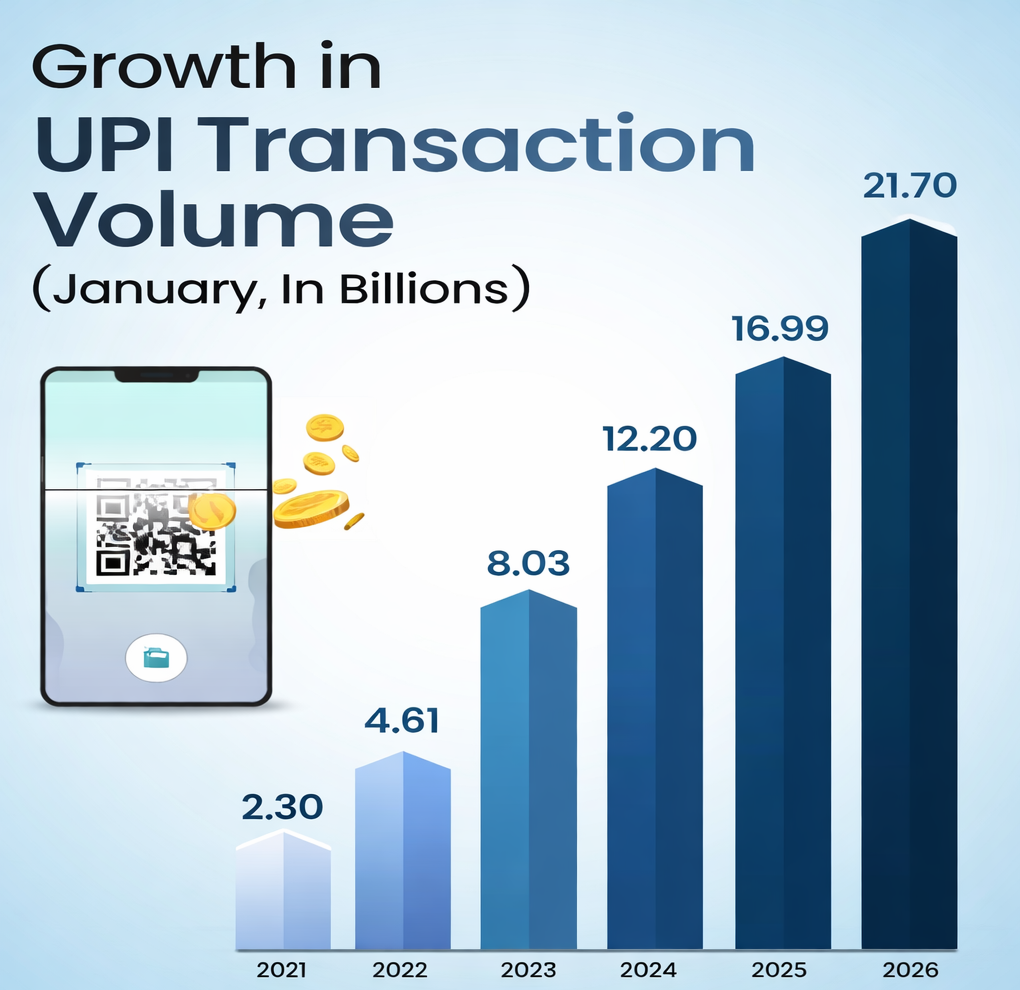
The Government of India recently released a comprehensive progress report (March 2026) titled “The Digital Blueprint for Ease of Doing Business,” highlighting the transformative impact of digital public infrastructure (DPI) on the national economy. Key milestones include the National Single Window System (NSWS) granting over 8.29 lakh approvals and the Unified Payments Interface (UPI) processing a staggering 21.70 billion transactions in January 2026 alone. This update underscores India’s shift toward a “Digital-First” regulatory environment aimed at achieving a $5 trillion economy.
Digital Transformation: The Engine of Business Growth
India has fundamentally reimagined its economic landscape by positioning digital transformation as a vital engine for business growth. Through flagship initiatives such as Digital India and Startup India, the government has pushed for a paradigm shift in regulatory simplification, replacing archaic paper-based processes with seamless, real-time digital interfaces.
Ease of Doing Business (EoDB) is more than a mere ranking; in the context of India’s economic aspirations, it represents a conducive investment climate where entrepreneurship can thrive without the stifling weight of bureaucratic inertia. It encompasses the entire business lifecycle from entry and registration to operational expansion and eventual exit. By harmonising central and state-level reforms through integrated digital platforms, India now offers a world-class gateway where data flows effortlessly across departments, significantly reducing the time and cost of doing business.
Conceptual Framework: Digital Governance and EoDB
Digital governance refers to the application of Information and Communication Technology (ICT) to deliver government services, exchange information, and integrate various standalone systems. In public administration, it serves as a tool for transparency, efficiency, and accountability by removing the “human interface” that often leads to delays or corruption.
Technology-led reforms act as the backbone of modern governance. For instance, the Goods and Services Tax Network (GSTN) serves as a synchronised interface for over a crore of taxpayers, ensuring effortless electronic invoicing and a transparent fiscal framework. Similarly, the digitisation of the Insolvency and Bankruptcy Board of India (IBBI) processes facilitates faster dispute resolution and asset recovery. These digital platforms ensure that “regulations” are no longer hurdles but “facilitators,” providing entrepreneurs with an efficient and reliable gateway to growth.
Key Digital Reforms Improving Ease of Doing Business
India’s digital reform agenda is multifaceted, spanning across clearance systems, taxation, and corporate compliance:
Single Window Digital Clearance Systems: The National Single Window System (NSWS) is a landmark reform that guides businesses in identifying and applying for approvals through a single gateway. It integrates 32 Central Departments and 32 State Governments, offering access to over 698 central and 7,435 state approvals. Additionally, the PARIVESH 3.0 portal has revolutionised environmental clearances by using AI-enabled support and inter-ministerial dashboards to enhance predictability and efficiency.
Digital Taxation Ecosystem: The GSTN platform has unified India’s indirect tax landscape, processing over ₹102.91 lakh crore in payments as of January 2026. Complementing this is the E-Way Bill system, which replaced multiple state-level permits with a single electronic document, effectively removing static border check posts and reducing transport time.
Digital Corporate Compliance: The MCA21 Version 3 project is an AI-driven initiative for the registry and incorporation of companies. Features like e-Scrutiny and e-adjudication ensure end-to-end digital compliance. The SPICe+ Form further simplifies entry by consolidating 10 essential procedures—including DIN allotment, PAN, and GSTIN—into a single integrated web form.
Financial Digital Infrastructure: The Unified Payments Interface (UPI) has become the world’s largest retail fast-payment system, handling 21.70 billion transactions in a single month (January 2026). This, alongside the c-KYC (Central Know Your Customer) Registry, reduces the burden of repetitive documentation for financial transactions.
Logistics and Procurement: PM Gati Shakti provides a unified digital platform with over 1,700 data layers for integrated infrastructure planning. Furthermore, the Government e-Marketplace (GeM) has digitised public procurement, recording over ₹4 lakh crore in order value in FY26.
Impact on Economic Growth and Entrepreneurship
The digitisation of governance has led to a surge in enterprise expansion. The Udyam Registration Portal has facilitated over 7.71 crore registrations, supporting an estimated 33.97 crore jobs as of February 2026. This paperless, self-declaration-based system has empowered the MSME sector, which is the bedrock of Indian entrepreneurship.
Investor confidence is at an all-time high, driven by the transparency of platforms like ICEGATE for customs and the e-CoO 2.0 system for trade efficiency. India’s fintech leadership is also evident globally, with UPI now live in over eight countries, including the UAE, Singapore, and France. These reforms are critical milestones toward the goal of a $5 trillion economy, fostering an environment where startups can scale rapidly through open networks like ONDC (Open Network for Digital Commerce), which promotes inclusivity by reducing dependency on monopolistic platforms.
Challenges and Structural Constraints
Despite significant progress, several structural constraints remain:
Digital Divide: While urban centres thrive, rural areas still face infrastructure gaps in high-speed internet connectivity, affecting the local uptake of digital reforms.
Cybersecurity: As the volume of data grows, ensuring the confidentiality and integrity of information is paramount. While the government adheres to ISO 27001 standards, the evolving nature of cyber threats requires constant vigilance.
Regulatory Overlap: There can be friction between various ministries and state versus central regulations. Although the Business Reforms Action Plan (BRAP) encourages states to simplify procedures, implementation remains uneven across different regions.
Data Privacy: The transition to AI-driven models like MCA21 V3 necessitates a robust data protection framework to prevent the misuse of sensitive corporate and personal information.
Global Comparison and Best Practices
India’s journey can be compared to global leaders:
Estonia: Known for its “e-Estonia” model, it has digitised nearly 99% of public services. India’s API Setu and DPI approach mirror this by allowing different systems to “talk” to each other.
Singapore: Renowned for its efficient regulatory framework, Singapore’s “Networked Trade Platform” is a benchmark India is approaching with the National Logistics Portal (Marine).
Lessons for India: India can adopt more “pro-active” service delivery where the government anticipates business needs based on data trends, moving from a “request-based” to a “delivery-based” model.
Way Forward
To sustain this momentum, the following policy directions are suggested:
Strengthening Infrastructure: Expanding the PM GatiShakti data layers to the district level (D-BRAP) to ensure last-mile connectivity and infrastructure planning.
AI-Based Monitoring: Utilising AI and Machine Learning for real-time regulatory monitoring and e-adjudication, as initiated in MCA21 V3.
Integrated Portals: Further linking GeM with TReDS (Trade Receivables Discounting System) to enhance MSME liquidity and ensure quicker financing.
Cooperative Federalism: Strengthening the Business Reforms Action Plan (BRAP) to ensure that “Aspirer” states (like Uttar Pradesh and Kerala in previous cycles) transition into “Top Achievers” through knowledge sharing.
Capacity Building: Training the bureaucracy to handle cognitive chat-bots and interactive dashboards effectively to resolve grievances faster.
Prelims question:
Q. With reference to India’s digital initiatives to improve the ‘Ease of Doing Business’, consider the following statements:
1.The National Single Window System (NSWS) integrates approval processes across all 28 States and 8 Union Territories in India.
2.The MCA21 Version 3 is an AI-driven platform that includes features such as e-adjudication and a cognitive chatbot-enabled helpdesk.
3.The Udyam Registration Portal for MSMEs is a paperless, self-declaration-based system that is integrated with the GSTN and CBDT databases.
4.India’s Unified Payments Interface (UPI) is currently live and operational in over 15 countries globally.
Which of the statements given above are correct?
A) 1 and 2 only
B) 2 and 3 only
C) 1, 3, and 4 only
D) 1, 2, 3, and 4
Answer: B) 2 and 3 only
Mains Question:
Q. “Digital Governance has emerged as the cornerstone of India’s strategy to enhance its Ease of Doing Business (EoDB) and achieve the goal of a $5 trillion economy.” Critically analyse this statement with reference to the role of Digital Public Infrastructure (DPI) and the Business Reforms Action Plan (BRAP). (250 words, 15 Marks)

- Artemis II: Humanity’s Return to Lunar Space and India’s Place in the New Moon Race - April 2, 2026
- A Missed Opportunity to Guarantee Minimum Wages - March 31, 2026
- ‘India’s Growth Claims, A Clash with Data Reality’. - March 30, 2026

No Comments