


28 Jan India’s Expanding Role in the Global Energy Transition
This article covers “Daily Current Affairs” and From India’s Expanding Role in the Global Energy Transition
SYLLABUS MAPPING
GS– 3- Environment & Ecology : India’s Expanding Role in the Global Energy Transition
FOR PRELIMS
What is India Energy Week (IEW)?
FOR MAINS
Why is energy important for India’s economic development?
Why in the news ?
India Energy Week (IEW) 2026, being held in Goa from 27–30 January 2026, has brought global attention to India’s expanding role in the global energy transition. The event highlights India’s progress in energy governance reforms, infrastructure expansion, biofuels, clean cooking, and low-carbon pathways at a time when India is projected to account for over 23% of global incremental energy demand by 2050.
India’s Energy Imperative in a Changing World
Energy is central to economic growth, social development, and human well-being, supporting industry, transport, agriculture, healthcare, digital connectivity, and household needs. India, the third-largest consumer of crude oil, continues to rely on hydrocarbons for mobility and industrial activity, even as it accelerates its transition to cleaner energy.
India’s energy demand is projected to grow faster than that of most major economies through 2035. To meet this demand sustainably, India has pursued
Policy and regulatory reforms,
Infrastructure expansion, and
Cleaner and diversified energy pathways.
A key milestone was achieved in June 2025, when 50% of India’s cumulative installed electricity capacity came from non-fossil fuel sources, five years ahead of its 2030 NDC target under the Paris Agreement.
Hydrocarbon Energy Governance and Sectoral Reforms
India’s hydrocarbons sector spans upstream, midstream, and downstream segments. Reforms across the value chain aim to enhance efficiency, attract investment, and strengthen energy security while supporting a gradual energy transition.
Upstream Sector Reforms
Oilfield (Regulation and Development) Amendment Act, 2025: Modernises upstream regulation, simplifies procedures, enables integrated energy development, and strengthens investor confidence.
Petroleum and Natural Gas Rules, 2025: Provide a transparent and predictable framework for oil and gas exploration and production, improving ease of doing business.
Under the Hydrocarbon Exploration Licensing Policy (HELP):
172 blocks covering 3.78 lakh sq km were awarded,
Attracting committed investments of USD 4.36 billion, and
Boosting exploration through seismic surveys and drilling programmes.
Midstream and Downstream Reforms
Unified Pipeline Tariff (UPT)
Introduced in 2023 under “One Nation, One Grid, One Tariff”.
Standardises gas transportation charges across the national grid.
As of December 2025, about 90% of operational pipelines are covered, improving gas affordability and competitiveness.
Strengthening Energy Security through Infrastructure Expansion
Fuel and Gas Infrastructure
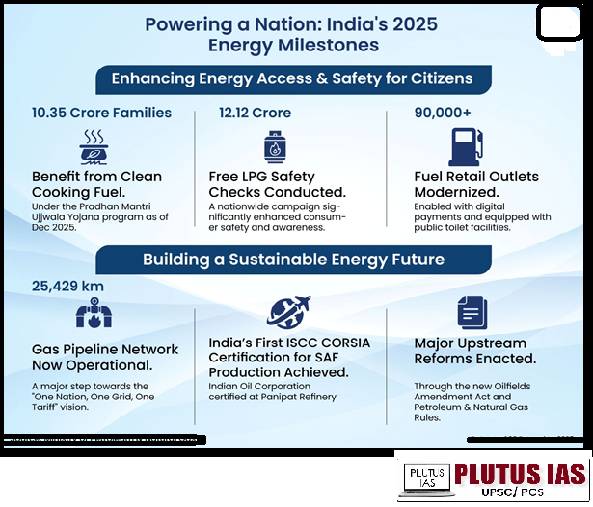
Fuel retail outlets expanded from ~52,000 (2014) to over 1 lakh (2025).
CNG stations increased from 968 to 8,477.
PNG household connections rose from 25 lakh to over 1.59 crore.
Natural gas pipeline network expanded to 25,400 km, with 10,459 km under construction.
Achieved 100% City Gas Distribution (CGD) geographical coverage.
Petroleum Marketing and Electric Mobility
Over 90,000 retail outlets enabled with digital payments.
2.71 lakh POS terminals installed.
3,200 fuel bowsers commissioned for door-to-door delivery.
8,932 EV charging stations installed under FAME-II, with 18,500+ additional chargers set up by OMCs.
Logistics and Wayside Amenities
500+ APNA GHAR facilities for truck drivers.
1,064 integrated Energy Stations operational as of November 2025.
Clean Energy Transition and Low-Carbon Pathways
India is pursuing a diversified transition strategy, combining renewables with alternative and low-carbon fuels.
Biofuels and Ethanol Blending
Foreign exchange savings of ₹1.59 lakh crore since 2014.
Reduction of 813 lakh metric tonnes of CO₂ emissions.
Substitution of 270 lakh metric tonnes of crude oil.
Average ethanol blending reached 19.05% (as of July 2025).
Target of 20% blending advanced to ESY 2025–26.
Clean Cooking Energy (PMUY)
10.41 crore beneficiaries as of January 2026.
Additional 25 lakh LPG connections approved for FY 2025–26.
Subsidy of ₹300 per 14.2 kg cylinder for up to 9 refills annually.
Average LPG consumption increased from 3 refills (2019–20) to 4.85 refills (2025–26).
Sustainable Aviation Fuel (SAF)
Indicative blending targets:
1% from 2027
2% from 2028
5% from 2030
IOCL became the first Indian company to receive ISCC-CORSIA certification for SAF production.
MoU signed with Air India for SAF supply.
India’s Global Energy Leadership
India plays an active and constructive role in global energy governance through its participation in international platforms such as the Global Biofuel Alliance (GBA) and the G20 Energy Transitions Working Group. Through these forums, India shares its experience in implementing scalable, inclusive, and affordable energy transition models, particularly relevant for emerging and developing economies. This engagement enables collective learning on issues of energy access, supply diversification, affordability, and emissions reduction, while reinforcing India’s commitment to cooperative and equitable global climate action.
India Energy Week (IEW) 2026
India Energy Week 2026 is underway in Goa from 27–30 January 2026. Hosted by the Ministry of Petroleum and Natural Gas, the platform highlights India’s expanding role in shaping global energy conversations, particularly from the perspective of emerging and developing economies. The event will see participants from over 120 countries and more than 6,500 conference delegates at a critical moment for global energy markets, geopolitics, and climate action.
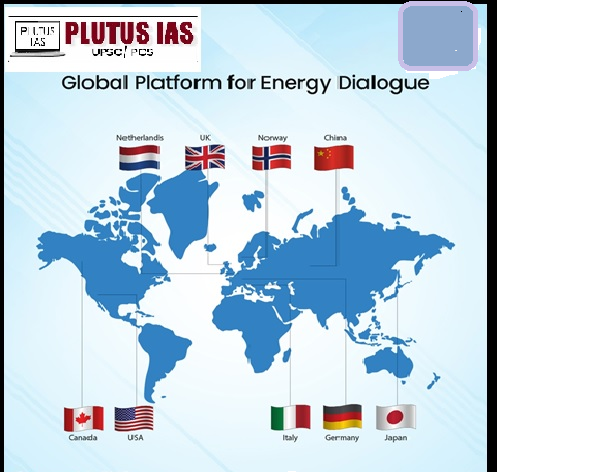
Launched in 2023, India Energy Week has evolved as a platform for international dialogue across the global energy value chain. The fourth edition of the event will bring together energy ministers, top leaders, financial institutions, international organisations, technology providers, and academic institutions to examine issues related to energy security, investment, affordability, and clean energy transition, with perspectives relevant to both emerging and advanced economies.
The IEW 2026 conference programme brings together policy-level discussions and implementation-focused exchanges through its strategic and technical tracks. These discussions will be held on varied issues such as energy security, investment mobilisation, clean energy transition, digital technologies, energy equity, and operational challenges across the energy value chain, including oil and gas, renewable energy, hydrogen, biofuels, carbon capture, power systems, and future mobility.
Conclusion
India’s energy transition reflects a pragmatic, inclusive, and scale-driven approach. Through governance reforms, infrastructure expansion, biofuels, clean cooking initiatives, and international engagement, India has strengthened energy security while reducing emissions intensity. These developments underline India’s commitment to balancing developmental needs with climate action, positioning the country as a key driver of the global energy transition.
Best ias coaching in delhi Best ias coaching in chandigarh
Prelims question:
Q. “India’s energy transition strategy emphasises scale, affordability, and inclusion while balancing energy security and climate goals.” Discuss this statement in the context of recent reforms in India’s energy sector. (250 words)

- Artemis II: Humanity’s Return to Lunar Space and India’s Place in the New Moon Race - April 2, 2026
- A Missed Opportunity to Guarantee Minimum Wages - March 31, 2026
- ‘India’s Growth Claims, A Clash with Data Reality’. - March 30, 2026

No Comments