


28 Feb India’s Journey from Conventional Power to Clean Energy
This article covers “Daily Current Affairs” and From India’s Journey from Conventional Power to Clean Energy.
SYLLABUS MAPPING
GS Paper III – Environment – Infrastructure – Energy -India’s Journey from Conventional Power to Clean Energy.
FOR PRELIMS
What are the major challenges in India’s energy transition?
FOR MAINS
How does renewable energy strengthen India’s energy security?
Why in the News?
India’s non-fossil capacity exceeding 50% and solar reaching 140 GW. It features the SHANTI Act 2025 for nuclear reform and the India Energy Stack digital infrastructure. These milestones showcase India’s transition toward Net Zero 2070 and global energy leadership.
India’s Energy Transition
Energy is the silent backbone of a nation’s advancement, powering every classroom fan, agricultural pump, and hospital light that facilitates economic growth and human development. As India continues its rapid progression, it has established itself as one of the world’s top three energy consumers, with a burgeoning demand that necessitates a robust and reliable supply.
The national focus is currently undergoing a strategic shift from merely addressing energy scarcity to orchestrating a sophisticated energy transition. This evolution is not about an abrupt abandonment of traditional sources but a carefully planned move toward an evolving spectrum of energy that is cleaner, more affordable, and more secure. By prioritizing this transition, India aims to power its future growth while fulfilling its long-term international commitment to achieving Net Zero emissions by 2070. This journey reflects a balanced approach to meeting the needs of a developing economy while assuming a leadership role in global climate responsibility.
Growth in Electricity Demand and Supply
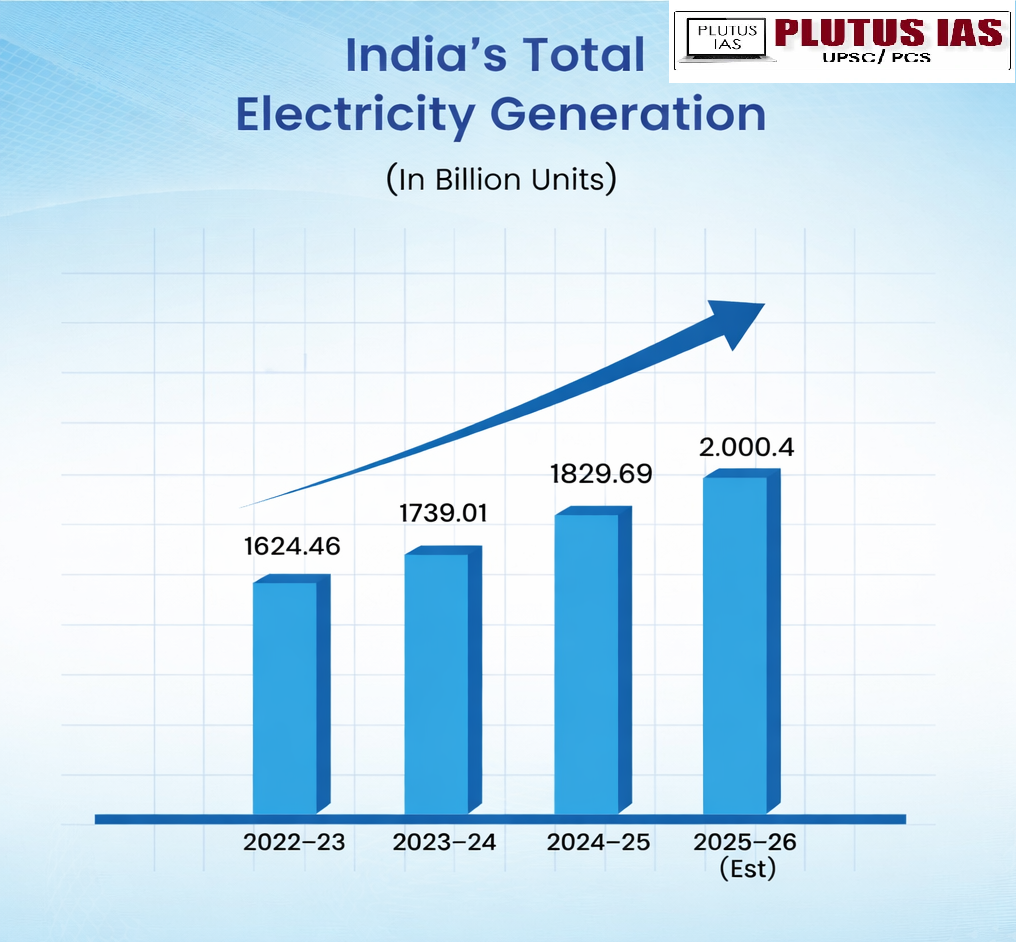
India has witnessed a significant surge in electricity generation to keep pace with its growing economy. Total generation rose from 1,739.09 Billion Units (BU) in 2023–24 to 1,829.69 BU in 2024–25, marking a growth of 5.21%. For the 2025–26 fiscal year, the government has set an ambitious generation target of 2,000.4 BU.
This growth in supply has been accompanied by a dramatic improvement in energy access, linking electricity with inclusive development across the country. Ongoing reforms have substantially increased power availability; rural areas have seen a jump from an average of 12.5 hours in 2014 to 22.6 hours today, while urban availability has reached 23.4 hours. This expansion of the grid has been supported by massive infrastructure investments, such as those under the SAUBHAGYA and DDUGJY schemes, which electrified over 18,374 villages and provided connections to 2.86 crore households. Furthermore, the Revamped Distribution Sector Scheme (RDSS), with an outlay of ₹3.03 lakh crore, is modernizing infrastructure to ensure that this increased capacity translates into a reliable 24×7 supply for all citizens.
India’s Current Energy Mix
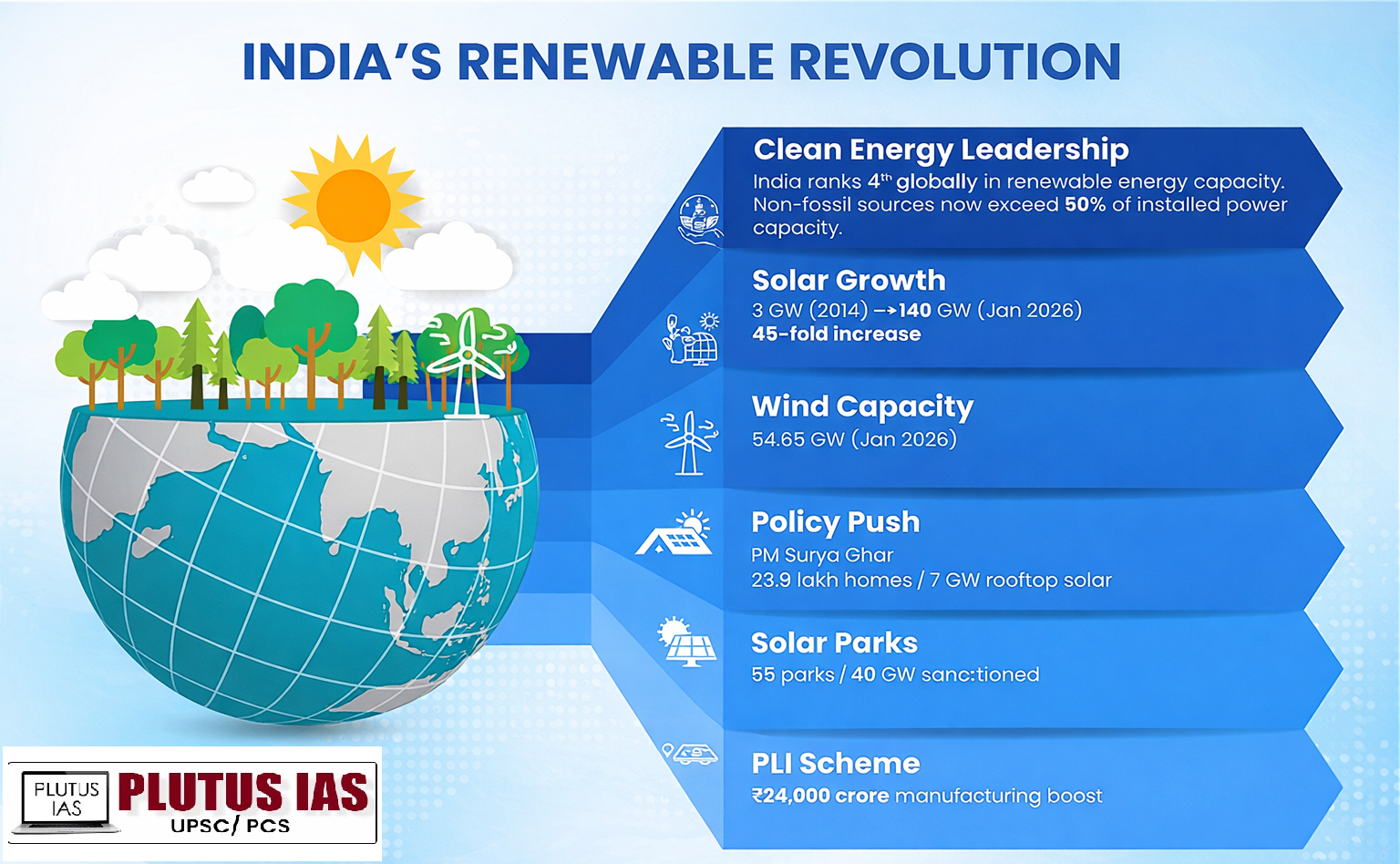
India’s renewable energy (RE) expansion is characterized by unprecedented scale and speed, ranking the country fourth globally in total installed RE capacity. This growth is driven by massive projects like 55 approved solar parks with a sanctioned capacity of 40 GW and specialized wind corridors. Rooftop solar has also become a priority through the PM Surya Ghar scheme, which has already enabled 23.9 lakh households to add 7 GW of clean energy capacity.
The benefits of this expansion extend beyond environmental protection; the Production Linked Incentive (PLI) Scheme, with a ₹24,000 crore outlay, is fostering domestic manufacturing, creating jobs, and reducing import dependence. Globally, India co-founded the International Solar Alliance (ISA), which now includes over 125 member countries, to mobilize finance and technology for solar deployment. Despite this success, the transition faces challenges such as the intermittency of solar and wind, which necessitates advancements in grid integration and storage technology to maintain a stable power flow. By addressing these, India seeks to build a competitive and self-reliant clean energy ecosystem.
Emerging Frontiers: Green Hydrogen & Nuclear Reform
India is pioneering new frontiers in energy through the National Green Hydrogen Mission, which aims to produce 5 MMT of green hydrogen annually by 2030. This mission is critical for decarbonizing “hard-to-abate” sectors like steel, refining, and heavy transport. With an outlay of ₹19,744 crore, the mission is expected to attract over ₹8 lakh crore in investment and significantly reduce fossil fuel imports. Pilot projects for hydrogen-powered mobility are already operational on ten routes.
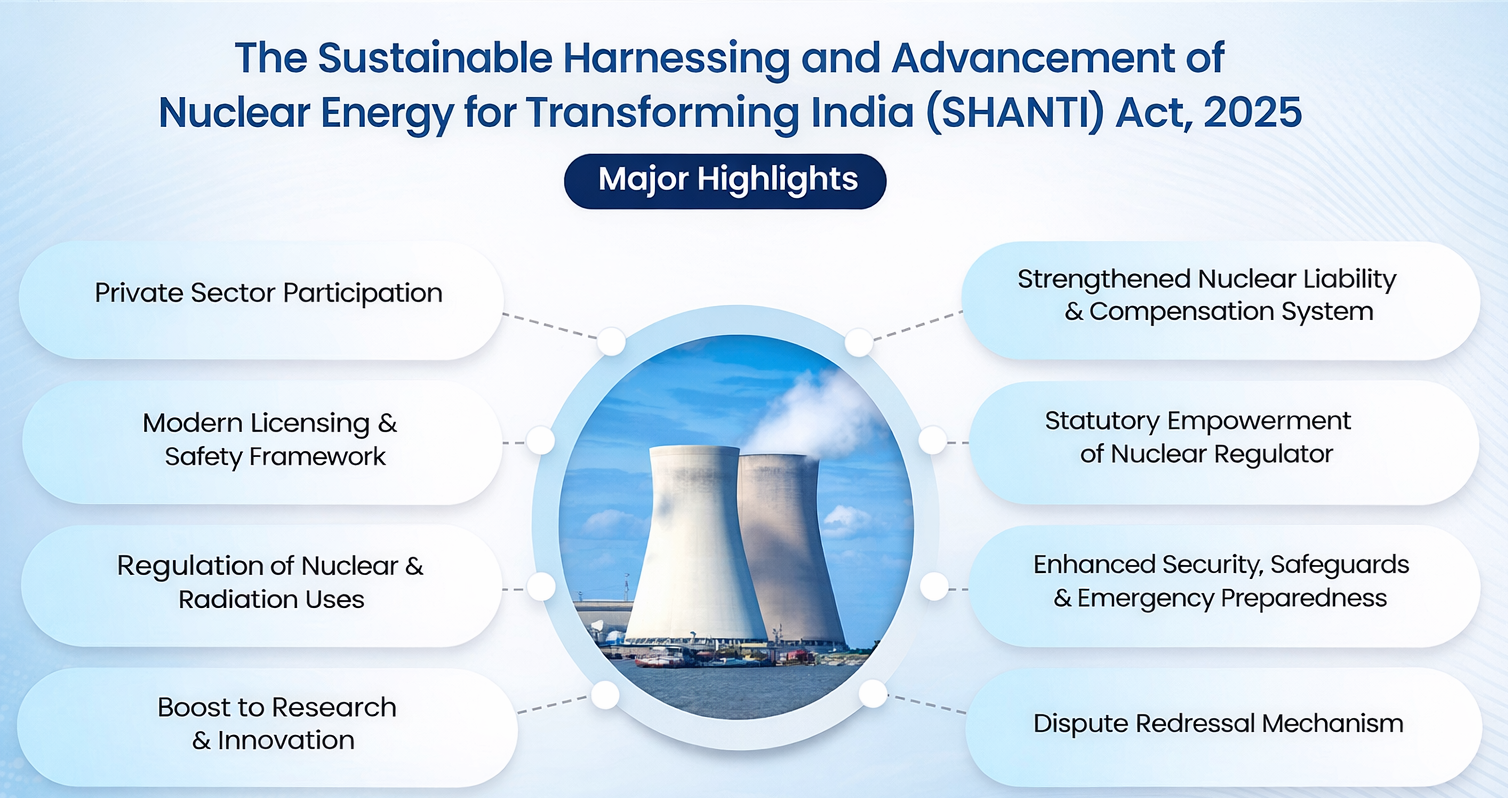
In tandem, the government is modernizing the nuclear sector through the SHANTI Act of 2025. This landmark legislation consolidates the nuclear legal framework, enabling limited private sector participation and introducing a graded liability framework while maintaining sovereign control. Nuclear energy is viewed as a vital, carbon-free baseload power source, with plans to increase capacity to 100 GW by 2047. The mission also includes a ₹20,000 crore allocation for Small Modular Reactors (SMRs), which offer flexible and scalable options for meeting diverse energy demands while upholding stringent safety and security standards.
Power Sector Reforms & Energy Efficiency
The financial and operational health of the power sector is being addressed through comprehensive distribution reforms. The RDSS is currently implementing projects worth ₹2.8 lakh crore to modernize DISCOM infrastructure. A central pillar of this digital transformation is the installation of 5.62 crore smart meters, which improve billing accuracy and reduce commercial losses.
Energy efficiency measures further ensure that growth does not lead to a proportionate rise in emissions. A major policy shift involves transitioning from the Perform, Achieve and Trade (PAT) scheme to the Carbon Credit Trading Scheme (CCTS), creating a market incentive for industries to meet greenhouse gas intensity targets. At the consumer level, the UJALA programme has been a massive success, distributing 36.87 crore LED bulbs and saving 47,883 million kWh of energy annually. These efforts are supplemented by the India Energy Stack (IES), a digital public infrastructure designed to empower consumers to become active participants in the energy market by monetizing assets like rooftop solar and batteries.
Challenges in Energy Transition
The transition to a clean energy future presents significant hurdles. The financing requirements are immense; for instance, the Green Hydrogen Mission alone requires investments exceeding ₹8 lakh crore. Moving away from coal dependency is a complex task that requires a “just transition” to ensure economic stability for regions currently reliant on fossil fuels.
Technological and logistical challenges also persist. The intermittency of renewable sources like solar and wind makes storage technology and grid modernization essential for maintaining reliability. While the sources do not explicitly detail land acquisition issues, they highlight the difficulty of decarbonizing intensive industries such as steel and shipping. Furthermore, India’s climate vulnerability necessitates a balanced approach where growth and sustainability move together, ensuring that the energy system remains resilient against future environmental pressures while meeting the country’s vast developmental needs.
Way Forward
India’s roadmap involves a balanced energy mix where solar, wind, nuclear, and green hydrogen work in concert to provide secure and affordable power. A key priority is grid modernization through the India Energy Stack, which uses open standards to enable better coordination between utilities and consumers. Innovation in storage and battery technology is also crucial to manage the variability of renewables.
The strategy emphasizes policy stability through legislative updates like the proposed Electricity (Amendment) Bill and the National Electricity Policy 2026, both of which aim for a financially viable and sustainable sector. Community participation is being fostered by empowering individuals to earn from the transition via rooftop solar and EV chargers. Ultimately, these domestic efforts are aligned with India’s international Roadmap to Net Zero 2070, as the country continues to lead global initiatives like the Global Biofuels Alliance and the International Solar Alliance.
Conclusion
India’s energy transformation is a gradual and structured transition, not a sudden replacement of existing systems. It is a layered process that combines infrastructure investment, technological innovation, and robust policy reform. By linking this transformation with both development and sustainability, India is demonstrating that a nation can power its economic growth while simultaneously acting with climate responsibility.
The milestones achieved from surpassing 50% non-fossil capacity to launching the National Green Hydrogen Mission reflect a commitment to a secure, affordable, and clean energy future. India is not merely generating more power; it is fundamentally redesigning how that power is produced and shared, ensuring a resilient and self-reliant system that is prepared for the needs of the future.
Prelims question:
Q. With reference to India’s energy sector and recent policy initiatives, consider the following statements:
1.According to the International Renewable Energy Agency (IRENA), India currently ranks second globally in total installed renewable energy capacity.
2.Under the government’s notified standards, hydrogen is classified as “green” only if total emissions do not exceed 2 kg of CO₂ equivalent for every 1 kg of hydrogen produced.
3.The SHANTI Act, 2025 provides statutory recognition to the Atomic Energy Regulatory Board (AERB) and allows for limited private sector participation.
4.The India Energy Stack (IES) is a physical infrastructure project aimed at building a national grid for green hydrogen pipelines.
Which of the statements given above are correct?
(A) 1 and 2 only
(B) 2 and 3 only
(C) 1, 3, and 4 only
(D) 2, 3, and 4 only
Answer: (B) 2 and 3 only
Mains Question:
Q. “India’s energy journey is no longer defined by a single source but by an evolving spectrum that balances growth with sustainability.” In the light of this statement, analyse how the integration of nuclear reforms and digital public infrastructure is expected to redefine India’s energy security and its path to Net Zero 2070. (250 words)

- Artemis II: Humanity’s Return to Lunar Space and India’s Place in the New Moon Race - April 2, 2026
- A Missed Opportunity to Guarantee Minimum Wages - March 31, 2026
- ‘India’s Growth Claims, A Clash with Data Reality’. - March 30, 2026

No Comments