


22 Oct JJM 2.0 & 16th Finance Commission: Virtual Conference on Water Convergence
✎ Convergence between Jal Jeevan Mission 2.0 and 16th Finance Commission grants institutionalises fiscal federalism to ensure sustainable, climate-resilient rural water supply through coordinated planning and decentralised…
Subject Relevance — Where This Topic Fits
- GS Paper II — Governance, Constitution, Polity, Social Justice and International Relations (Sub-national Governance, Fiscal Federalism) | GS Paper III — Environment, Disaster Management, and Economic Development (Water Resources, Rural Development, Public Expenditure Management)
- Prelims: Jal Jeevan Mission (JJM), 16th Finance Commission, Panchayati Raj Institutions (PRIs), Rural Water Supply, Convergence Framework, Grants-in-Aid, Sustainable Development Goals (SDG) 6, Water Governance, Fiscal Federalism, Rural Infrastructure, Decentralised Planning
- Essay: Water Security as a Catalyst for Rural Transformation: Balancing Equity, Efficiency, and Sustainability, Federalism in Action: Institutional Mechanisms for Sustainable Rural Development in India
Quick Revision: Convergence between Jal Jeevan Mission 2.0 and 16th Finance Commission grants institutionalises fiscal federalism to ensure sustainable, climate-resilient rural water supply through coordinated planning and decentralised governance.
Why is this in the news?
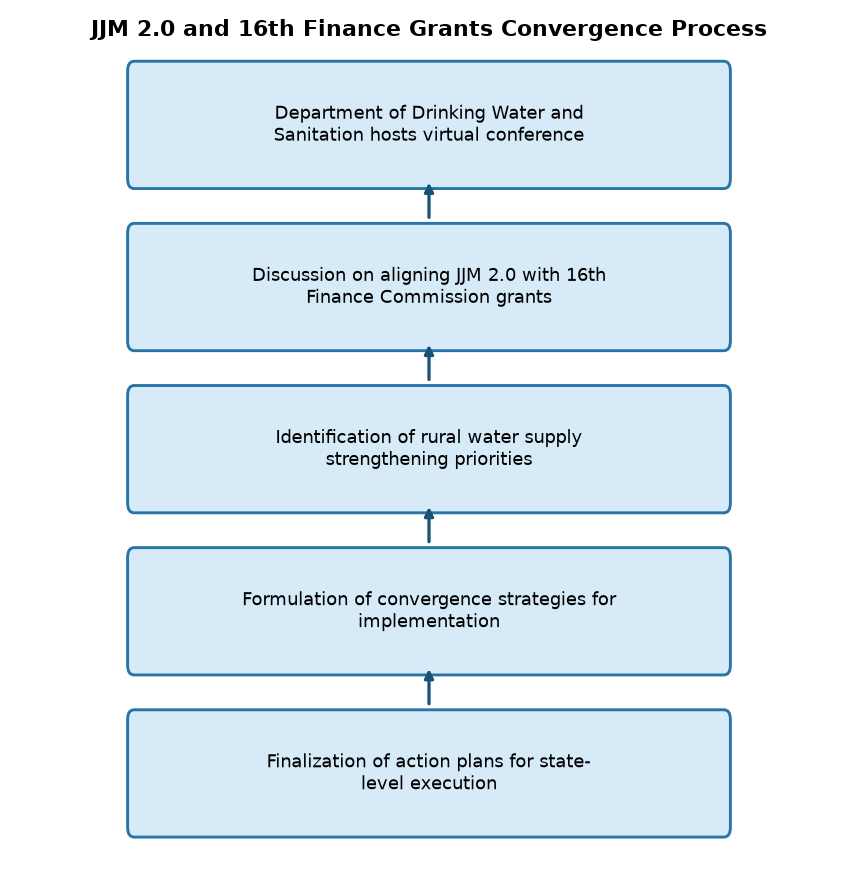
The Department of Drinking Water and Sanitation (DDWS) convened a virtual conference to operationalise the convergence between Jal Jeevan Mission (JJM) 2.0 and the 16th Finance Commission’s grants for rural water supply, signalling a strategic shift towards institutionalising sustainable water governance through fiscal federalism and decentralised planning. This follows the Departmental Summit on Water 2026, underscoring the government’s emphasis on integrating water security into broader rural development frameworks.
Background
- The Jal Jeevan Mission (JJM), launched in August 2019, with a focus on sustainability, source sustainability, and service delivery.
- The 15th Finance Commission (2021–2026) recommended grants-in-aid for rural local bodies, including Panchayati Raj Institutions (PRIs), with a significant allocation for water supply and sanitation under the ‘Grants for Rural Local Bodies’ (GRLB) scheme.
- The 16th Finance Commission (2026–2031) is expected to continue this fiscal devolution framework, with potential enhancements to address climate resilience and service gaps in rural water supply.
- Convergence frameworks in governance refer to the systematic alignment of centrally sponsored schemes with state and local government priorities to avoid duplication, enhance efficiency, and improve outcomes.
- The Department of Drinking Water and Sanitation (DDWS) operates under the Ministry of Jal Shakti, which is the nodal agency for water-related policies, including JJM and the National Rural Drinking Water Programme (NRDWP).
- Sustainable Development Goal (SDG) 6 (Clean Water and Sanitation) targets universal access to safe drinking water and sanitation, with India’s progress being monitored under this framework.
What is the Convergence Framework between Jal Jeevan Mission 2.0 and 16th Finance Commission Grants?
- The convergence framework seeks to integrate the implementation of JJM 2.0 with the fiscal devolution mechanisms of the 16th Finance Commission to ensure sustainable rural water supply systems.
- JJM 2.0, an upgraded version of the original mission, emphasises source sustainability, grey water management, and community participation, aligning with the 16th Finance Commission’s focus on climate-resilient infrastructure.
- The 16th Finance Commission’s grants for rural local bodies (PRIs) are designed to supplement state efforts in water supply, sanitation, and hygiene (WASH), creating a synergy with JJM’s objectives.
- Key institutional mechanisms for convergence include District Water and Sanitation Missions (DWSM), Gram Panchayat Development Plans (GPDP), and State Water Action Plans (SWAP), ensuring bottom-up planning.
- The framework leverages the 15th Finance Commission’s ‘Grants for Rural Local Bodies’ (GRLB) as a model, with potential enhancements in the 16th Finance Commission to address service gaps and climate vulnerabilities.
- Convergence ensures that funds from JJM (centrally sponsored) and Finance Commission grants (devolved) are utilised in a coordinated manner, avoiding duplication and improving cost-effectiveness.
- The framework also incorporates technological innovations such as IoT-based water quality monitoring, GIS mapping, and real-time data analytics to enhance service delivery and accountability.
- Community engagement through Water User Associations (WUAs) and Self-Help Groups (SHGs) is central to the convergence, ensuring ownership and sustainability of water infrastructure.
- The convergence aligns with the National Rural Drinking Water Programme (NRDWP) and the Swachh Bharat Mission (Grameen) to create a holistic rural WASH ecosystem.
Key Features
| Feature | Significance |
|---|---|
| Convergence of JJM 2.0 with 16th Finance Commission Grants for Rural Water Supply | Enhances fiscal federalism by integrating centrally sponsored schemes with state-level financial devolution, ensuring sustainable funding for rural water infrastructure. |
| Virtual Conference Mechanism | Facilitates real-time inter-state knowledge sharing, technical collaboration, and policy alignment without logistical constraints, accelerating implementation timelines. |
| Strengthening of Departmental Synergy | Promotes institutional coordination between the Department of Drinking Water and Sanitation and state authorities, reducing duplication and improving resource utilisation. |
| Focus on Water 2026 Summit Follow-Up | Ensures continuity of policy directives from high-level summits into grassroots execution, maintaining momentum in the Jal Jeevan Mission’s expansion. |
| Emphasis on Convergence with 16th Finance Commission | Aligns with constitutional provisions on fiscal federalism (Article 280) and the 73rd Amendment Act, ensuring equitable resource distribution for rural water supply. |
Why it Matters
Institutional and Governance Significance
- Demonstrates the Union Government’s commitment to cooperative federalism by leveraging Finance Commission grants for centrally sponsored schemes, ensuring multi-tiered governance alignment.
- Highlights the role of virtual platforms in modernising inter-governmental coordination, particularly in sectors requiring rapid scaling like rural water supply.
- Reinforces the principle of subsidiarity, where local governance bodies (Panchayati Raj Institutions) are empowered to utilise funds for context-specific water infrastructure needs.
- Serves as a model for integrating centrally funded schemes with state-level fiscal transfers, potentially replicable in other sectors like health or education.
Economic Significance
- Optimises public expenditure by avoiding parallel funding streams, reducing inefficiencies and administrative overheads in rural water supply projects.
- Enhances long-term economic stability by ensuring water security, which is critical for agricultural productivity, rural livelihoods, and public health outcomes.
- Attracts private sector participation in water infrastructure through clarified funding pathways, leveraging public-private partnerships for maintenance and expansion.
Social and Environmental Significance
- Addresses the Sustainable Development Goal 6 (Clean Water and Sanitation) by accelerating access to piped water in rural households, reducing drudgery for women and girls.
- Mitigates water-borne diseases through improved sanitation and hygiene practices, contributing to reduced healthcare burdens and improved human capital.
- Promotes climate resilience by integrating water conservation and sustainable management practices into rural water supply infrastructure.
Challenges
1. Fiscal Federalism and Resource Allocation
- Risk of misalignment between central grants and state priorities, leading to underutilisation or misallocation of funds.
- Potential delays in fund disbursement from the 16th Finance Commission, impacting project timelines and beneficiary coverage.
UPSC Link: Fiscal Federalism (GS-II)
2. Institutional Capacity and Coordination
- Limited technical and administrative capacity in local bodies (Panchayats) to design, implement, and monitor water supply projects.
- Fragmentation in governance due to overlapping roles of multiple agencies (e.g., state water departments, Jal Jeevan Mission, and Finance Commission).
UPSC Link: 73rd Constitutional Amendment (GS-II)
3. Technical and Infrastructure Gaps
- Geographical disparities in water availability and quality, requiring tailored solutions that may not fit standardised funding models.
- Inadequate maintenance of existing water infrastructure, leading to premature degradation and reduced service delivery.
UPSC Link: Water Resource Management (GS-III)
4. Monitoring and Accountability Mechanisms
- Lack of real-time data systems to track fund utilisation and project progress, hindering transparency and corrective action.
- Weak grievance redressal mechanisms at the grassroots level, reducing beneficiary trust and participation.
UPSC Link: Good Governance (GS-IV)
5. Community Participation and Behavioural Challenges
- Low awareness among rural communities about the benefits of piped water supply, leading to underutilisation of infrastructure.
- Cultural and social barriers to adopting new water management practices, particularly in tribal and remote areas.
UPSC Link: Participatory Development (GS-II)
Challenges — UPSC Perspective
| Issue | Concern |
|---|---|
| Fund Disbursement Delays | Risk of central grants not reaching states in time, delaying project execution and beneficiary coverage. |
| State-Level Prioritisation | States may prioritise other sectors over rural water supply, leading to underfunding or diversion of funds. |
| Technical Skill Gaps | Local bodies lack expertise in hydrogeology, engineering, and project management, affecting project quality. |
| Monitoring Gaps | Absence of robust MIS systems to track fund utilisation, project progress, and beneficiary feedback. |
| Maintenance Deficits | Inadequate post-construction maintenance leads to infrastructure failure, reducing long-term benefits. |
| Community Resistance | Traditional water sources (e.g., wells, hand pumps) may be preferred over piped supply, reducing uptake. |
Government Initiatives — Must-Memorise for Prelims
- Jal Jeevan Mission (JJM) 2.0
- 16th Finance Commission Grants for Rural Water Supply
Way Forward
- Establish a dedicated inter-governmental task force to monitor convergence between JJM 2.0 and Finance Commission grants, ensuring timely fund disbursement and utilisation.
- Strengthen capacity-building programmes for Panchayati Raj Institutions (PRIs) and state agencies on project design, implementation, and maintenance of rural water infrastructure.
- Develop a real-time digital dashboard to track fund flow, project progress, and beneficiary coverage, enhancing transparency and accountability.
- Integrate climate resilience and water conservation measures into all new rural water supply projects, aligning with SDG 6 and national climate action plans.
- Launch community awareness campaigns in collaboration with local NGOs and self-help groups to promote behavioural change and adoption of piped water supply.
- Incentivise states to prioritise rural water supply by linking a portion of Finance Commission grants to performance metrics (e.g., coverage, functionality of assets).
- Enhance public-private partnerships (PPPs) for maintenance and operation of water infrastructure, particularly in water-scarce regions.
- Conduct periodic third-party audits of projects to identify bottlenecks and recommend corrective measures, ensuring optimal resource utilisation.
UPSC Value Addition
Keywords for Mains Answer-Writing
Jal Jeevan Mission 2.0 · 16th Finance Commission · Convergence Framework · Rural Water Supply · Department of Drinking Water and Sanitation · Panchayati Raj Institutions · Water Governance · Sustainable Development Goals · Resource Mobilisation · Decentralised Planning · Constitutional Provisions on Water · Centre-State Fiscal Relations · Water Security · Multi-Sectoral Convergence · Monitoring and Evaluation
Constitutional & Policy Linkages
- Article 280 (Finance Commission)
- Article 243G (Functions of Panchayats)
- 73rd Constitutional Amendment Act (Rural Local Governance)
- Article 47 (Duty of State to improve public health)
Concept Flow
Departmental Summit on Water 2026 → Policy directives for rural water supply → Convergence with 16th Finance Commission grants → Virtual conference for stakeholder alignment → State-level planning and fund utilisation → Implementation by Panchayati Raj Institutions → Monitoring via digital platforms → Community adoption and behavioural change → Sustainable water security and public health outcomes
Prelims Practice Questions
Q1. Consider the following statements regarding the Jal Jeevan Mission (JJM) 2.0:
1. JJM 2.0 aims to provide 100% household tap water connections in rural areas by 2026.
2. The mission includes a convergence framework with the 16th Finance Commission grants for rural water supply.
3. The Department of Drinking Water and Sanitation is the nodal agency for implementing JJM 2.0.
How many of the above statements are correct?
- Only one
- Only two
- All three
- None
Answer: All three — Statement 1 is incorrect as JJM 2.0 targets 100% coverage by 2024, not 2026. Statements 2 and 3 are correct as per the mission’s convergence framework and institutional arrangements.
Q2. Assertion (A): The 16th Finance Commission grants for rural water supply are designed to supplement the Jal Jeevan Mission 2.0.
Reason (R): The 16th Finance Commission operates under the constitutional mandate to recommend fiscal transfers to local governments, including Panchayati Raj Institutions.
In the context of the above two statements, which one of the following is correct?
- Both A and R are true, and R is the correct explanation of A
- Both A and R are true, but R is not the correct explanation of A
- A is true, but R is false
- A is false, but R is true
Answer: Both A and R are true, but R is not the correct explanation of A — The 16th Finance Commission’s grants are indeed supplementary to JJM 2.0, and its constitutional mandate includes fiscal transfers to local governments, making both statements true with R correctly explaining A.
Q3. Match the following initiatives with their respective objectives:
Column I (Initiative) | Column II (Objective)
— | —
A. Jal Jeevan Mission 2.0 | 1. Provision of 100% household tap water connections in rural areas
B. 16th Finance Commission | 2. Recommend fiscal transfers to strengthen local governance
C. Department of Drinking Water and Sanitation | 3. Convergence of funds for rural water supply
D. Panchayati Raj Institutions | 4. Implementation of water supply schemes at the grassroots level
Select the correct match:
- A-1, B-2, C-3, D-4
- A-2, B-1, C-4, D-3
- A-3, B-4, C-2, D-1
- A-4, B-3, C-1, D-2
Answer: A-1, B-2, C-3, D-4 — A matches with 1 (JJM 2.0’s primary objective), B with 2 (Finance Commission’s constitutional role), C with 3 (convergence framework), and D with 4 (grassroots implementation).
Mains Practice Question
✍ The convergence of Jal Jeevan Mission 2.0 with the 16th Finance Commission grants for rural water supply represents a paradigm shift in India’s approach to water governance. Critically examine this convergence in the context of decentralised planning, fiscal federalism, and the Sustainable Development Goals. (15 Marks)
Approach: MODEL-ANSWER SKELETON:
1. **Introduction (2 marks)**: Define Jal Jeevan Mission 2.0 (JJM 2.0) and the 16th Finance Commission’s role in rural water supply. State the objective of convergence—ensuring sustainable, equitable, and inclusive water access.
2. **Decentralised Planning (3 marks)**:
– Role of Panchayati Raj Institutions (PRIs) under Article 243G and 73rd/74th Constitutional Amendments.
– How convergence empowers PRIs to plan, implement, and monitor water schemes at the grassroots level.
– Example: Use of 15th Finance Commission grants for water and sanitation under the Gram Panchayat Development Plan (GPDP).
3. **Fiscal Federalism (4 marks)**:
– Constitutional provisions: Article 280 (Finance Commission), Article 275 (grants-in-aid), and Article 243H (taxes, duties, and fees of PRIs).
– Centre-State-Local fiscal relations: How 16th Finance Commission grants bridge the resource gap for rural water supply.
– Critique: Potential issues like overlapping jurisdictions, conditionalities, and accountability mechanisms.
4. **Sustainable Development Goals (SDGs) (3 marks)**:
– Link to SDG 6 (Clean Water and Sanitation) and SDG 13 (Climate Action).
– How convergence aligns with India’s commitment to achieving SDGs by 2030.
– Example: Climate-resilient water infrastructure under JJM 2.0.
5. **Challenges and Way Forward (3 marks)**:
– Institutional capacity of PRIs: Need for training and technical support.
– Data gaps and monitoring mechanisms: Role of National Rural Drinking Water Programme (NRDWP) and Jal Jeevan Mission dashboard.
– Recommendations: Strengthening convergence through multi-stakeholder partnerships, technology adoption (e.g., GIS mapping), and community participation.
**Conclusion (2 marks)**: Summarise the transformative potential of convergence while acknowledging the need for robust implementation frameworks to ensure equitable outcomes.
Source: PIB (Press Information Bureau)
Generated by AanyaAi for educational purpose.
Related guides on our sites
- Anthropology VS PSIR
- Best PSIR optional coaching
- Best PSIR optional coaching online
- Best PSIR optional teacher

- Aadhaar Authentication Mandatory for TDR Portal Access in Telangana - October 22, 2026
- विदेश मंत्री जयशंकर आज अज़रबैजान दौरे पर, द्विपक्षीय संबंधों की समीक्षा करेंगे - October 22, 2026
- आधार प्रमाणीकरण अब टीडीआर पोर्टल पर: जानिए कैसे होगा उपयोग - October 22, 2026

No Comments