


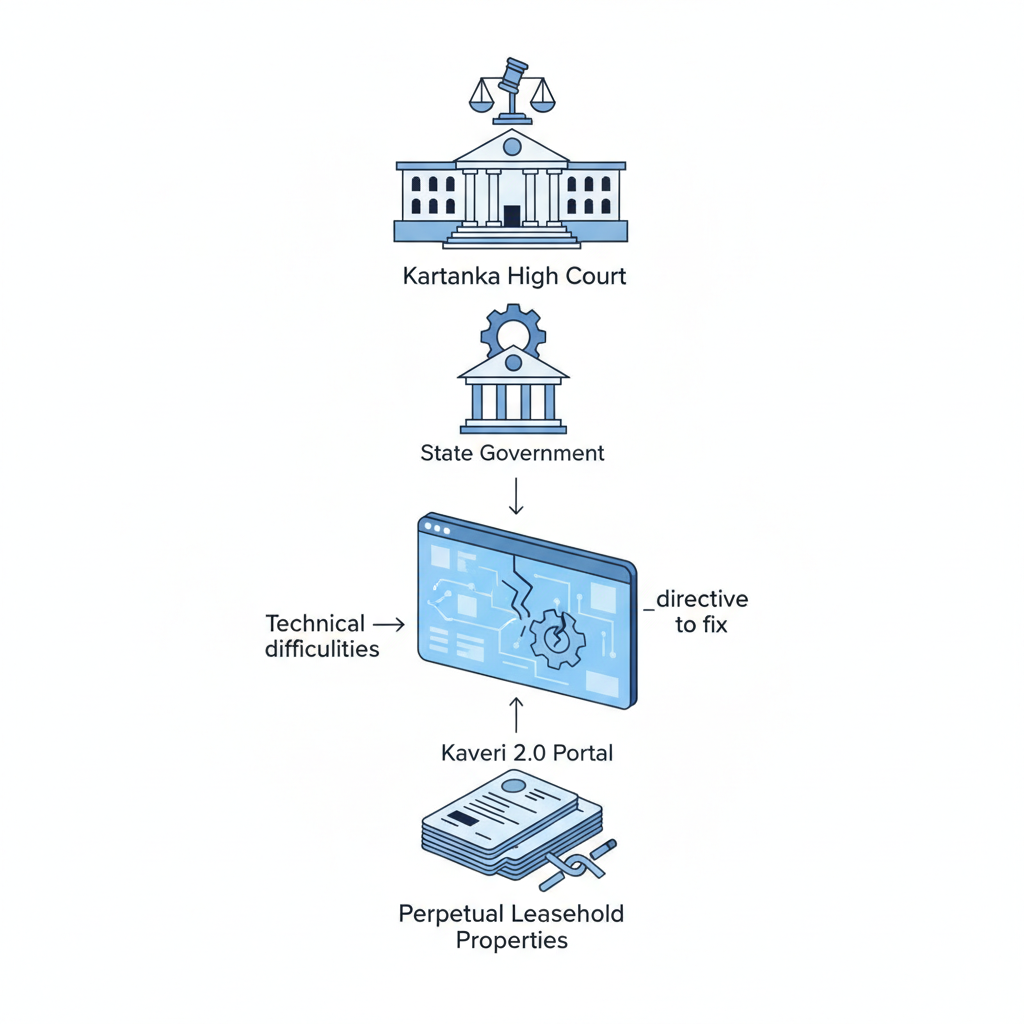
05 Sep Karnataka HC directs state to fix Kaveri 2.0 portal flaws for perpetual leaseholds
✎ A software system, while facilitating governance, cannot extinguish or restrict substantive property rights guaranteed under the Constitution; procedural defects must be rectified expeditiously to uphold legal and constitutional…
Subject Relevance — Where This Topic Fits
- GS Paper II — Functions and Responsibilities of the Union and the States, Issues and Challenges Pertaining to the Federal Structure | GS Paper III — Land Reforms in India, Role of Technology in Governance
- Prelims: Kaveri 2.0 portal, perpetual leasehold (Nirantara Patta), land registration, API mapping, substantive rights vs procedural defects
- Essay: The interface between technology and justice: Balancing efficiency with constitutional rights in governance
Quick Revision: A software system, while facilitating governance, cannot extinguish or restrict substantive property rights guaranteed under the Constitution; procedural defects must be rectified expeditiously to uphold legal and constitutional safeguards.
Why is this in the news?
The Karnataka High Court has directed the State government to rectify technical flaws in the Kaveri 2.0 portal within two months, citing that procedural defects in the software cannot extinguish or restrict the substantive property rights of citizens holding perpetual leasehold interests. The directive underscores the constitutional principle that technology, while facilitating governance, must not undermine legally recognised rights, particularly in property transactions involving perpetual leaseholds such as Nirantara Patta.
Background
- Perpetual leasehold arrangements, such as Nirantara Patta in Karnataka, confer transferable and inheritable rights to lessees, though ownership remains with the lessor (typically the State or a public authority).
- The Kaveri 2.0 portal was introduced by the Karnataka State government to streamline land and property registration processes, replacing the older Kaveri system.
- Technical mapping defects in the portal have led to discrepancies where the original lessor’s name is reflected as the ‘owner’ in municipal records, while the leaseholder’s name is not recognised, preventing registration of legitimate transactions.
- The issue has disproportionately affected the Belagavi region, where a significant number of properties are held under perpetual leasehold arrangements.
- The court’s intervention follows representations from the Confederation of Real Estate Developers’ Associations of India (CREDAI)-Belagavi and communications from registration authorities highlighting systemic difficulties in registering such properties.
- The principle that procedural defects cannot override substantive rights is rooted in constitutional jurisprudence, particularly in the context of property rights under Article 300A of the Constitution.
What is the Kaveri 2.0 portal and its significance in land governance?
- Kaveri 2.0 is a web-based land and property registration portal launched by the Karnataka government to digitise and streamline the process of land and property transactions, including registration, mutation, and issuance of encumbrance certificates.
- The portal integrates with municipal and revenue records to facilitate seamless transactions, reducing delays and enhancing transparency in land governance.
- Perpetual leasehold properties, such as those under Nirantara Patta, are legally recognised as transferable and inheritable, though ownership vests with the lessor (e.g., State government or municipal bodies).
- The portal’s technical mapping defect arises from an API integration issue where the original lessor’s name is incorrectly reflected as the ‘owner’ in the system, while the leaseholder’s name is not recognised, leading to registration failures.
- The court’s observation that a software system is a means for implementation of the law, not a source for extinguishing rights, reinforces the constitutional safeguard under Article 300A, which protects property rights from arbitrary state action.
- The directive highlights the need for robust data governance in digital public infrastructure, ensuring that technological solutions do not inadvertently erode legally established rights.
- The issue exemplifies the challenges in transitioning from manual to digital governance, particularly in states with diverse land tenure systems such as Karnataka.
- The court’s timeline of two months for rectification underscores the urgency of addressing systemic defects to prevent further erosion of citizens’ rights.
Key Features
| Feature | Significance |
|---|---|
| Kaveri 2.0 Portal | Digital platform for property registration in Karnataka, replacing legacy systems with automated workflows. |
| Perpetual Leasehold (Nirantara Patta) | A legally recognised land tenure system in Karnataka where the lessee holds transferable rights, distinct from ownership. |
| Technical Mapping Defect | Flaw in API integration that misclassifies leaseholders as ‘holders/taxpayers’ instead of ‘owners’, blocking registrations. |
| Substantive Property Rights | Constitutional and statutory protections for legally valid property interests, unaffected by implementation flaws. |
| Judicial Intervention | High Court’s directive to rectify software defects within two months, upholding citizens’ rights to property transfer. |
Why it Matters
Legal and Governance
- Reinforces the principle that technological systems must align with statutory rights; software cannot override substantive legal entitlements.
- Highlights the judiciary’s role in safeguarding property rights against administrative inefficiencies.
- Demonstrates the need for inter-departmental coordination between revenue, municipal, and registration authorities to maintain data integrity.
Economic
- Disruptions in property registration impede real estate transactions, affecting investment flows and construction sector stability.
- Delays in registration increase transaction costs and legal uncertainties for buyers and developers.
- Perpetual leasehold properties form a significant segment in Karnataka’s urban land market, particularly in Belagavi.
Technological
- Exposes vulnerabilities in digital governance systems where legacy data mapping fails to reflect current legal realities.
- Underscores the importance of API-driven interoperability between land records, municipal databases, and registration portals.
- Emphasises the need for periodic audits and updates to prevent systemic bottlenecks in e-governance platforms.
Challenges
1. Technological Integration Flaws
- API misclassification of leaseholders as ‘holders/taxpayers’ instead of ‘owners’, leading to registration denials.
- Inadequate data synchronisation between municipal records and the Kaveri 2.0 portal.
- Lack of real-time validation mechanisms to detect and rectify mapping errors before they impact transactions.
UPSC Link: GS-II: E-governance- applications, models, successes, limitations, and potential
2. Legal Recognition vs. Implementation Gap
- Discrepancy between the legal validity of perpetual leasehold rights and their operationalisation in digital systems.
- Risk of arbitrary denial of registration due to software constraints, despite clear statutory backing for leasehold transfers.
- Need for standardised definitions and data fields across all land-related digital platforms to prevent inconsistencies.
UPSC Link: GS-II: Fundamental Rights (Article 19(1)(f) and Article 300A)
3. Administrative Coordination Deficits
- Fragmented responsibility among revenue, municipal, and registration departments leading to data silos.
- Delayed response to identified technical issues due to bureaucratic inertia.
- Insufficient stakeholder consultation during the design and rollout of Kaveri 2.0, exacerbating implementation challenges.
UPSC Link: GS-II: Role of Civil Services in Policy Implementation
4. Access to Justice
- Over-reliance on judicial intervention for systemic issues, placing undue burden on citizens.
- Potential for prolonged litigation if similar defects persist across other digital governance platforms.
- Need for proactive grievance redressal mechanisms within administrative frameworks.
UPSC Link: GS-II: Judiciary and Judicial Review
Challenges — UPSC Perspective
| Issue | Concern |
|---|---|
| API Data Mapping Error | Leaseholders misclassified as ‘holders/taxpayers’, blocking registrations despite valid rights. |
| Legacy System Incompatibility | Kaveri 2.0 fails to integrate seamlessly with existing municipal and revenue records. |
| Lack of Automated Validation | No real-time checks to flag and correct data inconsistencies before processing. |
| Delayed Rectification | Administrative delays in addressing technical flaws, prolonging disruptions. |
| Inter-Departmental Silos | Poor coordination between revenue, municipal, and registration authorities. |
| Risk of Arbitrary Denials | Potential misuse of software flaws to deny legitimate property transfers. |
Way Forward
- Constitute a multi-departmental task force to audit and rectify API mapping defects in Kaveri 2.0 within the stipulated two-month deadline.
- Develop standard operating procedures (SOPs) for synchronising municipal, revenue, and registration databases to prevent future inconsistencies.
- Implement automated validation checks in Kaveri 2.0 to flag and resolve data classification errors in real time.
- Conduct periodic training for registration officers on legal nuances of perpetual leasehold rights and their digital registration process.
- Establish a dedicated grievance redressal cell within the Revenue Department to address registration-related disputes promptly.
- Introduce a pilot phase for API integration testing with select municipal bodies before statewide rollout of any future updates.
- Ensure transparency by publishing a public dashboard tracking the status of Kaveri 2.0 rectifications and registration backlogs.
- Incorporate stakeholder feedback from developers’ associations (e.g., CREDAI) into future software upgrades to align with user needs.
UPSC Value Addition
Keywords for Mains Answer-Writing
Karnataka High Court · Kaveri 2.0 portal · perpetual leasehold properties · Nirantara Patta · property registration · substantive rights · technical deficiencies in governance · land revenue administration · Constitution of India · Article 300A · right to property · digital governance · e-governance · land records digitisation · property rights jurisprudence · judicial review of administrative actions
Constitutional & Policy Linkages
- [‘Article 300A: Right to Property (Constitutional protection of legally valid interests)’]
- [‘Article 14: Equality before law (preventing arbitrary denial of rights due to technical errors)’]
Concept Flow
Perpetual leasehold rights (Nirantara Patta) granted under Karnataka land laws → → Construction and development of properties on leased land → → Introduction of Kaveri 2.0 portal for digital registration → → API data mapping error misclassifies leaseholders as ‘holders/taxpayers’ → → Registration of properties under perpetual leasehold halted due to software flaw → → Petitioner approaches High Court seeking remedy for substantive rights violation → → Judicial intervention directs state to rectify technical defects within two months → → Administrative action required to restore functional integrity of Kaveri 2.0 and uphold property rights
Prelims Practice Questions
Q1. Consider the following statements regarding perpetual leasehold properties in Karnataka:
1. Perpetual leasehold properties are governed under the Nirantara Patta scheme.
2. The Kaveri 2.0 portal is a digital platform for property registration in Karnataka.
3. The Karnataka High Court has ruled that technical deficiencies in the Kaveri 2.0 portal cannot extinguish substantive property rights.
4. The Constitution of India explicitly guarantees the right to perpetual leasehold properties under Article 300A.
How many of the above statements are correct?
- Only one
- Only two
- Only three
- All four
Answer: Only three — Statements 1, 2, and 3 are correct. Statement 4 is incorrect as Article 300A guarantees the right to property but does not specifically mention perpetual leasehold properties.
Q2. Assertion (A): The Kaveri 2.0 portal is designed to facilitate the registration of all types of immovable properties in Karnataka.
Reason (R): The portal ensures that the substantive rights of property holders are not restricted by technical deficiencies in the system.
Options:
A. Both A and R are true, and R is the correct explanation of A.
B. Both A and R are true, but R is not the correct explanation of A.
C. A is true, but R is false.
D. A is false, but R is true.
Answer: ? — Assertion (A) is true as the Kaveri 2.0 portal is intended for property registration. Reason (R) is also true but does not directly explain the purpose of the portal.
Q3. Match the following pairs related to property rights in India:
Column I
1. Nirantara Patta
2. Article 300A
3. Kaveri 2.0 portal
4. Perpetual leasehold
Column II
A. Digital property registration platform
B. Constitutional right to property
C. Type of leasehold property in Karnataka
D. Substantive property right recognised by the Constitution
- 1-C, 2-D, 3-A, 4-B
- 1-A, 2-B, 3-C, 4-D
- 1-C, 2-B, 3-A, 4-D
- 1-D, 2-A, 3-B, 4-C
Answer: 1-C, 2-D, 3-A, 4-B — 1-C: Nirantara Patta is a type of perpetual leasehold property in Karnataka. 2-B: Article 300A guarantees the right to property. 3-A: Kaveri 2.0 is a digital platform for property registration. 4-D: Perpetual leasehold is a substantive property right recognised by the Constitution.
Mains Practice Question
✍ The introduction of the Kaveri 2.0 portal for property registration in Karnataka has exposed the tension between digital governance and the protection of substantive property rights. Critically examine the legal and administrative implications of this development with reference to the Constitution of India and judicial precedents. Also, analyse the role of judicial review in ensuring that technical deficiencies in e-governance systems do not undermine constitutional rights. (15 Marks)
Approach: 1. **Introduction**: Define perpetual leasehold properties (Nirantara Patta) and the purpose of the Kaveri 2.0 portal in Karnataka’s land revenue administration.
2. **Constitutional Framework**:
– Article 300A: Right to property as a constitutional right.
– Judicial recognition of property rights (e.g., *Shantistar Builders v. Narayan Khimalal Totame*, 1990; *K.T. Plantation Pvt. Ltd. v. State of Karnataka*, 2011).
3. **Judicial Review and Substantive Rights**:
– Karnataka High Court’s ruling: Technical deficiencies cannot extinguish substantive rights.
– Principle of *substantive due process*: Courts’ role in protecting rights from arbitrary administrative actions.
4. **Administrative Implications**:
– Challenges in digitising land records: Mapping errors, API integration issues.
– Need for robust data governance and periodic audits.
5. **Balancing Efficiency and Rights**:
– E-governance as a tool for transparency and efficiency.
– Risks of over-reliance on technology without safeguards.
6. **Conclusion**: Emphasise the need for a balanced approach where digital systems serve governance without infringing upon constitutional rights. Provide a reasoned conclusion on the role of judicial review in this context.
Source: The Hindu
Karnataka PCS (KPSC) — State PCS Practice
Prelims: Which of the following issues has the Karnataka High Court recently directed the State government to address regarding the Kaveri 2.0 portal?
- Fixing technical difficulties in registering perpetual leasehold properties
- Introducing a new tax regime for agricultural lands
- Mandating digital signatures for all land transactions
- Expanding the portal to include urban property registrations
Answer: Fixing technical difficulties in registering perpetual leasehold properties — The Karnataka High Court directed the State government to fix technical difficulties in the Kaveri 2.0 portal specifically for registering perpetual leasehold properties.
Mains: Analyze the significance of the Karnataka High Court’s directive to the State government regarding the Kaveri 2.0 portal for registering perpetual leasehold properties. Discuss the potential implications for land governance, revenue collection, and ease of doing business in Karnataka.
Generated by AanyaAi for educational purpose.
Related guides on our sites
- Best PSIR optional coaching for upsc
- Best PSIR optional teacher for upsc
- Best teacher of PSIR optional for upsc
- Best PSIR optional coaching in delhi for UPSC

- India-Australia AUSTRAHIND 2026 Exercise: Key Highlights for UPSC & State PCS - October 22, 2026
- एससीओ बैठक में भारत का आतंकवाद विरोध: क्षेत्रीय सहयोग पर जोर - October 22, 2026
- SEC Directs Strict SC Order Compliance for Andhra ULB Polls - October 22, 2026

No Comments