


15 Sep Karnataka HC Slams Trial Court in Renukaswamy Case: PO Report Before Pardon Illegal
✎ Pardon to an accomplice under Section 306 CrPC is a judicial act with limited scope for challenge by co-accused, confined to procedural irregularities; probation reports under the Probation of Offenders Act, 1958, are admissible…
Subject Relevance — Where This Topic Fits
- GS Paper II — Polity and Governance: Judiciary and Criminal Justice System | GS Paper III — Security: Criminal Law and Procedure
- Prelims: Approver, Section 306 CrPC, Probation of Offenders Act, 1958, Section 4 Probation of Offenders Act, Trial Court vs High Court jurisdiction, Suo motu powers of courts, Pardon to accomplice
Quick Revision: Pardon to an accomplice under Section 306 CrPC is a judicial act with limited scope for challenge by co-accused, confined to procedural irregularities; probation reports under the Probation of Offenders Act, 1958, are admissible only post-conviction.
Why is this in the news?
The Karnataka High Court recently criticised a trial court for erroneously seeking a probation officer’s report prior to granting pardon to an accused seeking to become an approver in the Renukaswamy murder case. The judgment underscores the procedural strictures governing the grant of pardon under Section 306 of the Code of Criminal Procedure, 1973, and the limited scope of judicial review in such matters. It also highlights the statutory constraints on the use of probation reports under the Probation of Offenders Act, 1958, which are confined to post-conviction scenarios.
Background
- The Renukaswamy murder case pertains to a homicide investigation in Karnataka, involving multiple accused persons, including a prominent actor.
- An accused, Pradoosh, sought to become an ‘approver’ under Section 306 of the Criminal Procedure Code (CrPC), 1973, which allows a person involved in a crime to turn state witness in exchange for pardon.
- The trial court, while considering Pradoosh’s application, suo motu directed the probation officer to submit a report on his conduct and background.
- The High Court of Karnataka examined the legality of this procedural step and found it to be in violation of statutory provisions.
- The High Court clarified that the right of other accused persons to challenge the grant of pardon is restricted to procedural irregularities and not the merits of the decision.
- The judgment reaffirms the principle that judicial discretion in criminal trials must be exercised strictly within the framework of codified law.
Legal Framework Governing Pardon to Accomplices and the Role of Probation Reports
- Section 306 of the Criminal Procedure Code (CrPC), 1973: This provision empowers a Magistrate or a Court to tender a pardon to an accomplice in a crime, subject to conditions, in exchange for their testimony against co-accused. The grant of pardon is a judicial act and must adhere to procedural fairness.
- Approver: An accomplice who turns state witness after receiving a pardon under Section 306 CrPC. The testimony of an approver is admissible as evidence under Section 133 of the Indian Evidence Act, 1872, but is subject to corroboration.
- Probation of Offenders Act, 1958: This Act provides for the release of offenders on probation of good conduct instead of sentencing them to imprisonment. However, its application is restricted to post-conviction scenarios, as outlined in Section 4.
- Section 4 of the Probation of Offenders Act: This section specifies that a probation officer’s report may be called for only in three post-conviction contexts: (i) when determining the sentence, (ii) when suspending the sentence, or (iii) when releasing the offender on probation. The trial court’s action in the instant case was held to be premature and legally untenable.
- Suo motu powers of courts: While courts possess inherent powers to act on their own motion, such powers must be exercised within the bounds of statutory provisions. The High Court held that the trial court’s suo motu summoning of a probation report was an act of ‘blissful ignorance of the tenets of law’.
- Judicial review of pardon orders: The High Court clarified that the scope of challenge by co-accused is limited to procedural aberrations and does not extend to the merits of the pardon decision. This ensures finality in the trial process while safeguarding procedural justice.
- Distinction between pardon and probation: Pardon under Section 306 CrPC is a pre-conviction measure to secure testimony, whereas probation under the Probation of Offenders Act is a post-conviction measure for rehabilitation. The two are not interchangeable and serve distinct purposes.
- Institutional safeguards: The judgment reinforces the role of higher judiciary in correcting procedural lapses in trial courts, ensuring adherence to the rule of law and preventing miscarriage of justice.
Key Features
| Feature | Significance |
|---|---|
| Section 306 of the Criminal Procedure Code (CrPC) | Provides the legal framework for tendering a pardon to an accomplice in a criminal case, subject to judicial scrutiny and procedural compliance. |
| Section 4 of the Probation of Offenders Act, 1958 | Outlines the circumstances under which a probation officer’s report may be sought, all of which are post-conviction scenarios. |
| Judicial review of trial court orders | Ensures adherence to legal procedures and prevents misapplication of statutory provisions, thereby upholding the rule of law. |
| Role of the High Court in criminal appeals | Acts as a supervisory authority to correct procedural errors and ensure fair trial standards in subordinate courts. |
| Approver mechanism in criminal trials | Facilitates the prosecution by incentivizing accused persons to turn approvers, provided their testimony is deemed credible and reliable. |
Why it Matters
Legal and Judicial
- The judgment reinforces the principle that judicial orders must be grounded in statutory provisions, preventing arbitrary or extralegal considerations in criminal proceedings.
- It highlights the limited scope of challenge available to co-accused persons under Section 306 CrPC, restricting objections to procedural irregularities rather than the merits of the pardon.
- The ruling underscores the importance of judicial discipline in interpreting and applying the Probation of Offenders Act, 1958, to avoid misdirection in legal reasoning.
Procedural Integrity
- The case exemplifies the need for trial courts to strictly adhere to the procedural safeguards prescribed by law to maintain the sanctity of criminal trials.
- It demonstrates the role of higher judiciary in correcting procedural lapses in lower courts, thereby ensuring consistency in judicial interpretation.
- The decision serves as a precedent for future cases involving the tendering of pardons and the admissibility of evidence from approvers.
Rule of Law
- The judgment reinforces the supremacy of statutory law over extraneous considerations, thereby upholding the integrity of the criminal justice system.
- It emphasizes that judicial decisions must be based on legal provisions rather than subjective or discretionary factors, ensuring predictability and fairness.
Challenges
1. Procedural Misapplication of Statutory Provisions
- Trial courts may inadvertently overstep their authority by seeking reports from probation officers in pre-conviction scenarios, as highlighted in this case.
- Such procedural errors can lead to delays in trials and undermine the credibility of the judicial process.
- Ensuring that all stakeholders—judges, prosecutors, and defense counsel—are thoroughly familiar with the procedural requirements of the Probation of Offenders Act, 1958.
UPSC Link: Constitutional and Legal Framework
2. Balancing Judicial Discretion with Statutory Mandates
- Judges must exercise discretion within the bounds of the law, avoiding extraneous considerations that may compromise the fairness of criminal trials.
- The case illustrates the risks of judicial overreach, where a trial court’s actions, though well-intentioned, may not align with legal provisions.
- Training and capacity-building for judicial officers to ensure accurate interpretation and application of criminal statutes.
UPSC Link: Judicial Process and Accountability
3. Ensuring Fairness in the Approver Mechanism
- The tendering of pardons to approvers must be scrutinized to prevent misuse of the process, while ensuring that genuine cooperators are incentivized.
- The limited right of co-accused persons to challenge the grant of pardon underscores the need for transparency in the decision-making process.
- Developing guidelines to standardize the evaluation of approver testimonies and the procedural steps leading to the grant of pardon.
UPSC Link: Criminal Procedure Code
4. Judicial Efficiency and Timeliness
- Delays in trials, such as those caused by procedural errors, can erode public confidence in the judicial system and lead to backlog of cases.
- The High Court’s directive to the trial court to pass a fresh order within a week highlights the need for expeditious resolution of procedural disputes.
- Implementing mechanisms to monitor and expedite cases where procedural errors necessitate remand to lower courts.
UPSC Link: Judicial Reforms and Case Management
Challenges — UPSC Perspective
| Issue | Concern |
|---|---|
| Misapplication of Section 4 of the Probation of Offenders Act, 1958 | Trial courts may seek probation officer reports in pre-conviction scenarios, contravening statutory provisions. |
| Limited scope of challenge for co-accused persons | Co-accused persons can only challenge procedural irregularities in the grant of pardon, not its merits, which may limit their ability to contest the decision. |
| Judicial overreach in criminal trials | Trial courts may introduce extraneous considerations, such as probation officer reports, that are not legally permissible. |
| Delays in trial proceedings due to procedural errors | Procedural lapses can lead to adjournments and backlog, undermining the efficiency of the judicial system. |
| Ensuring transparency in the approver mechanism | The process of tendering pardons to approvers must be transparent to prevent misuse and ensure fairness. |
Way Forward
- Trial courts must rigorously adhere to the procedural requirements of the Probation of Offenders Act, 1958, and avoid seeking probation officer reports in pre-conviction scenarios.
- Judicial officers should undergo periodic training on the interpretation and application of criminal statutes to prevent procedural misapplications.
- High Courts should continue to exercise their supervisory jurisdiction to correct procedural errors in subordinate courts, ensuring consistency in judicial decisions.
- The legislature may consider amending the Probation of Offenders Act, 1958, to explicitly clarify the circumstances under which probation officer reports may be sought, thereby reducing ambiguity.
- Standardized guidelines should be developed for trial courts to follow when evaluating applications for pardon under Section 306 CrPC, ensuring transparency and fairness.
- Judicial reforms should focus on expediting the resolution of procedural disputes to minimize delays in criminal trials and reduce case backlog.
- Public awareness campaigns should be conducted to educate stakeholders, including accused persons and their legal representatives, about their rights and obligations under criminal law.
UPSC Value Addition
Keywords for Mains Answer-Writing
Criminal Procedure Code (CrPC), Section 306 · Probation of Offenders Act, 1958, Section 4 · Approver in criminal trials · Judicial review of trial court orders · Probation Officer’s report in criminal proceedings · Legal provisions governing pardon to accomplices · Constitutional safeguards in criminal jurisprudence · Judicial discretion in granting pardon · High Court’s supervisory jurisdiction over subordinate courts · Procedural fairness in criminal trials
Concept Flow
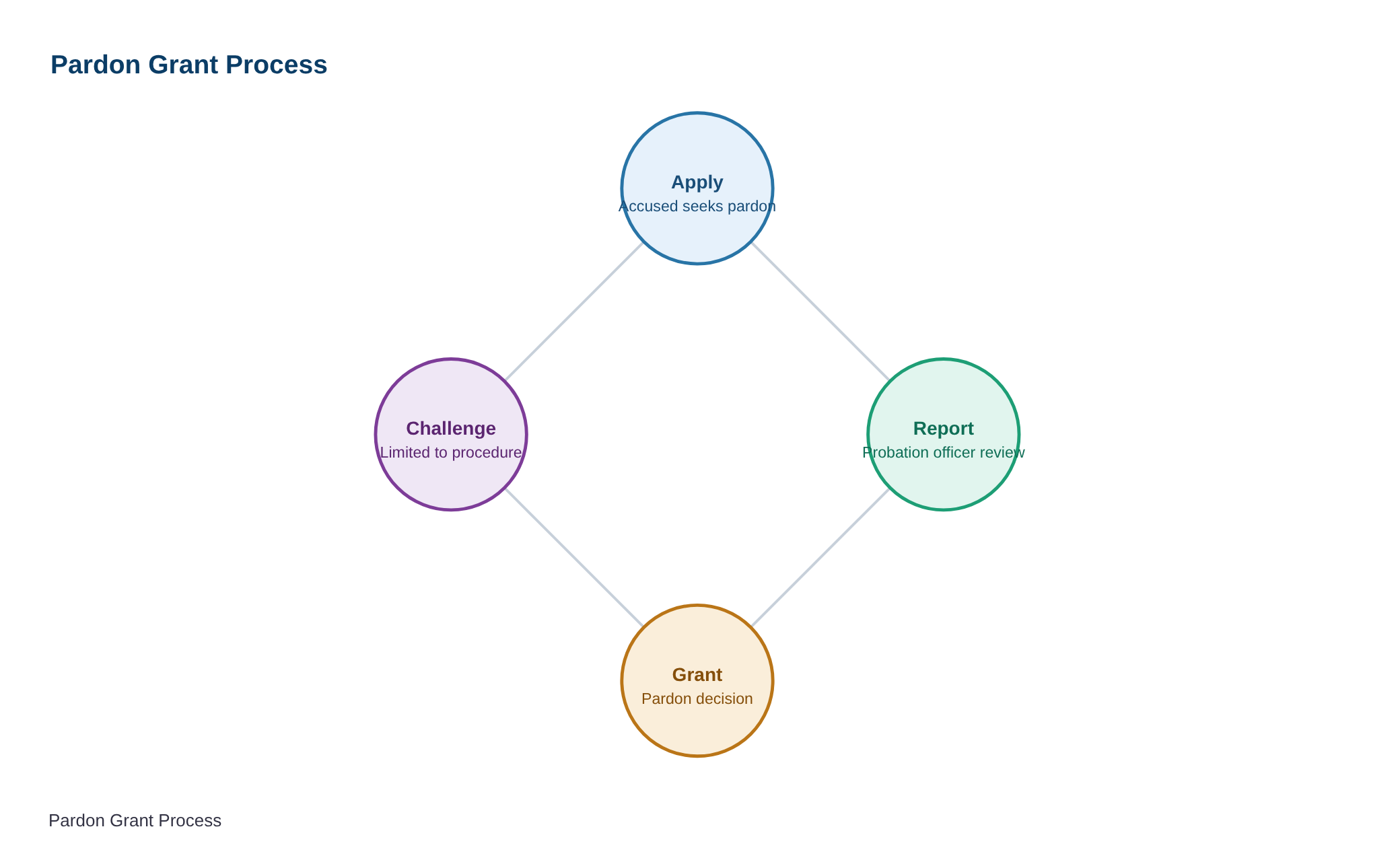
Accused person (Pradoosh) applies for pardon under Section 306 CrPC to turn approver in the Renukaswamy murder case. → Trial court seeks a report from the Probation Officer under Section 4 of the Probation of Offenders Act, 1958, in a pre-conviction scenario. → High Court of Karnataka examines the trial court’s decision and finds it legally unsustainable, as the Probation of Offenders Act permits probation officer reports only post-conviction. → High Court remits the matter back to the trial court, directing it to pass a fresh order on the pardon application without relying on the probation officer’s report. → Trial court reconsiders the pardon application strictly within the bounds of Section 306 CrPC and the Probation of Offenders Act, 1958. → Judicial review ensures procedural integrity and adherence to statutory provisions, upholding the rule of law in criminal trials.
Prelims Practice Questions
Q1. Consider the following statements regarding the grant of pardon to an approver under the Criminal Procedure Code, 1973:
1. The trial court must mandatorily obtain a report from the Probation Officer before granting pardon to an approver.
2. The right of other accused persons to challenge the order granting pardon is restricted to procedural aberrations under Section 306 of the CrPC.
3. The Probation of Offenders Act, 1958, empowers the trial court to seek a Probation Officer’s report at any stage of the trial.
How many of the above statements are correct?
- Only one
- Only two
- All three
- None
Answer: Only two — Statement 1 is incorrect as the trial court is not mandated to seek a Probation Officer’s report before granting pardon. Statement 2 is correct as per Section 306(4) of the CrPC, which restricts challenges to procedural irregularities. Statement 3 is incorrect as the Probation of Offenders Act, 1958, restricts the use of such reports to post-conviction scenarios.
Q2. Assertion (A): The Probation of Offenders Act, 1958, permits the trial court to seek a Probation Officer’s report before conviction to assess the conduct of an accused seeking pardon.
Reason (R): The Probation Officer’s report is statutorily required under Section 4 of the Act to guide the trial court in granting pardon to an approver.
Options:
A. Both A and R are true, and R is the correct explanation of A.
B. Both A and R are true, but R is not the correct explanation of A.
C. A is true, but R is false.
D. A is false, but R is true.
- A
- B
- C
- D
Answer: D — Assertion (A) is false because the Probation of Offenders Act, 1958, restricts the use of Probation Officer’s reports to post-conviction scenarios, as clarified by the Karnataka High Court. Reason (R) is also false as the Act does not mandate such reports before conviction.
Q3. Match the following provisions with their correct descriptions:
Column I
1. Section 306 of the Criminal Procedure Code, 1973
2. Section 4 of the Probation of Offenders Act, 1958
3. Article 21 of the Constitution of India
Column II
A. Governs the grant of pardon to an approver in criminal trials
B. Restricts the use of Probation Officer’s reports to post-conviction scenarios
C. Ensures procedural fairness and due process in criminal proceedings
Options:
1. 1-A, 2-B, 3-C
2. 1-B, 2-A, 3-C
3. 1-C, 2-A, 3-B
4. 1-A, 2-C, 3-B
- 1
- 2
- 3
- 4
Answer: 1 — Section 306 of the CrPC governs the grant of pardon to an approver (1-A). Section 4 of the Probation of Offenders Act restricts the use of Probation Officer’s reports to post-conviction scenarios (2-B). Article 21 of the Constitution ensures procedural fairness and due process (3-C).
Mains Practice Question
✍ The trial court’s decision to seek a Probation Officer’s report before granting pardon to an approver under Section 306 of the Criminal Procedure Code, 1973, reflects a misdirection in legal procedure. Critically examine the legal framework governing the grant of pardon to accomplices in criminal trials, with reference to the provisions of the Probation of Offenders Act, 1958, and the role of judicial discretion. Also, analyse the consequences of such procedural lapses on the fairness of trial. (15 Marks)
Approach: MODEL-ANSWER SKELETON:
1. **Legal Framework for Grant of Pardon to Approvers**
– Cite Section 306 of the Criminal Procedure Code, 1973, which empowers the trial court to tender a pardon to an accomplice on the condition of making a full and true disclosure.
– Highlight the limited role of other accused persons in challenging such orders (Section 306(4), CrPC).
2. **Probation of Offenders Act, 1958 – Section 4**
– Explain the restricted use of Probation Officer’s reports to post-conviction scenarios (sentencing, suspension, or probation).
– Emphasise that pre-conviction reports are not envisaged under the Act.
3. **Judicial Discretion and Procedural Fairness**
– Discuss the principle of judicial discretion in granting pardon (reference to *Kehar Singh v. State (Delhi Administration)* and *State of Gujarat v. Hon’ble High Court of Gujarat*).
– Analyse the Karnataka High Court’s observation in the Renukaswamy case regarding the trial court’s misdirection.
4. **Consequences of Procedural Lapses**
– Explain how such lapses may vitiate the trial process, leading to appeals and retrials.
– Reference Article 21 of the Constitution (right to a fair trial) and the principle of *audi alteram partem*.
5. **Balanced View**
– Acknowledge the need for judicial caution in granting pardon to avoid misuse.
– Conclude with the importance of adhering to statutory and constitutional safeguards in criminal jurisprudence.
Source: The Hindu
Karnataka PCS (KPSC) — State PCS Practice
Prelims: In the Renukaswamy murder case, the Karnataka High Court faulted the trial court for seeking a probation officer’s report before granting pardon to an approver. Which of the following legal principles was primarily violated by the trial court in this context?
- A. Principle of natural justice (audi alteram partem)
- B. Principle of proportionality in sentencing
- C. Principle of plea bargaining under the CrPC
- D. Principle of judicial discretion in granting bail
Answer: A. Principle of natural justice (audi alteram partem) — The trial court violated the principle of natural justice by seeking a probation officer’s report before granting pardon to the approver, as it denied the accused an opportunity to be heard on the report’s contents.
Mains: Critically analyze the implications of the Karnataka High Court’s observation in the Renukaswamy murder case regarding the trial court’s procedural lapse in seeking a probation officer’s report before granting pardon to an approver. How does this judgment reinforce the importance of adhering to due process in Karnataka’s criminal justice system? (250 words)
Generated by AanyaAi for educational purpose.
Related guides on our sites
- Best economics services coaching
- Anthropology VS PSIR
- Best PSIR optional coaching
- Best PSIR optional coaching online

- कर्नाटक हाईकोर्ट ने रेणुकास्वामी हत्या मामले में अपराधी को क्षमादान देने के लिए PO रिपोर्ट मांगने पर की आलोचना - September 15, 2026
- Karnataka HC Slams Trial Court in Renukaswamy Case: PO Report Before Pardon Illegal - September 15, 2026
- ओडिशा का राजकोषीय घाटा 23.6 हजार करोड़ रुपये पार, जानिए कारण और प्रभाव - September 15, 2026

No Comments