


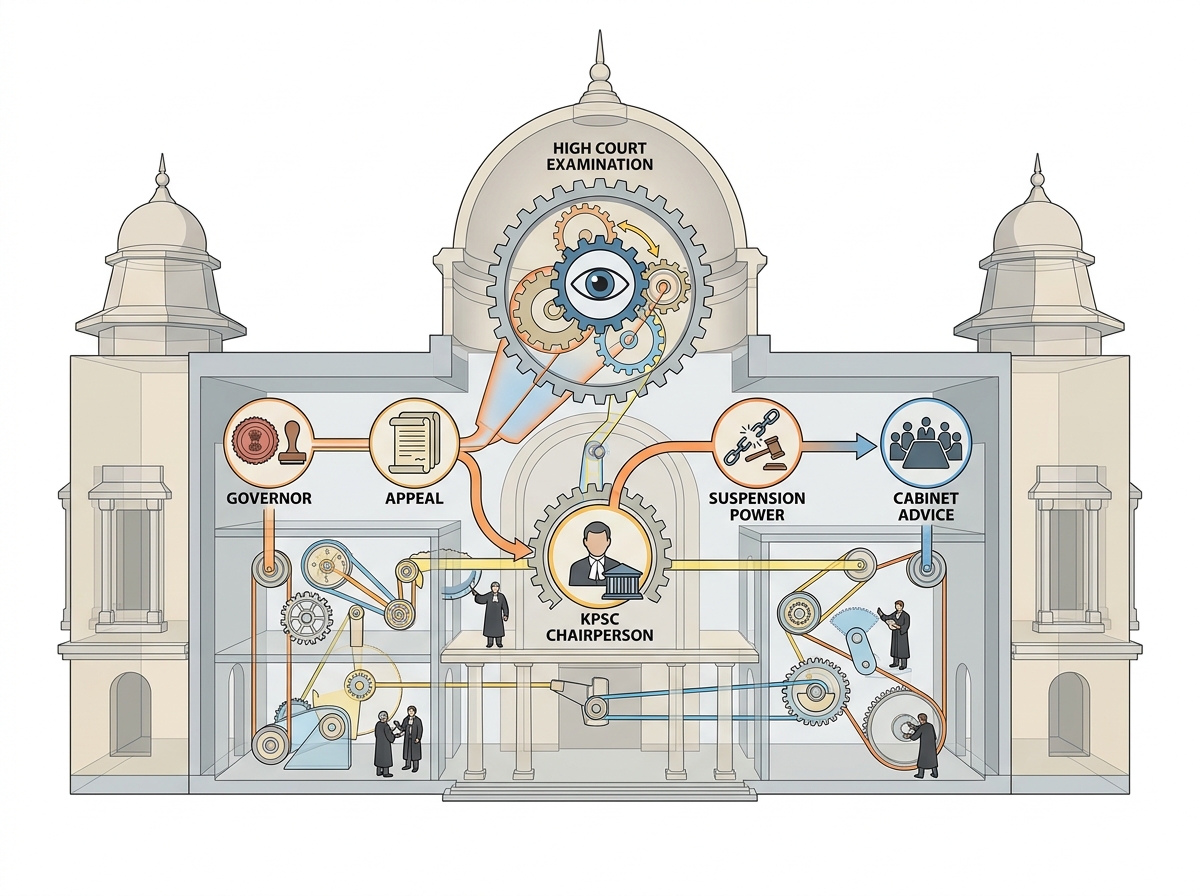
02 Sep Karnataka HC to examine Governor’s power to suspend KPSC chairperson without Cabinet advice
✎ The Governor’s power to suspend the KPSC Chairperson under Article 317(2) is subject to the requirement of prior aid and advice from the Council of Ministers, except in exceptional circumstances, and such actions may be validated…
Subject Relevance — Where This Topic Fits
- GS Paper II — Polity and Governance: Constitutional Framework, Role of Governor, and State Public Service Commissions | GS Paper IV — Ethics and Governance: Constitutional Morality and Procedural Fairness
- Prelims: Article 317(2), Governor’s discretionary powers, State Public Service Commission, post facto approval, doctrine of ratification, constitutional morality, aid and advice of Council of Ministers
- Essay: Constitutional Morality vs. Executive Expediency: Balancing Institutional Integrity and Procedural Fairness
Quick Revision: The Governor’s power to suspend the KPSC Chairperson under Article 317(2) is subject to the requirement of prior aid and advice from the Council of Ministers, except in exceptional circumstances, and such actions may be validated post facto through ratification by the Council.
Why is this in the news?
The Karnataka High Court’s decision to examine the Governor’s appeal against a single-judge ruling on the suspension of the KPSC chairperson without prior Cabinet advice underscores a critical constitutional question regarding the extent of executive discretion vested in the Governor under Article 317(2) of the Constitution. The case highlights the tension between urgent institutional action and the requirement of prior aid and advice from the Council of Ministers, raising implications for the autonomy and credibility of State Public Service Commissions.
Background
- Article 317(2) of the Indian Constitution empowers the Governor of a State to suspend the Chairperson or any member of the State Public Service Commission (SPSC) in cases of misbehaviour or incapacity, subject to the provisions of the Constitution.
- The Governor’s power under Article 317(2) is often exercised in situations where the integrity or credibility of the SPSC is perceived to be at risk, necessitating immediate action.
- The doctrine of ratification allows for post facto approval of executive actions by the Council of Ministers, provided there is no conflict between the original decision and the subsequent approval.
- The single-judge bench of the Karnataka High Court held that the Governor’s suspension order of July 10, 2026, was invalid due to the absence of prior aid and advice from the Council of Ministers, even in urgent circumstances.
- The Governor’s appeal challenges this interpretation, arguing that the subsequent ratification by the Council of Ministers on July 19, 2026, cures any procedural infirmity and validates the original order.
What is the Governor’s power under Article 317(2) of the Constitution?
- Article 317(2) empowers the Governor to act decisively against the chairperson or members of State public service commissions when an institution’s integrity is at stake.
- The Governor’s action under Article 317(2) is subject to judicial review, ensuring that the exercise of power does not violate constitutional principles such as natural justice and procedural fairness.
- The doctrine of ratification allows the Council of Ministers to approve the Governor’s action post facto, provided there is no conflict between the original decision and the subsequent approval.
- The Governor’s power under Article 317(2) is not absolute and must be exercised in a manner that upholds the autonomy and credibility of constitutional bodies like the SPSC.
- The requirement of prior aid and advice from the Council of Ministers ensures that the Governor’s actions are aligned with the collective wisdom of the elected executive, thereby enhancing democratic accountability.
- The doctrine of ratification serves as a safeguard against arbitrary executive actions while allowing for urgent institutional interventions when necessary.
Key Features
| Feature | Significance |
|---|---|
| Governor’s power under Article 317(2) | Constitutional authority to suspend the Chairperson or members of a State Public Service Commission (SPSC) in cases of misconduct or impropriety, ensuring institutional integrity. |
| Aid and advice of the Council of Ministers | Mandatory constitutional requirement under Article 163 for the Governor to act on the advice of the Council of Ministers, except in specified circumstances where discretion is permitted. |
| Doctrine of ratification | Legal principle that validates a prior irregular action if subsequently approved by the competent authority, retroactively curing procedural deficiencies. |
| Single Judge’s ruling | Judicial interpretation that the Governor cannot suspend the KPSC Chairperson without prior aid and advice of the Council of Ministers, even in urgent circumstances, and that post facto approval is invalid. |
| Division Bench’s notice | Judicial intervention to examine the appeal against the single judge’s ruling, deferring further hearing to December 2, 2026, and seeking response from the suspended Chairperson. |
UPSC Value Addition
Keywords for Mains Answer-Writing
Constitutional position of the Governor · Article 317 of the Constitution · Aid and advice of the Council of Ministers · Doctrine of ratification in constitutional law · Suspension of State Public Service Commission chairperson · Constitutional bodies and institutional integrity · Judicial review of gubernatorial actions · Supreme Court judgment in P.P. Singh case · Procedural fairness in administrative law · Separation of powers in Indian governance
Prelims Practice Questions
Q1. Consider the following statements regarding the constitutional provisions related to the Governor of a State:
1. The Governor can act in his discretion in matters relating to the appointment of the Chief Minister.
2. The Governor is bound by the aid and advice of the Council of Ministers in the exercise of his executive functions.
3. The Governor can suspend the Chairman of the State Public Service Commission without prior consultation with the Council of Ministers under Article 317(2).
4. The Governor’s power to grant pardons under Article 161 is subject to judicial review.
How many of the above statements are correct?
- Only one
- Only two
- Only three
- All four
Answer: Only three — Statements 1 and 3 are incorrect. The Governor acts on the aid and advice of the Council of Ministers in appointing the Chief Minister (Article 164). Article 317(2) does not empower the Governor to suspend the Chairman of the State Public Service Commission without prior consultation. Statements 2 and 4 are correct.
Q2. Assertion (A): The Governor of a State can suspend the Chairman of the State Public Service Commission under Article 317(2) without prior consultation with the Council of Ministers if the situation demands urgent action.
Reason (R): The doctrine of ratification allows the Council of Ministers to validate a gubernatorial action taken in urgent circumstances even if prior consultation was not possible.
Options:
A. Both A and R are true, and R is the correct explanation of A.
B. Both A and R are true, but R is not the correct explanation of A.
C. A is true, but R is false.
D. A is false, but R is true.
- A
- B
- C
- D
Answer: D — Assertion (A) is false because Article 317(2) requires the Governor to act with the aid and advice of the Council of Ministers. Reason (R) is true as the doctrine of ratification allows post facto approval, but it does not validate actions taken without prior consultation.
Q3. Match the following constitutional provisions with their correct descriptions:
Column I:
1. Article 317(2)
2. Article 161
3. Article 164
4. Article 74
Column II:
A. Power of the Governor to grant pardons, reprieves, respites or remissions of punishment.
B. Power of the Governor to suspend the Chairman or members of the State Public Service Commission.
C. The Governor shall act on the aid and advice of the Council of Ministers.
D. The Chief Minister shall be appointed by the Governor and other ministers shall be appointed on the advice of the Chief Minister.
Options:
1-B, 2-A, 3-D, 4-C
1-A, 2-B, 3-C, 4-D
1-C, 2-A, 3-D, 4-B
1-D, 2-C, 3-A, 4-B
- 1-B, 2-A, 3-D, 4-C
- 1-A, 2-B, 3-C, 4-D
- 1-C, 2-A, 3-D, 4-B
- 1-D, 2-C, 3-A, 4-B
Answer: 1-B, 2-A, 3-D, 4-C — The correct match is: 1-B (Article 317(2)), 2-A (Article 161), 3-D (Article 164), 4-C (Article 74).
Mains Practice Question
✍ The Governor’s power to suspend the Chairman of the State Public Service Commission under Article 317(2) of the Constitution is constrained by the requirement of prior consultation with the Council of Ministers. Critically examine this proposition in light of the recent Karnataka High Court judgment and the doctrine of ratification. Also, analyse the implications for the independence of constitutional bodies. (15 Marks)
Approach: MODEL-ANSWER SKELETON:
1. **Constitutional Framework**:
– Article 317(2) of the Constitution: Grounds for removal/suspension of Chairman/members of State Public Service Commissions.
– Article 163: Governor’s power to act with the aid and advice of the Council of Ministers.
– Article 164: Collective responsibility of the Council of Ministers to the State Legislature.
2. **Judicial Interpretation**:
– Karnataka High Court’s single judge ruling: Governor cannot suspend without prior aid and advice; post facto approval invalid.
– Reliance on the doctrine of ratification: Subsequent approval by the Council of Ministers does not cure procedural infirmity (Supreme Court in P.P. Singh case).
– Division Bench’s notice to examine the appeal: Legal question on the Governor’s discretionary power in urgent circumstances.
3. **Doctrine of Ratification**:
– Definition: Post facto approval validating an otherwise defective action.
– Limits: Does not apply when prior consultation is constitutionally mandated (as in Article 317(2)).
– Case law: Supreme Court’s stance in P.P. Singh (2019) and other relevant judgments.
4. **Institutional Independence**:
– Importance of independence of constitutional bodies (e.g., UPSC, SPSCs) for fair recruitment and governance.
– Risks of gubernatorial overreach: Potential erosion of public trust in institutions.
– Balancing urgency and procedural fairness: Need for safeguards against arbitrary actions.
5. **Conclusion**:
– The Governor’s power under Article 317(2) must align with constitutional mandates of aid and advice.
– The doctrine of ratification cannot override mandatory procedural requirements.
– Strengthening institutional safeguards to preserve the integrity of constitutional bodies.
Source: The Hindu
Karnataka PCS (KPSC) — State PCS Practice
Prelims: Recently, the Karnataka High Court agreed to examine the Governor’s appeal regarding the constitutional validity of which provision related to the suspension of the KPSC chairperson?
- Power to suspend KPSC chairperson without Cabinet advice
- Power to transfer KPSC chairperson without prior notice
- Power to appoint additional KPSC members without consultation
- Power to dismiss KPSC chairperson directly by the Governor
Answer: Power to suspend KPSC chairperson without Cabinet advice — The Governor’s appeal challenges the constitutional validity of the Governor’s power to suspend the KPSC chairperson without the advice of the Karnataka Cabinet.
Mains: Critically analyze the constitutional and administrative implications of the Governor’s power to suspend the KPSC chairperson without Cabinet advice in Karnataka. Discuss the relevant provisions of the Constitution and judicial precedents that may influence the Karnataka High Court’s decision.
Generated by AanyaAi for educational purpose.
Related guides on our sites
- Current affairs for upsc 2026
- Best PSIR optional coaching for upsc
- Best Law optional coaching for upsc
- Best PSIR optional teacher for upsc

- MMRDA’s Thane Coastal Road-2 Approved: 680 Mangroves Lost in Ramsar Site - October 21, 2026
- विशाखापट्टनम में उच्च जोखिम गर्भावस्था की निगरानी बढ़ाने पर कलेक्टर का निर्देश, जानिए पूरी जानकारी - October 21, 2026
- National Unity Day 2026: Key Preparations & Significance for UPSC - October 21, 2026

No Comments