


08 Aug Kerala FCRA Scrutiny: Manappat Foundation Faces Legal Action Over Punarjani Funds
✎ Rule 19 of the FCRA mandates NGOs to maintain meticulous records of foreign donations and their utilisation, and failure to comply can lead to criminal prosecution under the Prevention of Corruption Act (PCA) if the violation…
Subject Relevance — Where This Topic Fits
- GS Paper II — Governance, Transparency and Accountability | GS Paper III — Government Budgeting and Financial Accountability
- Prelims: Foreign Contribution (Regulation) Act, 2010, Rule 19 of FCRA, Vigilance and Anti-Corruption Bureau (VACB), Prevention of Corruption Act (PCA), Prohibition of Benami Property Transactions Act, 1988, Prevention of Money Laundering Act (PMLA), Central Bureau of Investigation (CBI), Public servant under PCA
- Essay: Ethical governance and accountability in public life: Balancing transparency with civil society participation, Role of NGOs in disaster relief: Accountability, transparency, and the regulatory framework
Quick Revision: Rule 19 of the FCRA mandates NGOs to maintain meticulous records of foreign donations and their utilisation, and failure to comply can lead to criminal prosecution under the Prevention of Corruption Act (PCA) if the violation involves a public servant.
Why is this in the news?
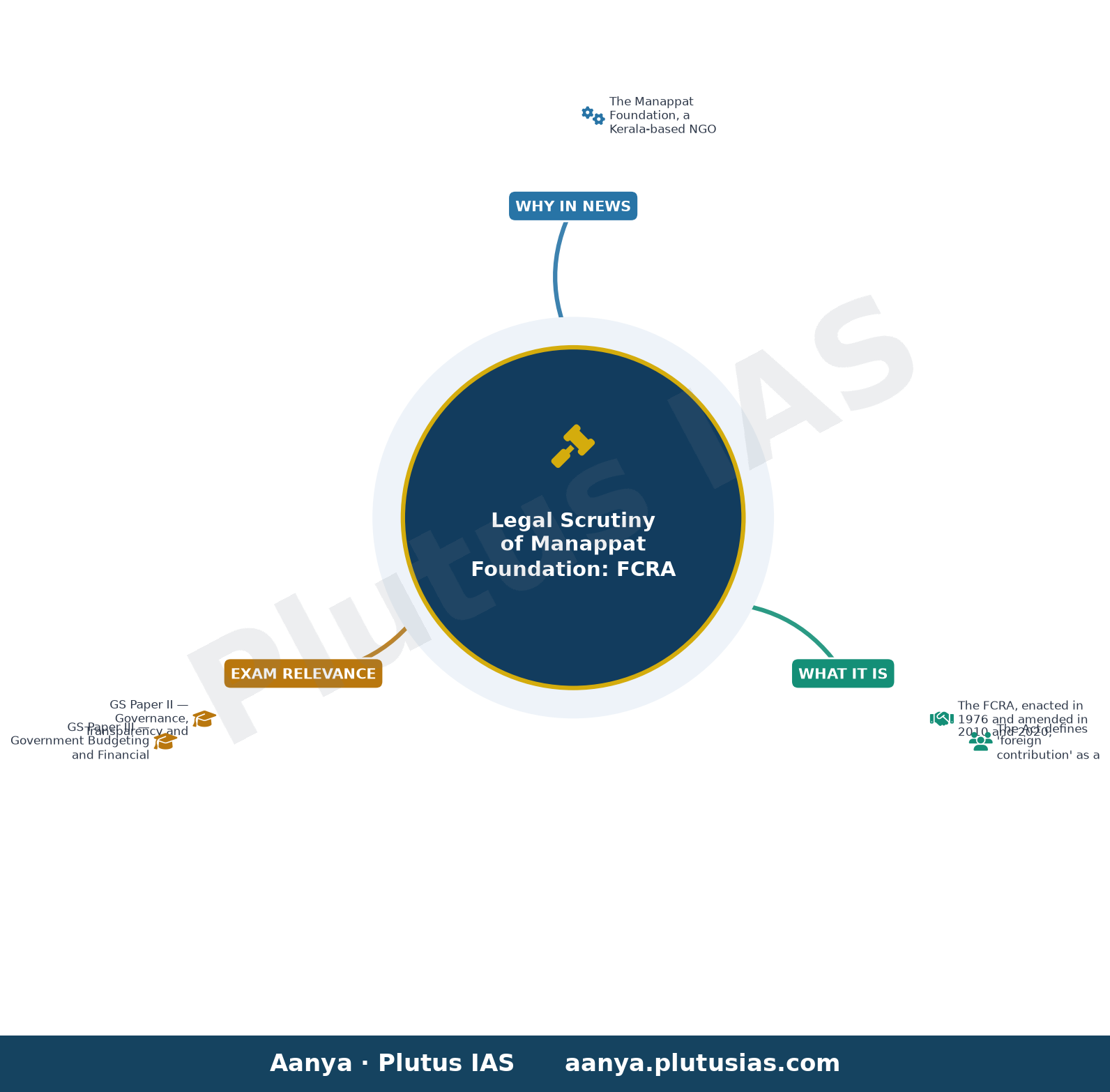
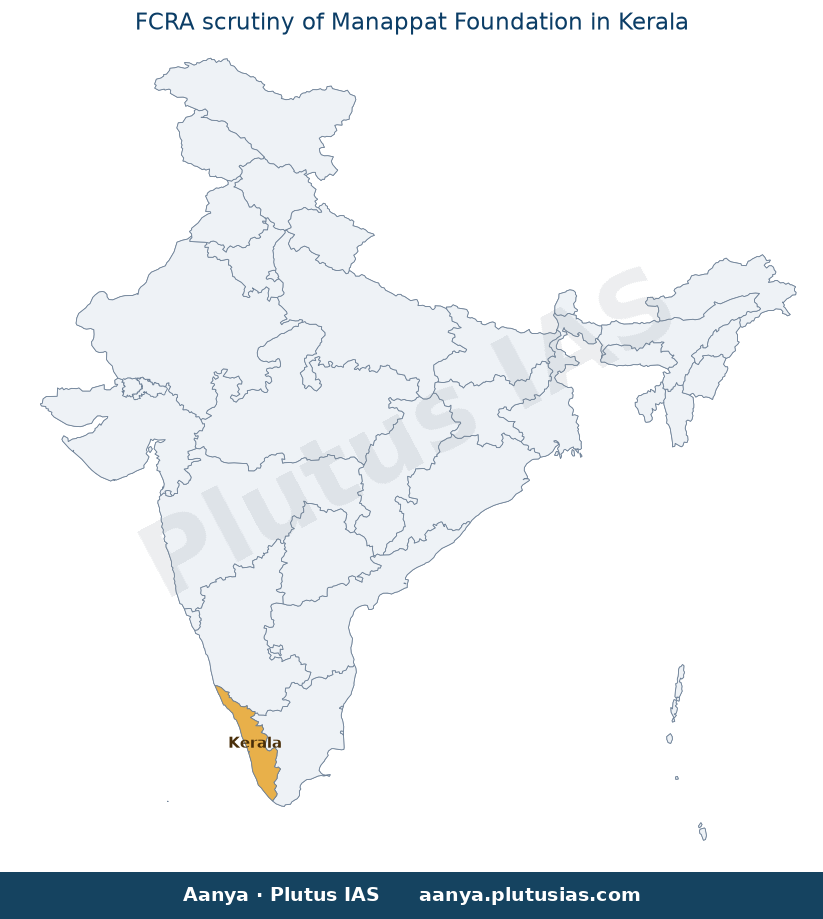
The Manappat Foundation, a Kerala-based NGO associated with the Punarjani flood rehabilitation scheme, faces legal scrutiny under the Foreign Contribution (Regulation) Act (FCRA) for alleged violations of record-keeping norms and suspicious financial transactions. The Kerala government is examining a VACB report that recommends a CBI inquiry, raising questions about the legality of foreign fund mobilisation by public representatives and the accountability of NGOs in disaster relief operations.
Background
- The Foreign Contribution (Regulation) Act (FCRA), 2010, regulates the acceptance and utilisation of foreign contributions by individuals, associations, and companies in India to ensure transparency and prevent misuse.
- Rule 19 of the FCRA mandates NGOs to maintain detailed records of foreign donations, including their source, amount, and utilisation, and submit annual returns to the Ministry of Home Affairs.
- The Punarjani scheme, launched by Leader of the Opposition V.D. Satheesan in Kerala, aimed to rehabilitate flood-affected communities in Paravoor, Ernakulam, and mobilised foreign funds for this purpose.
- The Vigilance and Anti-Corruption Bureau (VACB) of Kerala submitted a report to the Home Department in 2025, alleging that Manappat Foundation violated Rule 19 of the FCRA by failing to maintain proper records of foreign donations and their utilisation for the Punarjani project.
- The VACB also reported suspicious transactions amounting to ₹1.22 crore through the foundation’s FCRA account, current account, and personal accounts of its chairperson, Ameer Ahammed, prompting recommendations for a CBI investigation.
- The case has raised debates on the accountability of public representatives in mobilising foreign funds for welfare schemes and the potential misuse of such funds under the guise of charitable activities.
What is the Foreign Contribution (Regulation) Act (FCRA), 2010?
- The FCRA, enacted in 1976 and amended in 2010 and 2020, regulates the acceptance and utilisation of foreign contributions by individuals, associations, and companies in India to ensure transparency and prevent misuse for activities detrimental to national interest.
- The Act defines ‘foreign contribution’ as a donation, delivery, or transfer of any currency, security, or article from a foreign source, excluding contributions from Indian citizens residing abroad.
- NGOs, associations, and individuals receiving foreign contributions must register under the FCRA or obtain prior permission from the Ministry of Home Affairs to accept such funds.
- Rule 19 of the FCRA mandates NGOs to maintain detailed records of foreign donations, including their source, amount, and utilisation, and submit annual returns to the Ministry of Home Affairs by the 31st of December each year.
- Violations of FCRA provisions can lead to cancellation of registration, imposition of penalties, or criminal prosecution under the Act or other relevant laws such as the Prevention of Corruption Act (PCA) or the Prevention of Money Laundering Act (PMLA).
- The Act empowers the government to conduct inspections, seize records, and take suo motu action against entities violating its provisions, including recommending investigations by agencies like the CBI.
- The FCRA applies to all entities, including those associated with public representatives, to ensure that foreign funds are utilised for legitimate purposes and do not compromise national security or public interest.
- Recent amendments to the FCRA, such as the requirement for NGOs to open FCRA accounts in designated banks and the mandatory use of Aadhaar for registration, aim to enhance transparency and accountability in the utilisation of foreign funds.
UPSC Value Addition
Keywords for Mains Answer-Writing
Foreign Contribution (Regulation) Act (FCRA), 2010 · Rule 19 of FCRA · Punarjani scheme · Manappat Foundation · Vigilance and Anti-Corruption Bureau (VACB) · Central Bureau of Investigation (CBI) · Prevention of Corruption Act (PCA), 1988 · Prohibition of Benami Property Transactions Act, 1988 · Prevention of Money Laundering Act (PMLA), 2002 · Public servant under PCA · FCRA violations and accountability · NGO accountability and transparency · Constitutional morality and public office · Judicial scrutiny of executive actions
Prelims Practice Questions
Q1. Consider the following statements regarding the Foreign Contribution (Regulation) Act (FCRA), 2010:
1. FCRA regulates the acceptance and utilisation of foreign contributions by individuals, associations, and companies.
2. Rule 19 of FCRA mandates NGOs to maintain records of foreign donations and their utilisation.
3. Violations of FCRA can only be penalised under the Prevention of Corruption Act (PCA), 1988.
4. The Central Bureau of Investigation (CBI) is empowered to investigate FCRA violations without prior approval from the Home Ministry.
How many of the above statements are correct?
- Only one
- Only two
- Only three
- All
Answer: Only three — Statements 1 and 2 are correct. Statement 3 is incorrect as FCRA violations can also be penalised under the Prohibition of Benami Property Transactions Act, 1988, and the Prevention of Money Laundering Act (PMLA), 2002. Statement 4 is incorrect as the CBI requires prior approval for investigating FCRA violations.
Q2. Assertion (A): The Vigilance and Anti-Corruption Bureau (VACB) can recommend a Central Bureau of Investigation (CBI) inquiry against a public servant for alleged FCRA violations.
Reason (R): Public servants are explicitly included under the broad definition of ‘public office’ in the Prevention of Corruption Act (PCA), 1988, which enables such action.
Options:
A. Both A and R are true, and R is the correct explanation of A.
B. Both A and R are true, but R is NOT the correct explanation of A.
C. A is true, but R is false.
D. A is false, but R is true.
- A
- B
- C
- D
Answer: A — Both Assertion (A) and Reason (R) are true, and R correctly explains A. The PCA, 1988, broadens the definition of ‘public office’ to include public servants, enabling the VACB to recommend a CBI inquiry for FCRA violations.
Q3. Which of the following Acts is NOT directly invoked in the context of alleged FCRA violations by Manappat Foundation in Kerala?
A. Foreign Contribution (Regulation) Act, 2010
B. Prevention of Corruption Act, 1988
C. Right to Information Act, 2005
D. Prevention of Money Laundering Act, 2002
- A
- B
- C
- D
Answer: C — The Right to Information Act, 2005, is not directly invoked in the context of FCRA violations. The other three Acts—FCRA, 2010; PCA, 1988; and PMLA, 2002—are explicitly mentioned in the report.
Mains Practice Question
✍ Critically examine the legal and institutional framework governing the regulation of foreign contributions in India, with particular reference to the Foreign Contribution (Regulation) Act (FCRA), 2010. Also, analyse the implications of alleged FCRA violations by non-governmental organisations (NGOs) for democratic accountability and constitutional morality. (15 Marks)
Approach: MODEL-ANSWER SKELETON:
1. **Introduction**: Define FCRA, 2010, and its objectives (preamble: regulate foreign contributions to ensure transparency and accountability; prevent misuse).
2. **Key Provisions**:
– Section 17: Maintenance of accounts and records (Rule 19).
– Section 32: Offences and penalties (including imprisonment and fines).
– Section 35: Powers of the Central Government to prohibit receipt of foreign funds.
– Role of the Ministry of Home Affairs (MHA) in registration and compliance.
3. **Institutional Framework**:
– Role of the Central Bureau of Investigation (CBI) and Vigilance and Anti-Corruption Bureau (VACB) in investigating violations.
– Overlap with the Prevention of Corruption Act (PCA), 1988, and the Prevention of Money Laundering Act (PMLA), 2002.
4. **Case Study Analysis**:
– Alleged FCRA violations by Manappat Foundation (failure to maintain records under Rule 19; suspicious transactions; potential benami property transactions).
– Implications for public servants (e.g., V.D. Satheesan) under PCA.
5. **Democratic Accountability and Constitutional Morality**:
– Balancing transparency and freedom of association (Article 19(1)(c) of the Constitution).
– Ensuring NGOs operate within the rule of law while avoiding political witch-hunts.
– Judicial scrutiny and the role of the Supreme Court in interpreting FCRA provisions (e.g., cases like People’s Union for Civil Liberties v. Union of India, 2013).
6. **Challenges and Reforms**:
– Issues of delayed investigations and political interference.
– Need for stricter compliance mechanisms and whistle-blower protections.
7. **Conclusion**: Emphasise the need for a balanced approach that upholds democratic values while ensuring accountability.
Source: The Hindu
Generated by AanyaAi for educational purpose.

- मद्रास उच्च न्यायालय ने अनामलाई के खिलाफ मामले को रद्द किया: राजनीतिक टिप्पणियों पर न्यायिक फैसला - September 24, 2026
- Madras HC quashes case against Annamalai over Thevar remarks: UPSC Polity Analysis - September 24, 2026
- डीडीयू-जीकेवाई 2.0: ग्रामीण युवाओं को कौशल एवं रोजगार से जोड़ने की केंद्र सरकार की पहल - September 24, 2026

No Comments