


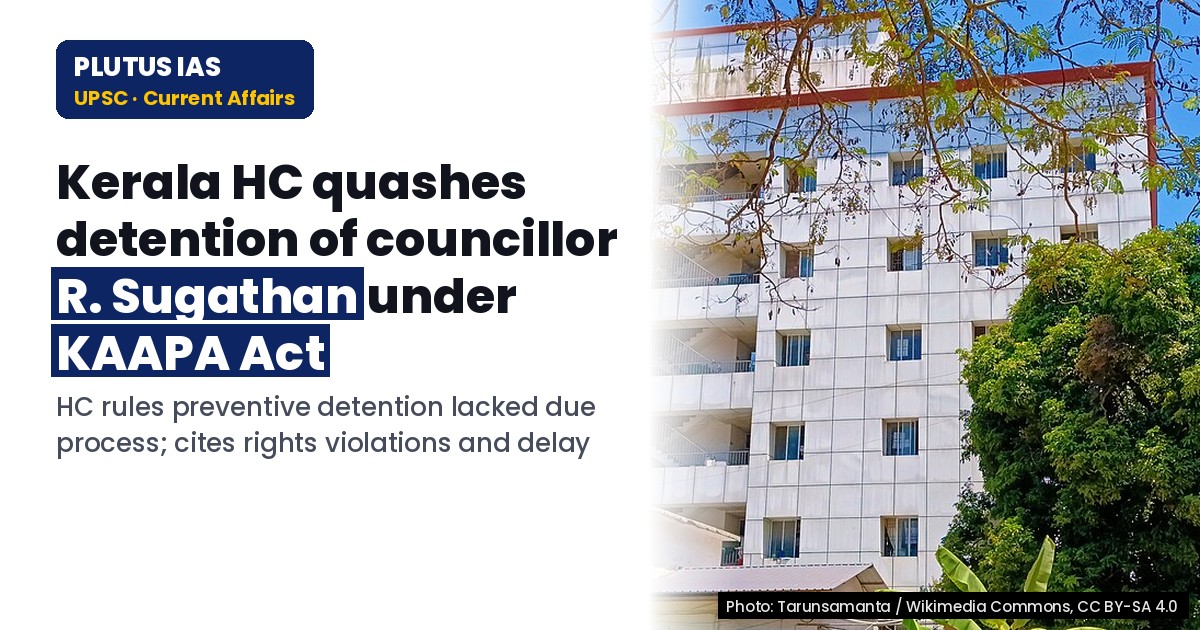
06 Oct Kerala HC quashes detention of councillor under KAAPA Act: UPSC Polity Analysis
✎ Preventive detention under Article 22(3)(b) of the Constitution is an extraordinary measure requiring strict adherence to procedural safeguards, including Advisory Board review, expeditious disposal of representations, and…
Subject Relevance — Where This Topic Fits
- GS Paper II — Judiciary and Constitutional Framework | GS Paper III — Role of State in Combating Crime and Violence
- Prelims: Preventive Detention, Article 22 of the Constitution, Judicial Review of Administrative Actions, Kerala Anti-Social Activities (Prevention) Act, 2007 (KAAPA), Right to Speedy Trial, Procedural Fairness in Detention Orders
- Essay: Judicial Activism vs. Executive Discretion: Balancing Security and Liberty
Quick Revision: Preventive detention under Article 22(3)(b) of the Constitution is an extraordinary measure requiring strict adherence to procedural safeguards, including Advisory Board review, expeditious disposal of representations, and non-arbitrary application of law, as reiterated by the Kerala High Court in quashing the detention order against R. Sugathan under KAAPA.
Why is this in the news?
The Kerala High Court set aside the preventive detention order issued against Thiruvananthapuram councillor R. Sugathan under the Kerala Anti-Social Activities (Prevention) Act, 2007 (KAAPA), citing procedural lapses, lack of application of mind, and violation of constitutional safeguards. The judgment underscores the judiciary’s role in scrutinising executive actions under preventive detention laws, particularly where administrative authorities fail to adhere to due process and statutory timelines.
Background
- Preventive detention laws empower the state to detain individuals without trial to prevent imminent threats to public order, security, or tranquillity, as envisaged under Article 22(3)(b) of the Constitution of India.
- The Kerala Anti-Social Activities (Prevention) Act, 2007 (KAAPA), is a state-specific legislation designed to curb organised crime and anti-social activities by allowing preventive detention for up to one year.
- The Act mandates the formation of an Advisory Board to review detention orders, ensuring a quasi-judicial check on executive discretion.
- Preventive detention is an exception to the general rule of ‘bail not jail’ and is subject to rigorous judicial scrutiny to prevent arbitrary deprivation of liberty.
- The case highlights recurring concerns about procedural fairness, delay in disposal of representations, and the sufficiency of bail conditions in mitigating the need for preventive detention.
- The judgment aligns with the Supreme Court’s consistent emphasis on the principle that preventive detention must be a measure of last resort, not a substitute for regular criminal prosecution.
What is Preventive Detention under the Constitution and KAAPA?
- Preventive detention is a legal mechanism where individuals are detained without trial to prevent anticipated breaches of public order or security, authorised under Article 22(3)(b) of the Constitution.
- Article 22(4) mandates that no law providing for preventive detention shall authorise detention beyond three months unless an Advisory Board, consisting of persons qualified to be High Court judges, confirms the necessity of such detention.
- The Kerala Anti-Social Activities (Prevention) Act, 2007 (KAAPA), empowers the state government to detain individuals engaged in ‘anti-social activities’ for up to one year, subject to Advisory Board review.
- KAAPA defines ‘anti-social activities’ broadly to include organised crime, habitual offenders, and individuals likely to disrupt public order, but requires objective criteria and procedural safeguards.
- The Act mandates the issuance of grounds for detention within five days of detention, followed by a representation to the government within 10 days, which must be decided expeditiously.
- Preventive detention under KAAPA is distinct from punitive detention post-conviction and is not a penal measure but a preventive one, aimed at averting future harm.
- The Supreme Court has repeatedly held that preventive detention must not be used as a shortcut to bypass regular criminal justice processes or to suppress dissent under the guise of maintaining law and order.
- The Kerala High Court’s ruling reinforces the doctrine of ‘procedural fairness’, emphasising that detention orders must be based on intelligible and cogent material, free from arbitrariness or malice.
Key Features
| Feature | Significance |
|---|---|
| Preventive Detention under KAAPA Act, 2007 | Allows executive authorities to detain individuals without trial to prevent ‘anti-social activities’ as defined under the Act. |
| Application of Mind by Detaining Authority | Mandates reasoned decision-making; absence of this renders detention order legally untenable. |
| Constitutional Safeguards against Arbitrary Detention | Article 22(5) of the Constitution requires prompt consideration of representation against detention orders. |
| Advisory Board under KAAPA Act | Constitutional body (Article 22(4)) that reviews detention orders to ensure compliance with procedural fairness. |
| Judicial Review of Executive Action | Judiciary ensures adherence to due process and prevents misuse of preventive detention powers. |
Why it Matters
Legal-Prudential Significance
- Reaffirms the principle that preventive detention must be resorted to sparingly and only when absolutely necessary, with strict adherence to procedural safeguards.
- Highlights the judiciary’s role in curbing potential executive overreach in matters involving civil liberties and personal liberty.
- Emphasises the constitutional guarantee under Article 21 (right to life and personal liberty) against arbitrary state action.
Governance and Administrative Significance
- Exposes systemic delays in administrative processes, particularly in the consideration of representations against detention orders.
- Underscores the need for meticulous documentation and legible service of legal documents in detention proceedings.
- Demonstrates the importance of inter-departmental coordination (e.g., between police, collectors, and advisory boards) in preventive detention cases.
Institutional Significance
- Reinforces the independence of the judiciary in reviewing executive decisions, particularly those affecting fundamental rights.
- Validates the role of advisory boards in providing an additional layer of scrutiny over preventive detention orders.
- Highlights the necessity for transparency in the functioning of local governance bodies (e.g., municipal corporations) in matters of law enforcement.
Challenges
1. Procedural Delays in Preventive Detention Cases
- Unexplained delays in considering representations against detention orders violate constitutional rights under Article 22(5).
- Such delays erode public trust in administrative and judicial processes.
UPSC Link: GS-II: Fundamental Rights (Article 22)
2. Documentation and Service of Legal Papers
- Illegible or improperly served documents undermine the fairness of detention proceedings.
- Lack of clarity in service of arrest intimation or documents can lead to legal challenges and nullification of orders.
UPSC Link: GS-II: Procedure Established by Law
3. Balancing Preventive Detention with Personal Liberty
- Preventive detention laws must balance the need for public order with the protection of individual liberties.
- Overuse or misuse of such powers risks undermining democratic principles and civil rights.
UPSC Link: GS-II: Fundamental Rights (Article 21)
4. Coordination Among Multiple Agencies
- Effective implementation of preventive detention laws requires seamless coordination between police, collectors, advisory boards, and courts.
- Lack of coordination can lead to procedural lapses, as seen in the delayed consideration of representations.
UPSC Link: GS-II: Centre-State Relations
5. Perception of Political Influence in Legal Proceedings
- Allegations of political malafides in detention orders can undermine public confidence in the impartiality of law enforcement.
- Such perceptions necessitate strict adherence to due process and transparency in all stages of detention proceedings.
UPSC Link: GS-II: Rule of Law and Judicial Review
Challenges — UPSC Perspective
| Issue | Concern |
|---|---|
| Delay in considering representations | Violates constitutional rights and procedural fairness under Article 22(5). |
| Illegible or improperly served documents | Undermines the legality and fairness of detention orders. |
| Lack of reasoned application of mind | Renders detention orders legally unsustainable and subject to judicial review. |
| Allegations of political influence | Erodes public trust in the impartiality of law enforcement and judicial processes. |
| Inadequate coordination among agencies | Leads to procedural lapses and delays in detention proceedings. |
Way Forward
- Strengthen administrative mechanisms to ensure timely consideration of representations against detention orders under Article 22(5).
- Implement strict protocols for the preparation, service, and documentation of legal papers in detention proceedings.
- Enhance training for executive authorities on the principles of reasoned decision-making in preventive detention cases.
- Ensure transparency in the functioning of advisory boards to bolster public confidence in their reviews.
- Promote inter-agency coordination through regular audits and feedback mechanisms to prevent procedural lapses.
- Clarify timelines for the disposal of representations and detention orders to avoid arbitrary delays.
- Encourage judicial activism in reviewing the sufficiency of grounds for preventive detention to prevent misuse.
UPSC Value Addition
Keywords for Mains Answer-Writing
Preventive Detention · Kerala Anti-Social Activities (Prevention) Act, 2007 · Article 22 of the Constitution · Judicial Review of Detention Orders · Procedural Safeguards in Detention · Advisory Board under Preventive Detention Laws · Right to Personal Liberty · Due Process of Law · Kerala High Court Judgments on Detention · Constitutional Validity of Preventive Detention · Arbitrary Detention and Judicial Scrutiny · Role of Collector in Preventive Detention · Criminal Procedure Code and Bail Conditions · Constitutional Remedies under Article 32 and 226 · Rule of Law and Executive Discretion
Constitutional & Policy Linkages
- Article 21: Protection of Life and Personal Liberty (due process and fairness in detention).
- Article 22(4): Advisory Board Review (constitutional safeguard against arbitrary detention).
- Article 22(5): Right to be informed of grounds and right to make representations against detention.
Concept Flow
Initiation of criminal proceedings against an individual → Classification as ‘known rowdy’ under KAAPA Act → Issuance of preventive detention order by Collector → Service of documents (including arrest intimation) → Individual’s representation against detention order → Delay in considering representation → Judicial intervention on grounds of procedural lapses → High Court sets aside detention order → Reinforcement of constitutional safeguards against arbitrary detention.
Prelims Practice Questions
Q1. Consider the following statements regarding preventive detention in India:
1. Preventive detention is permissible under Article 22(3)(b) of the Constitution.
2. The Advisory Board must be constituted within three months of the detention order.
3. The grounds for detention must be communicated to the detenu within five days of detention.
4. The Supreme Court has held that preventive detention cannot be imposed merely on the basis of suspicion.
How many of the above statements are correct?
- Only one
- Only two
- Only three
- All four
Answer: All four — Statements 1, 2, and 4 are correct. Statement 3 is incorrect as the grounds must be communicated to the detenu as soon as practicable, not necessarily within five days.
Q2. Assertion (A): The Kerala High Court set aside the detention order against R. Sugathan under the Kerala Anti-Social Activities (Prevention) Act, 2007, primarily on grounds of procedural lapses.
Reason (R): The court held that the detention order lacked application of mind and that the detenu was served with illegible documents.
In the context of the above statements, which of the following is correct?
- Both A and R are true, and R is the correct explanation of A.
- Both A and R are true, but R is not the correct explanation of A.
- A is true, but R is false.
- A is false, but R is true.
Answer: Both A and R are true, but R is not the correct explanation of A. — Both the assertion and reason are true, and the reason correctly explains the assertion as the procedural lapses cited by the court were the primary grounds for setting aside the detention order.
Q3. Match the following provisions with their respective legal instruments:
Column I (Provision)
A. Advisory Board for Preventive Detention
B. Right to be informed of grounds of arrest
C. Maximum period of preventive detention
D. Detention without trial
Column II (Legal Instrument)
1. Article 22(5) of the Constitution
2. Article 22(4)(a) of the Constitution
3. Kerala Anti-Social Activities (Prevention) Act, 2007
4. Criminal Procedure Code, 1973
Select the correct match:
- A-3, B-1, C-2, D-4
- A-1, B-3, C-2, D-4
- A-3, B-1, C-4, D-2
- A-1, B-4, C-2, D-3
Answer: A-3, B-1, C-2, D-4 — The correct match is: A (Advisory Board for Preventive Detention) → 3 (Kerala Anti-Social Activities (Prevention) Act, 2007), B (Right to be informed of grounds of arrest) → 1 (Article 22(5) of the Constitution), C (Maximum period of preventive detention) → 2 (Article 22(4)(a) of the Constitution), D (Detention without trial) → 4 (Criminal Procedure Code, 1973).
Mains Practice Question
✍ Examine the constitutional and statutory safeguards against arbitrary preventive detention in India. How does the Kerala High Court’s judgment in R. Sugathan v. State of Kerala (2026) reinforce these safeguards? Also, discuss the implications of procedural lapses in detention orders. (15 Marks)
Approach: MODEL-ANSWER SKELETON:
1. **Introduction (2 marks)**
– Define preventive detention and its constitutional basis under Article 22(3)(b) of the Constitution.
– Highlight the tension between individual liberty and societal security.
2. **Constitutional Safeguards (4 marks)**
– Article 22(4): Maximum period of detention (3 months without Advisory Board approval).
– Article 22(5): Right to be informed of grounds of detention and right to make a representation.
– Article 22(6): Advisory Board must be constituted within three months of detention.
– Article 21: Right to life and personal liberty (Maneka Gandhi v. Union of India, 1978).
3. **Statutory Safeguards (4 marks)**
– Kerala Anti-Social Activities (Prevention) Act, 2007: Role of Collector, Advisory Board, and grounds for detention.
– Criminal Procedure Code, 1973: Provisions on arrest, bail, and procedural fairness.
– Judicial review under Article 226 (High Court) and Article 32 (Supreme Court).
4. **Analysis of Kerala High Court Judgment (3 marks)**
– Court’s findings: Lack of application of mind, illegible documents, unexplained delay in considering representation.
– Reinforcement of procedural fairness and due process (A.K. Roy v. Union of India, 1982).
– Emphasis on the Advisory Board’s role in preventing arbitrary detention.
5. **Implications of Procedural Lapses (2 marks)**
– Erosion of public trust in executive actions.
– Potential for misuse of preventive detention powers.
– Need for strict adherence to constitutional and statutory safeguards.
6. **Conclusion (1 mark)**
– Summarize the importance of balancing individual rights with societal security.
Source: The Hindu
Kerala PCS (Kerala PSC (KAS)) — State PCS Practice
Prelims: Which constitutional provision was primarily invoked by the Kerala High Court to set aside the detention order of Thiruvananthapuram councillor R. Sugathan?
- Article 21 (Right to Personal Liberty)
- Article 22 (Protection against arrest and detention)
- Article 19 (Freedom of Speech and Expression)
- Article 14 (Right to Equality)
Answer: Article 22 (Protection against arrest and detention) — The Kerala High Court invoked Article 22 of the Constitution, which provides safeguards against arbitrary detention, to set aside the order.
Mains: Critically examine the legal and administrative implications of the Kerala High Court’s decision to set aside the detention order of Thiruvananthapuram councillor R. Sugathan, with specific reference to the balance between executive authority and judicial review in Kerala’s governance framework.
Generated by AanyaAi for educational purpose.
Related guides on our sites
- Current affairs for upsc 2026
- Best PSIR optional coaching for upsc
- Best PSIR optional teacher for upsc
- Best teacher of PSIR optional for upsc

- विशाखापट्टनम में उच्च जोखिम गर्भावस्था की निगरानी बढ़ाने पर कलेक्टर का निर्देश, जानिए पूरी जानकारी - October 21, 2026
- National Unity Day 2026: Key Preparations & Significance for UPSC - October 21, 2026
- 14वां इंडिया केम 2026: मुंबई में वैश्विक रसायन उद्योग का महाकुंभ - October 21, 2026

No Comments