


08 Aug Kerala NGO Manappat Foundation faces FCRA scrutiny over Punarjani funds

✎ FCRA violations by NGOs or public servants can attract penal provisions under the Prevention of Corruption Act (PCA) if the contravention involves misuse of public office or position, underscoring the need for strict compliance…
Subject Relevance — Where This Topic Fits
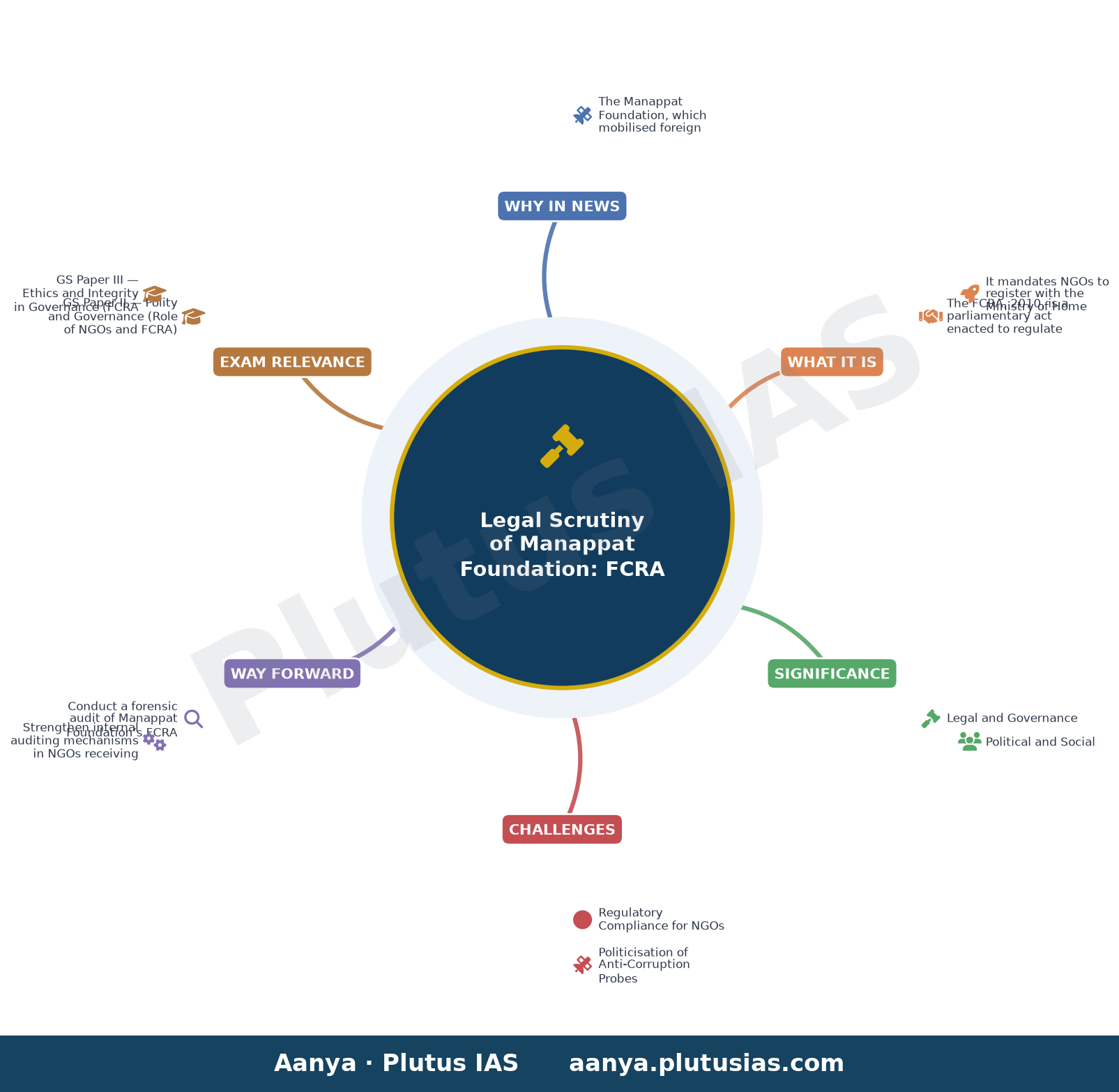
- GS Paper II — Polity and Governance (Role of NGOs and FCRA) | GS Paper III — Ethics and Integrity in Governance (FCRA violations and public office)
Quick Revision: FCRA violations by NGOs or public servants can attract penal provisions under the Prevention of Corruption Act (PCA) if the contravention involves misuse of public office or position, underscoring the need for strict compliance and transparency in fund utilisation.
Why is this in the news?
The Manappat Foundation, which mobilised foreign funds for Kerala’s Leader of the Opposition V.D. Satheesan’s flood rehabilitation scheme ‘Punarjani’, is under legal scrutiny for alleged violations of the Foreign Contribution (Regulation) Act (FCRA), 2010. The Kerala government is examining a 2025 Vigilance and Anti-Corruption Bureau (VACB) report that accuses the NGO of failing to maintain records of foreign donations and their utilisation, potentially implicating public servants under the Prevention of Corruption Act (PCA). The case raises critical questions about the regulatory oversight of NGOs, the accountability of public representatives in fund mobilisation, and the legal consequences of FCRA non-compliance.
Background
- The Foreign Contribution (Regulation) Act (FCRA), 2010, regulates the acceptance and utilisation of foreign contributions by NGOs, individuals, and associations in India to ensure transparency and prevent misuse.
- Rule 19 of the FCRA mandates NGOs to maintain detailed records of foreign contributions received, their sources, and their utilisation, failing which constitutes a violation.
- The Punarjani scheme was launched by V.D. Satheesan, Leader of the Opposition in Kerala, to rehabilitate flood-affected constituents in Paravoor, Ernakulam, and relied heavily on foreign donations.
- The Vigilance and Anti-Corruption Bureau (VACB) of Kerala submitted a report in 2025 to the Home Department, alleging that Manappat Foundation violated Rule 19 of the FCRA by failing to maintain records of foreign donations and their utilisation.
- The VACB also recommended a Central Bureau of Investigation (CBI) probe against the NGO’s chairperson, Ameer Ahammed, citing suspicious transactions amounting to ₹1.22 crore across multiple accounts.
- The case intersects with the Prevention of Corruption Act (PCA), 1988, as violations of FCRA by public servants or those acting in public office may attract penal provisions under the PCA.
What is the Foreign Contribution (Regulation) Act (FCRA), 2010?
- The FCRA, 2010, is a parliamentary act enacted to regulate the acceptance and utilisation of foreign contributions by NGOs, associations, and individuals in India, ensuring transparency and preventing misuse for activities detrimental to national interest.
- It mandates NGOs to register with the Ministry of Home Affairs (MHA) and obtain prior permission for receiving foreign contributions, with stringent reporting requirements for receipts and expenditures.
- Rule 19 of the FCRA specifies the obligation of NGOs to maintain accurate records of foreign contributions, including the source, amount, and purpose of utilisation, and submit annual returns to the MHA.
- Violations of FCRA provisions, including failure to maintain records or unauthorised utilisation of foreign funds, are punishable under the Act, with penalties ranging from fines to cancellation of registration.
- The FCRA applies to all NGOs, including those involved in disaster relief, social work, or political activities, and covers both monetary and non-monetary contributions from foreign sources.
- The Act empowers the MHA to conduct inspections, seize records, and initiate legal proceedings against violators, including public servants involved in FCRA-related offences.
- FCRA compliance is critical for NGOs to maintain their credibility and legitimacy, as non-compliance can lead to reputational damage, legal action, and loss of foreign funding.
- The Act also intersects with other laws such as the Prevention of Corruption Act (PCA) and the Prevention of Money Laundering Act (PMLA), where FCRA violations may trigger broader legal consequences.
Key Features
| Feature | Significance |
|---|---|
| Foreign Contribution (Regulation) Act (FCRA), 2010 | Regulates acceptance and utilisation of foreign contributions by NGOs, ensuring transparency and accountability to prevent misuse of funds. |
| Rule 19 of FCRA | Mandates maintenance of records of receipt and utilisation of foreign funds; non-compliance constitutes an offence under the Prevention of Corruption Act (PCA) if linked to public servants. |
| Vigilance and Anti-Corruption Bureau (VACB) | State-level anti-corruption agency that investigates financial irregularities, including FCRA violations, and recommends further action to the government. |
| Prevention of Corruption Act (PCA), 1988 | Criminalises corruption by public servants, including participation in or abetment of FCRA violations if abuse of official position is involved. |
| Prohibition of Benami Property Transactions Act, 1988 | May apply if foreign funds are routed through benami transactions to evade scrutiny or launder money. |
| Prevention of Money Laundering Act (PMLA), 2002 | Investigates financial crimes, including misuse of foreign contributions, and attaches proceeds of crime. |
Why it Matters
Legal and Governance
- FCRA violations by NGOs undermine public trust in charitable organisations and erode the credibility of flood-rehabilitation initiatives like Punarjani.
- Non-compliance with Rule 19 of FCRA may attract penal provisions under the PCA, particularly if public servants are involved, raising concerns about institutional integrity.
- Legal scrutiny of Manappat Foundation highlights the need for stricter compliance mechanisms for NGOs receiving foreign funds, especially in disaster relief contexts.
- The case underscores the role of state agencies like VACB in detecting financial irregularities and ensuring adherence to regulatory frameworks.
- The potential invocation of PMLA or the Benami Act signals a broader crackdown on financial misconduct linked to foreign contributions.
Political and Social
- Allegations against a prominent Opposition leader (V.D. Satheesan) introduce political dimensions, with accusations of witch-hunting by the ruling party.
- The Congress’s defence of Satheesan frames the issue as a political vendetta, complicating the legal and ethical discourse surrounding FCRA compliance.
- Public perception of charitable organisations may be adversely affected, particularly if foreign funds are perceived as misused or inadequately accounted for.
- The Punarjani scheme’s credibility is at stake, as allegations of financial impropriety could deter future donors and beneficiaries from engaging with similar initiatives.
Economic
- Misuse of foreign funds can distort resource allocation in disaster relief, diverting critical aid away from intended beneficiaries.
- Financial irregularities in NGOs may deter foreign donors from contributing to Indian causes, impacting the flow of humanitarian aid.
- Legal penalties under FCRA, PCA, or PMLA could result in heavy fines, freezing of assets, or criminal prosecution, affecting the financial sustainability of NGOs.
Institutional
- The case tests the efficacy of state-level vigilance mechanisms (e.g., VACB) in detecting and prosecuting FCRA violations, particularly in politically sensitive contexts.
- The Kerala government’s decision to seek legal opinions reflects the complexity of prosecuting FCRA violations, requiring inter-agency coordination (e.g., CBI, ED).
- The involvement of the Speaker’s office in seeking clarifications indicates the institutional sensitivity to allegations against elected representatives.
Challenges
1. Regulatory Compliance for NGOs
- NGOs often lack robust internal auditing systems to track foreign funds, leading to non-compliance with Rule 19 of FCRA.
- Complexity of FCRA provisions, including exemptions and reporting requirements, creates confusion among NGOs.
- Political interference in investigations may undermine the independence of state agencies like VACB.
- Delayed legal proceedings under FCRA/PCA/PMLA can result in prolonged uncertainty for NGOs and beneficiaries.
UPSC Link: GS-II: Statutory, regulatory and various quasi-judicial bodies
2. Politicisation of Anti-Corruption Probes
- Allegations of witch-hunting against Opposition leaders risk turning legal scrutiny into a political tool.
- Perceived bias in investigations can erode public confidence in anti-corruption agencies.
- Media sensationalism may distort the narrative, complicating fair legal proceedings.
UPSC Link: GS-II: Role of media and social-networking sites in internal security challenges
3. Transparency in Disaster Relief Funds
- Ensuring traceability of foreign contributions in disaster relief (e.g., Punarjani) is critical to prevent diversion or misuse.
- Lack of real-time auditing mechanisms for NGOs may delay detection of financial irregularities.
- Beneficiary accountability is weakened if funds are not directly linked to measurable outcomes.
UPSC Link: GS-III: Disaster and disaster management
4. Jurisdictional Complexities in FCRA Violations
- Overlap between state (VACB) and central agencies (CBI, ED) can lead to turf wars and delays in investigations.
- Dual scrutiny under FCRA and PCA/PMLA requires coordination between multiple enforcement bodies.
- Legal opinions from multiple agencies (e.g., Home Department, ED) may prolong case resolution.
UPSC Link: GS-II: Government policies and interventions for development in various sectors
5. Public Trust in Charitable Organisations
- High-profile FCRA violations can deter foreign donors from supporting Indian NGOs, impacting humanitarian aid.
- Beneficiaries of schemes like Punarjani may lose faith in the integrity of relief efforts.
- Negative publicity may discourage NGOs from engaging in disaster relief, exacerbating resource gaps.
UPSC Link: GS-IV: Ethics and integrity in governance
Challenges — UPSC Perspective
| Issue | Concern |
|---|---|
| Non-compliance with Rule 19 of FCRA | Failure to maintain records of foreign donations and utilisation, leading to legal and financial penalties. |
| Political interference in investigations | Risk of investigations being influenced by partisan interests, undermining their credibility. |
| Complexity of FCRA provisions | Ambiguity in exemptions and reporting requirements complicates compliance for NGOs. |
| Delayed legal proceedings | Prolonged investigations under FCRA/PCA/PMLA create uncertainty for NGOs and beneficiaries. |
| Overlap of enforcement agencies | Jurisdictional conflicts between state (VACB) and central agencies (CBI, ED) may delay justice. |
| Public perception of NGOs | Allegations of misuse of foreign funds can erode trust in charitable organisations. |
Government Initiatives — Must-Memorise for Prelims
- Punarjani Scheme (Kerala Flood Rehabilitation Initiative)
Way Forward
- Conduct a forensic audit of Manappat Foundation’s FCRA accounts to verify receipts, expenditures, and compliance with Rule 19.
- Strengthen internal auditing mechanisms in NGOs receiving foreign funds to ensure real-time tracking and reporting of contributions.
- Establish a dedicated inter-agency task force (VACB, CBI, ED) to expedite investigations into FCRA violations, minimising jurisdictional overlaps.
- Enhance transparency in disaster relief funds by mandating digital disbursement and beneficiary verification systems.
- Clarify FCRA exemptions and reporting requirements through circulars or advisory notes to reduce compliance ambiguities for NGOs.
- Implement whistle-blower protection mechanisms to encourage reporting of financial irregularities in NGOs.
- Conduct awareness programmes for NGOs on FCRA compliance, with a focus on disaster relief and public servant involvement.
- Review the Punarjani scheme’s governance structure to ensure separation of fund collection and utilisation roles to prevent conflicts of interest.
UPSC Value Addition
Keywords for Mains Answer-Writing
Foreign Contribution (Regulation) Act, 2010 · Rule 19 of FCRA · Punarjani scheme · Manappat Foundation · Vigilance and Anti-Corruption Bureau (VACB) · Prevention of Corruption Act (PCA) · Prohibition of Benami Property Transactions Act, 1988 · Prevention of Money Laundering Act (PMLA) · Central Bureau of Investigation (CBI) · FCRA violations and public servants · Foreign donations and utilisation records · Political witch-hunt and legal scrutiny · FCRA compliance and accountability mechanisms · Role of NGOs in disaster rehabilitation
Concept Flow
NGO receives foreign funds for flood relief → Alleged non-maintenance of FCRA records (Rule 19 violation) → VACB investigation uncovers suspicious transactions → Recommendation for CBI probe under PCA/PMLA → Political allegations and counter-allegations → Government seeks legal opinions → Potential prosecution under FCRA/PCA/PMLA → Impact on public trust in NGOs and disaster relief schemes.
Prelims Practice Questions
Q1. Consider the following statements regarding the Foreign Contribution (Regulation) Act (FCRA), 2010:
1. FCRA regulates the acceptance and utilisation of foreign contributions by individuals, associations, and companies.
2. Rule 19 of FCRA mandates the maintenance of records of foreign donations and their utilisation.
3. Violation of FCRA rules does not attract provisions under the Prevention of Corruption Act (PCA).
4. The Central Bureau of Investigation (CBI) is the sole authority to investigate FCRA violations.
How many of the above statements are correct?
- Only one
- Only two
- Only three
- All
Answer: Only three — Statements 1 and 2 are correct. Statement 3 is incorrect as FCRA violations can attract provisions under the PCA if public servants are involved. Statement 4 is incorrect as the CBI is not the sole authority; state vigilance bodies and other agencies can also investigate.
Q2. Assertion (A): The Vigilance and Anti-Corruption Bureau (VACB) recommended a CBI inquiry into the Manappat Foundation for alleged FCRA violations.
Reason (R): The VACB found evidence of suspicious transactions amounting to ₹1.22 crore and non-maintenance of records under Rule 19 of FCRA.
Options:
A. Both A and R are true, and R is the correct explanation of A.
B. Both A and R are true, but R is not the correct explanation of A.
C. A is true, but R is false.
D. A is false, but R is true.
Answer: ? — Both the Assertion (A) and Reason (R) are true, and R correctly explains A, as the VACB’s recommendation for a CBI inquiry was based on the findings of suspicious transactions and non-compliance with FCRA rules.
Q3. Match the following legal provisions with their respective Acts:
Column I
1. Rule 19 of FCRA
2. Prevention of Corruption Act (PCA)
3. Prohibition of Benami Property Transactions Act, 1988
4. Prevention of Money Laundering Act (PMLA)
Column II
A. Regulates foreign contributions and their utilisation
B. Addresses corruption by public servants
C. Prohibits benami transactions to curb black money
D. Targets money laundering and financial crimes
Options:
A. 1-A, 2-B, 3-C, 4-D
B. 1-B, 2-A, 3-D, 4-C
C. 1-C, 2-D, 3-A, 4-B
D. 1-D, 2-C, 3-B, 4-A
Answer: ? — The correct match is: 1-A (Rule 19 of FCRA regulates foreign contributions), 2-B (PCA addresses corruption by public servants), 3-C (Prohibition of Benami Property Transactions Act prohibits benami transactions), and 4-D (PMLA targets money laundering).
Mains Practice Question
✍ Critically examine the legal and institutional mechanisms governing the receipt and utilisation of foreign contributions in India, with particular reference to Rule 19 of the Foreign Contribution (Regulation) Act (FCRA), 2010. In your answer, also discuss the consequences of non-compliance and the role of investigative agencies like the Vigilance and Anti-Corruption Bureau (VACB) and the Central Bureau of Investigation (CBI). (15 Marks)
Approach: MODEL-ANSWER SKELETON:
1. **Introduction (2 marks)**: Define FCRA, 2010, and its objective to regulate foreign contributions to ensure transparency and prevent misuse. Mention Rule 19’s requirement to maintain records of foreign donations and their utilisation.
2. **Legal Framework (4 marks)**:
– **FCRA, 2010**: Key provisions, including Section 12 (registration of NGOs), Section 17 (intimation of foreign contributions), and Rule 19 (maintenance of records).
– **Prevention of Corruption Act (PCA), 1988**: Provisions for public servants involved in FCRA violations (Section 13).
– **Prohibition of Benami Property Transactions Act, 1988**: Relevance in cases of unexplained foreign funds.
– **Prevention of Money Laundering Act (PMLA), 2002**: Role in investigating financial crimes linked to foreign contributions.
3. **Institutional Mechanisms (4 marks)**:
– **Vigilance and Anti-Corruption Bureau (VACB)**: Role in investigating FCRA violations, as seen in the Manappat Foundation case.
– **Central Bureau of Investigation (CBI)**: Authority to investigate serious FCRA violations, especially when public servants are involved.
– **Home Ministry and FCRA Authority**: Oversight and regulatory functions.
4. **Consequences of Non-Compliance (3 marks)**:
– Cancellation of FCRA registration.
– Legal action under PCA, PMLA, or Benami Act.
– Political and reputational damage to NGOs and public figures.
– Impact on disaster rehabilitation efforts (e.g., Punarjani scheme).
5. **Critical Analysis (2 marks)**:
– Strengths of the FCRA framework in ensuring transparency.
– Challenges: Political interference, delayed investigations, and lack of awareness among NGOs.
– Suggestions: Strengthening institutional capacity, faster disposal of cases, and clearer guidelines for public servants.
Source: The Hindu
Generated by AanyaAi for educational purpose.

- मद्रास उच्च न्यायालय ने अनामलाई के खिलाफ मामले को रद्द किया: राजनीतिक टिप्पणियों पर न्यायिक फैसला - September 24, 2026
- Madras HC quashes case against Annamalai over Thevar remarks: UPSC Polity Analysis - September 24, 2026
- डीडीयू-जीकेवाई 2.0: ग्रामीण युवाओं को कौशल एवं रोजगार से जोड़ने की केंद्र सरकार की पहल - September 24, 2026

No Comments