


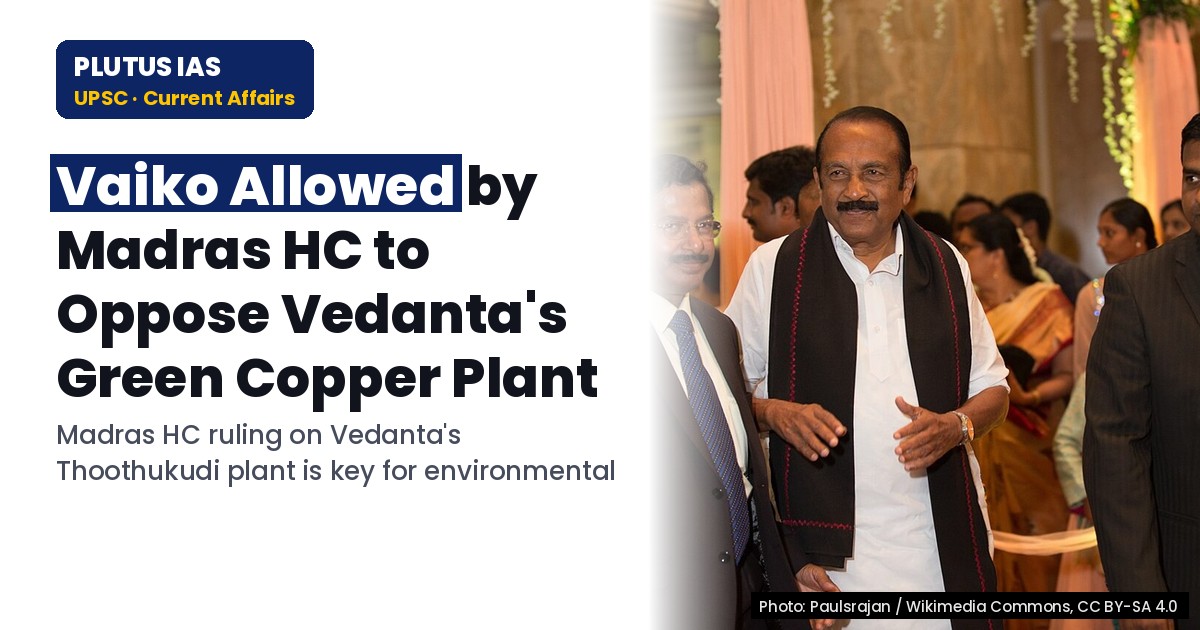
02 Nov Madras HC Allows Vaiko to Oppose Vedanta’s Green Copper Plant
✎ The Madras High Court's decision to allow impleading in the Vedanta-TNPCB case underscores the judiciary's role in ensuring comprehensive stakeholder participation and judicial review in environmental regulatory disputes.
Subject Relevance — Where This Topic Fits
- GS Paper II — Governance, Constitution, Polity, Social Justice | GS Paper III — Environment, Economy, Science and Technology
- Prelims: High Courts; Writ Jurisdiction; Impleading; Environmental Protection Act; Pollution Control Boards; Industrial Regulation; Sustainable Development; Green Copper Technology
- Essay: Environmental Protection and Sustainable Development: Balancing Industrial Growth with Ecological Concerns, The Role of Judiciary in Upholding Environmental Norms and Public Interest
Quick Revision: The Madras High Court’s decision to allow impleading in the Vedanta-TNPCB case underscores the judiciary’s role in ensuring comprehensive stakeholder participation and judicial review in environmental regulatory disputes.
Why is this in the news?
The Madras High Court has permitted various parties, including a political leader, a federation of traders’ associations, and an activist, to implead as respondents in a writ petition filed by Vedanta Limited. Vedanta is challenging the Tamil Nadu Pollution Control Board’s (TNPCB) refusal to grant ‘Consent to Operate’ for a proposed ‘green copper’ plant at its defunct Sterlite copper facility in Thoothukudi. This development signifies the judiciary’s role in facilitating broader public participation in matters of significant environmental and industrial consequence.
Background
- Vedanta Limited’s Sterlite copper plant in Thoothukudi has been a subject of extensive environmental controversy and public protests for several years, leading to its eventual closure.
- The Tamil Nadu Pollution Control Board (TNPCB) had previously issued orders refusing to grant ‘Consent to Operate’ (CTO) to the Sterlite plant, citing environmental non-compliance.
- Vedanta Limited has now proposed a ‘green copper’ plant, claiming it would utilise an environmentally superior process distinct from previous copper-smelting operations, aligning with sustainability principles.
- The company challenged the TNPCB’s rejection of its ‘green copper’ proposal in the Madras High Court, arguing that the rejection did not reflect a genuine statutory evaluation and overlooked the national demand for copper.
- The current legal proceedings involve Vedanta seeking a court-monitored multidisciplinary expert committee to examine its ‘green copper’ proposal independently and scientifically.
- The Madras High Court’s decision to allow impleading petitions from various stakeholders underscores the principle of natural justice and the right to be heard in cases with significant public interest implications.
- The case highlights the complex interplay between industrial development, environmental protection, public health concerns, and judicial oversight in India.
- The concept of ‘Consent to Operate’ (CTO) is a critical regulatory mechanism under environmental laws, ensuring that industrial units comply with prescribed pollution control standards before commencing or continuing operations.
Key Concepts in Environmental Governance and Judicial Review
- **Impleading:** In legal proceedings, impleading refers to the process by which a third party, not originally a party to the suit, is brought into the case by the court, either on its own motion or upon application, because their presence is necessary for a complete and final adjudication of the issues involved.
- **Writ Petition:** A writ petition is a formal written order issued by a court, typically a High Court or the Supreme Court, to enforce fundamental rights or to ensure that a public authority performs its duties. In this context, Vedanta filed a writ petition challenging the TNPCB’s order.
- **Consent to Operate (CTO):** Under the Water (Prevention and Control of Pollution) Act, 1974, and the Air (Prevention and Control of Pollution) Act, 1981, industrial units are required to obtain ‘Consent to Establish’ (CTE) before setting up and ‘Consent to Operate’ (CTO) before commencing production. These consents are granted by State Pollution Control Boards (SPCBs) or Pollution Control Committees (PCCs) after ensuring compliance with environmental standards.
- **State Pollution Control Boards (SPCBs):** Established under the Water (Prevention and Control of Pollution) Act, 1974, SPCBs are statutory bodies responsible for implementing environmental laws, monitoring pollution, granting consents to industries, and enforcing pollution control measures within their respective states.
- **Environmental Protection Act, 1986:** This comprehensive legislation provides for the protection and improvement of the environment and for matters connected therewith. It empowers the Central Government to take all necessary measures for protecting and improving environmental quality.
- **Green Copper Technology:** This term generally refers to copper production processes designed to minimise environmental impact, often through reduced energy consumption, lower emissions of greenhouse gases and pollutants, efficient resource utilisation, and sustainable waste management practices.
- **Judicial Review:** The power of the judiciary to examine the constitutionality or legality of legislative enactments and executive orders of both the Central and State Governments. In this case, the High Court is reviewing the administrative decision of the TNPCB.
- **Public Interest Litigation (PIL):** While not explicitly a PIL, the involvement of an activist and a traders’ federation highlights the broader public interest dimensions often addressed through judicial intervention in environmental matters.
Key Features
| Feature | Significance |
|---|---|
| Impleading Petition | Allows third parties with a direct interest to join existing legal proceedings, ensuring broader representation of perspectives. |
| Consent to Operate (CTO) | A mandatory regulatory clearance from pollution control boards for industries to commence or continue operations, ensuring environmental compliance. |
| Green Copper Plant Proposal | Vedanta’s initiative to establish an environmentally superior copper production facility, distinct from previous smelting processes, focusing on sustainability. |
| Court-Monitored Expert Committee | A proposed multidisciplinary body, overseen by the judiciary, to conduct an independent and scientific evaluation of complex industrial proposals. |
| Resource Nationalism | A country’s assertion of control over its natural resources, often driven by strategic and economic considerations, impacting global supply chains. |
Why it Matters
Environmental Governance
- The case highlights the critical role of environmental regulatory bodies, such as the Tamil Nadu Pollution Control Board (TNPCB), in evaluating industrial projects based on environmental impact assessments and statutory compliance.
- It underscores the judiciary’s function in overseeing administrative decisions and ensuring adherence to environmental protection norms, particularly in cases with significant public interest and past controversies.
Industrial Development and Sustainability
- The proposal for a ‘green copper’ plant reflects the evolving industrial landscape where companies are increasingly seeking to integrate sustainable practices and advanced technologies to mitigate environmental footprints.
- It brings to the forefront the tension between industrial growth, the demand for strategic resources like copper, and the imperative for ecological preservation, necessitating a balanced policy approach.
Legal and Judicial Process
- The Madras High Court’s decision to permit impleading petitions demonstrates the principle of natural justice and the right of affected parties to be heard in matters of public importance, enhancing transparency and accountability in judicial proceedings.
- The request for a court-monitored expert committee illustrates a mechanism for incorporating scientific and technical expertise into judicial decision-making, especially in complex environmental litigation.
Economic and Strategic Importance
- Copper is a vital strategic resource with increasing national and global demand, crucial for various industries including electronics, renewable energy, and infrastructure.
- Augmenting domestic copper production through facilities that prioritize sustainability can reduce import dependence and strengthen India’s economic resilience and resource security.
Challenges
1. Balancing Industrial Growth and Environmental Protection
- The primary challenge lies in reconciling the economic imperative of industrial development and meeting strategic resource demands with the paramount need for environmental sustainability and public health protection.
- Past controversies surrounding industrial units often create significant public distrust, making it difficult to introduce new projects even with improved environmental safeguards.
UPSC Link: Environmental Impact Assessment
2. Ensuring Regulatory Efficacy and Transparency
- The effectiveness of environmental regulatory bodies like the TNPCB is crucial. Challenges include ensuring their decisions are based on robust scientific evaluation, free from external pressures, and transparently communicated.
- The perception of regulatory capture or insufficient scrutiny can undermine public confidence in environmental governance.
UPSC Link: Environmental Governance
3. Public Participation and Stakeholder Engagement
- Integrating diverse stakeholder perspectives, including local communities, environmental activists, and industry, into decision-making processes is complex but essential for legitimacy and acceptance.
- Addressing historical grievances and building trust with affected communities requires sustained and genuine engagement, beyond mere legal compliance.
UPSC Link: Public Policy Formulation
4. Technological Assessment and Verification
- Evaluating the claims of ‘green’ or environmentally superior technologies requires specialized expertise to verify their efficacy, potential risks, and adherence to best available techniques.
- Establishing credible, independent mechanisms for such assessments is vital to ensure that new industrial proposals genuinely meet high environmental standards.
UPSC Link: Science and Technology
Challenges — UPSC Perspective
| Issue | Concern |
|---|---|
| Past Regulatory Actions | Previous legal proceedings and regulatory decisions often create a precedent and influence public and administrative perception of future proposals, even if new technologies are involved. |
| Public Trust Deficit | Historical incidents and perceived environmental damages can lead to deep-seated public opposition, making it challenging for industries to regain community acceptance. |
| Scientific Evaluation of ‘Green’ Claims | Ensuring that proposed ‘green’ technologies are genuinely environmentally superior and not merely a rebranding requires rigorous, independent scientific and technical assessment. |
| Resource Nationalism vs. Global Supply Chains | Balancing the national strategic interest in augmenting domestic production of critical resources with global environmental responsibilities and local community concerns. |
| Judicial Overlap with Executive Functions | The request for a court-monitored expert committee raises questions about the appropriate extent of judicial intervention in executive and regulatory decision-making processes. |
Way Forward
- Strengthen the capacity and independence of environmental regulatory bodies to conduct thorough, science-based evaluations of industrial proposals.
- Implement transparent and inclusive public consultation processes that genuinely address community concerns and build trust.
- Develop clear guidelines and standards for ‘green’ industrial technologies, ensuring rigorous verification of environmental claims.
- Promote inter-agency coordination between central and state governments to streamline environmental clearances while upholding stringent safeguards.
- Encourage industries to adopt best available technologies and practices that minimize environmental impact and promote circular economy principles.
- Establish independent expert committees, potentially with judicial oversight, to provide unbiased technical assessments for complex environmental projects.
- Foster environmental education and awareness among all stakeholders to facilitate informed decision-making and responsible industrial development.
UPSC Value Addition
Keywords for Mains Answer-Writing
Environmental clearances · Pollution Control Boards · Sustainable industrial development · Green technology adoption · Public participation in environmental governance · Judicial review of administrative decisions · Environmental Impact Assessment · Resource nationalism · Copper production · Corporate social responsibility
Constitutional & Policy Linkages
- {‘article’: ‘Article 21’, ‘note’: ‘Right to life and healthy environment’}
- {‘article’: ‘Article 48A’, ‘note’: “State’s duty to protect environment”}
- {‘article’: ‘Article 51A(g)’, ‘note’: “Citizen’s duty to protect environment”}
Concept Flow
Vedanta proposes ‘green copper’ plant at Thoothukudi. → TNPCB rejects ‘Consent to Operate’ application. → Vedanta challenges TNPCB’s decision in Madras High Court. → Public interest groups seek to implead in the case. → Madras High Court permits impleading petitions. → Court to further hear the writ petition and proposals. → Potential for court-monitored expert committee evaluation.
Prelims Practice Questions
Q1. Consider the following statements regarding ‘Consent to Operate’ (CTO) in India:
1. CTO is granted by the Central Pollution Control Board (CPCB) for all industrial units.
2. The refusal to grant CTO can be challenged in the High Court through a writ petition.
3. CTO is a statutory requirement under the Environment (Protection) Act, 1986.
How many of the above statements are correct?
- Only one
- Only two
- Only three
- None
Answer: Only two — Statement 1 is incorrect: CTO is primarily granted by State Pollution Control Boards (SPCBs) or Pollution Control Committees (PCCs) as per the Water (Prevention and Control of Pollution) Act, 1974, and Air (Prevention and Control of Pollution) Act, 1981. Statement 2 is correct: A refusal to grant CTO, being an administrative decision, can be challenged in the High Court under its writ jurisdiction (Article 226). Statement 3 is incorrect: CTO is primarily governed by the Water (Prevention and Control of Pollution) Act, 1974, and Air (Prevention and Control of Pollution) Act, 1981, not exclusively the Environment (Protection) Act, 1986, though the latter provides an overarching framework.
Q2. Which of the following is a key function of the State Pollution Control Boards (SPCBs) in India?
- Formulating national environmental policies.
- Granting ‘Consent to Establish’ and ‘Consent to Operate’ for industries.
- Adjudicating environmental disputes between states.
- Implementing international environmental treaties.
Answer: Granting ‘Consent to Establish’ and ‘Consent to Operate’ for industries. — SPCBs are responsible for implementing environmental laws and regulations at the state level, including granting ‘Consent to Establish’ (CTE) and ‘Consent to Operate’ (CTO) to industries, monitoring pollution levels, and advising state governments on pollution control matters. National policy formulation is primarily by the Ministry of Environment, Forest and Climate Change (MoEFCC) and CPCB. Environmental disputes between states are handled by tribunals or the judiciary. International treaty implementation involves the Union government.
Mains Practice Question
✍ Critically examine the role of judicial review in ensuring environmental accountability and promoting sustainable industrial practices in India. Discuss with reference to recent High Court decisions concerning industrial clearances. (15 Marks)
Approach: MODEL-ANSWER SKELETON: Introduction: Define judicial review and its significance in environmental governance. Role of Judicial Review: Upholding environmental laws (e.g., Water Act, Air Act, EPA), ensuring compliance with ‘Consent to Establish’ and ‘Consent to Operate’ conditions, safeguarding public participation (e.g., impleading parties), preventing arbitrary administrative action (e.g., TNPCB’s refusal). Recent High Court Decisions: Reference the Madras High Court’s decision allowing impleading petitions in the Vedanta case, highlighting judicial scrutiny of ‘green’ proposals and administrative rejections. Mention other relevant cases if applicable, where courts have intervened in environmental clearances or industrial operations. Challenges/Limitations: Potential for delays in project implementation, balancing environmental protection with economic development, technical complexities in environmental assessments, scope of judicial intervention versus expert administrative bodies. Conclusion: Summarize the critical role of judicial review as a check and balance, while acknowledging the need for a balanced approach that respects both environmental imperatives and economic realities, promoting genuine sustainable industrial practices.
Source: The Hindu
Generated by AanyaAi for educational purpose.
Related guides on our sites
- Anthropology VS PSIR
- Best PSIR optional coaching
- Best PSIR optional coaching online
- Best coaching for law optional

- Swachh Survekshan: MP’s 9 Cities Honored by President - November 8, 2026
- ईपीएफओ का विशेष अभियान 6: जनसेवा, स्वच्छता और रिकॉर्ड प्रबंधन में सफलता - November 8, 2026
- Andhra Pradesh: Drought to Deluge & Cyclones Impact - November 8, 2026

No Comments