


12 Mar No-Confidence Motion Against The Speaker OM Birla
This article covers “Daily Current Affairs” and From No-Confidence Motion Against The Speaker OM Birla
SYLLABUS MAPPING
GS- 2 – Indian polity and constitution – No-Confidence Motion Against The Speaker OM Birla
FOR PRELIMS
What type of majority is required to remove the Speaker of the Lok Sabha?
FOR MAINS
Explain the constitutional provisions governing the removal of the Speaker of the Lok Sabha.
Why in the news?
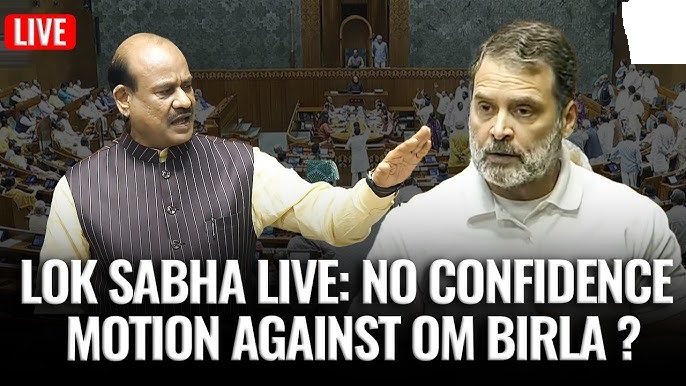
The Opposition has moved a no-confidence motion against Om Birla, the Lok Sabha Speaker. Parliamentary sources said the motion will now be examined and processed as per established rules.
The move follows criticism from the Congress and other parties, who accused the Speaker of not permitting the Leader of Opposition to quote from or discuss former Army Chief M M Naravane’s unpublished memoir.
The Opposition also objected to the Speaker’s claim that PM Modi could have been attacked inside the House, calling it unwarranted and contentious
Past Precedents of No-Confidence Motions Against Lok Sabha Speakers
No-confidence motions have been moved against the Lok Sabha Speaker on three occasions—in 1954, 1966, and 1987.
For such a motion to proceed, it must be supported by at least two Members of Parliament, and 50 members must stand in support, fulfilling the House’s quorum.
The procedure is governed by Rules 200–203 of the Rules of Procedure and Conduct of Business in Lok Sabha.
Historically:
1954: G V Mavalankar, the first Speaker, faced a motion
1966: Motion against Hukam Singh
1987: Motion against Balram Jakhar
In all three cases, the motions failed, and none of the Speakers were removed from office
Role of the Speaker in Parliamentary Democracy
In a parliamentary democracy, the Speaker of the lower house serves as the presiding officer, custodian of the House’s rules, and the ultimate authority on maintaining order and decorum during proceedings. The Speaker’s role extends far beyond mere moderation; they interpret the Constitution and rules of procedure, certify money bills, adjudicate defection cases under the anti-defection law, and ensure that parliamentary debates remain focused and fair. This office is pivotal to the smooth functioning of the legislature, acting as the bridge between the government, the opposition, and the constitutional framework. Without an effective Speaker, the House risks descending into chaos, undermining the very essence of representative democracy.
Neutrality and impartiality are the bedrock of the Speaker’s office. The Speaker is expected to rise above party affiliations, even though elected on a party ticket in India. Any perception of bias erodes public trust in Parliament, tilts the balance of power, and compromises the legitimacy of legislative outcomes. Impartiality ensures that minority voices are heard, procedural fairness is upheld, and the House functions as a true deliberative body rather than a rubber stamp for the majority. Deviations from neutrality invite accusations of partisanship, which can paralyse proceedings and invite judicial intervention.
The concept of a no-confidence or removal motion against the Speaker introduces a critical accountability mechanism. Unlike a standard no-confidence motion against the government (which requires only a simple majority of members present and voting), a motion to remove the Speaker is a stringent constitutional tool designed to check abuse of power while protecting the office’s stability. Its relevance lies in reinforcing democratic accountability: it allows the House to hold the presiding officer answerable without destabilising the government itself. Such motions, though rare, underscore that no office is above scrutiny, thereby safeguarding the sanctity of parliamentary democracy.
Constitutional Framework
The Constitution of India explicitly governs the Speaker’s position through Articles 93, 94, and allied provisions. Article 93 mandates the election of the Speaker and Deputy Speaker by the Lok Sabha (House of the People) as soon as possible after the first sitting of the new House. The Speaker holds office until the dissolution of the Lok Sabha or until they cease to be a member, resign, or are removed. This provision ensures continuity and democratic legitimacy, as the Speaker derives authority directly from the elected representatives.
Article 94 details the mechanisms for vacation, resignation, and removal. Clause (c) is particularly significant: the Speaker “may be removed from his office by a resolution of the House of the People passed by a majority of all the the members of the House,” provided at least fourteen days’ notice of the intention to move the resolution is given. This “effective” or “absolute” majority—more than 50% of the total strength of the House, irrespective of vacancies or absences—makes removal deliberately difficult, reflecting the framers’ intent to insulate the office from frivolous challenges while allowing accountability. Similar provisions apply to state legislative assemblies under Article 179.
The legal basis for a removal motion stems directly from Article 94(c), read with the Rules of Procedure and Conduct of Business in Lok Sabha (Rules 200–203). It is not a conventional no-confidence motion but a specific resolution for removal. The Constitution does not bar judicial review of the Speaker’s actions in certain contexts, reinforcing that the office operates within constitutional bounds. These provisions collectively balance stability with accountability, preventing arbitrary removal while empowering the House to act against proven misconduct or bias.
Procedure for Moving a No-Confidence/Removal Motion
The procedural steps for removal are rigorous and multi-layered. A member (or members) must submit a written notice to the Secretary-General of the Lok Sabha, clearly stating the intention to move the resolution and specifying charges with sufficient clarity. The notice must be signed by at least one member, though joint notices (as seen in recent instances with over 100 signatories) strengthen its legitimacy. A mandatory 14-day cooling-off period follows, during which the motion cannot be moved.
Once the notice period expires, the motion appears in the List of Business. The presiding officer (typically the Deputy Speaker when the motion targets the Speaker) reads the notice. For the motion to be admitted for discussion, at least 50 members must rise in support to grant “leave of the House.” If granted, a full debate ensues, allowing the Speaker to defend their position. The resolution requires passage by an absolute majority of the total membership (e.g., at least 272 votes in a 543-member House).
During proceedings on the removal motion, the Speaker cannot preside but may participate in debate and vote (except in case of tie). The Deputy Speaker assumes the chair, ensuring continuity and impartiality. Voting is by division if demanded. Identical procedures apply in state assemblies. These safeguards prevent hasty decisions and uphold due process.
Judicial Interpretations and Legal Debates
The Supreme Court has shaped the contours of the Speaker’s powers and removal through landmark rulings. In Kihoto Hollohan v. Zachillhu (1992), the Court upheld the anti-defection law (Tenth Schedule) but declared the Speaker’s decisions subject to limited judicial review on grounds of mala fides, perversity, or constitutional violation. It affirmed that the Speaker acts as a tribunal, bound by principles of natural justice and impartiality.
The Nabam Rebia case (2016) introduced a crucial safeguard: a Speaker facing a removal notice under Article 94 (or state equivalent) is constitutionally disabled from adjudicating disqualification petitions under the Tenth Schedule. This prevents conflict of interest and preserves the integrity of the removal process, as disqualifications could alter the House’s composition and influence the majority required for removal. The judgment has faced scrutiny, with calls for reconsideration, but it remains binding and highlights tensions between the Speaker’s dual roles.
In Keisham Meghachandra Singh v. Speaker, Manipur Legislative Assembly (2020), the Court directed Speakers to decide defection cases within three months, criticising delays motivated by political considerations. Recent observations by the Supreme Court (2025) have urged Parliament to replace the Speaker with an independent tribunal for anti-defection matters, citing persistent bias concerns. Controversies surrounding impartiality—such as selective certification of money bills, partisan rulings on adjournment motions, and delayed defection decisions—have intensified debates on whether the Speaker can truly detach from political pressures while remaining a party member.
Comparative Perspective
In the United Kingdom, the Speaker of the House of Commons is elected by secret ballot and follows the convention “once a Speaker, always a Speaker.” Upon election, the Speaker resigns party membership and maintains strict neutrality for life. Removal is possible via a substantive motion of censure or no confidence, typically requiring a simple majority, but such instances are exceedingly rare due to entrenched conventions. No fixed 14-day notice or absolute-majority threshold applies; the process relies more on political consensus and tradition.
Canada and Australia, fellow Westminster systems, mirror this model. Speakers are expected to sever partisan ties, and removal motions are substantive but rarely successful. Australia has seen occasional censure motions, but success demands broad support. Unlike India, these systems prioritise convention over rigid constitutional majorities, making removal procedurally simpler yet politically improbable.
The Indian system differs markedly: the Speaker retains party membership (not disqualified under anti-defection law), and removal demands an absolute majority with notice. This provides greater institutional stability but risks politicisation. Similarities include the emphasis on impartiality and the Deputy Speaker’s role in presiding over removal debates. The comparison underscores India’s unique blend of constitutional rigidity and political reality.
Political and Democratic Implications
No-confidence motions against the Speaker can disrupt parliamentary functioning, consuming valuable time and escalating partisan tensions. However, they strengthen accountability by signalling that the presiding officer is not immune to scrutiny. In a coalition or fragmented House, such motions test the ruling party’s numerical strength and opposition unity, potentially forcing dialogue on procedural fairness.
Critics argue these motions risk politicising the office further, turning every ruling into a political flashpoint. Yet, in a maturing democracy, they reinforce that power— even ceremonial—must remain answerable. When used judiciously, they bolster democratic health; when weaponised, they erode institutional dignity.
Challenges and Criticisms
Major concerns include misuse for political vendetta, especially when opposition strength is insufficient to succeed but sufficient to stall proceedings. Delays in defection decisions and perceived partisan bias (e.g., in money bill certification or opposition speaking time) undermine credibility. Structural challenges persist because the Speaker depends on majority support for survival yet must adjudicate against that majority’s interests. Critics highlight that without detaching from party affiliation, true neutrality remains elusive.
Reforms and Recommendations
Reforms could include a constitutional amendment mandating resignation from party membership upon assuming office, akin to the UK model. Establishing an independent tribunal or judicial panel for anti-defection cases would eliminate bias. Strict time-bound adjudication (enforcing the three-month guideline) and enhanced transparency in rulings (with reasoned orders) are essential. Parliament could also adopt conventions for cross-party consensus in Speaker elections and clearer guidelines on motion admission. These steps would enhance procedural clarity and restore public faith.
Conclusion
The no-confidence or removal motion against the Speaker embodies the delicate balance between authority and accountability in Indian parliamentary democracy. Rooted in Articles 93 and 94, bolstered by judicial safeguards, and tempered by stringent procedures, it protects institutional stability while preventing abuse. Comparative insights reveal opportunities for stronger conventions, while ongoing challenges underscore the need for urgent reforms. Ultimately, preserving the Speaker’s neutrality through constitutional safeguards is indispensable to sustaining a vibrant, fair, and resilient democracy. Only then can Parliament truly reflect the will of the people it serves.
Best ias coaching in delhi Best ias coaching in chandigar
Prelims question:
Q. Consider the following statements regarding the removal of the Speaker of the Lok Sabha:
1.The Speaker may be removed from office by a resolution passed by a majority of the members present and voting.
2.A minimum notice period of 14 days is required before moving a resolution for removal.
3.During the discussion on the removal motion, the Speaker cannot preside over the House.
4.The Constitution of India provides the procedure for removal under Article 94.
Which of the statements given above are correct?
A. 1 and 2 only
B. 2, 3 and 4 only
C. 1, 3 and 4 only
D. 1, 2, 3 and 4
Mains Question:
Q. In the light of the recent no-confidence motion against the Lok Sabha Speaker, discuss the constitutional provisions, procedure for removal, and the challenges affecting the impartiality of the office. (250 words)

- Artemis II: Humanity’s Return to Lunar Space and India’s Place in the New Moon Race - April 2, 2026
- A Missed Opportunity to Guarantee Minimum Wages - March 31, 2026
- ‘India’s Growth Claims, A Clash with Data Reality’. - March 30, 2026

No Comments