


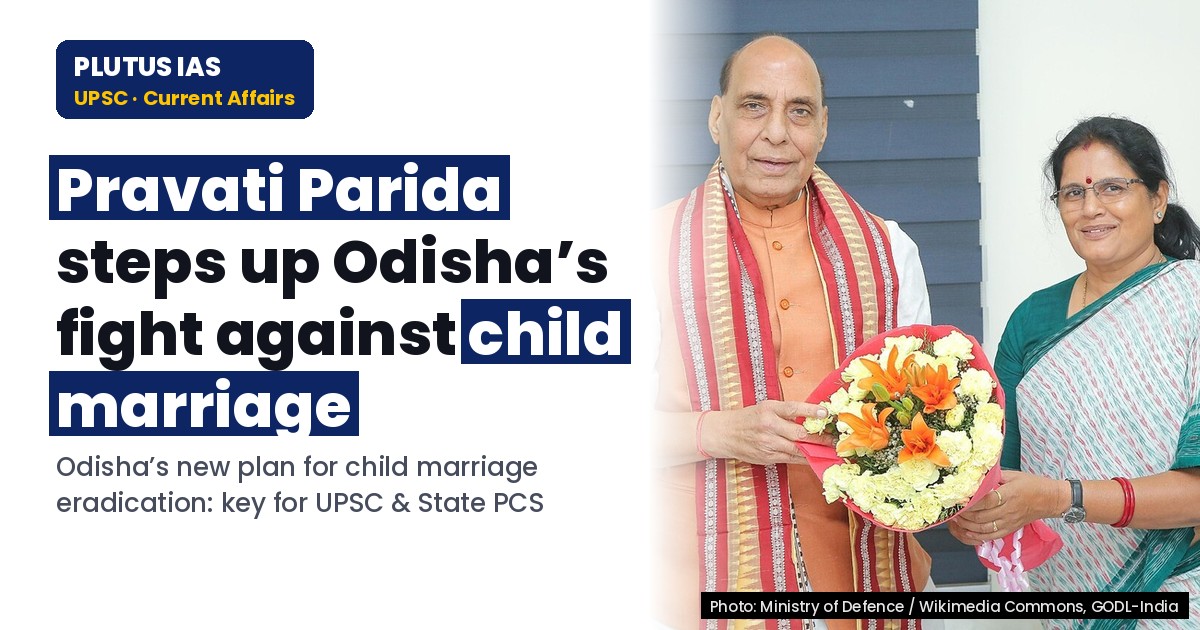
16 Oct Odisha’s Plan to Eradicate Child Marriage: Key Focus Areas for UPSC & PCS
✎ Child marriage in India is criminalised under the Prohibition of Child Marriage Act, 2006, while Odisha’s response integrates legal enforcement, institutional support (OSCs, Women Helpline 181), and economic empowerment…
Subject Relevance — Where This Topic Fits
- GS Paper I — Social Issues and Vulnerable Sections | GS Paper II — Government Policies and Interventions for Development in various sectors | GS Paper III — Role of Women and Children in Socio-Economic Development
- Prelims: Child Marriage Prohibition Act, 2006, Mission Vatsalya, Beti Bachao Beti Padhao (BBBP), One Stop Centres (OSC), Women Helpline 181, SHe-Box portal, Prevention of Sexual Harassment (POSH) Act, 2013, Pradhan Mantri Matru Vandana Yojana (PMMVY), Odisha Mamata Scheme
- Essay: Social Justice and Inclusive Development: The Role of State-Led Interventions, Balancing Tradition and Modernity: Addressing Harmful Social Practices in Contemporary India
Quick Revision: Child marriage in India is criminalised under the Prohibition of Child Marriage Act, 2006, while Odisha’s response integrates legal enforcement, institutional support (OSCs, Women Helpline 181), and economic empowerment frameworks under Mission Vatsalya and Beti Bachao Beti Padhao.
Why is this in the news?
The Government of Odisha, through a high-level review meeting chaired by the Deputy Chief Minister, has announced a comprehensive, time-bound action plan to intensify efforts against child marriage, with a focus on strengthening institutional mechanisms, inter-departmental coordination, and community participation. This initiative aligns with national frameworks such as Mission Vatsalya and the Beti Bachao Beti Padhao programme, while introducing district-level economic empowerment strategies to address root causes of the practice.
Background
- Child marriage remains a significant socio-legal challenge in India, with Odisha reporting higher prevalence rates in certain districts compared to the national average, as per NFHS-5 (2019-21) data.
- The Prohibition of Child Marriage Act, 2006, criminalises the solemnisation of marriage involving minors and mandates punishment for parents, guardians, and those who facilitate such marriages.
- Odisha has historically implemented targeted schemes such as the Mamata scheme (2011) for conditional cash transfers to pregnant and lactating women, and the Beti Bachao Beti Padhao (BBBP) initiative to improve child sex ratios and educational outcomes.
- The Union Ministry of Women and Child Development (MWCD) has been driving national-level convergence through Mission Vatsalya (2021), which consolidates child protection schemes under a unified framework.
- One Stop Centres (OSCs) and Women Helpline 181 are critical institutional mechanisms for providing integrated support to survivors of gender-based violence, including child marriage victims.
- The Prevention of Sexual Harassment (POSH) Act, 2013, and the SHe-Box portal are administrative tools aimed at ensuring workplace safety and redressal mechanisms for women.
Child Marriage in India: Legal Provisions, Institutional Mechanisms, and Odisha’s Strategic Response
- Child marriage is defined under the Prohibition of Child Marriage Act, 2006, as the marriage of a girl below 18 years or a boy below 21 years, rendering such unions legally voidable at the option of the child.
- Odisha’s strategy integrates legal enforcement with social reformation through district-level mapping of vulnerable communities, focused awareness campaigns, and inter-departmental coordination among police, health, legal, and rehabilitation services.
- Mission Vatsalya (2021) serves as the overarching framework for child protection in India.
- The Beti Bachao Beti Padhao (BBBP) programme, launched in 2015, aims to address declining child sex ratios and promote girls’ education through multi-sectoral interventions, including media campaigns and community mobilisation.
- One Stop Centres (OSCs) provide integrated support to women survivors of violence, including legal aid, medical assistance, psycho-social counselling, and temporary shelter, operating under the MWCD’s Umbrella Scheme for Protection and Empowerment of Women.
- Odisha’s Women’s Economic Empowerment Framework introduces district-level targets to track women’s workforce participation, earnings, and entrepreneurship, aligning with the Sustainable Development Goals (SDG 5: Gender Equality) and national priorities for inclusive growth.
Key Features
| Feature | Significance |
|---|---|
| Strengthening Women and Child Development Department Review Mechanism | Ensures systematic, time-bound implementation of policies through inter-departmental coordination and robust monitoring for measurable outcomes. |
| Village-Level Mapping of Vulnerable Areas | Identifies high-risk communities for targeted interventions, enabling precise resource allocation and community-specific awareness campaigns. |
| One Stop Centres and Women Helpline 181 | Provides integrated support services for survivors of violence, including legal aid, medical assistance, and rehabilitation under a single roof. |
| Mission Vatsalya Implementation | Aligns state-level child protection measures with the centrally sponsored scheme, ensuring compliance with the Juvenile Justice (Care and Protection of Children) Act, 2015. |
| Women’s Economic Empowerment Framework | Tracks workforce participation, earnings, and entrepreneurship at the district level, fostering data-driven policy adjustments for gender-inclusive economic growth. |
Why it Matters
Social Development
- Child marriage undermines human capital formation by disrupting education and health, particularly for adolescent girls, perpetuating intergenerational poverty.
- Strengthening women’s safety mechanisms addresses gender-based violence, a critical barrier to achieving Sustainable Development Goal 5 (Gender Equality).
- Early childhood development initiatives under Mission Vatsalya contribute to breaking cycles of malnutrition and poor health outcomes in vulnerable populations.
Institutional Strengthening
- Inter-departmental coordination enhances the efficacy of welfare schemes by reducing silos between police, health, legal, and rehabilitation services.
- Time-bound implementation and monitoring mechanisms improve accountability, ensuring that policy goals translate into tangible outcomes on the ground.
- Integration of national schemes (e.g., PMMVY, Beti Bachao Beti Padhao) with state-level initiatives (e.g., Mamata Scheme) optimises resource utilisation and programme reach.
Economic Implications
- Preventing child marriage and promoting women’s workforce participation can increase household incomes and contribute to state GDP growth by enhancing labour force productivity.
- Expansion of crèches and hostels for working women reduces the care burden on families, enabling greater female labour force participation, particularly in informal sectors.
- Data-driven frameworks for women’s economic empowerment facilitate evidence-based policymaking to address structural barriers in employment and entrepreneurship.
Challenges
1. Deep-Rooted Social Norms
- Child marriage persists due to patriarchal traditions, economic compulsions, and lack of awareness about legal provisions (e.g., Prohibition of Child Marriage Act, 2006).
- Community resistance to change, particularly in tribal and rural areas, poses a significant barrier to behavioural modification.
UPSC Link: GS1: Social Empowerment
2. Coordination Gaps Among Stakeholders
- Fragmented implementation across departments (e.g., police, health, legal) can lead to duplication of efforts or gaps in service delivery.
- Inadequate real-time data sharing between agencies hinders the identification of high-risk cases and timely intervention.
UPSC Link: GS2: Centre-State Relations
3. Resource Constraints
- Limited funding for awareness campaigns, rehabilitation services, and infrastructure (e.g., One Stop Centres) may dilute the impact of interventions.
- Shortage of trained personnel in grassroots-level institutions (e.g., Anganwadi workers, child protection officers) affects service quality.
UPSC Link: GS3: Resource Mobilisation
4. Legal Enforcement Challenges
- Underreporting of child marriage cases due to social stigma, fear of retaliation, or lack of awareness about reporting mechanisms.
- Slow judicial processes and weak enforcement of the Prohibition of Child Marriage Act, 2006, undermine deterrence.
UPSC Link: GS2: Judiciary
5. Data Deficiencies
- Incomplete or outdated district-level data on child marriage and women’s workforce participation hampers targeted policymaking.
- Lack of disaggregated data (e.g., by caste, tribe, or region) obscures disparities in access to services.
UPSC Link: GS3: Data Governance
Challenges — UPSC Perspective
| Issue | Concern |
|---|---|
| Social Norms | Patriarchal traditions and economic compulsions sustain child marriage despite legal prohibitions. |
| Institutional Coordination | Fragmented implementation across departments leads to inefficiencies in service delivery. |
| Resource Allocation | Inadequate funding and personnel shortages limit the reach and effectiveness of interventions. |
| Legal Enforcement | Underreporting and slow judicial processes weaken deterrence against child marriage. |
| Data Gaps | Incomplete or outdated data obscures disparities and hinders targeted policymaking. |
| Awareness Deficit | Lack of community-level awareness about legal rights and support services reduces programme impact. |
Government Initiatives — Must-Memorise for Prelims
- Prohibition of Child Marriage Act, 2006
- Juvenile Justice (Care and Protection of Children) Act, 2015
- Beti Bachao Beti Padhao
- Pradhan Mantri Matru Vandana Yojana (PMMVY)
- Odisha Mamata Scheme
- Women Helpline 181
- One Stop Centres (OSCs)
- Prevention of Sexual Harassment (POSH) Act, 2013
Way Forward
- Conduct district-level vulnerability mapping using multi-stakeholder consultations to identify high-risk communities for targeted interventions.
- Strengthen inter-departmental coordination through regular review meetings and real-time data-sharing platforms (e.g., integrated dashboards).
- Expand the reach of One Stop Centres and Women Helpline 181 by increasing staffing and digital outreach (e.g., helpline apps, WhatsApp groups).
- Launch community-led awareness campaigns in local languages, leveraging self-help groups (SHGs) and local leaders to drive behavioural change.
- Enhance enforcement of the Prohibition of Child Marriage Act, 2006 through fast-track courts and dedicated child protection units in police stations.
- Develop a state-specific Women’s Economic Empowerment Framework with district-level targets, linked to the National Data Governance Framework Policy.
- Establish a grievance redressal mechanism for survivors of child marriage and gender-based violence, with provisions for legal aid and rehabilitation.
- Promote convergence between Mission Vatsalya and national schemes (e.g., PMMVY, BBBP) to optimise resource utilisation and programme synergy.
UPSC Value Addition
Keywords for Mains Answer-Writing
Child marriage · Mission Vatsalya · Beti Bachao Beti Padhao · Prevention of Sexual Harassment (POSH) Act · Women and Child Development · One Stop Centres · Women Helpline 181 · SHe-Box portal · Women’s Economic Empowerment Framework · Pradhan Mantri Matru Vandana Yojana · Mamata scheme · Prohibition of Child Marriage Act 2006 · District Child Protection Units · Inter-departmental coordination · Community participation in governance
Concept Flow
Deep-rooted social norms and economic compulsions → High prevalence of child marriage in vulnerable communities → Disruption of education and health outcomes for adolescent girls → Intergenerational poverty and gender inequality → Weakened human capital formation → Reduced state-level economic productivity → Child marriage → Increased risk of maternal and infant mortality → Poor health outcomes → Higher healthcare costs for the state → Strain on public health infrastructure → Lack of women’s workforce participation → Reduced household incomes → Lower state GDP growth → Limited fiscal space for social sector investments → Underreporting of child marriage cases → Weak enforcement of legal provisions → Persistence of the practice → Undermined gender equality goals → Fragmented implementation of welfare schemes → Inefficient resource allocation → Reduced programme impact → Poor outcomes for target beneficiaries → Inadequate data on child marriage and women’s workforce participation → Poor policymaking → Ineffective interventions → Continued social and economic disparities
Prelims Practice Questions
Q1. Consider the following statements regarding the Prohibition of Child Marriage Act, 2006:
1. The Act defines a child as a person who has not completed the age of 18 years for both boys and girls.
2. The Act provides for the appointment of Child Marriage Prohibition Officers at the district level.
3. The Act makes child marriage voidable at the option of the contracting party who is a child.
4. The Act imposes a punishment of imprisonment up to two years and/or fine for promoting or permitting solemnisation of child marriage.
How many of the above statements are correct?
- Only one
- Only two
- Only three
- All four
Answer: All four — Statements 1, 2, and 4 are correct. Statement 3 is incorrect as child marriage under the Act is voidable at the option of the child, not automatically voidable.
Q2. Assertion (A): The Prevention of Sexual Harassment (POSH) Act, 2013 mandates every workplace to constitute an Internal Complaints Committee.
Reason (R): The POSH Act aims to provide a safe and secure working environment for women by addressing complaints of sexual harassment at the workplace.
Options:
A. Both A and R are true, and R is the correct explanation of A.
B. Both A and R are true, but R is not the correct explanation of A.
C. A is true but R is false.
D. A is false but R is true.
Answer: ? — Both A and R are true, and R correctly explains A as the POSH Act indeed mandates the constitution of an Internal Complaints Committee to address workplace sexual harassment.
Q3. Match the following initiatives with their respective objectives:
Column I (Initiative) | Column II (Objective)
— | —
1. Mission Vatsalya | A. Providing financial assistance to pregnant and lactating women
2. Beti Bachao Beti Padhao | B. Strengthening child protection services and systems
3. Pradhan Mantri Matru Vandana Yojana | C. Preventing gender-biased sex selection and ensuring survival and education of the girl child
4. Women Helpline 181 | D. Providing 24×7 emergency and non-emergency support to women affected by violence
- 1-B, 2-C, 3-A, 4-D; 1-A, 2-B, 3-C, 4-D; 1-D, 2-A, 3-B, 4-C; 1-C, 2-D, 3-A, 4-B
- answer_expected_pairing_indexes_to_verify_correctness_against_answer_key_above
Answer: 1-B, 2-C, 3-A, 4-D; 1-A, 2-B, 3-C, 4-D; 1-D, 2-A, 3-B, 4-C; 1-C, 2-D, 3-A, 4-B — The correct pairing is: 1-B (Mission Vatsalya focuses on child protection), 2-C (Beti Bachao Beti Padhao aims at gender-biased sex selection prevention), 3-A (PM Matru Vandana Yojana provides financial support to pregnant women), 4-D (Women Helpline 181 offers support to women in distress).
Mains Practice Question
✍ Child marriage remains a persistent social evil in India despite legislative and policy interventions. In this context, critically examine the constitutional and statutory framework for the eradication of child marriage, with particular reference to the role of state governments. Also, analyse the effectiveness of Odisha’s recent initiatives in this regard, as outlined in the review meeting chaired by the Deputy Chief Minister. (15 Marks)
Approach: MODEL-ANSWER SKELETON:
1. Constitutional and Statutory Framework:
– Article 21 (Right to Life and Personal Liberty) and Article 15(3) (special provisions for women and children) as constitutional bases.
– Prohibition of Child Marriage Act, 2006: Key provisions (Sections 3, 9, 11, 12), role of Child Marriage Prohibition Officers, and penalties.
– Protection of Children from Sexual Offences (POCSO) Act, 2012: Provisions addressing child marriage as a form of sexual exploitation.
– Directive Principles of State Policy (Articles 39(f), 45) and their role in guiding state action.
2. Role of State Governments:
– Concurrent List Entry 20 (Social Security and Social Insurance; employment and unemployment) empowers states to legislate and implement schemes.
– State-specific initiatives: Odisha’s Mission Vatsalya, Beti Bachao Beti Padhao, and Mamata scheme.
– Inter-departmental coordination: Police, health, legal, and rehabilitation services as outlined in Odisha’s plan.
3. Odisha’s Initiatives and Effectiveness:
– Focus areas: Child protection, women’s safety, nutrition, and economic empowerment.
– Key measures: Village-level mapping of vulnerable areas, community participation, One Stop Centres, Women Helpline 181, and SHe-Box portal.
– Strengths: Multi-sectoral approach, time-bound implementation, and robust monitoring mechanisms.
– Challenges: Deep-rooted socio-cultural norms, limited awareness, and resource constraints.
4. Comparative Perspective:
– Reference to other states’ models (e.g., Rajasthan’s ‘Balika Shivir’ or Bihar’s ‘Balika Vivah Nivaran Abhiyan’).
– Role of civil society and NGOs in supplementing state efforts.
5. Conclusion:
– Need for sustained awareness campaigns, strict enforcement of laws, and convergence of welfare schemes.
– Emphasise the importance of local governance (Panchayati Raj Institutions) in addressing child marriage at the grassroots level.
Source: orissapost.com
Odisha PCS (OPSC (OAS)) — State PCS Practice
Prelims: Which of the following districts in Odisha has been identified as having the highest prevalence of child marriage cases in recent reports by the State Commission for Protection of Child Rights (SCPCR)?
- Mayurbhanj
- Koraput
- Balangir
- Nabarangapur
Answer: Nabarangapur — Nabarangapur district has been highlighted in recent SCPCR reports for having the highest number of child marriage cases in Odisha.
Mains: Discuss the key initiatives launched by the Odisha government to combat child marriage in the state, and analyze their effectiveness in addressing the root causes of this social issue.
Generated by AanyaAi for educational purpose.
Related guides on our sites
- Current affairs for upsc 2026
- Best sociology optional coaching for upsc
- Which is best sociology optional coaching for upsc
- Best teacher of sociology optional for upsc

- JJM 2.0 & 16th Finance Commission: Virtual Conference on Water Convergence - October 22, 2026
- ब्रिक्स संसदीय मंच 2026: लोकसभा अध्यक्ष ने किया उद्घाटन की घोषणा - October 22, 2026
- Pradhan Mantri Samajik Sahayata Yojana: Key Features & UPSC Relevance - October 22, 2026

No Comments