


10 Mar PM e-Vidya: A Paradigm Shift in Indian Digital Education
This article covers “Daily Current Affairs” and From PM e-Vidya: A Paradigm Shift in Indian Digital Education
SYLLABUS MAPPING
GS – II – Governance, Constitution, Social Justice PM e-Vidya: A Paradigm Shift in Indian Digital Education.
FOR PRELIMS
What is the PM e-Vidya initiative ?
FOR MAINS
Discuss the role of SWAYAM and SWAYAM Prabha under PM e-Vidya.
Why in the news?
The landscape of Indian education underwent a seismic transformation during the COVID-19 pandemic. With approximately 25 crore school-going children and over 4.33 crore higher education students facing unprecedented disruptions, the Government of India recognised the urgent need for a future-ready, resilient, and inclusive digital learning solution. In response, the PM e-Vidya initiative was launched as a cornerstone of the Atmanirbhar Bharat Abhiyan in 2020, aiming to bridge the gap between classroom and home. By integrating multi-modal platforms under the banner of “One Nation, One Digital Platform for Education,” the initiative seeks to ensure that learning never stops, regardless of geography or socio-economic barriers.
What is PM e-Vidya?
PM e-Vidya is a comprehensive digital education programme designed to provide multi-mode access to education. Initially launched on 17 May 2020 as an emergency response to the nationwide lockdown, it was subsequently formalised under the Atmanirbhar Bharat Abhiyan on 7 August 2020.
Objectives and Governance The primary objective of PM e-Vidya is to ensure continuity of learning by leveraging technology to take the classroom to the student. It functions through a unified framework that integrates existing digital assets like Digital India, SAMAGRA Shiksha, and the National Mission on Education through Information and Communication Technology (NMEICT).
The scheme is spearheaded by the Ministry of Education, with key implementation and content curation handled by the National Council of Educational Research and Training (NCERT) and the Central Institute of Educational Technology (CIET). Its ultimate goal is to provide inclusive and equitable digital education through online, on-air, and offline channels.
Major Components of PM e-Vidya
The initiative is built upon six key pillars that create a robust multi-modal learning ecosystem.
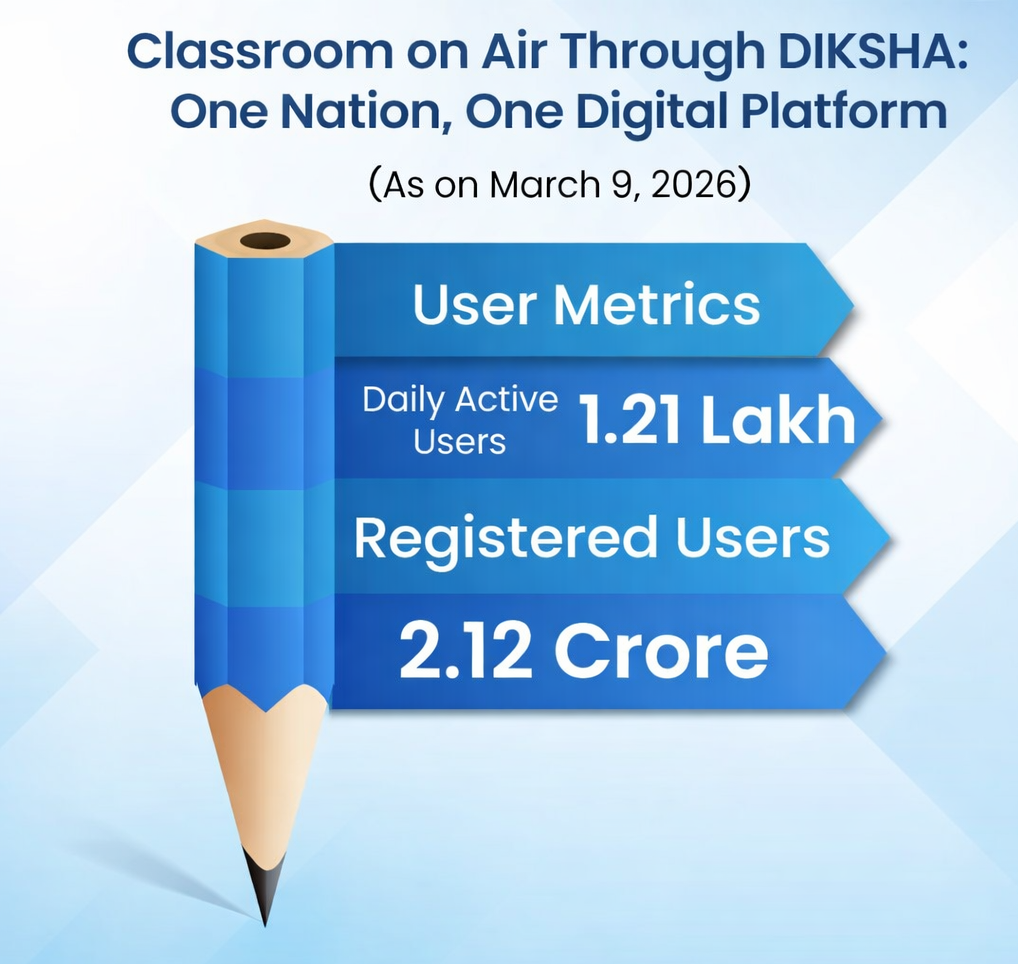
DIKSHA (Digital Infrastructure for Knowledge Sharing): As India’s flagship digital ecosystem for school education, DIKSHA serves over 2.00 crore registered users as of March 2026. It provides curriculum-linked digital materials for K–12 education across NCERT, CBSE, and State boards. A critical feature is the QR-coded Energised Textbooks, which link physical books to media-rich resources like 3D animations and virtual labs.
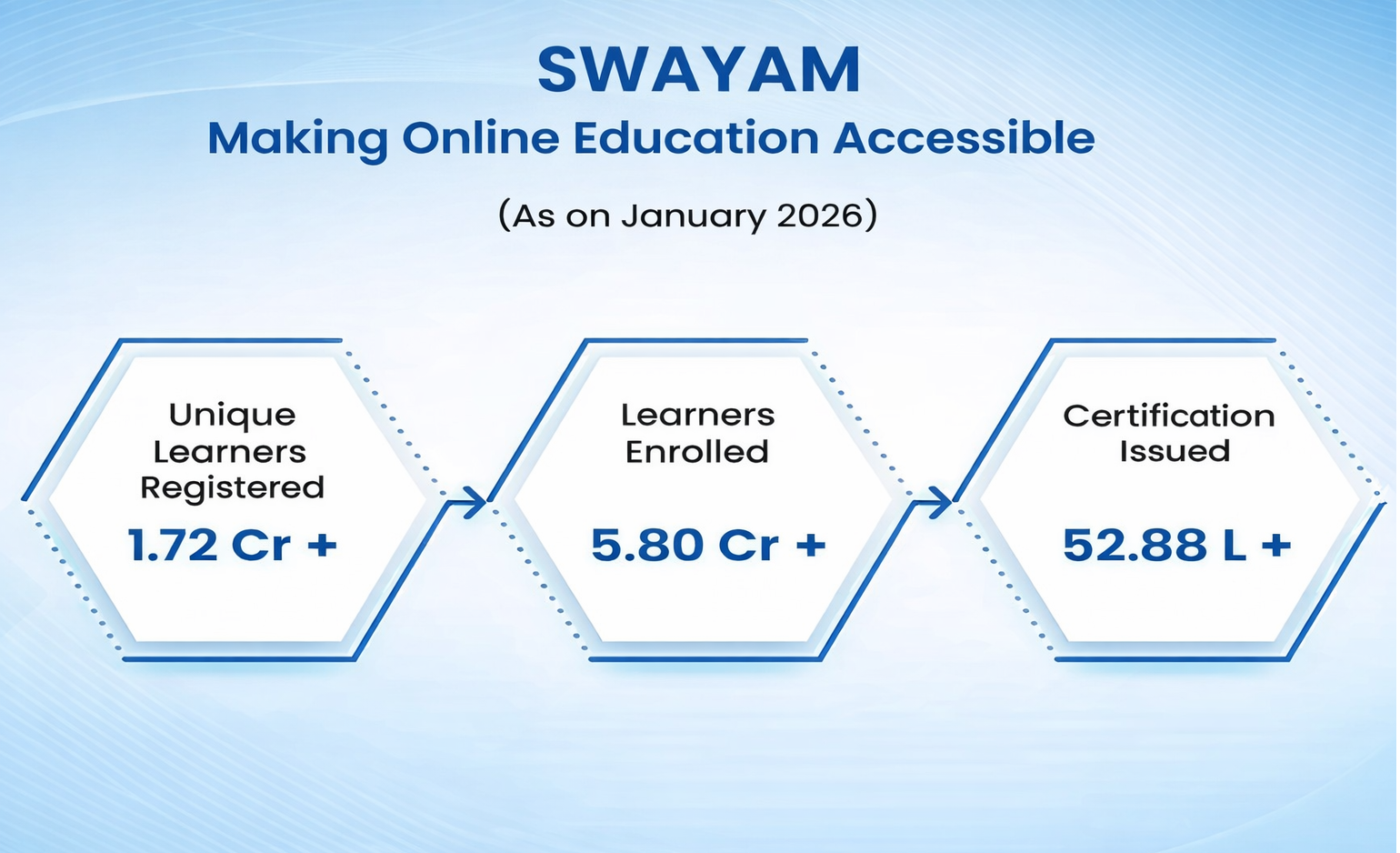
SWAYAM & SWAYAM Prabha: SWAYAM is India’s indigenous MOOC (Massive Open Online Course) platform, boasting over 5.80 crore enrolments. It offers over 4,400 courses for free, allowing students to earn credits that can constitute up to 40 per cent of a formal degree programme. SWAYAM Prabha complements this with 48 DTH channels broadcasting 24/7 educational content, specifically targeting rural areas with limited internet access.
One Class, One Channel: Under the SWAYAM Prabha component, this initiative provides dedicated TV channels for each class from 1 to 12, ensuring that students can access grade-specific content via DD Free Dish without internet dependency.
Education on AIR (Radio and Podcasts): For non-digital audiences, Mukta Vidya Vani (NIOS) and Shiksha Vani (CBSE) provide live interactive audio streaming and podcasts. These platforms deliver curriculum-aligned modules for secondary and senior secondary students, accessible via FM radio and mobile apps.
SATHEE (Self-Assessment, Test, and Help for Entrance Examination): Launched in collaboration with IIT Kanpur, SATHEE provides free, high-quality coaching for competitive exams like JEE and NEET. It features AI-driven personalised study plans, mock tests, and mentorship from IIT and AIIMS faculty.
Inclusive Content for CwSN: The initiative prioritises Children with Special Needs (CwSN) by providing content in Digital Accessible Information System (DAISY) format, Indian Sign Language (ISL) videos, and tactile maps.
Importance of PM e-Vidya for India
From a governance and policy perspective, PM e-Vidya is a critical enabler of the National Education Policy (NEP) 2020.
Bridging the Digital Divide: By utilizing TV and radio, the scheme ensures that students in remote geographies or those facing socio-economic compulsions (like household responsibilities) can still access quality education.
Inclusive Growth: It fosters equitable access, ensuring that even the most underserved learners have the same resources as those in urban centres.
Strengthening Digital India: PM e-Vidya treats digital education as a Digital Public Infrastructure (DPI), making it a scalable and robust foundation for India’s knowledge economy.
Role in Inclusive Education
PM e-Vidya is specifically designed to leave no learner behind:
Rural and Internet-Poor Students: The heavy reliance on DTH channels and radio means that learning is not dependent on high-speed internet, which is often a barrier in rural India.
Children with Disabilities: The Barkha reading series and ISL Dictionary are prime examples of Universal Design for Learning (UDL), making education accessible to visually and hearing-impaired learners.
Competitive Aspirants: Through SATHEE, the government has democratised access to elite coaching, which was previously a financial burden for many families.
Challenges and Limitations
While PM e-Vidya has made massive strides, several challenges persist in the broader digital education landscape:
The Device Gap: Despite content being free, many households in economically weaker sections lack the hardware smartphones, laptops, or even televisions to access these platforms.
Digital Literacy: There is a significant gap in the digital proficiency of both teachers and students, particularly in rural areas, which can hinder the effective use of tools like DIKSHA.
Infrastructure Constraints: Reliable electricity and last-mile internet connectivity remain issues in deep-rural and hilly terrains.
Language Barriers: While the sources mention multilingual content, the sheer diversity of Indian dialects means constant effort is needed to ensure no child is excluded due to language.
Government Efforts and the Way Forward
The government is actively evolving the initiative to address these gaps. Efforts include the expansion of SWAYAM Prabha to 48 channels and the integration of AI-based features in the SATHEE portal for personalised learning. Teacher training is being addressed through NISHTHA, which offers self-paced, certified training modules to upskill educators nationwide.
The Way Forward To realize the vision of Viksit Bharat@2047, the following steps are essential:
Expanding Infrastructure: Continued investment in rural internet through initiatives like BharatNet is vital.
Public-Private Partnerships: Collaborations could help provide low-cost devices to students from low-income backgrounds.
Strengthening Pedagogy: Moving beyond digital content delivery to digital pedagogy, where teachers are trained to facilitate interactive online learning rather than just broadcasting lectures.
AI and Adaptive Learning: Leveraging AI to provide truly personalised remediation for students, as seen in the nascent features of DIKSHA and SATHEE.
Conclusion
PM e-Vidya has evolved from a crisis-driven emergency response into a robust, scalable, and inclusive digital public infrastructure. It embodies the NEP 2020 vision of a flexible, multi-disciplinary, and technology-enabled education system. By prioritizing the last mile and ensuring that “classrooms are taken to the students,” the initiative is not just bridging the digital divide but is actively building the human capital necessary for India’s future as a global knowledge economy. As India marches toward Viksit Bharat@2047, PM e-Vidya stands as a global benchmark for how technology can be harnessed to empower every learner, regardless of their circumstances.
Prelims question:
Q. With reference to the PM e-Vidya initiative, consider the following statements:
It was launched as a unified framework under the Atmanirbhar Bharat Abhiyan to ensure continuity of learning
DIKSHA serves as the “One Nation, One Digital Platform” for school education across all States and Union Territories
SWAYAM Prabha utilizes a group of 48 DTH channels to broadcast educational content 24/7, specifically targeting students in rural areas
The SATHEE portal, developed with IIT Kanpur, provides free coaching and AI-driven analytics for competitive exams like JEE and NEET
Which of the statements given above are correct?
(a) 1 and 2 only
(b) 1, 2 and 3 only
(c) 3 and 4 only
(d) 1, 2, 3 and 4
Mains Question:
Q. “PM e-Vidya has transitioned from an emergency COVID-19 response into a robust Digital Public Infrastructure (DPI) that aligns with the National Education Policy (NEP) 2020.” Discuss how the multi-modal approach of this initiative addresses the challenges of accessibility and inclusion in the Indian education system. (250 Words)

- Artemis II: Humanity’s Return to Lunar Space and India’s Place in the New Moon Race - April 2, 2026
- A Missed Opportunity to Guarantee Minimum Wages - March 31, 2026
- ‘India’s Growth Claims, A Clash with Data Reality’. - March 30, 2026

No Comments