


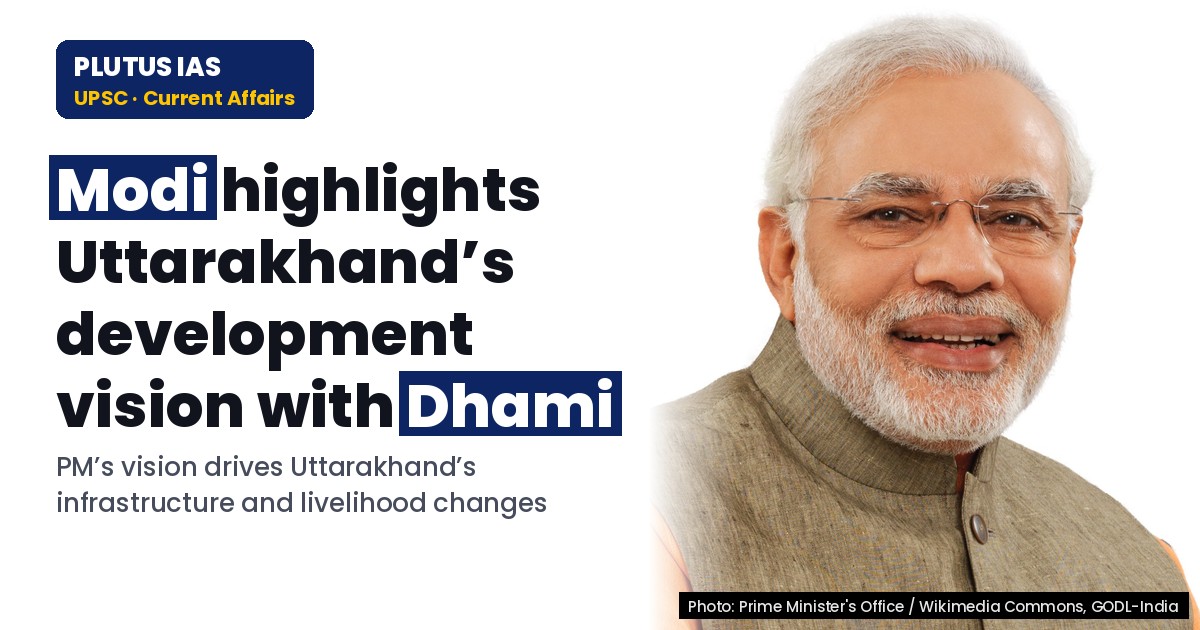
08 Oct PM Modi’s Vision Accelerates Uttarakhand’s Development Journey
✎ Centre-State coordination in Himalayan states like Uttarakhand is anchored in constitutional provisions (73rd/74th Amendments), and missions like NMSHE and Gati Shakti, ensuring sustainable development through integrated…
Subject Relevance — Where This Topic Fits
- GS Paper II — Functions and Responsibilities of the Union and the States, Issues and Challenges Pertaining to the Federal Structure
- Prelims: Himalayan States, Centre-State Relations, Union Government Initiatives, State Development Plans, Himalayan Ecosystem Conservation
- Essay: Federalism in India: Balancing Unity and Diversity, Sustainable Development in Mountainous Regions
Quick Revision: Centre-State coordination in Himalayan states like Uttarakhand is anchored in constitutional provisions (73rd/74th Amendments), and missions like NMSHE and Gati Shakti, ensuring sustainable development through integrated governance.
Why is this in the news?
On 8 October 2026, the Prime Minister’s Office (PMO) shared an article authored by the Chief Minister of Uttarakhand, highlighting the developmental vision of the Union Government for the state. The article underscores the accelerated pace of Uttarakhand’s development trajectory attributed to the Prime Minister’s commitment and strategic vision, reflecting the operational dynamics of centre-state collaboration in governance.
Background
- The 73rd and 74th Constitutional Amendments (1992) empower local governance bodies in hill states, necessitating integrated planning between the Union and state governments.
- The Union Government’s ‘National Mission for Sustaining the Himalayan Ecosystem (NMSHE)’ aim to balance development with environmental sustainability in Himalayan states.
- Uttarakhand’s development agenda aligns with the Union Government’s ‘Aspirational Districts Programme’, focusing on infrastructure, tourism, and livelihood enhancement.
- The Prime Minister’s emphasis on ‘Gati Shakti’ (National Master Plan for Multi-modal Connectivity) includes critical projects in Uttarakhand, such as the Char Dham Highway and Rishikesh-Karnaprayag Railway Line.
Centre-State Coordination in Uttarakhand’s Development: Institutional Mechanisms and Policy Frameworks
- The ‘National Mission for Sustaining the Himalayan Ecosystem (NMSHE)’ operates under the Ministry of Environment, Forest and Climate Change, focusing on climate resilience, biodiversity conservation, and sustainable livelihoods.
- The ‘Gati Shakti National Master Plan’ integrates 16 ministries to accelerate infrastructure development, with Uttarakhand identified as a priority state for connectivity enhancement in the Himalayas.
- The ‘Uttarakhand Vision 2030’ document, prepared in consultation with the Union Government, outlines strategic priorities such as renewable energy, eco-tourism, and skill development for youth.
- Institutional mechanisms like the ‘Inter-State Council’ and ‘Zonal Councils’ facilitate dialogue between the Union and state governments on Himalayan development challenges.
- The Union Government’s ‘Special Package for Uttarakhand’ (2021) included ₹10,000 crore for reconstruction post-disasters, reflecting its commitment to the state’s resilience and growth.
Key Features
| Feature | Significance |
|---|---|
| Development Vision for Uttarakhand | Articulates a long-term strategic roadmap for infrastructure, connectivity, and socio-economic upliftment in the Himalayan state, aligning with national priorities such as ‘Himalayan Vision 2030’. |
| Multi-sectoral Integration | Highlights the convergence of policies across sectors—tourism, hydropower, disaster resilience, and rural livelihoods—to ensure holistic development in ecologically sensitive regions. |
| Stakeholder Collaboration | Emphasises the role of Centre-State synergy, local governance, and community participation in implementing development projects, particularly in disaster-prone zones. |
| Focus on Inclusive Growth | Underscores equitable development by prioritising marginalised communities, women-led initiatives, and sustainable livelihoods in remote Himalayan districts. |
| Technology-Driven Governance | Advocates for the use of geospatial technologies, remote sensing, and digital platforms to monitor development progress and mitigate environmental risks. |
Why it Matters
Economic
- Enhanced connectivity via projects like the Char Dham Highway and Rishikesh-Karnaprayag Railway Line to boost tourism, trade, and pilgrimage-based economy.
Strategic
- Strengthens border infrastructure in Uttarakhand, a critical state for national security and disaster response in the Himalayas.
Environmental
- Balances development with ecological conservation, given Uttarakhand’s status as a biodiversity hotspot and its vulnerability to climate-induced disasters.
Social
- Improves access to healthcare, education, and basic amenities in remote areas, addressing the ‘last-mile connectivity’ challenge.
Governance
- Demonstrates Centre-State coordination in policy implementation, a model for federalism in India’s diverse and geographically challenging regions.
Challenges
1. Ecological Fragility and Climate Vulnerability
- Uttarakhand’s susceptibility to landslides, flash floods, and glacial lake outburst floods (GLOFs) necessitates climate-resilient infrastructure.
UPSC Link: GS3: Disaster Management
2. Geographical Constraints
- Hilly terrain and limited land availability pose challenges for large-scale infrastructure projects, requiring innovative engineering solutions.
UPSC Link: GS1: Indian Geography
3. Socio-Economic Disparities
- Wide disparities between urban centres (Dehradun, Haridwar) and remote districts (Uttarkashi, Chamoli) demand targeted interventions.
UPSC Link: GS2: Social Justice
4. Balancing Development and Conservation
- Ensuring that infrastructure projects do not compromise the state’s ecological integrity or violate environmental laws (e.g., Forest Rights Act, 2006).
UPSC Link: GS3: Environment
5. Disaster Risk Reduction
- Integrating early warning systems, community-based disaster preparedness, and resilient urban planning to mitigate risks.
UPSC Link: GS3: Disaster Management
6. Funding and Resource Allocation
- Securing adequate financial resources for long-term projects while ensuring efficient utilisation and transparency in public expenditure.
UPSC Link: GS3: Public Finance
Challenges — UPSC Perspective
| Issue | Concern |
|---|---|
| Landslide and Flood Risk | High frequency of natural disasters disrupts development projects and threatens lives. |
| Limited Land Availability | Hilly terrain restricts large-scale construction, necessitating land-use planning and eco-friendly designs. |
| Climate Change Impact | Increased glacial melt and erratic rainfall patterns exacerbate environmental degradation. |
| Tourism Pressure | Unregulated tourism strains local ecosystems and infrastructure, requiring sustainable tourism policies. |
| Agricultural Decline | Shift from traditional farming to non-farm activities due to climate change and economic factors. |
| Urban-Rural Divide | Concentration of resources in urban areas exacerbates regional inequalities. |
Government Initiatives — Must-Memorise for Prelims
- Pradhan Mantri Gram Sadak Yojana (PMGSY) – Phase III for rural connectivity
- National Mission for Clean Ganga (NMCG) – for river basin management in Uttarakhand
- National Disaster Management Authority (NDMA) guidelines for disaster resilience
Way Forward
- Accelerate the implementation of climate-resilient infrastructure projects with robust environmental impact assessments.
- Strengthen Centre-State coordination through regular reviews under the NITI Aayog’s Himalayan Vision 2030 framework.
- Promote sustainable tourism models to balance economic growth with ecological conservation.
- Enhance disaster preparedness by integrating traditional knowledge with modern early warning systems.
- Leverage geospatial technologies for real-time monitoring of development projects and environmental changes.
- Ensure inclusive growth by prioritising marginalised communities in policy design and implementation.
- Increase public investment in rural healthcare and education to address the urban-rural divide.
- Foster public-private partnerships for skill development and livelihood enhancement in ecologically sensitive zones.
UPSC Value Addition
Keywords for Mains Answer-Writing
Uttarakhand development vision · Centre-State coordination in development · Federalism in India · Prime Minister’s Office (PMO) role · State-led development initiatives · Himalayan region development · Public policy implementation · Sustainable development in ecologically fragile regions · Intergovernmental relations · Policy coherence between Union and State governments
Constitutional & Policy Linkages
- Seventh Schedule – State List (Entry 18: Land) and Concurrent List (Entry 17A: Forests), governing land-use and environmental regulations.
Concept Flow
Vision for Uttarakhand’s Development → Centre-State Policy Alignment → Infrastructure Planning (Roads, Railways, Hydropower) → Environmental and Disaster Risk Assessment → Implementation with Stakeholder Participation → Monitoring and Adaptive Governance → Socio-Economic Outcomes (Tourism, Livelihoods, Connectivity) → Feedback Loop for Policy Refinement.
Prelims Practice Questions
Q1. Consider the following statements regarding the role of the Prime Minister’s Office (PMO) in India’s federal structure:
1. The PMO is a constitutional body established under Article 74 of the Constitution.
2. The PMO coordinates between the Union Government and State Governments on policy matters.
3. The PMO has no role in the implementation of centrally sponsored schemes in States.
4. The PMO can directly allocate funds to State Governments for developmental projects.
How many of the above statements are correct?
- Only one
- Only two
- Only three
- All
Answer: Only two — Statement 1 is incorrect: The PMO is not a constitutional body; it is a non-statutory entity. Statement 2 is correct: The PMO facilitates intergovernmental coordination. Statements 3 and 4 are incorrect: The PMO does not implement schemes directly nor allocate funds to States.
Q2. Assertion (A): The Prime Minister’s Office (PMO) in India serves as a nodal agency for monitoring flagship national schemes.
Reason (R): The PMO derives its authority directly from Article 74(1) of the Constitution, which mandates the Prime Minister to be the head of the Council of Ministers.
Options:
A. Both A and R are true, and R is the correct explanation of A.
B. Both A and R are true, but R is not the correct explanation of A.
C. A is true, but R is false.
D. A is false, but R is true.
Answer: ? — Assertion (A) is true: The PMO monitors flagship national schemes. Reason (R) is true but is not the correct explanation of (A); the PMO’s monitoring role stems from administrative practice, not Article 74(1).
Q3. Match the following pairs related to Centre-State relations in India:
Column I (Institution/Body) Column II (Function)
A. NITI Aayog 1. Advisory body on inter-State river water disputes
B. Inter-State Council 2. Policy think tank for socio-economic development
C. National Development Council 3. Constitutional body for Centre-State coordination
D. Interstate River Water Disputes Tribunal 4. Extra-constitutional body for national planning
Options:
A-2, B-3, C-4, D-1
A-1, B-4, C-3, D-2
A-3, B-1, C-2, D-4
A-4, B-3, C-2, D-1
Answer: ? — Correct matching: A-2 (NITI Aayog is a policy think tank), B-3 (Inter-State Council is a constitutional body under Article 263), C-4 (National Development Council is an extra-constitutional body), D-1 (Interstate River Water Disputes Tribunal resolves river water disputes).
Mains Practice Question
✍ The Prime Minister’s articulation of a shared vision for Uttarakhand’s development exemplifies the evolving dynamics of Centre-State cooperation in India’s federal structure. Critically examine the mechanisms through which the Union Government can support State-led development while respecting federal principles. (15 Marks)
Approach: MODEL-ANSWER SKELETON:
1. **Introduction (2 marks)**: Define federalism in India (quasi-federal nature, Article 1 of the Constitution) and highlight the constitutional division of powers (Union List, State List, Concurrent List).
2. **Mechanisms of Centre-State Cooperation (5 marks)**:
– **Constitutional Bodies**: Role of the Inter-State Council (Article 263), National Development Council (extra-constitutional), and Zonal Councils.
– **Statutory Schemes**: Centrally Sponsored Schemes (CSS) like the Pradhan Mantri Gram Sadak Yojana (PMGSY) and the National Mission for Sustaining the Himalayan Ecosystem (NMSHE) for Uttarakhand.
– **Institutional Coordination**: NITI Aayog’s role in fostering cooperative federalism (e.g., Aspirational Districts Programme) and the PMO’s oversight in monitoring flagship schemes.
– **Financial Mechanisms**: Finance Commission recommendations (e.g., 15th Finance Commission’s grants for disaster management and sustainable development) and the role of the GST Council in revenue sharing.
3. **Challenges to Federal Balance (5 marks)**:
– **Over-centralisation**: Concerns over the PMO’s growing role in State-level implementation (e.g., criticism of ‘top-down’ approaches in centrally sponsored schemes).
– **Resource Asymmetry**: Disparities in fiscal capacity between the Union and States (e.g., Uttarakhand’s dependence on central funds for disaster resilience).
– **Ecological Constraints**: Balancing development with environmental sustainability in fragile Himalayan regions (e.g., the 2021 Chamoli disaster and the need for climate-resilient infrastructure).
– **Political Dimensions**: Perceived erosion of State autonomy in policy formulation (e.g., debates over the ‘one nation, one policy’ approach).
4. **Way Forward (3 marks)**:
– Strengthening the Inter-State Council as a platform for consensus-building.
– Leveraging technology (e.g., GIS mapping for disaster risk reduction) and participatory governance models.
– Ensuring greater fiscal devolution and flexibility in CSS design to align with State priorities.
**Balance of Views**: Acknowledge the Union Government’s role in ensuring equitable development and disaster resilience, while critiquing instances where centralisation may undermine State agency.
Source: PIB (Press Information Bureau)
Uttarakhand PCS (UKPSC) — State PCS Practice
Prelims: Which of the following key initiatives was recently highlighted by the Prime Minister in an article about Uttarakhand’s developmental journey?
- A. Launch of the ‘Uttarakhand One District One Product’ scheme
- B. Inauguration of the Char Dham Railway Project
- C. Implementation of the ‘Himalayan Clean Energy Mission’
- D. Establishment of the ‘Uttarakhand Heritage Conservation Fund’
Answer: B. Inauguration of the Char Dham Railway Project — The Prime Minister’s article emphasized the Char Dham Railway Project as a major developmental initiative for Uttarakhand.
Mains: Critically analyse the role of central government initiatives in shaping Uttarakhand’s developmental trajectory, with special reference to the Char Dham Railway Project and its socio-economic implications for the state.
Generated by AanyaAi for educational purpose.
Related guides on our sites
- Anthropology VS PSIR
- Best PSIR optional coaching
- Best PSIR optional coaching online
- Best PSIR optional teacher

- PM Modi’s Vision Accelerates Uttarakhand’s Development Journey - October 8, 2026
- हौथी विद्रोही संगठन ने रियाद हवाईअड्डे पर किया बैलिस्टिक मिसाइल हमला - October 8, 2026
- Defence Production Launches Special Campaign 6.0 for Cleanliness & Efficiency - October 8, 2026

No Comments