


03 Sep Shivraj Singh Chouhan Unveils ₹11L Cr Credit Roadmap for SHGs & Women Entrepreneurs
✎ The SHG-Bank Linkage Programme under DAY-NRLM is a structured mechanism to integrate rural women into the formal financial ecosystem, leveraging NABARD’s refinancing, RBI’s PSL norms, and government subsidies to scale credit…
Subject Relevance — Where This Topic Fits
- GS Paper II — Governance, Welfare Schemes for Vulnerable Sections | GS Paper III — Banking, Financial Inclusion, Rural Development
- Prelims: Deendayal Antyodaya Yojana – National Rural Livelihoods Mission (DAY-NRLM), Self-Help Groups (SHGs), SHG-Bank Linkage Programme, Lakhpati Didi Initiative, NABARD, Priority Sector Lending, Financial Inclusion, RBI Guidelines on SHG Financing
- Essay: Role of Women in India’s Socio-Economic Transformation, Financial Inclusion as a Catalyst for Rural Development
Quick Revision: The SHG-Bank Linkage Programme under DAY-NRLM is a structured mechanism to integrate rural women into the formal financial ecosystem, leveraging NABARD’s refinancing, RBI’s PSL norms, and government subsidies to scale credit access and foster entrepreneurship.
Why is this in the news?
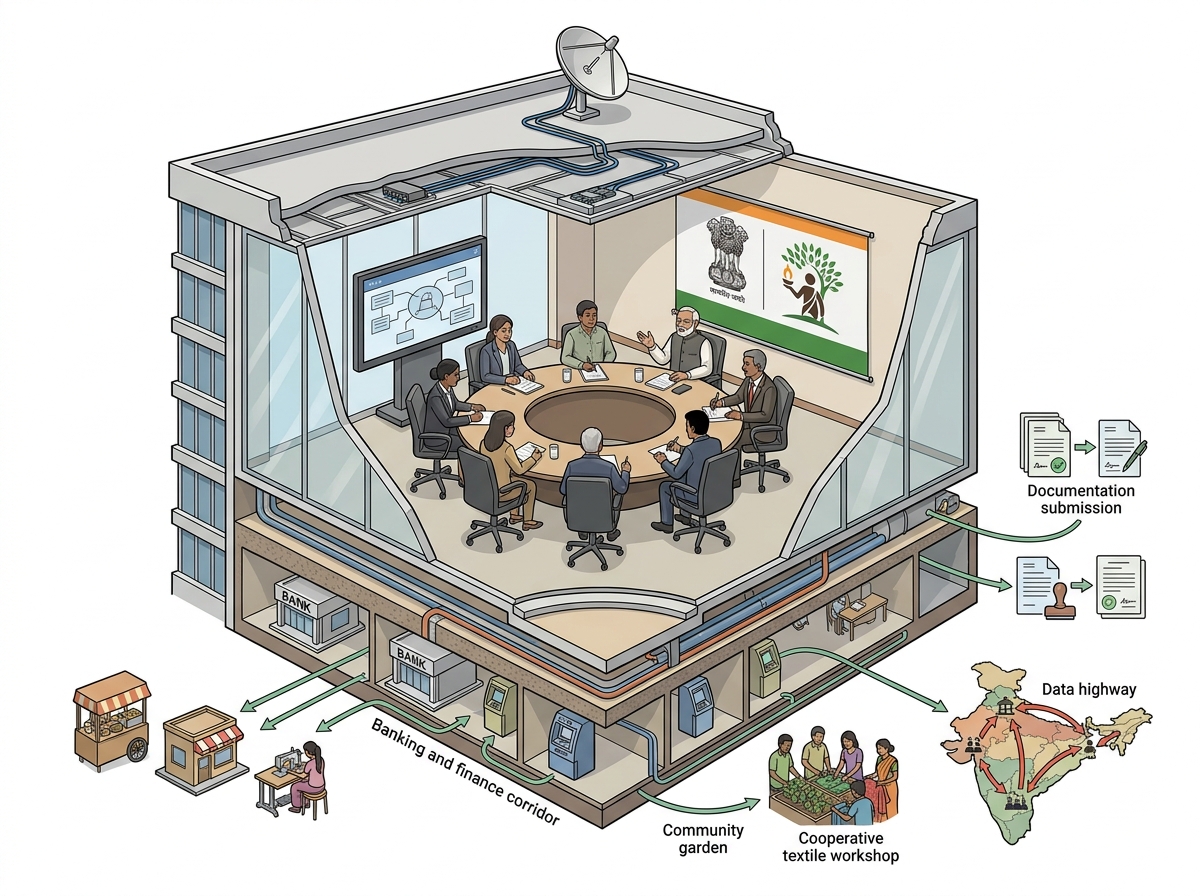
A high-level review meeting chaired by the Union Minister for Rural Development, Agriculture and Farmers’ Welfare in Mumbai assessed the progress and bottlenecks in the SHG-Bank linkage and individual enterprise financing under the Deendayal Antyodaya Yojana – National Rural Livelihoods Mission (DAY-NRLM). The meeting outlined a concrete roadmap to expedite, scale and simplify credit access for women entrepreneurs, aligning with the government’s vision of creating 6 crore ‘Lakhpati Didis’ by 2030. The deliberations focused on systemic barriers such as delayed loan approvals, documentation hurdles, and regional disparities in credit flow, while also mandating quarterly virtual and bi-annual physical reviews for accountability.
Background
- The Deendayal Antyodaya Yojana – National Rural Livelihoods Mission (DAY-NRLM) was launched in 2011 as a flagship programme under the Ministry of Rural Development to alleviate rural poverty by promoting self-employment and skilled wage employment opportunities.
- The SHG-Bank Linkage Programme, a core component of DAY-NRLM, facilitates financial inclusion by enabling SHGs to access formal credit through commercial banks, regional rural banks, and cooperative banks, thereby reducing dependence on informal credit sources.
- As of 2023, over 8.5 crore women were mobilised into 70 lakh SHGs across India, with cumulative bank linkages exceeding ₹6.2 lakh crore, demonstrating the programme’s scale and impact on rural livelihoods.
- The Reserve Bank of India (RBI) and NABARD have historically played a pivotal role in standardising SHG financing norms, including simplified documentation, interest subvention schemes, and priority sector lending (PSL) targets for banks to support rural women-led enterprises.
- Despite progress, challenges persist in ensuring timely credit disbursal, uniform access across regions, and capacity building among bankers to handle SHG-related transactions efficiently.
What is the SHG-Bank Linkage Programme under DAY-NRLM?
- The SHG-Bank Linkage Programme is a tripartite arrangement between SHGs, banks, and the government, designed to integrate rural women into the formal financial system by providing collateral-free loans for income-generating activities.
- Under DAY-NRLM, SHGs are federated into higher-level institutions such as Cluster Level Federations (CLFs) and State Level Federations (SLFs) to enhance bargaining power, access to markets, and financial services.
- Banks extend credit to SHGs based on their internal grading, repayment track record, and the viability of the proposed enterprise, with interest rates often subsidised through government schemes like the ‘Interest Subvention Scheme for SHGs’.
- NABARD acts as the nodal agency for refinancing SHG loans, monitoring credit flow, and conducting capacity-building programmes for bankers and SHG members on financial literacy and enterprise management.
- The programme also integrates with digital payment systems (e.g., UPI, Aadhaar Enabled Payment System) and financial literacy campaigns to enhance transparency, reduce leakages, and improve financial decision-making among SHG members.
Key Features
| Feature | Significance |
|---|---|
| Self-Help Group (SHG)-Bank Linkage | Facilitates formal credit access to rural women by leveraging collective financial strength, reducing dependency on informal lenders. |
| Individual Entrepreneur Financing | Provides direct credit to women-led micro-enterprises, fostering self-employment and economic independence. |
| Quarterly Virtual and Bi-Annual Physical Reviews | Ensures time-bound monitoring of commitments, addressing bottlenecks through structured institutional feedback. |
| Helpline for Credit Relief | Offers immediate redressal for grievances related to loan approvals, documentation, and disbursement delays. |
| Sensitization of Bankers | Mandates district-level coordination meetings with private bankers to align branch-level processes with rural financial inclusion goals. |
Why it Matters
Economic Empowerment
- Expands formal credit access to 6 crore women entrepreneurs, aligning with the Prime Minister’s vision of ‘Lakhpati Didi’ for inclusive economic growth.
- Enhances liquidity in rural economies by channeling ₹11 lakh crore (₹10 lakh crore to SHGs and ₹1 lakh crore to individuals) over five years.
- Reduces financial exclusion by addressing structural barriers in loan approvals, documentation, and credit limits for women-led enterprises.
Social Equity
- Promotes gender parity in economic participation, particularly in regions with higher poverty indices, ensuring equitable resource distribution.
- Encourages grassroots entrepreneurship among women, fostering intergenerational economic mobility in rural households.
- Strengthens community-based financial networks (SHGs) that serve as catalysts for collective bargaining and social cohesion.
Institutional Coordination
- Bridges gaps between rural self-help groups, commercial banks, and regulatory bodies (RBI, NABARD) through structured dialogue and accountability mechanisms.
- Integrates state-level Rural Livelihood Missions (SRLMs) with central financial institutions for scalable and sustainable credit delivery.
- Leverages multi-stakeholder platforms (e.g., district coordination committees) to align policy implementation with ground realities.
Challenges
1. Delayed Loan Approvals
- Bureaucratic delays in loan sanctioning processes due to cumbersome documentation and multi-tiered approval systems.
- Inconsistent application of RBI guidelines on priority sector lending, leading to ad-hoc credit restrictions for SHGs.
UPSC Link: GS-III: Banking & Financial Inclusion
2. Regional Disparities in Credit Access
- Concentration of credit facilities in urban/metropolitan branches, leaving rural and tribal regions underserved.
- Limited financial literacy and awareness among SHG members, exacerbating exclusion in high-poverty districts.
UPSC Link: GS-II: Social Sector & Governance
3. Credit Limit Constraints
- Inadequate loan amounts for individual entrepreneurs, restricting scalability of micro-enterprises.
- Over-reliance on collateral-based lending models, disproportionately affecting women with limited asset ownership.
UPSC Link: GS-III: MSMEs & Financial Services
4. Institutional Insensitivity
- Lack of sensitization among bank staff regarding rural women’s financial needs and socio-economic contexts.
- Absence of dedicated grievance redressal mechanisms at the branch level, delaying dispute resolution.
UPSC Link: GS-IV: Ethics in Governance
5. Data and Monitoring Gaps
- Inadequate real-time tracking of loan disbursement and repayment cycles, hindering evidence-based policy adjustments.
- Fragmented reporting systems across states, complicating the aggregation of national-level progress metrics.
UPSC Link: GS-II: Government Policies & Interventions
Challenges — UPSC Perspective
| Issue | Concern |
|---|---|
| Documentation Overload | Excessive paperwork delays loan approvals, disproportionately affecting low-literacy SHG members. |
| Branch-Level Bias | Urban-centric branch allocations limit rural women’s access to credit facilities. |
| Collateral Requirements | Stringent collateral norms exclude women entrepreneurs without formal asset ownership. |
| Financial Literacy Deficit | Low awareness of digital banking and loan products restricts informed decision-making. |
| Grievance Redressal Lag | Absence of localized helplines exacerbates frustration among SHG members. |
| Monitoring Fragmentation | Inconsistent state-level reporting obscures national progress tracking. |
Government Initiatives — Must-Memorise for Prelims
- Deendayal Antyodaya Yojana – National Rural Livelihoods Mission (DAY-NRLM)
Way Forward
- Institutionalize quarterly virtual reviews and bi-annual physical meetings to ensure time-bound resolution of bottlenecks.
- Expand the scope of helplines to include multilingual support and 24/7 accessibility for rural women.
- Mandate district-level coordination committees with mandatory participation from private bankers to align branch operations with rural credit goals.
- Introduce simplified loan application formats in regional languages, reducing documentation burdens for SHG members.
- Launch targeted financial literacy campaigns in high-poverty districts, leveraging SHG networks for peer-to-peer learning.
- Strengthen digital payment infrastructure in rural areas to facilitate seamless loan disbursement and repayment.
- Establish a unified national dashboard for real-time monitoring of credit disbursement, repayment, and grievance redressal metrics.
- Conduct periodic sensitization workshops for bank staff, focusing on gender-responsive banking practices and rural socio-economic contexts.
UPSC Value Addition
Keywords for Mains Answer-Writing
National Rural Livelihood Mission (DAY-NRLM) · Self-Help Groups (SHGs) · SHG-Bank Linkage Programme · Women Entrepreneurship · Financial Inclusion · Lakhpati Didi Initiative · Rural Credit Access · NITI Aayog · NABARD · Reserve Bank of India (RBI) · Gender Budgeting · Rural Poverty Alleviation · Credit Guarantee Schemes · District Level Coordination Committees · Financial Literacy
Concept Flow
Rural women’s economic exclusion → Limited formal credit access → Informal debt traps → DAY-NRLM’s SHG-Bank Linkage initiative → SHG formation and capacity-building → Collective financial strength → Formal credit linkage with banks → Loan disbursement challenges → Documentation delays, collateral constraints → Institutional bottlenecks → High-level reviews and helplines → Time-bound monitoring → Improved credit accessibility → Women-led micro-enterprises → Economic empowerment → Contribution to ‘Lakhpati Didi’ vision → Scalable credit models → Rural economic growth → Alignment with ‘Viksit Bharat’ 2047 goals
Prelims Practice Questions
Q1. Consider the following statements regarding the Self-Help Group (SHG)-Bank Linkage Programme under DAY-NRLM:
1. The programme aims to provide credit linkages to SHGs through commercial banks, regional rural banks, and cooperative banks.
2. NABARD acts as the nodal agency for the implementation of the SHG-Bank Linkage Programme.
3. The Reserve Bank of India (RBI) is responsible for the disbursement of loans to SHGs under this programme.
How many of the above statements are correct?
- Only one
- Only two
- All three
- None
Answer: Only two — Statement 1 is correct as the SHG-Bank Linkage Programme facilitates credit linkages through various banking channels. Statement 2 is incorrect because NABARD is the nodal agency for refinancing and monitoring, not the primary implementing agency. Statement 3 is incorrect as RBI regulates the banking system but does not directly disburse loans to SHGs.
Q2. Assertion (A): The Lakhpati Didi initiative aims to create 6 crore women entrepreneurs in rural India by 2029.
Reason (R): The initiative is part of the National Rural Livelihood Mission (DAY-NRLM) and focuses on providing credit linkages and financial literacy to women-led SHGs.
Options:
A. Both A and R are true, and R is the correct explanation of A.
B. Both A and R are true, but R is not the correct explanation of A.
C. A is true, but R is false.
D. A is false, but R is true.
Answer: ? — Assertion (A) is true as the Lakhpati Didi initiative targets 6 crore women entrepreneurs by 2029. Reason (R) is also true and correctly explains the assertion, as the initiative is indeed a component of DAY-NRLM aimed at credit linkages and financial literacy for women-led SHGs.
Q3. Match the following institutions with their roles in the SHG-Bank Linkage Programme under DAY-NRLM:
Column I (Institution) Column II (Role)
1. NITI Aayog A. Regulatory oversight of banking operations
2. Reserve Bank of India (RBI) B. Policy formulation and monitoring
3. NABARD C. Refinancing and capacity building
4. State Rural Livelihood Mission (SRLM) D. Implementation at state level
Options:
A. 1-B, 2-A, 3-C, 4-D
B. 1-A, 2-B, 3-C, 4-D
C. 1-D, 2-A, 3-B, 4-C
D. 1-B, 2-C, 3-A, 4-D
- A
- B
- C
- D
Answer: A — NITI Aayog (1) is responsible for policy formulation and monitoring (B). RBI (2) regulates banking operations (A). NABARD (3) provides refinancing and capacity building (C). State Rural Livelihood Missions (4) implement the programme at the state level (D).
Mains Practice Question
✍ The National Rural Livelihood Mission (DAY-NRLM) has been pivotal in promoting women-led entrepreneurship through the SHG-Bank Linkage Programme. Critically examine the role of DAY-NRLM in enhancing financial inclusion and rural women empowerment. Also, assess the challenges in achieving the ‘Lakhpati Didi’ vision by 2029. (15 Marks)
Approach: MODEL-ANSWER SKELETON:
1. **Introduction (2 Marks)**
– Briefly define DAY-NRLM and its objectives under the SHG-Bank Linkage Programme.
– Mention the ‘Lakhpati Didi’ initiative and its target of 6 crore women entrepreneurs by 2029.
2. **Role of DAY-NRLM in Financial Inclusion (5 Marks)**
– **Credit Linkages**: Explain how DAY-NRLM facilitates credit access for SHGs through banks (RBI, NABARD, commercial banks). Cite data on credit disbursement (e.g., ₹10 lakh crore for SHGs in 5 years).
– **Financial Literacy**: Discuss the role of SHGs in promoting savings, budgeting, and digital financial literacy.
– **Institutional Mechanisms**: Highlight the role of NABARD (refinancing), RBI (regulatory oversight), and SRLMs (state-level implementation).
– **Policy Support**: Mention gender budgeting and inclusive credit policies under DAY-NRLM.
3. **Women Empowerment through DAY-NRLM (4 Marks)**
– **Economic Empowerment**: Explain how access to credit enables women to start micro-enterprises and achieve financial independence.
– **Social Empowerment**: Discuss the impact on decision-making power, mobility, and social status of women in rural areas.
– **Collective Agency**: Highlight the role of SHGs in fostering collective bargaining and social capital.
4. **Challenges in Achieving ‘Lakhpati Didi’ Vision (4 Marks)**
– **Structural Barriers**: Discuss issues like low credit limits, bureaucratic delays, and lack of collateral among rural women.
– **Regional Disparities**: Highlight gaps in credit access between states (e.g., higher poverty states needing more support).
– **Banking Sector Hurdles**: Address challenges like low sensitivity of bankers, complex paperwork, and limited branch penetration in remote areas.
– **Monitoring and Accountability**: Critique the current monitoring mechanisms and suggest improvements (e.g., quarterly virtual reviews, helplines).
5. **Conclusion (2 Marks)**
– Summarize the transformative potential of DAY-NRLM in rural women empowerment.
– Emphasize the need for multi-stakeholder collaboration (government, banks, NGOs) to overcome challenges and achieve the ‘Lakhpati Didi’ vision.
Source: PIB (Press Information Bureau)
Maharashtra PCS (MPSC) — State PCS Practice
Prelims: Under the leadership of Union Minister Shri Shivraj Singh Chouhan, a high-level meeting was held in Mumbai to discuss which of the following initiatives under the National Rural Livelihood Mission (NRLM)?
- Self-Help Group-Bank Linkage and Enterprise Promotion
- Digital Literacy for Rural Women
- Pradhan Mantri Kisan Samman Nidhi (PM-KISAN)
- Ayushman Bharat Health Scheme for Rural Areas
Answer: Self-Help Group-Bank Linkage and Enterprise Promotion — The meeting focused on strengthening the Self-Help Group-Bank Linkage model and promoting entrepreneurship under NRLM to enhance rural livelihoods in Maharashtra.
Mains: Discuss the significance of the Self-Help Group-Bank Linkage initiative under the National Rural Livelihood Mission (NRLM) for rural women empowerment in Maharashtra. Analyze its impact on financial inclusion, economic independence, and social mobility, with specific reference to recent policy interventions in the state.
Generated by AanyaAi for educational purpose.
Related guides on our sites
- Best PSIR optional coaching for upsc
- Best PSIR optional teacher for upsc
- Best teacher of PSIR optional for upsc
- Best PSIR optional coaching in delhi for UPSC

- India-Australia AUSTRAHIND 2026 Exercise: Key Highlights for UPSC & State PCS - October 22, 2026
- एससीओ बैठक में भारत का आतंकवाद विरोध: क्षेत्रीय सहयोग पर जोर - October 22, 2026
- SEC Directs Strict SC Order Compliance for Andhra ULB Polls - October 22, 2026

No Comments