


04 Feb Strengthening India’s Chemical Manufacturing
This article covers “Daily Current Affairs” and From
SYLLABUS MAPPING
GS- 3 – Economy and Science & technology – Strengthening India’s Chemical Manufacturing
FOR PRELIMS
What are Chemical Parks?
FOR MAINS
What is the aim of Bulk Drug Parks ?
Why in the News?
India is the sixth-largest producer of chemicals globally and possesses considerable potential to expand its footprint in global chemical value chains, particularly in high-value and specialty segments. The sector continues to be a major contributor to industrial growth and exports, supported by well-established manufacturing hubs and clusters across Gujarat, Odisha, Andhra Pradesh, and Tamil Nadu. These clusters have attracted significant investment and generated large-scale employment. Building on this strong foundation, there is growing scope to enhance sectoral competitiveness through better infrastructure integration, regulatory simplification, and strengthened environmental compliance mechanisms.
In this context, the Government’s proposal in the Union Budget 2026–27 to establish dedicated Chemical Parks represents a forward-looking, infrastructure-driven, supply-side intervention. With a budgetary allocation of ₹600 crore in BE FY 2026–27, the initiative aims to provide integrated plug-and-play industrial infrastructure and coordinated governance mechanisms. These parks are expected to reduce project implementation timelines, lower capital costs, promote cluster-based synergies, and create globally competitive chemical manufacturing ecosystems while supporting sustainable and inclusive growth.
Union Budget 2026–27: Strengthening Domestic Chemical Manufacturing
The Union Budget 2026–27 has introduced a new scheme to support States in establishing three dedicated Chemical Parks through a challenge-based selection process, backed by an allocation of ₹600 crore in BE FY 2026–27. These parks are envisioned as cluster-based manufacturing ecosystems supported by shared infrastructure and common utilities. The initiative marks the first dedicated budgetary support for chemical park infrastructure and aims to strengthen domestic production capacity, improve supply-chain integration, and reduce import dependence in the chemicals sector.
Chemical Industry: Overview
India’s chemical industry forms a critical pillar of the manufacturing ecosystem by supplying essential inputs to key sectors such as agriculture, pharmaceuticals, textiles, automobiles, and construction. The sector contributes approximately 7 percent to the national GDP. India ranks as the third-largest chemical producer in Asia and manufactures more than 80,000 products across segments such as bulk chemicals, specialty chemicals, agrochemicals, petrochemicals, polymers, and fertilisers.
Among these, specialty chemicals have emerged as a key growth segment, driven by India’s strong process engineering capabilities, cost advantages, and expanding innovation base. Reflecting its structural significance, the Economic Survey 2025–26 highlights that the chemical sector contributed 8.1 percent to manufacturing Gross Value Added in FY24. The production of major chemicals and petrochemicals increased from 45,638 thousand metric tonnes in FY16 to 58,617 thousand metric tonnes in FY25, registering a CAGR of 2.8 percent.
What are Chemical Parks?
Chemical Parks are planned industrial clusters specifically designed for chemical and petrochemical manufacturing, where multiple manufacturing units operate within a common ecosystem supported by world-class infrastructure and shared services.
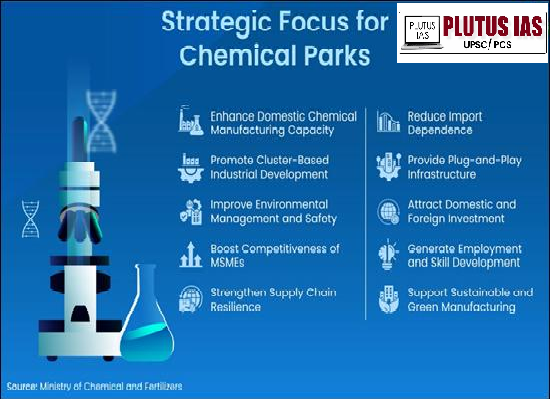
Strategic Focus of Chemical Parks
The Chemical Parks initiative is designed as a comprehensive infrastructure-led supply-side intervention aimed at strengthening the structural foundation of the chemical sector by enabling scale, efficiency, and sustainability.
Current Landscape and Rationale for Chemical Parks
India’s chemical industry has benefited significantly from cluster-based development initiatives such as Plastic Parks, Bulk Drug Parks, and Petroleum, Chemicals and Petrochemicals Investment Regions (PCPIRs). These initiatives have demonstrated the advantages of shared infrastructure, anchor investments, and coordinated planning.
Building on these successful models, the proposed Chemical Parks aim to provide an integrated platform covering the entire chemical value chain, including bulk chemicals, specialty chemicals, and downstream industries.
By offering plug-and-play infrastructure, common utilities, integrated logistics support, and streamlined regulatory clearances, the initiative is expected to:
1. Reduce project gestation periods and capital investment requirements
2. Promote economies of scale and strengthen backward and forward linkages
3. Improve environmental management and industrial safety through shared facilities
4. Enhance India’s competitiveness in domestic and international chemical markets
Together with Plastic Parks, Bulk Drug Parks, and PCPIRs, Chemical Parks create a cohesive policy framework for cluster-driven industrial development. Supported by targeted policy measures, technological adoption, innovation, and sustainability initiatives, this integrated approach is expected to deepen domestic manufacturing capabilities and strengthen India’s position in global chemical value chains.
Scheme for Setting up Plastic Parks
Plastic Parks are a key component of India’s strategy to promote plastic recycling, manage plastic waste, and support the polymer industry. A plastic park is a specialised industrial zone developed for plastic processing industries. The Department of Chemicals and Petrochemicals launched this scheme in 2013–14 to consolidate and strengthen the plastic processing industry, promote investment, enhance production and exports, and generate employment opportunities.
To support research and innovation in polymer and plastic technologies, the Department has established 13 Centres of Excellence across national institutions. The scheme provides central grant assistance of up to 50 percent of the project cost, subject to a maximum limit of ₹40 crore per park. So far, 10 Plastic Parks have been approved across States including Assam, Madhya Pradesh, Odisha, Jharkhand, Tamil Nadu, Uttarakhand, Chhattisgarh, Karnataka, and Uttar Pradesh.
Scheme for Promotion of Bulk Drug Parks
Bulk drugs form the backbone of pharmaceutical manufacturing and are essential for ensuring affordable and accessible healthcare. As the pharmaceutical sector expands, ensuring uninterrupted availability of high-quality bulk drugs and scaling up production capacity during emergencies has become increasingly critical.
To strengthen domestic manufacturing capacity and reduce dependence on imports, the Government launched the Promotion of Bulk Drug Parks Scheme in 2020. The scheme aims to reduce production costs, improve competitiveness, and address infrastructure gaps through the development of shared common infrastructure.
Under the scheme, three Bulk Drug Parks have been approved in Gujarat, Himachal Pradesh, and Andhra Pradesh, with a total outlay of ₹3,000 crore. The scheme supports the creation of Common Infrastructure Facilities such as:
Central Effluent Treatment Plants (CETPs)
Solid waste management systems
Storm water drainage networks
Common solvent storage and recovery systems
Warehousing facilities
Dedicated power substations and distribution networks
Water treatment and supply systems
Steam generation and distribution networks
Cooling and energy distribution systems
Common logistics infrastructure
Advanced testing laboratories and research centres
Emergency response centres
Industrial safety and hazardous operations audit facilities
Centres of Excellence
Petroleum, Chemicals and Petrochemical Investment Regions (PCPIRs)
PCPIRs are specifically delineated investment regions designed to promote domestic and export-oriented chemical and petrochemical manufacturing. These regions integrate manufacturing units with utilities, logistics, environmental protection infrastructure, and administrative services, enabling comprehensive industrial development.
Currently, PCPIRs have been developed in Andhra Pradesh (Visakhapatnam), Gujarat (Dahej), and Odisha (Paradeep).
Collectively, Plastic Parks, Bulk Drug Parks, PCPIRs, and Chemical Parks represent India’s transition towards cluster-based industrial development focused on scale, efficiency, and sustainability. While Plastic Parks and Bulk Drug Parks have demonstrated success in specific segments, Chemical Parks extend this integrated approach across the entire chemical value chain.
Strengthening Environmental Management and Industrial Safety
As India expands its chemical manufacturing capacity, managing environmental impacts and industrial safety risks becomes increasingly important. Robust environmental management systems and high safety standards are essential for sustainable sectoral growth.
Green initiatives such as Carbon Capture, Utilisation, and Storage (CCUS), launched in December 2025, play a crucial role in reducing industrial carbon emissions by capturing and reusing or safely storing carbon dioxide. The Union Budget 2026–27 has announced an allocation of ₹20,000 crore over five years to support the development and deployment of CCUS technologies across emission-intensive industries, including the chemicals sector.
In this context, Chemical Parks provide an enabling platform for implementing such climate initiatives. By offering shared environmental infrastructure, utilities, and coordinated governance mechanisms, these parks facilitate cost-effective deployment of CCUS and other clean technologies. The clustering of manufacturing units allows efficient emissions management, waste treatment, and energy optimisation, thereby lowering compliance costs and improving environmental performance.
Conclusion
The establishment of three dedicated Chemical Parks marks a major step towards strengthening India’s domestic chemical manufacturing ecosystem through a targeted infrastructure-driven approach. By providing cluster-based plug-and-play facilities supported by shared utilities and integrated infrastructure, the initiative addresses long-standing structural challenges related to scale, value chain integration, and global competitiveness.
Aligned with the priorities outlined in the Union Budget 2026–27, the initiative is expected to attract investment, support import substitution, integrate MSMEs into organised value chains, generate employment, and promote environmentally sustainable manufacturing practices. Additionally, the Budget’s emphasis on CCUS complements the Chemical Parks initiative by supporting low-carbon technological innovation, while the parks provide the infrastructure required for cost-effective deployment.
Together, these initiatives are expected to strengthen supply-chain resilience and reinforce India’s emergence as a globally competitive and reliable hub for chemical manufacturing.
Best ias coaching in delhi Best ias coaching in chandigarh
Prelims question:
Q. With reference to the proposed Chemical Parks announced in Union Budget 2026–27, consider the following statements:
1.Chemical Parks aim to provide plug-and-play infrastructure for chemical manufacturing.
2.The scheme is intended to reduce import dependence in the chemicals sector.
3.The Government plans to establish five Chemical Parks under the scheme.
Which of the statements given above is/are correct?
(a) 1 and 2 only
(b) 2 and 3 only
(c) 1 only
(d) 1, 2 and 3
Q. Discuss the significance of Chemical Parks in strengthening India’s domestic manufacturing ecosystem. How can such parks help improve industrial competitiveness and environmental sustainability? (250 words)

- Artemis II: Humanity’s Return to Lunar Space and India’s Place in the New Moon Race - April 2, 2026
- A Missed Opportunity to Guarantee Minimum Wages - March 31, 2026
- ‘India’s Growth Claims, A Clash with Data Reality’. - March 30, 2026

No Comments