


05 Feb “Strengthening India’s Textile Value Chain: Budget 2026–27 Focuses on Employment, Exports, and Sustainable Manufacturing”
This article covers “Daily Current Affairs” and From “Strengthening India’s Textile Value Chain: Budget 2026–27 Focuses on Employment, Exports, and Sustainable Manufacturing”
SYLLABUS MAPPING
GS-3- Indian Economy – Industry (Textiles Sector)
FOR PRELIMS
What is Samarth 2.0 scheme?
FOR MAINS
How does the textile sector contribute to India’s exports ?
Why in the News?
The Union Budget 2026–27 places the textile sector at the centre of India’s growth strategy, emphasising scale, employment generation, exports, rural livelihoods, and sustainable manufacturing. As one of India’s oldest and most diverse industries, textiles are deeply rooted in centuries-old traditions and continue to play a vital role in the country’s economic development.
The textile sector is a labour-intensive industry and serves as a major driver of job creation, export growth, rural development, and industrial expansion. Recognising its strategic importance, the Budget prioritises scaling up manufacturing in textiles and other frontier sectors.
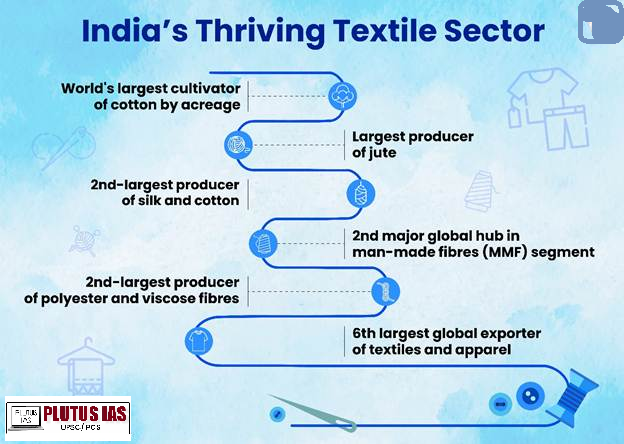
India possesses significant intrinsic strengths in textiles. It is the world’s largest cultivator of cotton by acreage, the largest producer of jute, and the second-largest producer of silk and cotton. India is also a major global hub for man-made fibres (MMF) and the second-largest producer of polyester and viscose fibres.
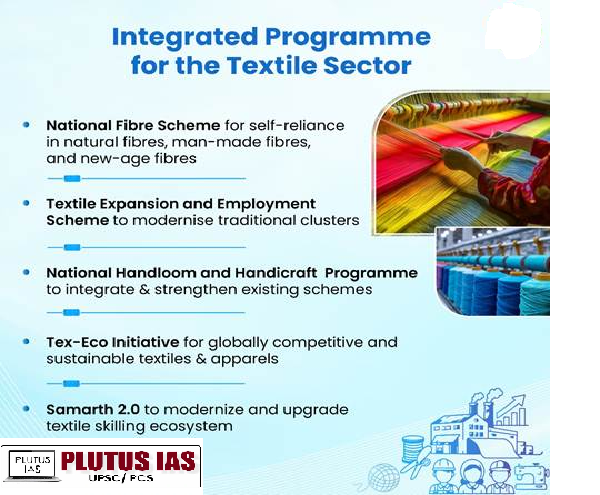
Integrated Programme for the Textile Sector
To strengthen the entire textile value chain from fibre to fashion and from village industries to global markets the Government has announced a comprehensive Integrated Programme structured around five key components:
1. National Fibre Scheme
This scheme aims to promote self-reliance across the fibre spectrum by supporting natural fibres such as silk, wool, and jute, along with man-made and new-age fibres. It seeks to:
Reduce import dependence
Promote diversification beyond cotton
Encourage innovation in advanced textile materials
Strengthen India’s capability in specialised and high performance textiles
2. Textile Expansion and Employment Scheme
This component focuses on modernising traditional textile clusters by providing:
Capital support for machinery and technology upgrades
Establishment of common testing and certification centres
These measures are expected to improve productivity, enhance quality compliance, and generate large-scale employment.
3. National Handloom and Handicraft Programme
Existing handloom and handicraft schemes will be integrated into a unified national programme to:
Support weavers and artisans
Improve incomes and market linkages
Preserve India’s textile heritage
Financial assistance will also be provided for promoting natural dyes and establishing dye houses under the Mega Cluster Development Programme and Special Infrastructure Projects.
4. Tex-Eco Initiative
The Tex-Eco Initiative promotes environmentally sustainable and globally competitive textile manufacturing. It aligns domestic production with international sustainability standards and facilitates access to emerging green markets.
5. Samarth 2.0
Samarth 2.0 is an upgraded skill development programme designed to modernise the textile skill ecosystem. It focuses on collaboration between industry and academic institutions to ensure availability of skilled manpower across the textile value chain.
Mega Textile Parks and Technical Textiles
The Government has announced the establishment of Mega Textile Parks to provide integrated infrastructure, improve scale efficiencies, and enhance value addition.
These parks will also promote technical textiles, which have applications in:
Medical sector
Defence
Infrastructure
Industrial manufacturing
Technical textiles represent a high-growth segment with strong global demand.
Mahatma Gandhi Gram Swaraj Initiative
This initiative aims to strengthen khadi, handloom, and handicrafts sectors by focusing on:
1.Market linkages and branding
2.Training and skilling
3.Quality improvement
4.Modernisation of production processes.
It will also support rural youth and align with the One District One Product (ODOP) initiative.
Export Promotion Measures
To support textile exports, the Government has extended the export obligation period from six months to twelve months for textile and leather exporters using duty-free imported inputs.
This measure will:
1.Improve working capital management
2.Provide operational flexibility
3.Enhance export competitiveness
India is currently the 6th largest exporter of textiles and apparel globally, with approximately 4% share in global exports.
Textile exports increased from USD 35.87 billion in FY24 to USD 37.75 billion in FY25 despite global trade challenges. Export growth was observed across multiple countries, including the UAE, Egypt, Japan, Germany, France, and the UK.
Liquidity Support for Textile MSMEs
To strengthen MSMEs, the Government has enhanced the Trade Receivables Discounting System (TReDS), an electronic platform that enables financing of MSME receivables.
Key measures include:
1.Mandatory use of TReDS by CPSEs
2.Credit guarantee support through CGTMSE
3.Integration of Government e-Marketplace (GeM) with TReDS
4.Introduction of receivables as asset-backed securities
Over ₹7 lakh crore has already been facilitated through TReDS.
Additionally, a ₹10,000 crore SME Growth Fund has been introduced to support future “Champion SMEs.”
Contribution of the Textile Sector to the Economy
India’s textile industry has an estimated size of USD 179 billion and contributes significantly to the economy:
a).2% of GDP
b).11% of manufacturing Gross Value Added (GVA)
c).8.63% of total exports
The sector provides employment to over 45 million people, making it the second-largest employment generator after agriculture.
Major Growth Drivers
PM MITRA Scheme
The Government has approved 7 Mega Integrated Textile Region and Apparel (PM MITRA) Parks with an outlay of ₹4445 crore.
Key highlights:
₹27,434 crore investment potential
Infrastructure works worth ₹2590 crore underway
Employment generation of 3 lakh persons per park
Production Linked Incentive (PLI) Scheme
The PLI Scheme promotes production of MMF apparel, fabrics, and technical textiles. It aims to enhance competitiveness, attract investment, and create employment.
Cotton Sector Reforms
The Government has introduced several reforms, including:
1.Kapas Kisan mobile app for farmer registration
2.Kasturi Cotton Bharat Programme
3.Quality Control Order improvements
The cotton sector supports around 6 million farmers and millions of workers across the value chain.
Sustainability and Labour Reforms
Efforts are underway to promote sustainability and circular economy practices, including procurement of upcycled textile products.
Labour reforms under the new Labour Codes provide:
Improved worker welfare
Streamlined compliance
Better workplace safety and social security
GST rationalisation in textiles has also reduced costs, boosted exports, and supported employment.
Future Outlook and Vision 2030
India’s textile exports currently stand at approximately ₹3 lakh crore. The Government has set a Vision 2030 target of increasing exports to ₹9 lakh crore.
Trade agreements such as the India – EU Free Trade Agreement will provide:
1.Zero duty access for textile exports
2.Reduction of tariffs by up to 12%
These measures will significantly boost exports and global competitiveness.
The Government’s policy direction focuses on:
1.Scaling up manufacturing
2.Promoting technical textiles
3.Supporting MSMEs and artisans
4.Enhancing sustainability
5.Strengthening global value chain integration
Conclusion
India’s textile sector is at a critical stage of transformation, supported by strong production capabilities, rising exports, and sustained policy support.
The Union Budget 2026–27 strengthens the entire textile value chain—from fibre production and manufacturing to skill development and sustainability.
With continued emphasis on scale, innovation, and global integration, the textile sector is well-positioned to drive economic growth, generate employment, support rural livelihoods, and reinforce India’s position as a leading global textile hub.
Best ias coaching in delhi Best ias coaching in chandigar
Prelims question:
Q. With reference to the Integrated Programme for the Textile Sector announced in the Union Budget 2026–27, consider the following statements:
1.The National Fibre Scheme aims to promote both natural fibres and man-made fibres.
2.Samarth 2.0 focuses on providing credit support to textile MSMEs.
3.Tex-Eco Initiative promotes sustainable textile manufacturing aligned with global standards.
4.The Textile Expansion and Employment Scheme includes support for technology upgradation.
Which of the statements given above are correct?
(a) 1, 3 and 4 only
(b) 1 and 2 only
(c) 2 and 4 only
(d) 1, 2, 3 and 4
Answer: (a)
Q. Examine the role of the textile sector in India’s economic growth. How will recent policy measures such as PM MITRA Parks, PLI Scheme, and Integrated Textile Programme help India achieve its Vision 2030 export target ? (250 words)

- Artemis II: Humanity’s Return to Lunar Space and India’s Place in the New Moon Race - April 2, 2026
- A Missed Opportunity to Guarantee Minimum Wages - March 31, 2026
- ‘India’s Growth Claims, A Clash with Data Reality’. - March 30, 2026

No Comments