


01 Sep Supreme Court Collegium Recommends New Chief Justice for Rajasthan HC
✎ The Collegium System, though not explicitly constitutional, is the judiciary’s self-governing mechanism for appointing and transferring judges, ensuring independence but facing scrutiny over transparency and accountability.
Subject Relevance — Where This Topic Fits
- GS Paper II — Polity and Governance — Judiciary and Constitutional Framework | GS Paper II — Polity and Governance — Appointment and Transfer of Judges
- Prelims: Collegium System, Judicial Appointments Commission, Acting Chief Justice, High Court Chief Justice, Judicial Transfer, Supreme Court Collegium, Judicial Integrity, Judicial Roster, Public Interest Litigation (PIL), Contempt of Court
- Essay: Judicial Independence and Accountability: Balancing the Scales, The Role of Judiciary in Upholding Constitutional Values
Quick Revision: The Collegium System, though not explicitly constitutional, is the judiciary’s self-governing mechanism for appointing and transferring judges, ensuring independence but facing scrutiny over transparency and accountability.
Why is this in the news?
The Supreme Court Collegium’s recommendation of a new Chief Justice for the Rajasthan High Court, following allegations of judicial impropriety against the Acting Chief Justice, underscores the procedural and institutional dynamics of judicial appointments and transfers in India. This development highlights the Collegium System’s role in ensuring judicial integrity, the mechanisms for addressing complaints against judges, and the broader implications for judicial governance and public trust in the judiciary.
Background
- The Collegium System, established through judicial pronouncements, is the constitutional mechanism for the appointment and transfer of judges to the higher judiciary in India, as enunciated in the Second and Third Judges Cases (1993 and 1998).
- The Rajasthan High Court, established in 1949, functions as the highest judicial authority for the state, with its Chief Justice playing a pivotal role in judicial administration, roster allocation, and case management.
- The Acting Chief Justice of the Rajasthan High Court, Sanjeev Prakash Sharma, faced allegations of misuse of judicial powers, prompting a Supreme Court judge to write to the Chief Justice of India (CJI) expressing concerns over judicial integrity.
- Lawyer associations in Rajasthan protested against the Acting Chief Justice, leading to a temporary alteration in the judicial roster and his subsequent leave.
- The Supreme Court Collegium, comprising the CJI and four senior-most judges of the Supreme Court, is empowered to recommend appointments and transfers of Chief Justices and judges of High Courts.
What is the Collegium System and its Role in Judicial Appointments?
- The Collegium System is a judicial innovation, not explicitly mentioned in the Constitution, but evolved through judicial interpretation to ensure the independence of the judiciary from executive interference.
- It comprises the Chief Justice of India (CJI) and the four senior-most judges of the Supreme Court for appointments to the Supreme Court and High Courts, and the three senior-most judges for transfers.
- The system aims to safeguard judicial independence by vesting the power of appointment and transfer in the judiciary itself, thereby insulating it from political pressures.
- The Collegium evaluates candidates based on merit, seniority, integrity, and performance, while also considering the need for representation from various regions and communities.
- The Collegium’s recommendations are binding on the government, which is constitutionally obligated to implement them, though the government retains the power to raise objections or seek clarifications.
- The system has been criticised for its opacity, lack of transparency, and the absence of a formalised process for grievances against judges, which has led to demands for judicial accountability reforms.
- The Collegium System operates alongside constitutional provisions such as Articles 124(2), 217, and 222, which govern the appointment and transfer of judges.
- The Supreme Court Collegium’s decision to recommend a new Chief Justice for the Rajasthan High Court exemplifies its role in addressing institutional concerns while maintaining judicial continuity.
Key Features
| Feature | Significance |
|---|---|
| Supreme Court Collegium’s Recommendation | Demonstrates the collegium system’s role in judicial appointments, ensuring constitutional governance and judicial independence. |
| Transfer of Acting Chief Justice | Highlights the institutional mechanism for addressing allegations of misconduct or integrity concerns within the judiciary. |
| Roster Adjustment and Case Reallocation | Shows the procedural response to protests and allegations, ensuring continuity of judicial functions. |
| Judicial Integrity and Accountability | Underscores the judiciary’s self-regulatory mechanisms to maintain public trust and institutional credibility. |
| Division Bench Reallocation | Illustrates the hierarchical structure and delegation of judicial authority within High Courts. |
Why it Matters
Judicial Governance
- Reaffirms the primacy of the collegium system in judicial appointments and transfers, as envisaged under the Constitution.
- Demonstrates the judiciary’s capacity for self-correction and internal accountability.
- Highlights the procedural safeguards in place to address allegations against judicial officers.
Institutional Credibility
- The episode underscores the judiciary’s commitment to transparency and integrity amid public scrutiny.
- Shows the judiciary’s responsiveness to protests and allegations, reinforcing public confidence.
- Demonstrates the hierarchical and functional separation within the judiciary to ensure impartiality.
Judicial Administration
- The adjustment of rosters and reallocation of cases ensures the uninterrupted functioning of the judiciary.
- The transfer of judicial officers reflects the judiciary’s ability to address systemic or individual concerns.
- The collegium’s decision-making process balances judicial independence with institutional accountability.
Challenges
1. Allegations of Judicial Misconduct
- Raises concerns about the integrity and impartiality of judicial officers, which can undermine public trust.
- Demonstrates the need for robust mechanisms to investigate and address such allegations promptly.
- Highlights the delicate balance between judicial independence and the need for accountability.
UPSC Link: Judicial Review and Judicial Activism
2. Protests by Legal Fraternity
- Reflects the legal community’s role in holding the judiciary accountable for its actions.
- Underscores the importance of dialogue and transparency in addressing grievances within the judiciary.
- Demonstrates the potential for protests to disrupt judicial administration if not managed effectively.
UPSC Link: Judicial Reforms and Governance
3. Judicial Appointment and Transfer Process
- The collegium system, while designed for transparency, can face scrutiny over delays or perceived opacity.
- The transfer of judicial officers must balance institutional needs with individual rights and career progression.
- The process must ensure that appointments and transfers are based on merit and not influenced by extraneous factors.
UPSC Link: Appointment of Judges and Collegium System
4. Maintaining Judicial Independence
- Ensuring that judicial officers are free from external pressures or influences is critical for impartiality.
- The judiciary must navigate allegations and protests without compromising its independence or integrity.
- Institutional mechanisms must be in place to protect judicial officers from undue interference.
UPSC Link: Judicial Independence and Separation of Powers
Challenges — UPSC Perspective
| Issue | Concern |
|---|---|
| Allegations of Misconduct | Undermines public trust in the judiciary and raises questions about accountability. |
| Protests by Lawyers | Can disrupt judicial administration and highlight systemic issues within the judiciary. |
| Collegium System Transparency | May face scrutiny over perceived opacity in decision-making processes. |
| Judicial Appointment Delays | Can lead to vacancies and affect the efficiency of judicial administration. |
| Balancing Independence and Accountability | Requires robust mechanisms to ensure both without compromising either. |
Way Forward
- Strengthen institutional mechanisms to address allegations of judicial misconduct promptly and transparently.
- Enhance dialogue between the judiciary and the legal fraternity to address grievances and prevent disruptions.
- Review and refine the collegium system to ensure transparency and reduce delays in judicial appointments.
- Implement training and sensitization programs for judicial officers on integrity, impartiality, and administrative efficiency.
- Establish clear guidelines for roster management and case allocation to ensure fairness and continuity.
- Encourage public awareness campaigns to educate citizens about the judiciary’s role and the mechanisms for accountability.
- Promote research and studies on judicial governance to identify best practices and areas for improvement.
UPSC Value Addition
Keywords for Mains Answer-Writing
Supreme Court Collegium · Judicial Appointments · Chief Justice of High Court · Judicial Integrity · Judicial Roster · Judicial Governance · Judicial Transfer · Judicial Accountability · Judicial Independence · Constitution of India (Article 217) · Judicial Reforms · Judicial Collegium System
Constitutional & Policy Linkages
- Article 217: Appointment of High Court Judges
- Article 222: Transfer of High Court Judges
- Article 124(2): Appointment of Supreme Court Judges
- Article 145: Rules of Court
Concept Flow
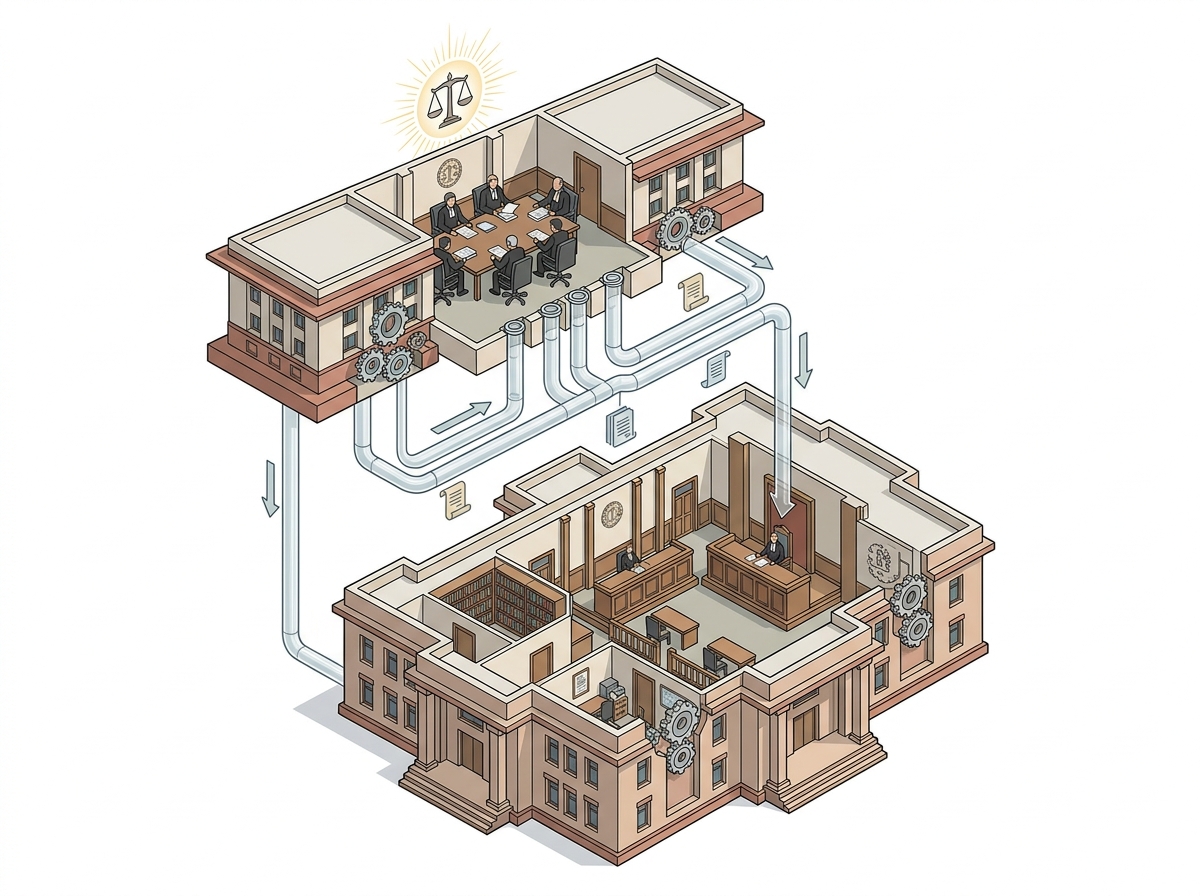
Allegations of judicial misconduct emerge against Acting Chief Justice. → Supreme Court judge raises concerns with the Chief Justice of India. → Collegium reviews the matter and recommends a new Chief Justice and transfer of the Acting Chief Justice. → Legal fraternity protests, prompting roster adjustments and case reallocation. → Judicial administration continues with division benches handling reassigned matters. → Collegium’s decision is implemented, ensuring continuity and institutional credibility.
Prelims Practice Questions
Q1. Consider the following statements regarding the appointment of a Chief Justice of a High Court in India: 1. The appointment is made by the President of India after consultation with the Chief Justice of India and the Governor of the State. 2. The Supreme Court Collegium recommends the name for appointment. 3. The appointment is governed by Article 217 of the Constitution of India. 4. The Chief Justice of a High Court must have served as a judge in any High Court for at least five years. How many of the above statements are correct?
- Only one
- Only two
- Only three
- All four
Answer: All four — Statements 1, 2, and 3 are correct. Statement 4 is incorrect as the Constitution does not prescribe a minimum period of service as a judge in a High Court for appointment as Chief Justice.
Q2. Assertion (A): The Supreme Court Collegium system is a constitutional body responsible for the appointment and transfer of judges in India. Reason (R): The Collegium system derives its authority from the Constitution of India, specifically Article 124(2) and Article 217, read with the Supreme Court’s judgment in the Second and Third Judges Cases.
- Both A and R are true, and R is the correct explanation of A
- Both A and R are true, but R is not the correct explanation of A
- A is true, but R is false
- A is false, but R is true
Answer: Both A and R are true, but R is not the correct explanation of A — Both the Assertion (A) and Reason (R) are true, and R correctly explains A. The Collegium system is a judicial innovation that functions under the constitutional framework established by the Supreme Court in the Second and Third Judges Cases.
Q3. Match the following provisions of the Constitution of India with their respective articles: Column I (Provision) | Column II (Article) A. Appointment of Governor | 1. Article 153 B. Appointment of Chief Justice of High Court | 2. Article 217 C. Appointment of Judges of Supreme Court | 3. Article 124 D. Appointment of Chief Justice of India | 4. Article 126
- A-1, B-2, C-3, D-4
- A-2, B-1, C-4, D-3
- A-1, B-2, C-4, D-3
- A-3, B-1, C-2, D-4
Answer: A-1, B-2, C-3, D-4 — A-1 (Article 153: Appointment of Governor), B-2 (Article 217: Appointment of Chief Justice of High Court), C-3 (Article 124: Appointment of Judges of Supreme Court), D-4 (Article 126: Appointment of Acting Chief Justice of India).
Mains Practice Question
✍ The Supreme Court Collegium’s recommendation for the appointment of a Chief Justice of a High Court is a critical governance function in India’s judicial system. Critically examine the constitutional framework governing such appointments, the role of the Collegium, and the challenges to judicial integrity and independence that have emerged in recent times. (15 Marks)
Approach: MODEL-ANSWER SKELETON:
1. **Constitutional Framework (4 marks)**
– Article 217: Appointment of Chief Justice of a High Court requires consultation with the Chief Justice of India and the Governor of the State.
– Article 124(2) and judicial precedents (Second and Third Judges Cases): Evolution of the Collegium system as a judicial innovation.
– Role of the President: Formal appointment authority under Article 74(1) read with Article 217.
2. **Role of the Supreme Court Collegium (4 marks)**
– Composition: Senior-most judges of the Supreme Court.
– Functions: Recommendations for appointment and transfer of judges.
– Collegium’s discretion: Judicial independence vs. executive accountability.
3. **Challenges to Judicial Integrity and Independence (5 marks)**
– Allegations of misuse of powers and integrity concerns (e.g., Acting Chief Justice Sanjeev Prakash Sharma case).
– Lawyers’ protests and altered judicial rosters as indicators of institutional strain.
– Need for transparency, accountability, and checks and balances in judicial appointments.
4. **Conclusion (2 marks)**
– Balancing judicial independence with accountability.
– Reforms: Strengthening transparency in Collegium proceedings, institutionalising grievance redressal mechanisms, and ensuring adherence to constitutional principles.
Source: The Indian Express
Rajasthan PCS (RPSC / RAS) — State PCS Practice
Prelims: Recently, the Supreme Court Collegium has recommended a new Chief Justice for the Rajasthan High Court. Who among the following is the current Chief Justice of Rajasthan High Court as of June 2024?
- Justice Pradeep Kumar Srivastava
- Justice Naveen Joshi
- Justice Manindra Mohan Shrivastava
- Justice Arun Bhansali
Answer: Justice Manindra Mohan Shrivastava — Justice Manindra Mohan Shrivastava is the current Chief Justice of Rajasthan High Court, recommended by the Supreme Court Collegium in May 2024.
Mains: Discuss the constitutional significance of the Supreme Court Collegium’s role in recommending the Chief Justice of a High Court, with special reference to the Rajasthan High Court. Analyze how this process ensures judicial independence and transparency in the Indian judicial system.
Generated by AanyaAi for educational purpose.
Related guides on our sites
- Anthropology VS PSIR
- Best PSIR optional coaching
- Best PSIR optional coaching online
- Best PSIR optional teacher

- सितंबर 2026 का कोर इंडस्ट्री इंडेक्स: जानिए अगस्त 2026 का अंतिम आँकड़ा - October 21, 2026
- Treasury Bills Auction: RBI Releases Full Results for UPSC Exam - October 21, 2026
- यूपीएससी के लिए महत्वपूर्ण: 91, 182 और 364 दिन के टी-बिल नीलामी परिणाम - October 21, 2026

No Comments