


01 Sep Supreme Court Collegium Recommends New Chief Justices for Three High Courts
✎ The Supreme Court Collegium recommends judicial appointments to ensure judicial independence, with Article 217 governing the appointment of High Court Chief Justices.
Subject Relevance — Where This Topic Fits
- GS Paper II — Polity and Governance
- Prelims: Collegium System, Judicial Appointments, Article 217, High Court Chief Justice, Supreme Court Collegium
Quick Revision: The Supreme Court Collegium recommends judicial appointments to ensure judicial independence, with Article 217 governing the appointment of High Court Chief Justices.
Why is this in the news?
These recommendations, if approved by the Government of India, will trigger formal administrative changes in the judicial governance of these High Courts, underscoring the constitutional process of judicial appointments.
Background
- The Supreme Court Collegium is a body of senior Supreme Court judges responsible for recommending appointments and transfers of judges to the High Courts and the Supreme Court.
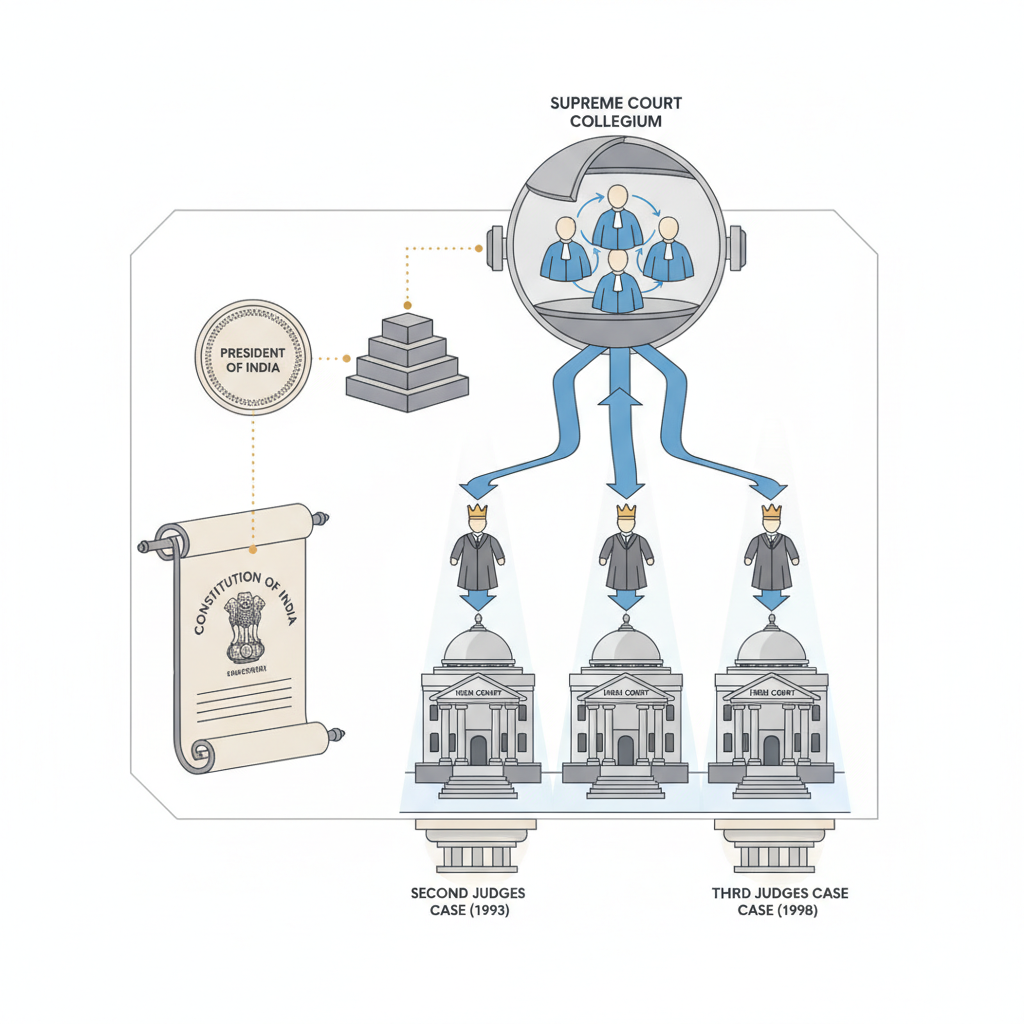
- Article 217 of the Constitution of India empowers the President to appoint Chief Justices of High Courts, acting on the advice of the Union Council of Ministers, which is informed by the Collegium’s recommendations.
- The Collegium System evolved through judicial pronouncements, notably the Second and Third Judges Cases (1993 and 1998), which established the primacy of the judiciary in judicial appointments.
- High Court Chief Justices play a pivotal role in the administration of justice, including the allocation of cases, supervision of subordinate judiciary, and ensuring the timely disposal of cases.
- The recommendations follow a structured process involving consultations among senior judges, assessment of seniority, and consideration of administrative efficiency.
- The current recommendations reflect the Collegium’s emphasis on meritocracy, seniority, and administrative continuity in judicial governance.
What is the Supreme Court Collegium System?
- The Collegium System is an extra-constitutional mechanism evolved through judicial interpretation to ensure judicial independence in the appointment and transfer of judges.
- It comprises the Chief Justice of India and the four senior-most judges of the Supreme Court for recommending appointments to the Supreme Court and High Courts.
- The system aims to insulate judicial appointments from executive interference, thereby safeguarding the autonomy of the judiciary.
- Recommendations are made after thorough deliberations, including consultations with senior judges and assessment of the candidate’s judicial record and seniority.
- The Collegium’s recommendations are sent to the Union Ministry of Law and Justice, which processes them for the President’s approval.
- If approved, the appointees assume office as Chief Justices, assuming administrative responsibilities over the High Court’s functioning.
- The system has been subject to debates regarding transparency, accountability, and the need for a broader consultative process involving stakeholders.
- The Collegium’s decisions are not subject to judicial review, reinforcing the judiciary’s self-governance in matters of judicial appointments.
Key Features
| Feature | Significance |
|---|---|
| Appointment of Chief Justices | Ensures continuity and leadership in High Courts, maintaining judicial independence and efficiency. |
| Collegium System | Upholds the primacy of the judiciary in judicial appointments, as per the Supreme Court’s interpretation of the Constitution. |
| Judicial Appointment Process | Involves consultation among senior judges, ensuring meritocracy and transparency in selections. |
| Inter-High Court Transfers | Facilitates administrative flexibility and equitable distribution of judicial resources across states. |
| Constitutional Role of the President | Final authority in judicial appointments, acting on the advice of the Council of Ministers after Collegium recommendations. |
Why it Matters
Judicial Administration
- Maintains the independence and impartiality of the judiciary by ensuring appointments are based on merit and seniority.
- Facilitates the smooth functioning of High Courts, which are constitutional bodies under Article 214 of the Constitution.
- Supports the rule of law by ensuring timely and transparent judicial leadership transitions.
Constitutional Governance
- Reinforces the separation of powers by vesting the judiciary with the authority to recommend judicial appointments.
- Ensures that judicial vacancies are filled expeditiously, preventing backlogs and delays in justice delivery.
- Upholds the principles of federalism by allowing inter-state judicial transfers and appointments.
Judicial Reforms
- Promotes transparency in judicial appointments through the Collegium system, reducing executive interference.
- Encourages a merit-based and inclusive judiciary by considering seniority and performance in recommendations.
- Supports the decentralization of judicial power, ensuring representation across diverse regions.
Challenges
1. Judicial Vacancies and Backlogs
- Prolonged vacancies in High Courts can lead to case backlogs, delaying justice delivery.
- Delays in filling Chief Justice positions may disrupt judicial functioning and administrative efficiency.
UPSC Link: Judicial Appointments (Collegium System)
2. Collegium System Criticisms
- Lack of transparency in the Collegium’s decision-making process has been a subject of debate.
- Perceived opacity may erode public trust in the judiciary’s appointment process.
UPSC Link: Judicial Independence
3. Inter-High Court Transfers
- Frequent transfers may disrupt the continuity of judicial work in specific High Courts.
- Balancing administrative needs with judicial preferences remains a challenge.
UPSC Link: Judicial Reforms
Challenges — UPSC Perspective
| Issue | Concern |
|---|---|
| Collegium System Transparency | Lack of public disclosure of selection criteria and deliberations. |
| Judicial Vacancies | Potential delays in justice delivery due to unfilled positions. |
| Inter-High Court Transfers | Disruption of judicial continuity and regional representation. |
| Executive-Judiciary Relations | Balancing judicial independence with constitutional roles of the executive. |
| Regional Representation | Ensuring equitable distribution of judicial leadership across states. |
Way Forward
- Strengthen transparency in the Collegium system by publishing selection criteria and deliberations.
- Ensure timely filling of judicial vacancies to prevent case backlogs and delays.
- Promote inter-state judicial transfers based on merit and administrative needs.
- Enhance public awareness about the judicial appointment process to build trust.
- Conduct periodic reviews of the Collegium system to address criticisms and improve efficiency.
- Encourage diversity in judicial appointments to reflect the socio-cultural fabric of the nation.
UPSC Value Addition
Keywords for Mains Answer-Writing
Supreme Court Collegium System · Appointment of Chief Justices of High Courts · Article 217 of the Constitution · Judicial Appointments Commission (JAC) · First and Second Judges Cases · Judicial Independence · Constitutional Provisions for High Court Judges · Process of Judicial Appointments · Judicial Accountability · Judicial Reforms
Constitutional & Policy Linkages
- Article 124(2) – Appointment of Supreme Court Judges
- Article 217 – Appointment of High Court Judges
- Article 222 – Transfer of High Court Judges
Concept Flow
Judicial vacancy arises in High Courts -> Collegium evaluates senior judges for appointment -> Recommendations forwarded to the President -> Executive processes appointments -> Chief Justices assume office -> Judicial administration continues uninterrupted.
Prelims Practice Questions
Q1. Consider the following statements regarding the appointment of Chief Justices of High Courts in India:
1. The Chief Justice of a High Court is appointed by the President of India after consultation with the Chief Justice of India.
2. The Supreme Court Collegium consists of the Chief Justice of India and four senior-most judges of the Supreme Court.
3. The appointment of a Chief Justice of a High Court does not require the approval of the Union Government.
4. The President of India has the power to reject the recommendation of the Supreme Court Collegium for the appointment of a Chief Justice of a High Court.
How many of the above statements are correct?
- Only one
- Only two
- Only three
- All
Answer: Only three — Statements 1 and 2 are correct. Statement 3 is incorrect because the appointment requires the approval of the Union Government. Statement 4 is incorrect because the President acts on the advice of the Council of Ministers, which is bound by the Collegium’s recommendation.
Q2. Assertion (A): The Supreme Court Collegium system is a judicial innovation that evolved through judicial pronouncements rather than a constitutional provision.
Reason (R): The First and Second Judges Cases established the primacy of the Collegium in judicial appointments and transfers.
Options:
A. Both A and R are true, and R is the correct explanation of A.
B. Both A and R are true, but R is not the correct explanation of A.
C. A is true, but R is false.
D. A is false, but R is true.
Answer: ? — Both A and R are true, and R correctly explains A. The First and Second Judges Cases (1993 and 1998) established the Collegium system, which is not explicitly mentioned in the Constitution but evolved through judicial interpretation.
Mains Practice Question
✍ The Supreme Court Collegium has recommended the appointment of Chief Justices for three High Courts—Rajasthan, Madhya Pradesh, and Jammu & Kashmir & Ladakh. In this context, critically examine the constitutional framework governing the appointment of High Court judges and the role of the Collegium system. Also, discuss the implications of this system on judicial independence and accountability. (15 Marks)
Approach: MODEL-ANSWER SKELETON:
1. Constitutional Provisions: Article 217 (appointment of High Court judges), Article 222 (transfer of judges), and the role of the President (Art. 74(1)).
2. Evolution of the Collegium System: First Judges Case (1993), Second Judges Case (1998), and Third Judges Case (1998).
3. Composition and Functioning: The Collegium (CJI + 4 senior-most judges), consultation process, and the role of the Union Government.
4. Judicial Independence vs. Accountability: Arguments for Collegium (protection from executive interference) vs. criticisms (lack of transparency, opacity in decision-making).
5. Recent Developments: Judicial Appointments Commission (JAC) Bill (2014) and its rejection by the Supreme Court.
6. Implications: Strengthening judicial independence, potential for judicial overreach, and the need for reforms (e.g., transparency in Collegium deliberations).
7. Conclusion: Balancing judicial independence with accountability while ensuring constitutional governance.
Source: amarujala.com
Generated by AanyaAi for educational purpose.
Related guides on our sites
- Anthropology VS PSIR
- Best PSIR optional coaching
- Best PSIR optional coaching online
- Best PSIR optional teacher

- सुप्रीम कोर्ट ने शिक्षक भर्ती में ट्रांसजेंडर्स को शामिल न करने पर सरकार से पूछा सवाल - October 20, 2026
- SBI SCO 2026 Recruitment: AI & Tech Posts Open for Experts - October 20, 2026
- दिल्ली में प्रदूषण नियंत्रण: 1 नवंबर से लागू होंगे 10 प्रमुख उपाय - October 20, 2026

No Comments