


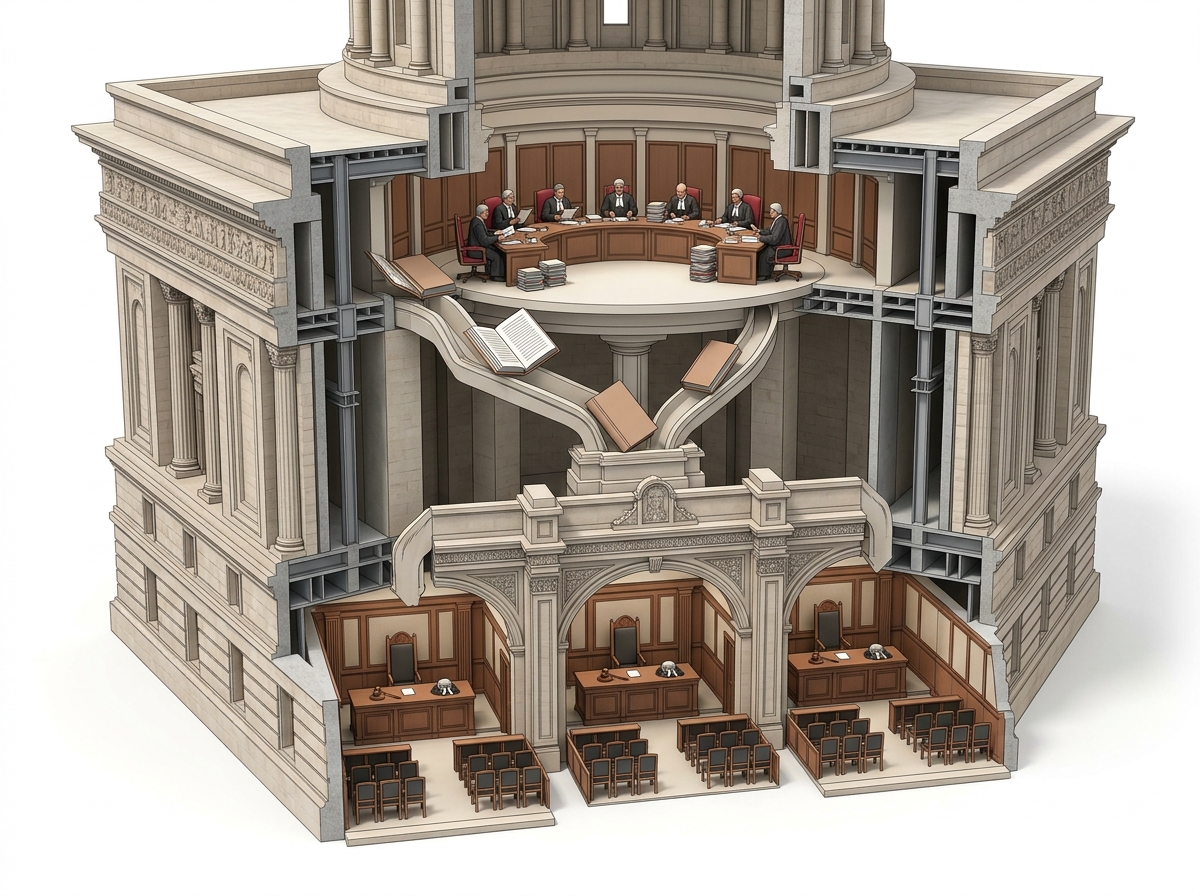
01 Sep Supreme Court Collegium Recommends New Chief Justices for Three High Courts
✎ The appointment of High Court Chief Justices in India is governed by Article 217 of the Constitution and the collegium system, which ensures judicial primacy in the selection process to safeguard judicial independence.
Subject Relevance — Where This Topic Fits
- GS Paper II — Polity and Governance — Judiciary and Constitutional Framework
- Prelims: Judicial Appointments Commission, Collegium System, Article 217, Chief Justice of High Court, Supreme Court Collegium, constitutional provisions for judicial appointments
- Essay: Judicial Independence and Accountability: Balancing Constitutional Mandates, The Role of the Judiciary in Upholding Democratic Governance
Quick Revision: The appointment of High Court Chief Justices in India is governed by Article 217 of the Constitution and the collegium system, which ensures judicial primacy in the selection process to safeguard judicial independence.
Why is this in the news?
These recommendations, if approved through the constitutional process, will address pending vacancies and ensure the continuity of judicial administration in these high courts. The decisions follow a structured evaluation of seniority, merit, and institutional requirements, reflecting the collegium’s role in judicial governance.
Background
- The Supreme Court Collegium is a body of senior judges responsible for recommending the appointment and transfer of judges to the higher judiciary, including High Court Chief Justices, under the collegium system established by judicial precedents such as the Second and Third Judges Cases (1993, 1998).
- The collegium system emerged as a judicial response to the perceived inadequacies of the executive-led appointment process, particularly in ensuring transparency and judicial independence.
- High Court Chief Justices are appointed under Article 217 of the Constitution, which mandates consultation with the Chief Justice of India and the Governor of the State, though the final authority rests with the President of India.
- The collegium’s recommendations are forwarded to the Union Ministry of Law and Justice, which processes them for presidential assent, completing the constitutional formalities.
- The appointment process is designed to insulate judicial appointments from political interference, ensuring the judiciary remains an independent pillar of governance.
What is the Supreme Court Collegium System?
- The collegium system is an extra-constitutional mechanism evolved by the judiciary to recommend appointments and transfers of judges to the higher judiciary, including Chief Justices of High Courts and Supreme Court judges.
- It operates under the doctrine of judicial primacy, where the judiciary itself determines the criteria for appointments, ensuring that judges are selected based on merit, seniority, and institutional needs rather than executive preferences.
- The collegium for High Court Chief Justices typically consists of the Chief Justice of India (CJI) and the four senior-most judges of the Supreme Court, who collectively evaluate candidates based on their judicial record, experience, and suitability for the role.
- Recommendations are made after thorough consultations within the collegium, followed by a formal resolution, which is then sent to the Union Government for processing.
- The system was crystallised through judicial interpretations of Articles 124(2) and 217 of the Constitution, particularly after the landmark judgments in *S.P. Gupta v. Union of India* (1981) and *Supreme Court Advocates-on-Record Association v. Union of India* (1993, 1998), which reaffirmed judicial primacy in appointments.
- The collegium system aims to maintain the independence of the judiciary by preventing executive overreach in judicial appointments, a principle enshrined in the Basic Structure of the Constitution.
- Criticisms of the collegium system include lack of transparency, absence of a formalised selection process, and occasional delays in filling vacancies, which have led to debates on the need for a judicial appointments commission with legislative backing.
Key Features
| Feature | Significance |
|---|---|
| Appointment of Chief Justices via Supreme Court Collegium | Ensures judicial independence by insulating the judiciary from executive interference, as per the Third Judges Case (1998) and Article 124(2) of the Constitution. |
| Recommended transfers across High Courts | Facilitates administrative efficiency by redistributing judicial resources and addressing regional imbalances in judicial appointments. |
| Role of the Supreme Court Collegium | Acts as a constitutional body (post-Second and Third Judges Cases) to recommend judicial appointments, ensuring transparency and meritocracy in the process. |
| Constitutional mandate under Article 217 | High Court Chief Justices are appointed by the President after consultation with the Chief Justice of India and the Governor of the State, as per constitutional provisions. |
| Judicial vacancy management | Proactive filling of vacancies ensures continuity in judicial administration and reduces pendency of cases in High Courts. |
Why it Matters
Judicial Administration
- Maintains the constitutional framework of judicial appointments, ensuring adherence to the principles of independence, impartiality, and efficiency.
- Addresses regional disparities in judicial strength by reallocating judges across High Courts based on workload and vacancy status.
- Strengthens the functional autonomy of High Courts by ensuring timely appointments to key administrative positions.
Governance and Accountability
- Demonstrates the institutional mechanism for judicial governance, where the Collegium system balances executive and judicial roles in appointments.
- Highlights the importance of transparency in judicial appointments to uphold public trust in the judiciary.
- Ensures continuity in judicial leadership, which is critical for maintaining judicial discipline and case management.
Legal Precedents and Jurisprudence
- Reflects the evolving jurisprudence on judicial appointments, post the landmark judgments in the Second and Third Judges Cases.
- Reinforces the principle that judicial appointments are a matter of judicial primacy, subject to constitutional safeguards.
Challenges
1. Regional Imbalance in Judicial Appointments
- Persistent disparities in the distribution of judicial resources across High Courts, particularly in smaller states or union territories.
- Delays in filling vacancies due to procedural complexities or lack of consensus within the Collegium system.
UPSC Link: Judicial Appointments (GS-II)
2. Ensuring Transparency and Meritocracy
- Maintaining objectivity in the selection process to prevent perceptions of favoritism or bias in judicial appointments.
- Balancing the need for regional representation with the requirement for judicial competence and seniority.
UPSC Link: Judicial Reforms (GS-II)
3. Administrative Efficiency in Judicial Transfers
- Managing the logistical and operational challenges of transferring judges across High Courts without disrupting judicial work.
- Ensuring that transfers do not adversely impact the functioning of the High Courts they are leaving or joining.
UPSC Link: Judicial Administration (GS-II)
4. Public Trust and Perception of Impartiality
- Addressing concerns about the perceived politicization of judicial appointments, despite the Collegium system’s constitutional safeguards.
- Ensuring that the process of appointment and transfer is perceived as fair and free from external influences.
UPSC Link: Judicial Independence (GS-II)
5. Coordination Between Central and State Governments
- Facilitating smooth coordination between the Supreme Court Collegium, the central government, and state authorities in the appointment process.
- Resolving potential conflicts or delays arising from differences in priorities or interpretations of constitutional provisions.
UPSC Link: Centre-State Relations (GS-II)
Challenges — UPSC Perspective
| Issue | Concern |
|---|---|
| Regional Imbalance | Disproportionate allocation of judicial resources across High Courts, particularly in smaller states. |
| Transparency in Appointments | Perceptions of opacity in the Collegium system, despite its constitutional mandate. |
| Administrative Delays | Procedural bottlenecks leading to prolonged vacancies in key judicial positions. |
| Judicial Workload | Uneven distribution of cases and administrative responsibilities across High Courts. |
| Public Perception | Erosion of public trust in the judiciary due to perceived lack of impartiality in appointments. |
Way Forward
- Strengthen the Collegium system by institutionalizing transparent criteria for judicial appointments and transfers.
- Conduct periodic reviews of judicial strength and workload across High Courts to ensure equitable distribution of resources.
- Enhance public awareness about the judicial appointment process to build trust and accountability.
- Streamline administrative procedures to reduce delays in filling judicial vacancies.
- Promote regional representation in judicial appointments while prioritizing merit and seniority.
- Establish a dedicated mechanism for addressing grievances related to judicial transfers or appointments.
- Encourage inter-High Court exchanges to foster judicial camaraderie and administrative efficiency.
UPSC Value Addition
Keywords for Mains Answer-Writing
Supreme Court Collegium System · Appointment of Chief Justices of High Courts · Judicial Appointments in India · Constitutional provisions governing judicial appointments · Article 217 of the Constitution · Judicial independence · Judicial accountability · Process of judicial appointments · High Court Chief Justices · Supreme Court of India · Judicial governance · Constitutional functionaries · Judicial reforms · Judicial collegium system · Appointment of judges under Article 224A
Constitutional & Policy Linkages
- Article 124(2) — Appointment of Supreme Court Judges
- Article 217 — Appointment of High Court Judges
- Article 222 — Transfer of High Court Judges
- Third Judges Case (1998) — Collegium System
Concept Flow
Judicial vacancy arises in High Courts due to retirements or transfers → Supreme Court Collegium evaluates candidates based on merit, seniority, and regional representation → Collegium recommends appointments to the President, who issues the formal notification → Appointed Chief Justices assume office after completing constitutional formalities → Judicial administration in the High Courts resumes with renewed leadership and administrative efficiency
Prelims Practice Questions
Q1. Consider the following statements regarding the appointment of Chief Justices of High Courts in India:
1. The appointment is made by the President of India after consultation with the Supreme Court Collegium.
2. The Supreme Court Collegium consists of the Chief Justice of India and four senior-most judges of the Supreme Court.
3. The appointment process is governed by Article 217 of the Constitution.
4. The Chief Justice of a High Court must have served as a judge in any High Court for at least 10 years.
How many of the above statements are correct?
- Only one
- Only two
- Only three
- All four
Answer: All four — Statements 1, 2, and 3 are correct. Statement 4 is incorrect as the minimum requirement is 10 years of combined service as an advocate or judge in any High Court, not necessarily as a judge.
Q2. Assertion (A): The Supreme Court Collegium system for judicial appointments has been criticized for lacking transparency and accountability.
Reason (R): The Collegium system is based solely on seniority and does not involve any formal consultation with the executive branch.
In the context of the above statements, which of the following is correct?
- Both A and R are true, and R is the correct explanation of A
- Both A and R are true, but R is not the correct explanation of A
- A is true, but R is false
- A is false, but R is true
Answer: A is true, but R is false — Both A and R are true, but R is not the correct explanation of A. The Collegium system is indeed criticized for lack of transparency, but it does involve consultation, albeit informal, with the executive.
Q3. Match the following High Courts with their respective Chief Justices as recently recommended by the Supreme Court Collegium:
Column I (High Court)
A. Rajasthan High Court
B. Madhya Pradesh High Court
C. Jammu & Kashmir and Ladakh High Court
D. Chhattisgarh High Court
Column II (Chief Justice recommended)
1. Justice Sanjay Karanwal Agrawal
2. Justice Alok Yashvant Khare
3. Justice Pushpendra Singh Bhati
4. Justice Krishna Ram Mahapatra
Select the correct match:
- A-1, B-2, C-3, D-4
- A-2, B-1, C-4, D-3
- A-3, B-4, C-1, D-2
- A-4, B-3, C-2, D-1
Answer: A-1, B-2, C-3, D-4 — The correct matches are: A-1 (Justice Sanjay Karanwal Agrawal for Rajasthan), B-2 (Justice Alok Yashvant Khare for Madhya Pradesh), C-3 (Justice Pushpendra Singh Bhati for J&K and Ladakh), and D-4 (Justice Krishna Ram Mahapatra for Chhattisgarh).
Mains Practice Question
✍ The Supreme Court Collegium system has been a subject of debate regarding its effectiveness in ensuring judicial independence while maintaining accountability. Critically examine the process of appointment of Chief Justices of High Courts in India, with reference to the recent recommendations made by the Collegium. Also, analyse the constitutional provisions governing such appointments and their implications for judicial governance. (15 Marks)
Approach: MODEL-ANSWER SKELETON:
1. **Constitutional Framework**:
– Article 217 of the Constitution outlines the process for the appointment of High Court judges, including Chief Justices.
– The President appoints the Chief Justice after consultation with the Chief Justice of India (CJI) and other judges as deemed necessary.
– The Collegium system evolved through judicial pronouncements (e.g., Second and Third Judges Cases) to ensure primacy of the judiciary in appointments.
2. **Role of the Supreme Court Collegium**:
– Composition: CJI and four senior-most judges of the Supreme Court.
– Process: The Collegium recommends names for appointment, elevation, or transfer of judges.
– Recent Recommendations: The Collegium’s recent recommendations for Chief Justices of Rajasthan, Madhya Pradesh, Jammu & Kashmir, Ladakh, and Chhattisgarh High Courts.
3. **Judicial Independence vs. Accountability**:
– **Independence**: The Collegium system aims to insulate judicial appointments from executive interference, ensuring autonomy.
– **Accountability**: Criticisms include lack of transparency, absence of formal criteria, and inadequate representation of marginalised sections.
4. **Constitutional Provisions and Judicial Pronouncements**:
– Article 50 of the Constitution emphasizes separation of judiciary from the executive.
– Landmark cases: S.P. Gupta v. Union of India (First Judges Case, 1981), Supreme Court Advocates-on-Record Association v. Union of India (Second Judges Case, 1993), and In re: Special Reference 1 of 1998 (Third Judges Case, 1998).
5. **Implications for Judicial Governance**:
– **Merits**: Ensures judicial independence, reduces executive overreach, and maintains the integrity of the judiciary.
– **Demerits**: Perceived opacity, lack of diversity in appointments, and potential for nepotism or favouritism.
6. **Way Forward**:
– Need for a transparent, merit-based system with defined criteria.
– Role of the National Judicial Appointments Commission (NJAC) and its rejection by the Supreme Court.
– Suggestions for reforms, such as the inclusion of non-judicial members in the appointment process.
7. **Conclusion**:
– The Collegium system, while ensuring judicial independence, must balance transparency and accountability to uphold public trust in the judiciary.
Source: amarujala.com
Generated by AanyaAi for educational purpose.
Related guides on our sites
- Anthropology VS PSIR
- Best PSIR optional coaching
- Best PSIR optional coaching online
- Best PSIR optional teacher

- UNEP Report 2026 Warns: Paris 1.5°C Target Slipping Away - October 23, 2026
- पूर्व आईएएस अधिकारी हत्या मामले में आईएएस एसोसिएशन की मुख्यमंत्री से मुलाकात - October 23, 2026
- UPSC Exam: Rare Glimpse of Ritwik Ghatak’s Cinematic Legacy at 4-Day Festival - October 23, 2026

No Comments