


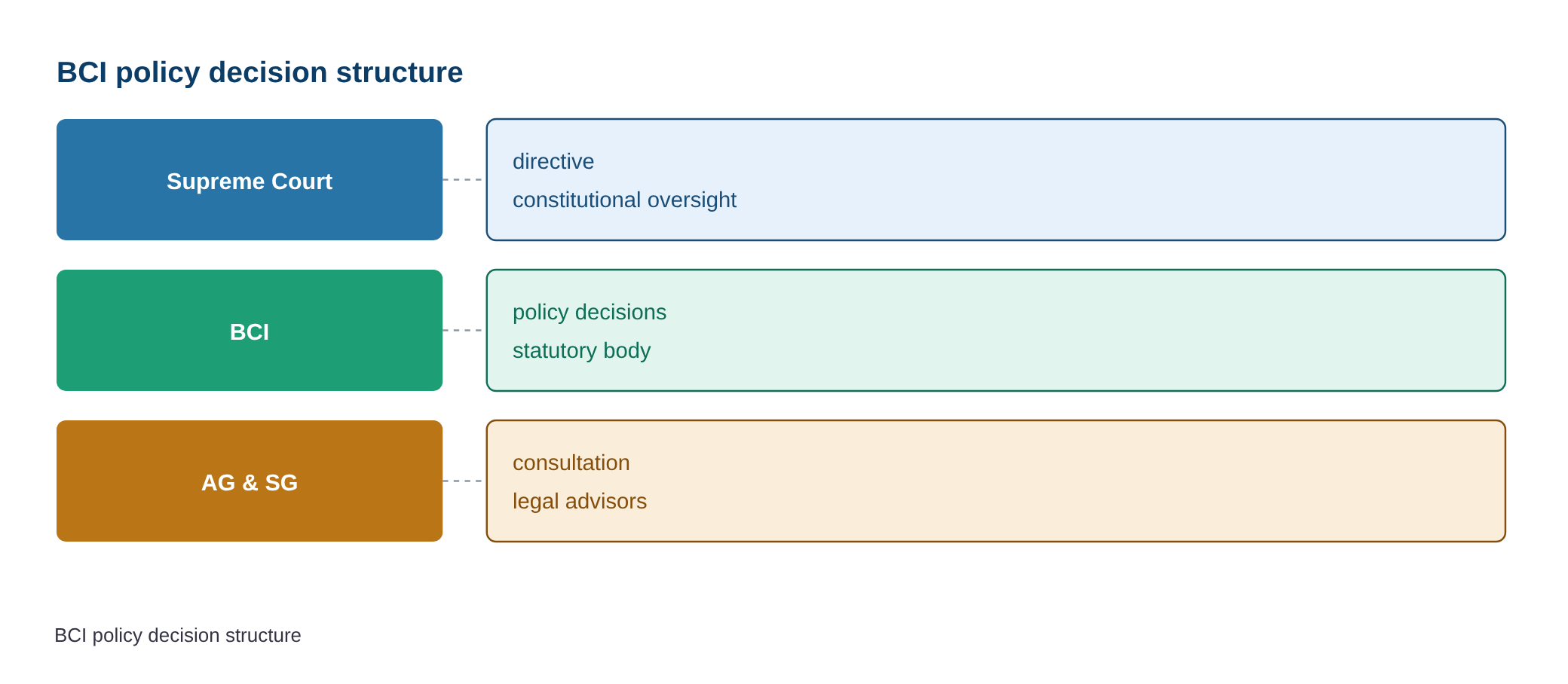
02 Sep Supreme Court Directs BCI to Consult AG, SG on Policy Decisions
✎ The Bar Council of India (BCI), as a statutory body under the Advocates Act, 1961, must consult the Attorney General and Solicitor General for all policy decisions, as mandated by the Supreme Court to ensure constitutional…
Subject Relevance — Where This Topic Fits
- GS Paper II — Polity and Governance | GS Paper II — Judiciary and Legal Framework
- Prelims: Bar Council of India (BCI), Attorney General of India, Solicitor General of India, Judicial Review, Judicial Activism, Constitutional Provisions related to Legal Profession
- Essay: Role of Constitutional Authorities in Upholding the Rule of Law, Separation of Powers and Checks and Balances in the Indian Constitution
Quick Revision: The Bar Council of India (BCI), as a statutory body under the Advocates Act, 1961, must consult the Attorney General and Solicitor General for all policy decisions, as mandated by the Supreme Court to ensure constitutional compliance and inter-institutional coordination.
Why is this in the news?
The Supreme Court of India, while adjudicating a petition challenging the prolonged tenure of the Bar Council of India (BCI) Chairperson, issued a significant directive mandating that all policy decisions of the BCI must be taken in consultation with the Attorney General for India and the Solicitor General. This ruling underscores the constitutional principle of inter-institutional consultation and highlights the judiciary’s role in ensuring adherence to due process in the functioning of statutory bodies regulating the legal profession.
Background
- The Bar Council of India (BCI) is a statutory body established under the Advocates Act, 1961, responsible for regulating the legal profession and legal education in India.
- The BCI functions under the oversight of the Ministry of Law and Justice, Government of India, and its decisions are subject to judicial review.
- The Attorney General for India is a constitutional office under Article 76 of the Constitution, tasked with providing legal advice to the Government of India.
- The Supreme Court has, in prior judgments, emphasized the necessity of inter-institutional consultation to ensure transparency and accountability in the functioning of statutory bodies.
- The present case arose from a petition questioning the legality of the prolonged tenure of the BCI Chairperson, raising concerns about the governance and decision-making processes within the BCI.
What is the Bar Council of India (BCI)?
- The BCI is a statutory body constituted under the Advocates Act, 1961, with the primary mandate of regulating the legal profession and legal education in India.
- It is responsible for enrolling advocates, prescribing standards of professional conduct, and promoting legal education through affiliated law colleges.
- The BCI is governed by a Chairman and members elected from among advocates across the country, with its decisions subject to judicial review.
- The BCI’s functions include framing rules for legal education, conducting examinations for advocates, and maintaining the roll of advocates.
- The BCI’s decisions are guided by the Advocates Act and the Bar Council of India Rules.
- The BCI’s policy decisions have far-reaching implications for the legal profession, including standards of practice, disciplinary actions, and the accreditation of law schools.
- The Supreme Court’s directive to consult the Attorney General and Solicitor General in policy-making reflects the constitutional principle of inter-institutional coordination and oversight.
Key Features
| Feature | Significance |
|---|---|
| Judicial oversight of BCI policy decisions | Ensures constitutional propriety and legal accountability in the functioning of statutory bodies regulating legal professionals. |
| Mandatory consultation with AG and Solicitor General | Strengthens the institutional role of the executive’s legal advisors in policy formulation affecting the legal fraternity. |
| Supreme Court’s directive on prolonged tenure of BCI Chairman | Highlights the need for adherence to term limits and procedural norms in statutory appointments. |
| Judicial review of statutory body governance | Reaffirms the judiciary’s role in ensuring transparency and adherence to law in the functioning of autonomous legal institutions. |
| Plea challenging BCI Chairperson’s tenure | Demonstrates the use of judicial remedies to address governance irregularities in professional regulatory bodies. |
Why it Matters
Institutional Governance
- The Supreme Court’s directive underscores the principle of inter-institutional coordination between the judiciary, executive, and statutory bodies like the BCI.
- It reinforces the constitutional framework wherein the executive’s legal advisors (AG and Solicitor General) play a consultative role in matters affecting the legal profession.
- The ruling serves as a precedent for ensuring that statutory bodies adhere to prescribed norms in governance and policy-making.
- It highlights the judiciary’s role in safeguarding the integrity of institutions regulating professional conduct.
Legal Profession Regulation
- The BCI, as the statutory regulator of legal practitioners, is mandated to function within a framework that ensures fairness, transparency, and accountability.
- The directive ensures that major policy decisions of the BCI are vetted by the AG and Solicitor General, aligning regulatory actions with legal principles.
- This mechanism prevents arbitrary or prolonged tenures in key positions, thereby enhancing public trust in the legal profession.
- It also ensures that regulatory policies are consistent with the broader legal and constitutional framework.
Checks and Balances
- The ruling exemplifies the system of checks and balances inherent in the Indian constitutional scheme, where the judiciary can intervene to correct governance lapses in statutory bodies.
- It prevents the concentration of power in a single office (e.g., BCI Chairperson) by mandating external oversight in policy decisions.
- The directive ensures that regulatory actions are not insulated from executive or judicial scrutiny, thereby upholding the rule of law.
Challenges
1. Governance Irregularities in Statutory Bodies
- Prolonged tenures in key positions within statutory bodies like the BCI can lead to institutional inertia and lack of accountability.
- The absence of clear term limits or consultation mechanisms may result in governance deficits and erosion of public trust.
- Such irregularities can undermine the credibility of regulatory bodies and their ability to function effectively.
- Addressing these issues requires robust institutional mechanisms and judicial oversight.
UPSC Link: GS-II: Statutory Bodies and Regulatory Authorities
2. Role Clarity in Inter-Institutional Coordination
- The precise delineation of roles between the judiciary, executive, and statutory bodies remains a challenge in ensuring seamless coordination.
- Ambiguities in consultation requirements may lead to delays or conflicts in policy implementation.
- Clear guidelines are needed to define the scope and process of consultation between the BCI, AG, and Solicitor General.
- Institutional mechanisms must be strengthened to avoid overlaps or gaps in governance.
UPSC Link: GS-II: Separation of Powers and Constitutional Governance
3. Ensuring Transparency in Regulatory Functions
- The opacity in decision-making processes of statutory bodies like the BCI can erode public confidence in the legal profession.
- Lack of transparency in policy formulation and implementation may lead to allegations of favoritism or arbitrariness.
- Mechanisms for public consultation and disclosure of regulatory actions are essential to maintain accountability.
- Judicial interventions, such as the present ruling, can act as catalysts for greater transparency.
UPSC Link: GS-II: Transparency and Accountability in Governance
Challenges — UPSC Perspective
| Issue | Concern |
|---|---|
| Prolonged tenure of BCI Chairperson | Lack of term limits and adherence to procedural norms undermines institutional credibility. |
| Ambiguity in consultation requirements | Unclear guidelines for AG/Solicitor General involvement may lead to governance conflicts. |
| Opacity in BCI policy decisions | Absence of transparency in regulatory actions raises concerns about fairness and accountability. |
| Judicial review of statutory bodies | Balancing judicial oversight with institutional autonomy remains a persistent challenge. |
| Coordination between judiciary and executive | Ensuring seamless inter-institutional coordination without overreach is critical. |
| Public trust in legal profession | Governance lapses in regulatory bodies can erode confidence in the legal system. |
Way Forward
- The BCI should formalize term limits and eligibility criteria for key positions, including the Chairperson, to ensure adherence to statutory norms.
- Clear guidelines must be framed to define the scope, process, and frequency of consultation between the BCI, AG, and Solicitor General in policy-making.
- Institutional mechanisms for transparency, such as public disclosure of policy decisions and stakeholder consultations, should be institutionalized.
- Judicial review mechanisms should be strengthened to address governance irregularities in statutory bodies promptly and effectively.
- Capacity-building initiatives for members of statutory bodies like the BCI should be undertaken to enhance governance standards.
- Periodic audits of the BCI’s functioning by an independent body may be considered to ensure compliance with regulatory norms.
- Public awareness campaigns should be launched to educate stakeholders about the roles and responsibilities of regulatory bodies like the BCI.
UPSC Value Addition
Keywords for Mains Answer-Writing
Bar Council of India (BCI) · Supreme Court of India · Attorney General of India · Solicitor General of India · Constitutional bodies · Judicial governance · Legal profession regulation · Judicial review · Institutional checks and balances · Constitutional morality
Constitutional & Policy Linkages
- {‘Article 76’: ‘Role of Attorney General and Solicitor General in advising the executive.’}
- {‘Article 144’: ‘Obligation of all authorities to act in aid of the Supreme Court.’}
- {‘Article 226’: ‘Power of High Courts to issue writs for enforcement of rights and redressal of grievances.’}
- {‘Article 32’: ‘Power of the Supreme Court to issue writs for enforcement of fundamental rights.’}
Concept Flow
Supreme Court’s directive on BCI policy decisions → Mandates consultation with AG and Solicitor General → Ensures inter-institutional coordination → Strengthens governance framework → Enhances public trust in legal profession → Reinforces rule of law → Upholds constitutional principles
Prelims Practice Questions
Q1. Consider the following statements regarding the Bar Council of India (BCI) and its functioning:
1. The BCI is a statutory body established under the Advocates Act, 1961.
2. The Attorney General of India and the Solicitor General of India are constitutional functionaries who must be consulted by the BCI for all policy decisions.
3. The Supreme Court of India has the power to direct the BCI to consult the Attorney General and Solicitor General before framing policies.
4. The BCI chairman holds office for a fixed term of five years as per the Advocates Act, 1961.
How many of the above statements are correct?
- Only one
- Only two
- Only three
- All four
Answer: Only three — Statements 1 and 3 are correct. Statement 2 is incorrect because the Supreme Court’s direction does not mandate consultation as a constitutional requirement but as a judicial oversight measure. Statement 4 is incorrect as the tenure of the BCI chairman is not fixed statutorily and may vary.
Q2. Assertion (A): The Supreme Court of India has the power to issue directions to constitutional bodies like the Bar Council of India for ensuring adherence to constitutional principles.
Reason (R): The Supreme Court derives its power of judicial review from Article 136 of the Constitution of India.
Options:
A. Both A and R are true, and R is the correct explanation of A.
B. Both A and R are true, but R is NOT the correct explanation of A.
C. A is true, but R is false.
D. A is false, but R is true.
Answer: ? — Assertion (A) is true as the Supreme Court can issue directions to constitutional bodies for ensuring constitutional adherence. Reason (R) is true but incorrect as the power of judicial review is derived from Articles 32 and 226, not Article 136, which pertains to special leave petitions.
Q3. Match the following constitutional functionaries with their respective roles:
Column I
1. Attorney General of India
2. Solicitor General of India
3. Chairman, Bar Council of India
4. Chief Justice of India
Column II
A. Principal legal advisor to the Government of India
B. Head of the judiciary and the Supreme Court
C. Assists the Attorney General and represents the Government in courts
D. Elected by the members of the State Bar Councils and is the head of the BCI
Options:
1. 1-A, 2-C, 3-D, 4-B
2. 1-B, 2-A, 3-C, 4-D
3. 1-C, 2-D, 3-A, 4-B
4. 1-D, 2-B, 3-A, 4-C
Answer: ? — The correct match is: 1-A (Attorney General is the principal legal advisor), 2-C (Solicitor General assists the Attorney General), 3-D (Chairman of BCI is elected by State Bar Councils), and 4-B (Chief Justice of India heads the judiciary).
Mains Practice Question
✍ The Supreme Court has recently directed the Bar Council of India (BCI) to consult the Attorney General and Solicitor General before framing any policy decisions. Critically examine the implications of this judicial intervention on the autonomy of the legal profession and the doctrine of separation of powers in India. (15 Marks)
Approach: MODEL-ANSWER SKELETON:
1. **Context**: Brief on the Supreme Court’s directive and its legal basis (judicial review under Articles 32/226).
2. **Autonomy of the Legal Profession**: Discuss the constitutional and statutory framework governing the BCI (Advocates Act, 1961) and the principle of self-regulation in the legal profession.
3. **Judicial Intervention**: Analyse the scope of judicial review in regulating professional bodies (citing cases like *Romesh Thappar v. State of Madras*, *SP Gupta v. Union of India*).
4. **Separation of Powers**: Examine the tension between judicial oversight and the independence of the BCI as a statutory body.
5. **Checks and Balances**: Discuss how consultation with constitutional functionaries (AG and SG) aligns with the doctrine of checks and balances.
6. **Critique**: Weigh the arguments for judicial intervention (preventing arbitrary decisions) against the risks (encroachment on professional autonomy).
7. **Conclusion**: Suggest a balanced approach where judicial oversight is exercised without undermining institutional independence.
Source: orissapost.com
Generated by AanyaAi for educational purpose.
Related guides on our sites
- Anthropology VS PSIR
- Best PSIR optional coaching
- Best PSIR optional coaching online
- Best PSIR optional teacher

- तमिलनाडु स्टार्टअप मिशन के अध्यक्ष नियुक्त हुए सिंगई जी. रामचंद्रन - September 2, 2026
- Tamil Nadu Appoints Singai G. Ramachandran as TANSIM Chairperson: Key UPSC Facts - September 2, 2026
- दिल्ली विधेयक: व्यवसाय शुरू करने में होगी आसानी, एकल खिड़की प्रणाली लागू होगी - September 2, 2026

No Comments