


10 Sep Supreme Court Rejects Abu Salem’s Plea for Release After 25 Years in Jail
✎ Extradition conditions, including imprisonment limits, are enforceable under domestic law and subject to judicial review to ensure compliance with constitutional rights and treaty obligations.
Subject Relevance — Where This Topic Fits
- GS Paper II — Polity and Governance: Judiciary, Fundamental Rights, and Extradition | GS Paper III — Security Challenges: Organised Crime and Terrorism
- Prelims: Extradition Treaty, Article 21 of the Constitution, Judicial Review, Preventive Detention, Terrorism and Organised Crime (Prevention) Act, 2002, Supreme Court jurisdiction under Article 136
- Essay: The Balance Between Individual Liberty and State Security in Criminal Justice, The Role of International Law in Domestic Judicial Proceedings
Quick Revision: Extradition conditions, including imprisonment limits, are enforceable under domestic law and subject to judicial review to ensure compliance with constitutional rights and treaty obligations.
Why is this in the news?
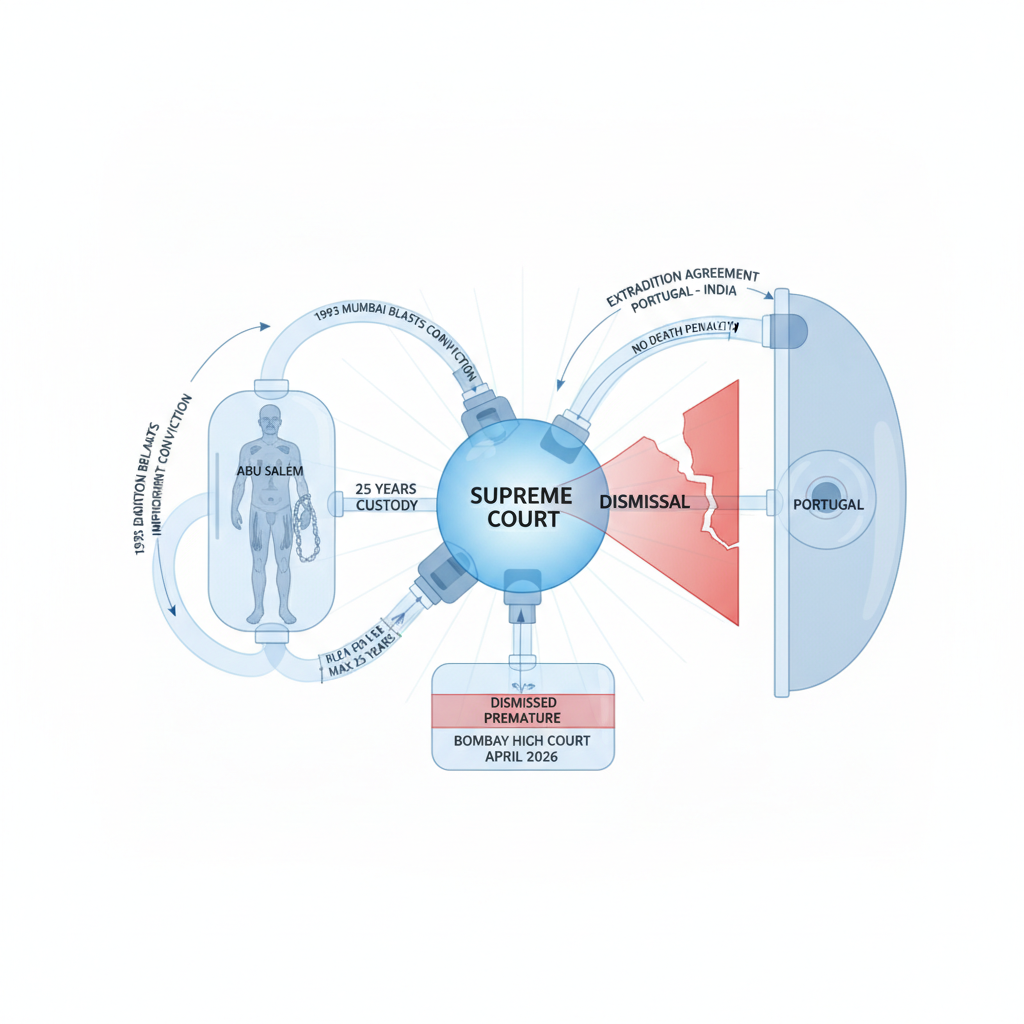
The Supreme Court of India dismissed a plea by Abu Salem, a convict in the 1993 Mumbai serial blasts, seeking release after 25 years in custody, citing the terms of his extradition agreement with Portugal.
Background
- Abu Salem was extradited from Portugal to India in November 2005 after a prolonged legal process, following his conviction in the 1993 Mumbai serial blasts case.
- The extradition agreement between India and Portugal stipulated that Salem would not be subjected to the death penalty and that his imprisonment would not exceed 25 years, a condition invoked by Salem in his plea for release.
- The Bombay High Court, in April 2026, dismissed Salem’s petition for immediate release, deeming it premature and legally misconceived, a decision upheld by the Supreme Court.
- The case raises critical questions about the enforceability of extradition conditions, the limits of judicial review in such matters, and the balance between individual rights and state security imperatives.
What is Extradition and How Do Its Legal Conditions Operate?
- Extradition is the formal process by which one sovereign state requests and obtains the surrender of a person accused or convicted of a crime committed within the requesting state’s jurisdiction, to face trial or serve a sentence.
- Extradition treaties are bilateral or multilateral agreements that define the legal framework for such transfers, including the crimes covered, the conditions for surrender, and any limitations on punishment (e.g., prohibition of the death penalty).
- In India, extradition is governed by the Extradition Act, 1962, which provides the legal basis for requesting and executing extradition requests, subject to judicial oversight and constitutional safeguards.
- Judicial review of extradition conditions is a critical safeguard, ensuring that the terms of such agreements are interpreted in conformity with domestic law and constitutional principles, including the prohibition of arbitrary detention.
- The enforcement of extradition conditions, such as the 25-year cap in Salem’s case, is subject to judicial scrutiny to prevent abuse of process and to uphold the rule of law.
Key Features
| Feature | Significance |
|---|---|
| Extradition Agreement with Portugal (2002) | Establishes legal obligations for India to respect the terms of extradition, including non-imposition of death penalty and a maximum 25-year prison term for Abu Salem. |
| Supreme Court Verdict (2026) | Reinforces the primacy of extradition treaties in domestic law and upholds the principle of judicial review over executive decisions in extradition cases. |
| Bombay High Court’s April 2026 Order | Demonstrates the judiciary’s role in interpreting extradition terms and ensuring compliance with international obligations. |
| Abu Salem’s 25-Year Custody Period | Highlights the procedural safeguards in extradition cases and the balance between justice for victims and the rights of the accused. |
| Judicial Review of Extradition Terms | Underscores the constitutional duty of courts to scrutinize extradition agreements and their enforcement to prevent abuse of process. |
Why it Matters
Legal and Judicial
- The verdict reaffirms the binding nature of extradition treaties under domestic law, aligning with Article 253 of the Constitution, which empowers Parliament to implement international agreements.
- It sets a precedent for future extradition cases, ensuring that terms agreed upon with foreign jurisdictions are strictly adhered to by Indian courts.
- The ruling demonstrates the judiciary’s capacity to balance international obligations with domestic legal processes, particularly in high-profile cases involving terrorism and organised crime.
- It reinforces the principle that extradition agreements are not merely administrative but enforceable legal instruments subject to judicial oversight.
International Relations
- The case underscores the importance of diplomatic agreements in cross-border criminal justice cooperation, particularly in cases involving terrorism and organised crime.
- It highlights the role of international extradition frameworks in ensuring that fugitives cannot evade justice by seeking refuge in foreign jurisdictions.
- The verdict may influence future extradition negotiations, as foreign governments may seek stronger guarantees regarding the treatment of extradited individuals.
Criminal Justice System
- The case exemplifies the challenges in prosecuting complex terrorism cases, where extradition, trial, and imprisonment span decades due to legal and procedural hurdles.
- It raises questions about the adequacy of prison terms for serious offences, particularly when extradition terms impose upper limits on sentencing.
- The ruling may prompt a review of sentencing policies for crimes involving terrorism, organised crime, and other heinous offences to ensure proportionality with international standards.
Challenges
1. Enforcement of Extradition Terms
- Ensuring strict compliance with extradition agreements, particularly when domestic legal frameworks or public sentiment may conflict with treaty obligations.
- Balancing the rights of the accused with the expectations of justice for victims, especially in cases involving terrorism and organised crime.
- Addressing delays in judicial proceedings that prolong custody periods beyond the terms agreed upon in extradition treaties.
UPSC Link: Constitutional Law – Extradition Treaties
2. Judicial Delays and Backlog
- The prolonged legal battle (2005–2026) highlights systemic inefficiencies in the criminal justice system, including delays in trials and appeals.
- The case underscores the need for expedited judicial processes in cases involving terrorism and organised crime to ensure timely justice.
UPSC Link: Judicial Reforms – Delayed Justice
3. Proportionality in Sentencing
- The 25-year cap on Abu Salem’s imprisonment, imposed by the extradition treaty, raises questions about whether such terms are commensurate with the gravity of the offences committed.
- It challenges the judiciary and legislature to revisit sentencing policies for terrorism and organised crime to ensure they reflect societal expectations of justice.
UPSC Link: Criminal Law – Sentencing Policy
4. International Cooperation in Extradition
- The case demonstrates the complexities of extradition negotiations, particularly when foreign jurisdictions impose conditions that may conflict with domestic legal priorities.
- It highlights the need for robust diplomatic and legal frameworks to facilitate smooth extradition processes while safeguarding the rights of both the accused and the requesting state.
UPSC Link: International Law – Extradition Treaties
Challenges — UPSC Perspective
| Issue | Concern |
|---|---|
| Extradition Treaty Compliance | Risk of domestic courts deviating from treaty terms due to public pressure or legal ambiguity. |
| Judicial Backlog | Prolonged trials and appeals delay justice and may lead to premature petitions for release. |
| Sentencing Policy | Extradition-imposed caps on imprisonment may not align with the severity of crimes in domestic law. |
| International Relations | Foreign jurisdictions may impose stricter conditions in future extradition agreements, complicating domestic enforcement. |
| Victim Justice | Prolonged custody without finality in sentencing may undermine public trust in the criminal justice system. |
| Prison Administration | Long-term incarceration of high-profile convicts poses logistical and security challenges for prison authorities. |
Way Forward
- Strengthen judicial infrastructure to expedite trials in terrorism and organised crime cases, reducing delays that prolong custody periods.
- Review extradition treaties to ensure that terms such as imprisonment caps are balanced with the gravity of offences and public expectations of justice.
- Enhance coordination between the judiciary, executive, and law enforcement agencies to streamline extradition processes and ensure compliance with treaty obligations.
- Develop clear sentencing guidelines for terrorism and organised crime to ensure proportionality and consistency in punishment.
- Promote public awareness campaigns to educate stakeholders on the legal and procedural aspects of extradition and its role in cross-border justice.
- Explore legislative amendments to address gaps in domestic law that may conflict with extradition treaty obligations.
- Invest in prison reform to manage long-term incarceration of high-profile convicts while ensuring humane conditions and security.
- Establish specialised courts or fast-track mechanisms for cases involving extradited individuals to ensure timely justice.
UPSC Value Addition
Keywords for Mains Answer-Writing
Extradition Law · Extradition Treaty between India and Portugal · Abu Salem case · Supreme Court of India · Bombay High Court · Extradition conditions · Prison term limits in extradition · 1993 Mumbai serial blasts · Judicial review of extradition terms · Constitutional safeguards in extradition · International cooperation in criminal matters · Prison reforms in India · Judicial precedents on extradition · Extradition Agreement and its enforcement · Constitutional provisions on personal liberty and imprisonment
Constitutional & Policy Linkages
- Article 253: Empowers Parliament to implement international agreements through legislation.
Concept Flow
Extradition Agreement with Portugal (2002) → Abu Salem’s Extradition (2005) → Trial and Conviction (1993 Mumbai Blasts) → Petition for Release (2026) → Bombay High Court Rejection → Supreme Court Verdict (2026) → Judicial Review of Extradition Terms → Reinforcement of Legal Precedent
Prelims Practice Questions
Q1. Consider the following statements regarding the extradition of Abu Salem from Portugal to India:
1. Abu Salem was extradited under the Extradition Treaty between India and Portugal.
2. The extradition agreement explicitly prohibited the imposition of the death penalty on Abu Salem.
3. The agreement stipulated a maximum prison term of 25 years for Abu Salem.
How many of the above statements are correct?
- Only one
- Only two
- All three
- None
Answer: All three — Statements 1 and 2 are correct as Abu Salem was extradited under the India-Portugal Extradition Treaty, which prohibited the death penalty. Statement 3 is incorrect because the agreement did not stipulate a maximum prison term of 25 years; rather, it was a condition imposed by the Supreme Court of India in its judgment.
Q2. Assertion (A): The Supreme Court of India dismissed Abu Salem’s plea for release after 25 years in custody, upholding the Bombay High Court’s order.
Reason (R): The extradition agreement between India and Portugal did not impose a 25-year maximum prison term on Abu Salem; it was a judicial interpretation by the Supreme Court.
In the context of the above statements, which of the following is correct?
- Both A and R are true, and R is the correct explanation of A.
- Both A and R are true, but R is not the correct explanation of A.
- A is true, but R is false.
- A is false, but R is true.
Answer: A is true, but R is false. — Assertion (A) is true as the Supreme Court dismissed Abu Salem’s plea. Reason (R) is also true, but the 25-year limit was not part of the extradition agreement; it was a judicial interpretation. Hence, R is not the correct explanation of A.
Q3. Match the following extradition-related terms with their correct descriptions:
Column I Column II
A. Extradition Treaty 1. A formal agreement between two countries for the surrender of fugitives.
B. Extradition Request 2. A legal process initiated by a country to seek the return of a fugitive from another country.
C. Principle of Speciality 3. A condition that the fugitive will not be tried for offences other than those specified in the extradition request.
D. Non-Extradition of Nationals 4. A provision that prevents the surrender of a country’s own nationals to another country.
Select the correct match:
- A-1, B-2, C-3, D-4
- A-2, B-1, C-4, D-3
- A-3, B-4, C-1, D-2
- A-4, B-3, C-2, D-1
Answer: A-1, B-2, C-3, D-4 — The correct matches are: A-1 (Extradition Treaty is a formal agreement), B-2 (Extradition Request is a legal process), C-3 (Principle of Speciality restricts trials to specified offences), and D-4 (Non-Extradition of Nationals prevents surrender of a country’s own citizens).
Mains Practice Question
✍ The Supreme Court of India, in dismissing Abu Salem’s plea for release after 25 years in custody, underscored the primacy of judicial interpretation over extradition terms. Critically examine the legal and constitutional dimensions of extradition agreements and their enforcement in India. Also, analyse the implications of such judicial interpretations on India’s extradition policy and international cooperation in criminal matters. (15 Marks)
Approach: MODEL-ANSWER SKELETON:
1. **Introduction (2 marks)**: Define extradition and its constitutional basis under Article 21 (right to liberty) and Article 22 (protection against arrest and detention). Mention the legal framework: Extradition Act, 1962, and India’s extradition treaties with foreign countries.
2. **Extradition Agreements and Their Enforcement (4 marks)**:
– Explain the role of extradition treaties as formal agreements under international law.
– Discuss the principle of specialty (as seen in the Abu Salem case) and its legal basis.
– Highlight the conditions under which extradition requests are entertained (e.g., dual criminality, non-extradition of nationals).
– Reference the India-Portugal Extradition Treaty and its specific clauses.
3. **Judicial Interpretation and Constitutional Safeguards (4 marks)**:
– Analyse the Supreme Court’s role in interpreting extradition terms (e.g., the 25-year limit in Abu Salem’s case).
– Discuss the balance between judicial discretion and treaty obligations.
– Reference landmark cases such as *State (Delhi Administration) v. Laxman Kumar* (1985) and *Union of India v. Mubarak Ali* (2012) on extradition and judicial review.
– Explain how Article 21 (right to life and liberty) and Article 22 (protection against arbitrary detention) apply to extradited convicts.
4. **Implications for Extradition Policy and International Cooperation (3 marks)**:
– Discuss how judicial interpretations can impact India’s extradition policy and its credibility in international cooperation.
– Analyse the potential for conflicting interpretations between domestic courts and foreign jurisdictions.
– Reference India’s extradition relations with key partners (e.g., UK, UAE, Portugal) and recent cases.
5. **Conclusion (2 marks)**: Summarise the findings and offer a balanced view on the need for clarity in extradition agreements and judicial consistency. Suggest reforms, such as codifying principles of specialty and non-extradition of nationals in domestic law.
Source: orissapost.com
Tamil Nadu PCS (TNPSC) — State PCS Practice
Prelims: Recently, the Supreme Court of India dismissed Abu Salem’s plea seeking release after completing 25 years of imprisonment. In the context of Tamil Nadu’s criminal justice system, which of the following statements is correct regarding the remission policies for life convicts?
- A. Tamil Nadu follows a mandatory remission policy for all life convicts after 14 years of imprisonment.
- B. Remission of sentence for life convicts in Tamil Nadu is governed by the Tamil Nadu Prison Rules, 1980, and requires the approval of the State Government.
- C. The Supreme Court has directed all states, including Tamil Nadu, to release life convicts automatically after 25 years without any conditions.
- D. Tamil Nadu does not have any remission policy for life convicts and all such cases are decided solely by the judiciary.
Answer: B. Remission of sentence for life convicts in Tamil Nadu is governed by the Tamil Nadu Prison Rules, 1980, and requires the approval of the State Government. — Remission of sentence for life convicts in Tamil Nadu is governed by the Tamil Nadu Prison Rules, 1980, and requires the approval of the State Government as per the legal framework.
Mains: Critically examine the role of the State Government in granting remission to life convicts in Tamil Nadu, with special reference to the legal and administrative procedures involved. Discuss the balance between judicial discretion and executive powers in such matters.
Generated by AanyaAi for educational purpose.
Related guides on our sites
- Current affairs for upsc 2026
- Best PSIR optional coaching for upsc
- Best PSIR optional teacher for upsc
- Best teacher of PSIR optional for upsc

- Supreme Court Rejects Abu Salem’s Plea for Release After 25 Years in Jail - September 10, 2026
- UPSC Civil Services (Main) Examination 2026 — Maithili Literature Paper I: Question Paper | Plutus IAS - September 10, 2026
- Supreme Court directs CBSE to exempt Class 6 from 3-language policy this year - September 10, 2026

No Comments