


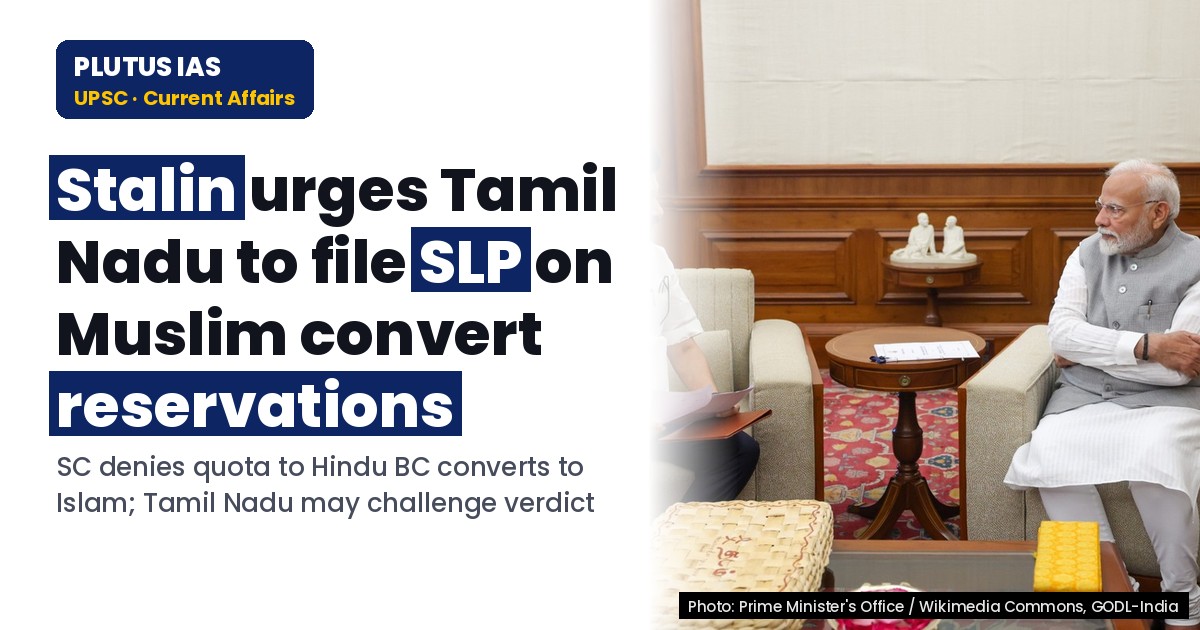
15 Oct Supreme Court Verdict on Muslim Convert Reservations: Key Analysis for UPSC & State PCS
✎ Reservation for converted communities hinges on the principle of ‘social backwardness’ as defined by Articles 15(4) and 16(4), not on religious conversion alone, as established by judicial precedents such as EV Chinnaiah (2005)…
Subject Relevance — Where This Topic Fits
- GS Paper II — Fundamental Rights and Constitutional Provisions | GS Paper II — Judiciary and Constitutional Framework | GS Paper II — Welfare Schemes for Vulnerable Sections
- Prelims: Article 15(4), Article 16(4), Article 16(5), Article 340, Indra Sawhney v. Union of India (1992), T.M.A. Pai Foundation v. State of Karnataka (2002), State of Kerala v. N.M. Thomas (1976), EV Chinnaiah v. State of Andhra Pradesh (2005), Nagaraj v. Union of India (2006), Jarnail Singh v. Lachhmi Narain Gupta (2018), Backward Classes, Most Backward Classes, Scheduled Castes, reservation for converted communities, constitutional amendment, social justice, judicial review
- Essay: Social justice as a constitutional mandate: Balancing equality and affirmative action, The role of the judiciary in upholding constitutional morality in reservation policies
Quick Revision: Reservation for converted communities hinges on the principle of ‘social backwardness’ as defined by Articles 15(4) and 16(4), not on religious conversion alone, as established by judicial precedents such as EV Chinnaiah (2005) and Nagaraj (2006).
Why is this in the news?
The Supreme Court’s recent order, upholding a Madras High Court verdict denying reservation benefits to Backward Classes (BC) members who converted to Islam, has reignited the debate on the constitutional validity of denying reservation rights to converted communities. The issue intersects with the principles of social justice, non-discrimination, and the State’s obligation to address historical injustices. The call by political stakeholders, including M.K. Stalin, urging the Tamil Nadu government to seek judicial redress through a Special Leave Petition (SLP) highlights the ongoing tension between judicial interpretation and legislative intent in reservation policies.
Background
- The constitutional framework for reservation in India is rooted in Articles 15(4) and 16(4), which empower the State to make special provisions for the advancement of socially and educationally backward classes, including Scheduled Castes (SCs) and Scheduled Tribes (STs).
- Reservation policies in India have historically been designed to address caste-based discrimination and social exclusion, with the Indra Sawhney v. Union of India (1992) judgment capping reservations at 50% while recognising the State’s power to exceed this limit in exceptional circumstances.
- The issue of reservation for converted communities has been a subject of judicial scrutiny, with the Supreme Court in EV Chinnaiah v. State of Andhra Pradesh (2005) ruling that SC status is not transferable to converts from Hinduism to other religions, as it is tied to the caste system.
- The Nagaraj v. Union of India (2006) judgment reinforced the need for empirical data to justify reservation policies, ensuring that such policies are not arbitrary but based on identifiable social and educational backwardness.
- State governments, including Tamil Nadu, have periodically introduced measures to extend reservation benefits to converted communities, often citing the principles of social justice and the Dravidian model of social reform.
Reservation for Converted Communities: Constitutional Provisions, Judicial Precedents, and Policy Implications
- **Constitutional Basis**: Articles 15(4) and 16(4) of the Constitution empower the State to make special provisions for the advancement of socially and educationally backward classes. These provisions do not explicitly exclude converted communities but tie reservation to the principle of ‘social backwardness’ rather than religion.
- The EV Chinnaiah v. State of Andhra Pradesh (2005) judgment established that Scheduled Caste status is not transferable to converts from Hinduism to other religions, as SC status is inherently linked to the caste system and not merely to economic or social disadvantage.
- The Nagaraj v. Union of India (2006) case introduced the requirement of empirical data to justify reservation policies, ensuring that such policies are not arbitrary and are based on quantifiable backwardness. This has implications for converted communities seeking reservation benefits.
- State governments, such as Tamil Nadu, have historically adopted progressive reservation policies under the Dravidian model, which emphasises social justice and the upliftment of marginalised communities, including converted groups.
- The Supreme Court’s recent order denying reservation to converted Muslims underscores the tension between judicial interpretation and legislative intent, particularly in states with a strong commitment to social justice.
- The call for a constitutional amendment to extend reservation benefits to converted communities reflects the ongoing debate on whether social backwardness can be addressed independently of religious identity.
Key Features
| Feature | Significance |
|---|---|
| Constitutional Reservation Framework | Ensures representation of socially and educationally backward classes in public employment and education, as mandated by Articles 15(4) and 16(4) of the Constitution. |
| Caste-based Reservation Policy | Aims to correct historical injustices and promote social justice by providing proportional representation to marginalised castes, including Scheduled Castes (SCs), Scheduled Tribes (STs), and Other Backward Classes (OBCs). |
| Religious Conversion and Reservation | Examines whether conversion to another religion nullifies the social backwardness of a caste, thereby affecting eligibility for reservation benefits under the OBC category. |
| Judicial Interpretation of Reservation | Highlights the role of the judiciary in interpreting constitutional provisions related to reservation, particularly in cases involving religious conversion and caste identity. |
| State Government’s Role in Reservation Policy | Illustrates the authority of state governments in formulating and implementing reservation policies, subject to constitutional and judicial oversight. |
Why it Matters
Constitutional and Legal Significance
- The issue underscores the tension between caste-based reservation and religious conversion, raising questions about the constitutional validity of denying reservation benefits post-conversion.
- The Supreme Court’s recent judgment aligns with its earlier stance that conversion does not automatically entitle individuals to reservation benefits unless their social backwardness persists.
- The case reinforces the principle that reservation is a tool for social justice, not a blanket entitlement, and must be grounded in empirical evidence of backwardness.
- The debate highlights the need for a nuanced approach to reservation, balancing individual rights with the collective goal of social equity.
Social and Political Significance
- The issue reflects the ongoing struggle for social justice among marginalised communities, particularly those historically oppressed due to caste discrimination.
- It raises questions about the intersection of religion and caste, and whether religious conversion can alter the social realities that reservation policies seek to address.
- The debate is particularly salient in states like Tamil Nadu, where caste-based reservation has been a cornerstone of social policy under the ‘Dravidian Model’.
- The political discourse surrounding reservation reflects broader societal debates on identity, equality, and the role of the state in addressing historical injustices.
Judicial and Governance Significance
- The case exemplifies the judiciary’s role in interpreting constitutional provisions related to reservation, ensuring that policies align with the principles of justice and equality.
- It underscores the importance of evidence-based policymaking, where reservation benefits are granted based on demonstrated social backwardness rather than assumptions about religious affiliation.
- The issue highlights the need for clarity in reservation policies, particularly in cases involving religious conversion, to prevent ambiguity and legal disputes.
Challenges
1. Legal Ambiguity in Reservation for Converts
- The lack of a clear constitutional or statutory provision addressing reservation benefits for individuals who convert to another religion creates legal ambiguity.
- Judicial interpretations vary, with some courts denying reservation benefits post-conversion while others emphasise the persistence of social backwardness.
- This ambiguity leads to inconsistent application of reservation policies, resulting in legal disputes and uncertainty for affected communities.
UPSC Link: GS-II: Fundamental Rights (Article 15, 16)
2. Balancing Social Justice and Individual Rights
- Reservation policies must balance the collective goal of social justice with the individual rights of citizens, particularly in cases involving religious conversion.
- Denying reservation benefits solely on the grounds of religious conversion may be perceived as discriminatory, while granting benefits without evidence of backwardness could undermine the policy’s intent.
- This challenge requires a nuanced approach that considers the social realities of marginalised communities, irrespective of their religious affiliation.
UPSC Link: GS-II: Fundamental Rights (Article 14, 15)
3. Ensuring Evidence-Based Reservation Policies
- Reservation benefits must be grounded in empirical evidence of social backwardness, rather than assumptions about caste or religious affiliation.
- The absence of a standardised mechanism to assess social backwardness post-conversion complicates the implementation of reservation policies.
- States must develop robust data collection and analysis frameworks to ensure that reservation benefits are granted fairly and transparently.
UPSC Link: GS-II: Welfare Schemes for Vulnerable Sections
4. Political and Social Polarisation
- The issue of reservation for converts often becomes politicised, leading to polarisation along religious and caste lines.
- Political rhetoric may overshadow the substantive debate on social justice, complicating efforts to address the issue through evidence-based policymaking.
- States must navigate these sensitivities carefully to ensure that reservation policies are implemented in a manner that promotes social harmony and equity.
UPSC Link: GS-II: Issues Relating to Development and Management of Social Sector
5. Judicial Overreach and Policy Implementation
- The judiciary’s role in interpreting reservation policies can sometimes lead to judicial overreach, where courts dictate policy implementation rather than deferring to legislative intent.
- This challenge is particularly acute in cases involving complex social issues like reservation for converts, where judicial decisions may lack clarity or consistency.
- States must work closely with the judiciary to ensure that judicial interpretations align with constitutional principles and policy objectives.
UPSC Link: GS-II: Judiciary (Basic Structure Doctrine)
Challenges — UPSC Perspective
| Issue | Concern |
|---|---|
| Legal Ambiguity | Lack of clear provisions on reservation for converts creates inconsistency in judicial rulings. |
| Social Justice vs Individual Rights | Balancing collective social justice goals with individual rights post-conversion is complex. |
| Evidence-Based Policymaking | Absence of standardised mechanisms to assess social backwardness post-conversion. |
| Political Polarisation | Issue often becomes politicised, complicating evidence-based policymaking. |
| Judicial Overreach | Courts may interpret reservation policies in ways that lack clarity or consistency. |
Way Forward
- States should conduct empirical studies to assess the social and educational backwardness of communities post-conversion, ensuring reservation policies are evidence-based.
- The central government, in consultation with state governments, should explore the possibility of a constitutional amendment to clarify the status of reservation for converts, if necessary.
- Judicial bodies should adopt a consistent approach in interpreting reservation policies, particularly in cases involving religious conversion, to reduce ambiguity.
- States should strengthen data collection mechanisms to track the socio-economic status of marginalised communities, including those who have converted to another religion.
- Civil society organisations and academic institutions should be engaged to conduct research on the intersection of caste, religion, and reservation, providing inputs for evidence-based policymaking.
- Public awareness campaigns should be launched to educate communities about the principles of reservation and the criteria for eligibility, reducing misconceptions and polarisation.
- The Union and state governments should collaborate to develop a national framework for assessing social backwardness, ensuring uniformity in reservation policies across states.
UPSC Value Addition
Keywords for Mains Answer-Writing
Reservation policy for Backward Classes · Constitutional provisions on social justice · Supreme Court judgments on caste-based reservation · Reservation for converted minorities · Dravidian Model of social justice · Article 15(4) and 16(4) of the Constitution · Indra Sawhney case (1992) · Constitutional morality and social justice · Scheduled Castes and Scheduled Tribes (Prevention of Atrocities) Act, 1989 · State-level Backward Class Commissions · Judicial review of reservation policies · Intersectionality of caste and religion
Constitutional & Policy Linkages
- Article 15(4): Special provisions for the advancement of socially and educationally backward classes.
- Article 16(4): Reservation in public employment for backward classes.
- Article 46: Promotion of educational and economic interests of Scheduled Castes, Scheduled Tribes, and weaker sections.
- Article 340: Appointment of a Commission to investigate the conditions of socially and educationally backward classes.
Concept Flow
Historical caste oppression → Social backwardness persists post-conversion → Reservation as a tool for social justice → Judicial interpretation of reservation eligibility → Policy ambiguity and legal disputes → Need for evidence-based reforms.
Prelims Practice Questions
Q1. Consider the following statements regarding the reservation policy in India:
1. The Constitution (103rd Amendment) Act, 2019 introduced 10% reservation for Economically Weaker Sections (EWS) among the general category.
2. The Indra Sawhney case (1992) upheld the concept of ‘creamy layer’ in reservation policies.
3. The Constitution explicitly prohibits reservation on the basis of religion.
4. The Supreme Court has consistently held that conversion to another religion automatically entitles a person to reservation benefits.
How many of the above statements are correct?
- Only one
- Only two
- Only three
- All four
Answer: Only two — Statement 1 is correct as the 103rd Amendment introduced EWS reservation. Statement 2 is correct as the Indra Sawhney case established the creamy layer principle. Statement 3 is incorrect as the Constitution does not explicitly prohibit reservation on religious grounds. Statement 4 is incorrect as the Supreme Court has not held that conversion automatically entitles one to reservation benefits.
Q2. Assertion (A): The Supreme Court, in its recent judgment, upheld the Madras High Court’s decision denying reservation to Hindu Backward Class members who converted to Islam.
Reason (R): The Supreme Court ruled that social backwardness is not erased by religious conversion and that reservation benefits are tied to caste identity, not religion.
In the context of the above statements, which of the following is correct?
- Both A and R are true, and R is the correct explanation of A.
- Both A and R are true, but R is not the correct explanation of A.
- A is true, but R is false.
- A is false, but R is true.
Answer: Both A and R are true, and R is the correct explanation of A. — Both the Assertion (A) and Reason (R) are factually correct and R correctly explains A. The Supreme Court’s judgment aligns with the principle that reservation benefits are tied to caste-based social backwardness, which is not erased by religious conversion.
Q3. Match the following constitutional provisions with their correct descriptions:
Column I (Provisions)
A. Article 15(4)
B. Article 16(4)
C. Article 340
D. Article 341
Column II (Descriptions)
1. Empowers the President to specify Scheduled Castes in states
2. Provides for the appointment of a Commission to investigate the conditions of socially and educationally backward classes
3. Enables the State to make special provisions for the advancement of socially and educationally backward classes
4. Permits the State to make provisions for reservation in appointments and services
- A-3, B-4, C-2, D-1
- A-1, B-2, C-3, D-4
- A-4, B-3, C-1, D-2
- A-2, B-1, C-4, D-3
Answer: A-3, B-4, C-2, D-1 — The correct matches are: A (Article 15(4)) – 3 (special provisions for backward classes), B (Article 16(4)) – 4 (reservation in appointments), C (Article 340) – 2 (Commission for backward classes), D (Article 341) – 1 (specification of Scheduled Castes).
Mains Practice Question
✍ The Supreme Court’s recent judgment upholding the denial of reservation benefits to Backward Class members who convert to Islam has reignited debates on the intersectionality of caste and religion in India’s reservation policy. Critically examine the constitutional and judicial foundations of reservation for socially backward classes, with particular reference to the principle that ‘social backwardness is not erased by religious conversion’. Also, assess the implications of such judgments for the ‘Dravidian Model’ of social justice. (15 Marks)
Approach: MODEL-ANSWER SKELETON:
1. **Constitutional Foundations**:
– Article 15(4) and 16(4) as enabling provisions for reservation for socially and educationally backward classes.
– The Indra Sawhney case (1992) and the ‘creamy layer’ principle.
– The 103rd Amendment (2019) introducing EWS reservation, distinct from caste-based reservation.
2. **Judicial Interpretation**:
– Supreme Court’s stance on caste-based reservation (e.g., M. Nagaraj case, 2006; Jarnail Singh case, 2018).
– Recent judgment denying reservation to converted Muslims: reasoning based on the persistence of caste-based social backwardness.
– Contrast with the constitutional morality of social justice (Article 46) and the Directive Principles.
3. **Dravidian Model of Social Justice**:
– Tamil Nadu’s historical approach to reservation, including the Justice Venkataswami Commission (1985) and subsequent expansions.
– The ‘Dravidian Model’ as a framework for caste-based affirmative action, distinct from religious considerations.
– Recent legislative efforts (e.g., reservation for converted Adi Dravidas) and their constitutional validity.
4. **Intersectionality of Caste and Religion**:
– The debate on whether reservation should extend to religious minorities who face caste-based discrimination.
– Judicial reluctance to equate caste with religion (e.g., Supreme Court’s stance in the ‘Hindutva’ cases).
– The role of State Backward Class Commissions in determining eligibility for reservation.
5. **Implications and Way Forward**:
– The tension between constitutional provisions (Articles 14, 15, 16) and judicial interpretations.
– The need for a nuanced policy that addresses intersectional identities without diluting the principle of social justice.
– The role of Parliament in clarifying the scope of reservation through constitutional amendments or legislative action.
Source: The Hindu
Tamil Nadu PCS (TNPSC) — State PCS Practice
Prelims: Which of the following statements is correct regarding the recent appeal by Tamil Nadu Chief Minister M.K. Stalin regarding reservation for converted Muslims?
- Stalin urged the TVK (Tamil Nadu Viduthalai Siruthaigal Katchi) government to file an appeal in the Supreme Court over reservation for converted Muslims.
- The Tamil Nadu government has already filed an appeal in the Supreme Court for reservation benefits to converted Muslims.
- The Supreme Court has already granted reservation benefits to converted Muslims in Tamil Nadu.
- The Union Government has rejected the demand for reservation for converted Muslims in Tamil Nadu.
Answer: Stalin urged the TVK (Tamil Nadu Viduthalai Siruthaigal Katchi) government to file an appeal in the Supreme Court over reservation for converted Muslims. — The statement aligns with the reported action by Chief Minister M.K. Stalin urging the TVK government to file an appeal in the Supreme Court regarding reservation for converted Muslims.
Mains: Examine the socio-political implications of providing reservation benefits to converted Muslims in Tamil Nadu. Discuss the constitutional provisions and judicial precedents that may influence such a policy decision.
Generated by AanyaAi for educational purpose.
Related guides on our sites
- Best PSIR optional coaching for upsc
- Best sociology optional coaching for upsc
- Which is best sociology optional coaching for upsc
- Best PSIR optional teacher for upsc

- विशाखापट्टनम में उच्च जोखिम गर्भावस्था की निगरानी बढ़ाने पर कलेक्टर का निर्देश, जानिए पूरी जानकारी - October 21, 2026
- National Unity Day 2026: Key Preparations & Significance for UPSC - October 21, 2026
- 14वां इंडिया केम 2026: मुंबई में वैश्विक रसायन उद्योग का महाकुंभ - October 21, 2026

No Comments