


31 Aug Supreme Court’s Landmark Order on Live-Streaming of Court Proceedings: UPSC & State PCS Analysis
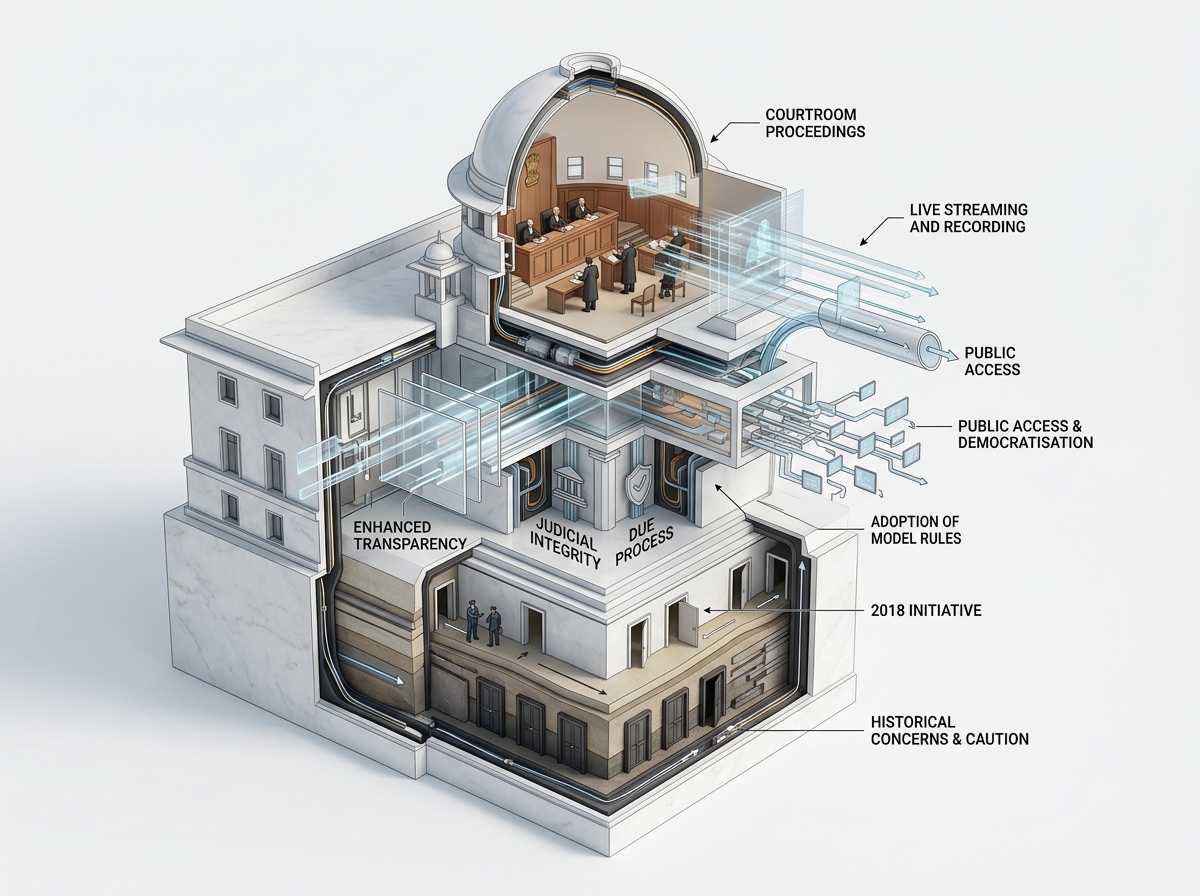
✎ The Supreme Court’s adoption of Model Rules for live-streaming and recording of proceedings is a landmark step toward judicial transparency, balancing public access with the protection of privacy and judicial integrity.
Subject Relevance — Where This Topic Fits
- GS Paper II — Judiciary and Constitutional Framework | GS Paper IV — Ethics in Governance (Transparency and Accountability)
- Prelims: Article 129, Article 215, Article 226, Supreme Court Rules, 2013 (Amended 2023), Live-streaming of judicial proceedings, Right to Information (RTI), Judicial Accountability
- Essay: Transparency in governance as a cornerstone of democracy, Balancing judicial independence with public access to justice
Quick Revision: The Supreme Court’s adoption of Model Rules for live-streaming and recording of proceedings is a landmark step toward judicial transparency, balancing public access with the protection of privacy and judicial integrity.
Why is this in the news?
The Supreme Court of India, in its order dated 24-07-2026 in WP(Civil) No. 751/2026, has formally adopted the Model Rules for live-streaming and recording of court proceedings. This decision marks a significant step toward enhancing judicial transparency, public access to court proceedings, and the democratisation of justice delivery in India. The move aligns with global best practices and seeks to address long-standing concerns regarding the opacity of judicial processes while safeguarding the integrity of judicial proceedings.
Background
- The Supreme Court has historically been cautious about broadcasting its proceedings due to concerns over judicial independence, privacy of litigants, and potential misuse of footage.
- The 2018 initiative by the Supreme Court to live-stream proceedings in select cases (e.g., landmark constitutional matters and bail hearings) laid the groundwork for broader adoption of transparency measures.
- The COVID-19 pandemic accelerated the adoption of virtual hearings, which inadvertently demonstrated the feasibility of digital access to judicial processes.
- The Law Commission of India, in its 275th Report (2018) on ‘Legal Framework for Live-Streaming of Court Proceedings’, recommended the live-streaming of court proceedings to enhance public trust in the judiciary.
- The Right to Information (RTI) Act, 2005, has been invoked to seek greater transparency in judicial functioning, though courts have traditionally resisted full disclosure of proceedings.
- Global precedents, such as the live-streaming of proceedings in the United States Supreme Court (select cases) and the UK Supreme Court, have influenced India’s approach.
What are the Model Rules for Live-Streaming and Recording of Court Proceedings?
- The Model Rules provide a structured framework for the live-streaming and recording of Supreme Court proceedings, ensuring consistency and accountability in implementation.
- Key objectives include enhancing transparency, public access to justice, and fostering greater trust in the judiciary by allowing citizens to observe court proceedings in real time.
- The rules outline the categories of cases eligible for live-streaming, prioritising constitutional matters, public interest litigation (PIL), and cases of significant legal or social importance.
- Provisions are made to exclude sensitive cases involving minors, victims of sexual offences, or matters affecting national security to protect privacy and prevent misuse.
- The Supreme Court’s digital infrastructure will be upgraded to support high-definition live streaming, with archival recording of proceedings for future reference and research.
- A dedicated portal or platform will be developed to host live streams and recorded proceedings, ensuring accessibility and ease of use for the public.
- The rules mandate the anonymisation of litigants in cases where their identities are not already in the public domain, to prevent harassment or stigma.
- Mechanisms for feedback and grievance redressal will be established to address concerns regarding the broadcasting of proceedings, ensuring a participatory and iterative process.
Key Features
| Feature | Significance |
|---|---|
| Live streaming of court proceedings | Enhances transparency and public access to judicial processes, fostering trust in the judiciary through real-time observation of courtroom activities. |
| Recording of proceedings | Facilitates archival documentation, enabling legal research, academic study, and future reference for judicial precedents. |
| Model Rules adoption | Provides a uniform framework for courts across jurisdictions, ensuring consistency in implementation and adherence to judicial best practices. |
| Digital infrastructure requirements | Mandates technological upgrades in courts, including audio-visual systems, secure networks, and data storage solutions. |
| Accessibility provisions | Ensures that proceedings are accessible to persons with disabilities through sign language interpretation, captioning, or other assistive technologies. |
| Judicial discretion safeguards | Balances transparency with the need to protect sensitive information, privacy of litigants, and national security concerns through controlled access protocols. |
Why it Matters
Judicial Governance
- Strengthens the principle of open justice by making court proceedings publicly observable, reducing opacity in judicial decision-making.
- Encourages accountability among judges and legal practitioners by subjecting proceedings to public scrutiny.
- Facilitates greater legal literacy among citizens by enabling direct exposure to judicial processes and reasoning.
- Supports the judiciary’s role as a guardian of constitutional values by reinforcing democratic accountability mechanisms.
Technological Integration
- Accelerates the digitisation of the judiciary, aligning it with India’s broader digital governance initiatives.
- Promotes the use of technology in dispute resolution, reducing delays and improving efficiency in judicial administration.
- Sets a precedent for other branches of governance to adopt digital transparency measures in public service delivery.
Legal and Academic Utility
- Provides an invaluable resource for law students, researchers, and legal professionals for case studies and precedent analysis.
- Enables empirical research on judicial trends, sentencing patterns, and procedural delays, informing policy reforms.
- Supports the development of AI-driven legal tools by providing structured, searchable datasets of court proceedings.
Challenges
1. Digital Divide and Infrastructure Gaps
- Rural and semi-urban courts may lack the financial resources or technical expertise to implement live streaming and recording systems.
- Inconsistent internet connectivity and power supply in certain regions could disrupt the seamless transmission of proceedings.
- High costs of procuring and maintaining audio-visual equipment pose a barrier to universal adoption across all court complexes.
UPSC Link: GS-II: Judiciary – Challenges in Judicial Reforms
2. Privacy and Data Security Concerns
- Risk of sensitive personal or commercial information being exposed during live broadcasts, violating litigant privacy rights.
- Cybersecurity threats, including hacking or data breaches, could compromise the integrity of recorded proceedings.
- Need for robust data encryption and access control mechanisms to prevent misuse of judicial records.
UPSC Link: GS-II: Right to Privacy – Judicial Safeguards
3. Judicial Workload and Operational Disruptions
- Additional administrative burden on court staff to manage recording equipment, technical troubleshooting, and archival processes.
- Potential for technical glitches to disrupt court proceedings, leading to delays or misinterpretations of judicial orders.
- Requirement for training judges, lawyers, and court staff in the use of new digital tools and protocols.
UPSC Link: GS-II: Judicial Reforms – Efficiency Concerns
4. Balancing Transparency with Fair Trial Rights
- Risk of live streaming influencing judicial behaviour, such as judges being unduly cautious or influenced by public perception.
- Need to protect the identity of vulnerable witnesses or victims to prevent harassment or intimidation.
- Ensuring that the right to a fair trial (Article 21) is not compromised by public scrutiny of proceedings.
UPSC Link: GS-II: Fair Trial – Constitutional Guarantees
5. Legal and Ethical Dilemmas
- Unclear liability in case of technical failures or misrepresentation of proceedings due to recording errors.
- Potential for selective editing or misuse of recordings by media or other stakeholders for sensationalism or propaganda.
- Ethical concerns regarding the commercialisation of court proceedings or the exploitation of judicial data.
UPSC Link: GS-II: Judicial Ethics – Accountability Mechanisms
Challenges — UPSC Perspective
| Issue | Concern |
|---|---|
| Infrastructure deficits | High costs and technical limitations impede uniform implementation across all court complexes. |
| Privacy violations | Risk of exposing sensitive information, violating litigant rights under Article 21 and Article 20(3). |
| Cybersecurity risks | Vulnerability to data breaches or hacking, threatening the integrity of judicial records. |
| Judicial discretion conflicts | Need to balance transparency with the protection of fair trial rights and judicial independence. |
| Operational disruptions | Technical glitches or administrative burdens may disrupt court proceedings and delay justice. |
| Ethical ambiguities | Lack of clear guidelines on the use, storage, and commercialisation of recorded proceedings. |
Way Forward
- Constitute a High-Level Committee under the Supreme Court to oversee the phased implementation of live streaming and recording protocols across all tiers of the judiciary.
- Allocate dedicated funds under the Centrally Sponsored Scheme for Judicial Infrastructure to support digital upgrades in under-resourced courts.
- Develop a National Judicial Data Grid to standardise archival formats, ensuring interoperability and accessibility of recorded proceedings.
- Mandate regular training programmes for judges, lawyers, and court staff on digital tools, cybersecurity, and ethical use of judicial data.
- Establish a robust grievance redressal mechanism to address privacy violations, technical failures, or misuse of recorded proceedings.
- Collaborate with the Ministry of Electronics and Information Technology to leverage existing digital infrastructure, such as the National Judicial Data Grid and e-Courts services.
- Formulate clear guidelines on the permissible use of recordings, including restrictions on commercial exploitation and safeguards for vulnerable litigants.
- Conduct periodic audits of implementation progress, with public reporting to ensure transparency and accountability in the adoption of Model Rules.
UPSC Value Addition
Keywords for Mains Answer-Writing
Judicial transparency · Live-streaming of court proceedings · Model Rules for Live Streaming and Recording of Court Proceedings, 2026 · Open justice principle · Judicial accountability · Constitutional right to information · Supreme Court of India · Public access to judicial proceedings · Judicial reforms · Digital governance in judiciary
Constitutional & Policy Linkages
- Article 14 – Right to Equality: Ensures uniform application of live streaming rules across all citizens, regardless of jurisdiction.
- Article 19(1)(a) – Freedom of Speech and Expression: Facilitates public access to judicial proceedings, reinforcing democratic accountability.
- Article 21 – Right to Life and Personal Liberty: Balances transparency with the protection of fair trial rights and privacy.
- Article 20(3) – Protection against Self-Incrimination: Requires safeguards to prevent exposure of sensitive information during live broadcasts.
Concept Flow
Judicial transparency → Public scrutiny of court proceedings → Enhanced trust in the judiciary → Strengthening of democratic accountability → Adoption of Model Rules for live streaming and recording. → Digital governance initiatives → Integration of technology in judicial administration → Implementation of live streaming protocols → Archival of proceedings → Legal research and precedent analysis. → Open justice principle → Public access to judicial processes → Real-time observation of proceedings → Reduction in judicial opacity → Strengthening of constitutional values. → Technological adoption → Infrastructure upgrades → Training of stakeholders → Operationalisation of recording systems → Addressing privacy and security concerns. → Judicial reforms → Efficiency improvements → Reduction in delays → Enhanced access to justice → Alignment with constitutional guarantees.
Prelims Practice Questions
Q1. Consider the following statements regarding the Model Rules for Live Streaming and Recording of Court Proceedings, 2026:
1. The rules mandate live streaming of all Supreme Court proceedings.
2. The rules allow for recording of court proceedings for archival purposes.
3. The rules are binding on all High Courts in India.
4. The rules are based on the principle of open justice.
How many of the above statements are correct?
- Only one
- Only two
- Only three
- All four
Answer: Only three — Statements 2 and 4 are correct. The Model Rules permit recording of court proceedings for archival purposes and are grounded in the principle of open justice. Statement 1 is incorrect as the rules do not mandate live streaming of all Supreme Court proceedings. Statement 3 is incorrect as the rules are not binding on High Courts, though they may serve as guidelines.
Q2. Assertion (A): The Model Rules for Live Streaming and Recording of Court Proceedings aim to enhance transparency in judicial proceedings.
Reason (R): Transparency in judicial proceedings is a fundamental principle of the Indian Constitution.
Options:
A. Both A and R are true, and R is the correct explanation of A.
B. Both A and R are true, but R is not the correct explanation of A.
C. A is true, but R is false.
D. A is false, but R is true.
Answer: ? — Both Assertion (A) and Reason (R) are true. The Model Rules are indeed designed to enhance transparency in judicial proceedings. Reason (R) is also correct as transparency in judicial proceedings is a fundamental principle of the Indian Constitution, enshrined in Articles 14 and 21. However, R is not the correct explanation of A, as the Model Rules are a specific governance measure to operationalise the principle of transparency.
Mains Practice Question
✍ The Supreme Court of India, in its order dated 24-07-2026, adopted the Model Rules for Live Streaming and Recording of Court Proceedings. Critically examine the constitutional and governance implications of these rules for judicial transparency and accountability in India. (15 Marks)
Approach: MODEL-ANSWER SKELETON:
1. **Constitutional Foundation**:
– Link to the principle of open justice under Articles 14 (Right to Equality) and 21 (Right to Life and Personal Liberty) of the Constitution.
– Reference to the Supreme Court’s earlier judgments such as *Naz Foundation v. NCT of Delhi* (2012) and *Swapnil Tripathi v. Supreme Court of India* (2018) upholding the right to access court proceedings.
2. **Governance and Transparency**:
– Explain how live streaming and recording enhance judicial accountability by allowing public scrutiny.
– Discuss the role of technology in modernising judicial governance and reducing information asymmetry.
3. **Scope and Limitations**:
– Clarify that the Model Rules are not mandatory for High Courts but serve as guidelines.
– Highlight exceptions (e.g., cases involving minors, national security, or privacy concerns) where live streaming may be restricted.
4. **Challenges and Concerns**:
– Address potential misuse of recorded proceedings (e.g., sensationalism, privacy violations).
– Discuss the need for digital infrastructure and capacity-building in lower courts.
5. **Comparative Perspective**:
– Briefly compare India’s approach with global practices (e.g., the UK’s Supreme Court live streaming, the US Supreme Court’s limited broadcasting).
6. **Conclusion**:
– Weigh the benefits of transparency against the risks of misuse. Emphasise the need for a balanced framework that upholds both accountability and privacy.
Source: aphc.gov.in
Generated by AanyaAi for educational purpose.
Related guides on our sites
- Current affairs for upsc 2026
- Best PSIR optional coaching for upsc
- Best PSIR optional teacher for upsc
- Best teacher of PSIR optional for upsc

- विशाखापट्टनम में उच्च जोखिम गर्भावस्था की निगरानी बढ़ाने पर कलेक्टर का निर्देश, जानिए पूरी जानकारी - October 21, 2026
- National Unity Day 2026: Key Preparations & Significance for UPSC - October 21, 2026
- 14वां इंडिया केम 2026: मुंबई में वैश्विक रसायन उद्योग का महाकुंभ - October 21, 2026

No Comments