


01 Sep Tamil Nadu Bill: No Collector’s NOC Needed for Wetland Development in Non-Planning Areas
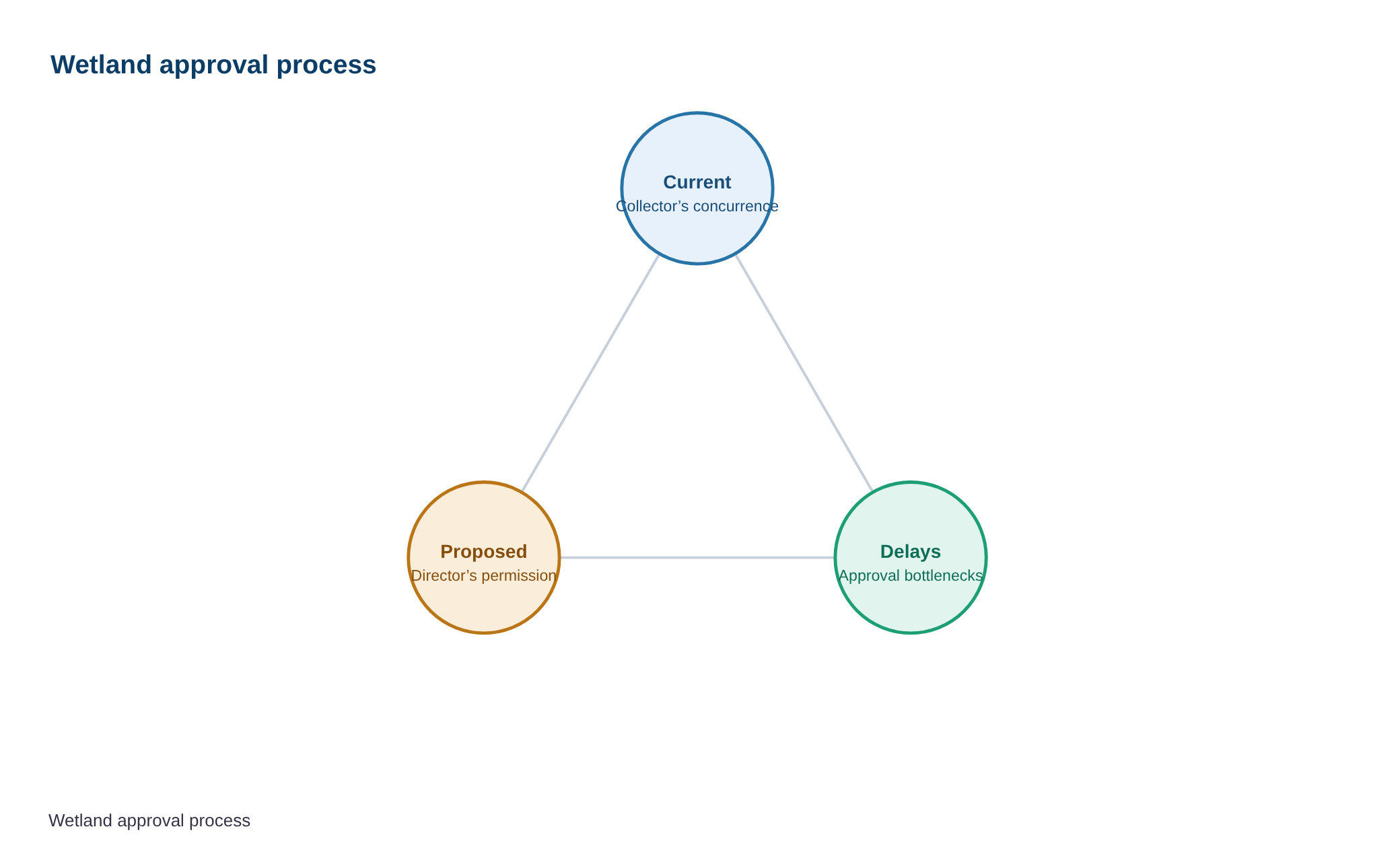
✎ A Bill to further amend the Tamil Nadu Town and Country Planning Act, 1971, aims to streamline wetland development in non-planning areas by replacing the District Collector's prior concurrence with the Director of Town and…
Subject Relevance — Where This Topic Fits
- GS Paper II — Functions and Responsibilities of the Union and the States, Issues and Challenges Pertaining to the Federal Structure | GS Paper III — Conservation, Environmental Pollution and Degradation, Environmental Impact Assessment
- Prelims: Tamil Nadu Town and Country Planning Act, 1971, District Collector’s role in land-use regulation, Wetland conservation under the Wetlands (Conservation and Management) Rules, 2017, Urban Development Authority (UDA), Non-planning areas in urban governance, Prior concurrence mechanism for land development, Section 47-A of the Tamil Nadu Act 35 of 1972, Madras High Court’s role in environmental governance
- Essay: Balancing developmental imperatives with environmental sustainability: A case study of wetland governance in Tamil Nadu, Federalism and environmental governance: The role of state legislation in conservation
Quick Revision: A Bill to further amend the Tamil Nadu Town and Country Planning Act, 1971, aims to streamline wetland development in non-planning areas by replacing the District Collector’s prior concurrence with the Director of Town and Country Planning’s approval, while retaining environmental safeguards and institutional coordination.
Why is this in the news?
The Tamil Nadu Legislative Assembly introduced a Bill on September 1, 2026, to amend the Tamil Nadu Town and Country Planning Act, 1971, with the objective of streamlining wetland development in non-planning areas by removing the requirement for prior concurrence from the District Collector. The proposed amendment seeks to empower the Director of Town and Country Planning to grant prior permissions, thereby addressing delays in processing development applications while maintaining regulatory oversight for environmental conservation.
Background
- The Tamil Nadu Town and Country Planning Act, 1971, governs land-use planning and development control in the state, including provisions for wetland conservation and development in non-planning areas.
- Section 47-A of the Tamil Nadu Act 35 of 1972 mandates prior concurrence from the Director of Town and Country Planning for land development in non-planning areas, with additional concurrence required from the District Collector for wetlands.
- The requirement for prior concurrence from the District Collector has been cited as a cause of delays in the processing of development applications, particularly for wetland projects in non-planning areas.
- Wetlands in Tamil Nadu, such as the Pallikaranai marshland, are ecologically significant but face developmental pressures due to urban expansion and infrastructure needs.
- The Madras High Court has previously intervened in wetland conservation cases, such as in the Pallikaranai marshland, to ensure regulated development without outright bans on construction activities.
- The Bill also proposes institutional reforms within the Urban Development Authority (UDA) to enhance efficiency and accountability in urban planning and development.
What is A Bill to further amend the Tamil Nadu Town and Country Planning Act, 1971?
- The Bill seeks to amend the Tamil Nadu Town and Country Planning Act, 1971, to remove the requirement for prior concurrence from the District Collector for wetland development in non-planning areas.
- It empowers the Director of Town and Country Planning to grant prior permissions for such developments, thereby streamlining the approval process.
- The Bill retains the District Collector as a member of the Urban Development Authority (UDA) to ensure coordination between urban planning and district administration.
- It proposes the creation of full-time positions for the Chairman and Member-Secretary of the UDA to enhance focus, continuity, and accountability in urban development functions.
- The amendment aims to address delays in processing development applications while maintaining regulatory oversight for environmental conservation.
- The Bill does not propose to relax environmental safeguards but seeks to rationalise the approval process for wetland development in non-planning areas.
- The proposed changes are part of broader efforts to modernise urban governance and improve the efficiency of development approvals in Tamil Nadu.
- The Bill has been introduced amid ongoing debates on wetland conservation, particularly in ecologically sensitive areas like the Pallikaranai marshland.
Key Features
| Feature | Significance |
|---|---|
| Dispensation of Collector’s concurrence for wetland development in non-planning areas | Eliminates a redundant procedural layer, reducing delays in wetland development approvals while maintaining oversight through the Director’s concurrence. |
| Empowerment of the Director under the Tamil Nadu Town and Country Planning Act, 1971 | Centralises regulatory authority for wetland development in non-planning areas, ensuring uniformity in decision-making and reducing inter-departmental friction. |
| Appointment of full-time Chairman and Member-Secretary for Urban Development Authority | Enhances institutional capacity, ensures continuity in urban planning, and improves accountability in spatial planning and infrastructure development. |
| Retention of District Collector as a member of the Urban Development Authority | Preserves coordination between urban planning authorities and district administration, ensuring alignment with local governance priorities. |
| Amendment to Section 47-A of the Tamil Nadu Act 35 of 1972 | Clarifies the scope of prior concurrence requirements, distinguishing between planning and non-planning areas to streamline wetland development processes. |
Why it Matters
Governance and Administrative Efficiency
- Streamlines the approval process for wetland development by reducing bureaucratic layers, thereby expediting infrastructure projects in non-planning areas.
- Enhances the operational autonomy of urban development authorities, reducing dependency on district-level officials for routine approvals.
- Improves the responsiveness of spatial planning mechanisms to local developmental needs while balancing environmental conservation.
Urban Planning and Infrastructure Development
- Facilitates targeted wetland development in non-planning areas, aligning with state-level urbanisation and infrastructure expansion goals.
- Strengthens the institutional framework for urban governance by ensuring dedicated leadership and continuity in planning processes.
- Promotes sustainable land-use practices by integrating wetland conservation with developmental imperatives.
Environmental Regulation and Wetland Conservation
- Maintains regulatory oversight through the Director’s concurrence, ensuring that wetland development does not compromise ecological integrity.
- Balances developmental pressures with conservation priorities by retaining environmental safeguards in the planning framework.
- Supports state-level initiatives for wetland restoration and management, as evidenced by parallel efforts in regions like the Nilgiris.
Institutional Capacity Building
- Addresses the need for specialised urban planning expertise by creating full-time positions within the Urban Development Authority.
- Enhances inter-departmental coordination by retaining the District Collector as a member, ensuring alignment with district-level priorities.
Challenges
1. Balancing Development and Environmental Conservation
- Risk of unchecked wetland development in non-planning areas, potentially leading to ecological degradation and loss of biodiversity.
- Challenge of ensuring that the Director’s concurrence mechanism effectively substitutes for Collector’s oversight without compromising environmental safeguards.
- Need for robust monitoring mechanisms to prevent misuse of the streamlined approval process.
UPSC Link: GS3: Conservation, Environmental Pollution and Degradation
2. Institutional Coordination and Capacity Gaps
- Potential resistance from district-level authorities due to reduced role in approval processes, necessitating clear guidelines for role delineation.
- Requirement for capacity-building initiatives to ensure that the Urban Development Authority’s new leadership can effectively discharge its expanded responsibilities.
- Need for periodic reviews to assess the impact of the amendment on urban planning and environmental outcomes.
UPSC Link: GS2: Functions and Responsibilities of Various Constitutional Bodies
3. Legal and Procedural Clarity
- Ambiguity in defining ‘non-planning areas’ and ‘wetlands’ may lead to disputes over the scope of the amendment’s application.
- Risk of legal challenges if the amendment is perceived as diluting environmental protections or altering established regulatory frameworks.
- Need for transparent and participatory processes to address stakeholder concerns and ensure procedural fairness.
UPSC Link: GS2: Separation of Powers between Executive and Judiciary
4. Public Participation and Transparency
- Ensuring that local communities and environmental groups are adequately consulted in wetland development decisions to prevent conflicts.
- Requirement for accessible grievance redressal mechanisms to address concerns related to wetland development projects.
- Need for proactive disclosure of approvals and monitoring data to foster public trust and accountability.
UPSC Link: GS2: Role of Civil Society in Governance
5. Alignment with National Wetland Conservation Frameworks
- Ensuring that the amendment does not conflict with national-level wetland conservation policies, such as the Wetlands (Conservation and Management) Rules, 2017.
- Need for coordination with central agencies to harmonise state-level initiatives with national environmental goals.
- Challenge of integrating state-specific amendments with broader frameworks like the National Mission for Clean Ganga or the National Action Plan on Climate Change.
UPSC Link: GS3: Conservation, Environmental Pollution and Degradation
Challenges — UPSC Perspective
| Issue | Concern |
|---|---|
| Ecological degradation risk | Potential for unchecked wetland development leading to loss of biodiversity and ecosystem services. |
| Institutional capacity gaps | Limited expertise in urban planning and environmental regulation within the Urban Development Authority. |
| Legal ambiguity | Unclear definitions of ‘non-planning areas’ and ‘wetlands’ may lead to disputes. |
| Public participation deficits | Risk of inadequate consultation with local communities and environmental groups. |
| Regulatory fragmentation | Possible misalignment with national wetland conservation frameworks and policies. |
| Monitoring and enforcement gaps | Challenge of ensuring compliance with environmental safeguards post-approval. |
Way Forward
- Conduct a comprehensive mapping of wetlands in non-planning areas to delineate boundaries and update regulatory frameworks accordingly.
- Establish a multi-stakeholder committee comprising environmental experts, urban planners, and local authorities to oversee the implementation of the amendment.
- Develop standardised guidelines for the Director’s concurrence process to ensure consistency and transparency in decision-making.
- Strengthen institutional capacity by providing training programmes for Urban Development Authority officials on wetland conservation and urban planning.
- Introduce digital platforms for real-time monitoring and public disclosure of wetland development approvals and environmental impact assessments.
- Align the amendment with the Wetlands (Conservation and Management) Rules, 2017, to ensure compliance with national conservation frameworks.
- Conduct periodic impact assessments to evaluate the amendment’s effect on wetland conservation and urban development outcomes.
- Enhance public awareness campaigns to educate stakeholders on the amendment’s objectives and safeguards.
UPSC Value Addition
Keywords for Mains Answer-Writing
Tamil Nadu Town and Country Planning Act, 1971 · Urban Development Authorities · District Collector’s concurrence · Wetland conservation · Spatial planning · Local authority permissions · Urban Development Authority (UDA) · Non-planning areas · Urban governance reforms · Environmental governance
Concept Flow
Wetland development in non-planning areas → Requirement for Collector’s concurrence under Section 47-A → Perceived delays in approvals → Introduction of Bill to amend Tamil Nadu Town and Country Planning Act, 1971 → Dispensation of Collector’s concurrence → Empowerment of Director for prior concurrence → Appointment of full-time Chairman and Member-Secretary → Enhanced institutional capacity → Streamlined wetland development process → Balancing developmental needs with environmental conservation → Long-term sustainability of wetlands.
Prelims Practice Questions
Q1. Consider the following statements regarding the Tamil Nadu Town and Country Planning Act, 1971:
1. The Act mandates prior concurrence of the District Collector for wetland development in non-planning areas.
2. The Act empowers the Director of Town and Country Planning to grant prior permission for land development in areas other than planning areas.
3. The Act requires the creation of a full-time Chairman and Member-Secretary for the Urban Development Authority.
How many of the above statements are correct?
- Only one
- Only two
- All three
- None
Answer: All three — Statement 1 is correct as per the Bill’s context. Statement 2 is correct under Sub-section (2) of Section 47-A. Statement 3 is correct as the Bill proposes these posts for the UDA.
Q2. Assertion (A): The Tamil Nadu Bill seeks to streamline wetland development by removing the requirement for District Collector’s concurrence in non-planning areas.
Reason (R): The existing process under the Town and Country Planning Act, 1971, has been criticised for causing avoidable delays in granting planning permissions.
Options:
A. Both A and R are true, and R is the correct explanation of A.
B. Both A and R are true, but R is not the correct explanation of A.
C. A is true, but R is false.
D. A is false, but R is true.
Answer: ? — The Bill aims to remove Collector’s concurrence to reduce delays, making A and R both true with R correctly explaining A.
Q3. Match the following provisions of the Tamil Nadu Town and Country Planning Act, 1971 with their corresponding authorities:
Column I (Provision) | Column II (Authority)
1. Prior concurrence for land development in non-planning areas | A. Director of Town and Country Planning
2. Grant of permission for urban development projects | B. District Collector
3. Coordination with district administration in UDA | C. Local authority
4. Wetland development approval in non-planning areas | D. Urban Development Authority
Options:
A. 1-A, 2-C, 3-B, 4-D
B. 1-B, 2-A, 3-C, 4-D
C. 1-A, 2-B, 3-D, 4-C
D. 1-B, 2-C, 3-A, 4-D
Answer: ? — 1 matches B (District Collector), 2 matches C (Local authority), 3 matches A (Director), and 4 matches D (UDA) as per the Bill’s context.
Mains Practice Question
✍ The Tamil Nadu Town and Country Planning Act, 1971, has been amended to dispense with the District Collector’s concurrence for wetland development in non-planning areas, transferring this authority to the Director of Town and Country Planning. Critically examine the implications of this amendment for urban governance, environmental conservation, and administrative efficiency in the state. (15 Marks)
Approach: MODEL-ANSWER SKELETON:
1. **Context and Provision**:
– Briefly explain the Tamil Nadu Town and Country Planning Act, 1971, and its 2026 amendment.
– Highlight the removal of District Collector’s concurrence for wetland development in non-planning areas and the empowerment of the Director.
– Mention the proposed creation of a full-time Chairman and Member-Secretary for the Urban Development Authority (UDA).
2. **Administrative Efficiency**:
– Discuss how the amendment aims to reduce delays in granting planning permissions (reference to Section 47-A and Sub-section 2).
– Argue the need for dedicated roles (Chairman and Member-Secretary) to ensure continuity and accountability in spatial planning.
– Contrast with the existing system where Collector’s concurrence may have caused bottlenecks.
3. **Environmental Conservation**:
– Examine the potential risks to wetland conservation posed by the amendment.
– Wetlands are critical for biodiversity, groundwater recharge, and flood mitigation (reference to Ramsar Convention and National Wetland Conservation Programme).
– Discuss the role of local authorities and the UDA in balancing development and conservation post-amendment.
4. **Urban Governance Reforms**:
– Evaluate the shift in authority from the District Collector to the Director and its implications for decentralised governance.
– Discuss the retention of the Collector as a member of the UDA to ensure coordination with district administration.
– Assess whether this amendment aligns with the 74th Constitutional Amendment Act, 1992, which devolves powers to urban local bodies.
5. **Balanced View and Way Forward**:
– Present arguments for and against the amendment (e.g., efficiency vs. environmental safeguards).
– Suggest measures such as mandatory environmental impact assessments, public consultations, and post-project monitoring to mitigate risks.
– Conclude with a balanced assessment of the amendment’s overall impact on sustainable urban development in Tamil Nadu.
Source: The Hindu
Tamil Nadu PCS (TNPSC) — State PCS Practice
Prelims: Which of the following statements is correct regarding the recent Tamil Nadu Bill that seeks to remove the Collector’s concurrence requirement for wetland development in non-planning areas?
- The Bill aims to streamline wetland development by reducing bureaucratic delays in non-planning areas.
- The Bill mandates that all wetland development projects must now obtain Collector’s approval, even in planning areas.
- The Bill proposes to transfer all wetland development powers exclusively to the State Wetlands Authority.
- The Bill seeks to abolish all wetland development regulations in Tamil Nadu, including those in planning areas.
Answer: The Bill aims to streamline wetland development by reducing bureaucratic delays in non-planning areas. — The Bill intends to simplify the process for wetland development in non-planning areas by eliminating the need for Collector’s concurrence, thereby reducing regulatory hurdles.
Mains: Critically examine the implications of the Tamil Nadu Bill to remove Collector’s concurrence for wetland development in non-planning areas. How does this align with the state’s environmental conservation goals and developmental priorities?
Generated by AanyaAi for educational purpose.
Related guides on our sites
- Anthropology VS PSIR
- Best PSIR optional coaching
- Best PSIR optional coaching online
- Best PSIR optional teacher

- UNEP Report 2026 Warns: Paris 1.5°C Target Slipping Away - October 23, 2026
- पूर्व आईएएस अधिकारी हत्या मामले में आईएएस एसोसिएशन की मुख्यमंत्री से मुलाकात - October 23, 2026
- UPSC Exam: Rare Glimpse of Ritwik Ghatak’s Cinematic Legacy at 4-Day Festival - October 23, 2026

No Comments