


01 Sep Tamil Nadu Bill removes Collector’s nod for wetland projects in non-planning areas
✎ The proposed amendments to the Tamil Nadu Town and Country Planning Act, 1971, aim to streamline wetland development approvals in non-planning areas by vesting prior permission authority in the Director of Town and Country…
Subject Relevance — Where This Topic Fits
- GS Paper II — Functions and Responsibilities of the Union and the States, Issues and Challenges Pertaining to the Federal Structure | GS Paper III — Conservation, Environmental Pollution and Degradation, Environmental Impact Assessment
- Prelims: Wetland (Conservation and Management) Rules, 2017, Town and Country Planning Act, District Collector’s statutory functions, Urban Development Authority, Section 47-A of Tamil Nadu Town and Country Planning Act, 1972, Madras High Court directives on wetland conservation, Pallikaranai Marshland, Nilgiris wetland restoration initiative
- Essay: Balancing Development and Environmental Conservation: Lessons from Urban Wetland Governance Reforms
Quick Revision: The proposed amendments to the Tamil Nadu Town and Country Planning Act, 1971, aim to streamline wetland development approvals in non-planning areas by vesting prior permission authority in the Director of Town and Country Planning, while maintaining the District Collector’s role in the Urban Development Authority for coordination.
Why is this in the news?
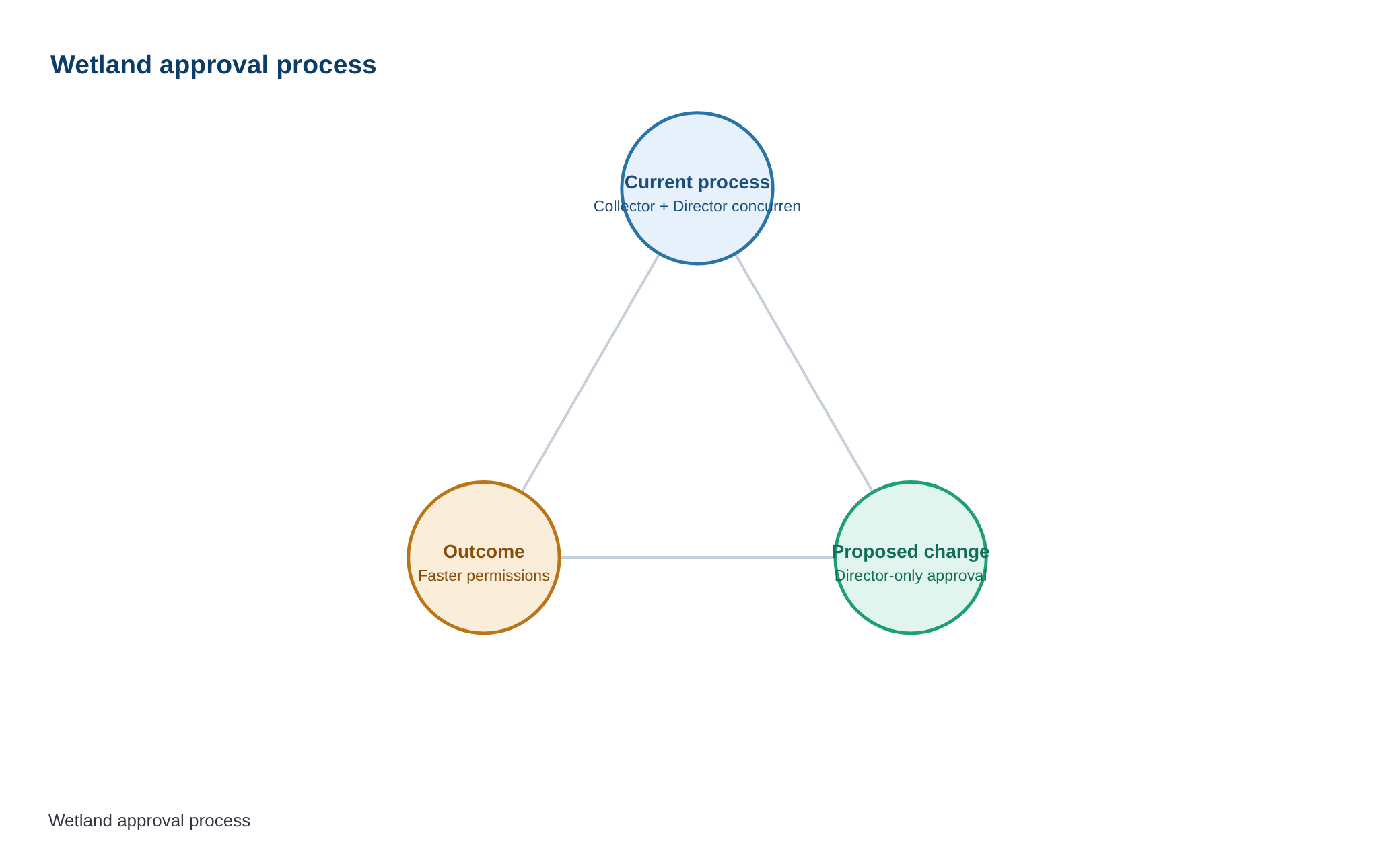
The Tamil Nadu Legislative Assembly has introduced a Bill to amend the Tamil Nadu Town and Country Planning Act, 1971, with the objective of streamlining the process for wetland development in non-planning areas by removing the requirement for prior concurrence of the District Collector. This legislative move aims to address delays in urban planning permissions while ensuring that wetland conservation remains a priority within the broader framework of sustainable urban development.
Background
- The Tamil Nadu Town and Country Planning Act, 1971, governs the regulation of urban and rural land use, including the development of wetlands in non-planning areas.
- Section 47-A of the Tamil Nadu Town and Country Planning Act, 1971, mandates that local authorities obtain prior concurrence from the Director of Town and Country Planning before granting permission for land development in non-planning areas.
- For wetlands specifically, prior concurrence from the District Collector is additionally required, creating a layered approval process that has been criticised for causing delays in urban development projects.
- Wetlands in Tamil Nadu, such as the Pallikaranai Marshland, are ecologically significant but face pressures from urbanisation, necessitating balanced governance frameworks.
- The proposed amendments align with broader national initiatives such as the Wetland (Conservation and Management) Rules, 2017, which emphasise the conservation and sustainable management of wetlands.
- Judicial interventions, including directives from the Madras High Court, have highlighted the need for regulated development around ecologically sensitive wetland areas.
What are the key provisions of the proposed amendments to the Tamil Nadu Town and Country Planning Act, 1971?
- The Bill seeks to amend Sub-section (2) of Section 47-A of the Tamil Nadu Town and Country Planning Act, 1971, to remove the requirement for prior concurrence of the District Collector for wetland development in non-planning areas.
- The power to grant prior permission for such developments will be vested with the Director of Town and Country Planning, who will act as the competent authority for approvals.
- The Bill proposes the appointment of a full-time Chairman and a full-time Member-Secretary to the Urban Development Authority to enhance focus, continuity, and accountability in urban planning and development functions.
- The District Collector will continue to be a member of the Urban Development Authority to ensure effective coordination between urban planning and district administration.
- The amendments aim to expedite the processing of applications for planning permissions, thereby reducing avoidable delays in urban development projects.
- The proposed changes are intended to integrate wetland conservation with urban development by streamlining approval processes while maintaining regulatory oversight.
- The Bill reflects a shift towards decentralised decision-making in urban planning, with greater authority vested in specialised urban development institutions.
Key Features
| Feature | Significance |
|---|---|
| Dispensation of Collector’s concurrence for wetland development in non-planning areas | Streamlines the approval process by removing a redundant layer of clearance, reducing bureaucratic delays in wetland utilisation for development projects. |
| Empowerment of the Director under the Tamil Nadu Town and Country Planning Act, 1971 | Centralises authority for granting prior permission for wetland development, ensuring uniformity in decision-making and reducing inter-departmental friction. |
| Appointment of full-time Chairman and Member-Secretary for Urban Development Authority | Enhances institutional capacity, ensures sustained focus on spatial planning, and improves accountability in urban governance. |
| Retention of District Collector as a member of the Urban Development Authority | Maintains coordination between urban planning authorities and district administration, preserving ground-level administrative oversight. |
| Amendment to Section 47-A of the Tamil Nadu Act 35 of 1972 | Legalises the procedural changes, providing statutory backing to the reforms in land-use regulation for wetlands. |
Why it Matters
Governance and Administrative Efficiency
- Eliminates redundant clearance requirements, reducing processing time for wetland development projects in non-planning areas.
- Enhances the autonomy of urban planning authorities, fostering faster decision-making in land-use regulation.
- Strengthens institutional capacity through dedicated leadership roles, improving the implementation of urban development policies.
Environmental and Ecological Implications
- Wetlands are critical ecosystems for biodiversity, water regulation, and climate resilience; unregulated development may pose environmental risks.
- The amendment does not explicitly address environmental safeguards, raising concerns about potential degradation of ecologically sensitive areas.
- Balancing developmental imperatives with ecological conservation remains a key challenge in wetland governance.
Urban Planning and Spatial Development
- Facilitates structured urban expansion by streamlining approval processes for wetland utilisation in non-planning areas.
- Promotes integrated land-use planning, aligning with the objectives of the National Urban Policy Framework.
- Ensures continuity in urban growth planning through dedicated leadership in the Urban Development Authority.
Legal and Regulatory Framework
- Clarifies the division of powers between the District Collector and the Director, reducing ambiguity in land-use regulation.
- Requires robust implementation mechanisms to prevent misuse of the streamlined process, ensuring compliance with environmental laws.
- May necessitate complementary amendments to the Wetlands (Conservation and Management) Rules, 2017, to align state and central regulations.
Challenges
1. Environmental Degradation Risks
- Unregulated wetland development could lead to loss of biodiversity, reduced water retention capacity, and increased flood risks.
- Lack of stringent environmental impact assessments may exacerbate ecological damage in sensitive areas.
- Need for robust monitoring mechanisms to ensure compliance with environmental norms post-amendment.
UPSC Link: GS3: Conservation, Environmental Pollution and Degradation
2. Institutional Capacity Gaps
- Urban Development Authorities may lack the expertise to balance developmental and environmental priorities effectively.
- Inadequate staffing or resources could undermine the effectiveness of the newly appointed full-time roles.
- Coordination challenges between multiple agencies (e.g., local authorities, environmental bodies) may persist.
UPSC Link: GS2: Functions and Responsibilities of Various Constitutional Bodies
3. Legal and Policy Alignment
- Potential conflict with the Wetlands (Conservation and Management) Rules, 2017, if state amendments dilute central environmental safeguards.
- Risk of ad-hoc development without adherence to the National Urban Policy Framework or state-level spatial plans.
- Need for clear guidelines to define ‘wetland development’ and its permissible limits in non-planning areas.
UPSC Link: GS2: Government Policies and Interventions for Development in Various Sectors
4. Public Participation and Transparency
- Limited scope for public consultation in the approval process for wetland development projects.
- Risk of marginalisation of local communities and environmental groups in decision-making processes.
- Need for transparent grievance redressal mechanisms to address concerns of affected stakeholders.
UPSC Link: GS2: Role of Civil Services in a Democracy
5. Inter-State Coordination
- Wetlands often span multiple administrative jurisdictions; unilateral state amendments may disrupt regional ecological balance.
- Potential for disputes with neighbouring states over shared wetland resources and developmental priorities.
- Need for collaborative frameworks to ensure sustainable management of transboundary wetlands.
UPSC Link: GS2: Federalism, Devolution of Powers and Finances up to Local Levels
6. Implementation and Enforcement Gaps
- Lack of clarity on post-approval monitoring and enforcement mechanisms for wetland development projects.
- Risk of corruption or favouritism in granting permissions, undermining the intended efficiency gains.
- Need for periodic audits and third-party evaluations to assess the impact of the amendment on wetland ecosystems.
UPSC Link: GS4: Ethics and Integrity in Governance
Challenges — UPSC Perspective
| Issue | Concern |
|---|---|
| Environmental safeguards | Risk of ecological degradation due to unregulated development in wetlands. |
| Institutional capacity | Potential inefficiencies in the Urban Development Authority despite structural reforms. |
| Legal alignment | Possible conflict with central environmental regulations and state-level spatial plans. |
| Public participation | Limited scope for community engagement in decision-making processes. |
| Inter-state coordination | Challenges in managing transboundary wetlands and resolving jurisdictional disputes. |
| Enforcement mechanisms | Gaps in post-approval monitoring and corruption risks in the approval process. |
Way Forward
- Draft and notify detailed guidelines under the amended Act to define permissible wetland development activities in non-planning areas, ensuring alignment with the Wetlands (Conservation and Management) Rules, 2017.
- Establish a multi-stakeholder Wetland Management Committee comprising environmental experts, local authorities, and community representatives to oversee implementation.
- Strengthen the capacity of the Urban Development Authority through training programmes on ecological conservation and sustainable urban planning.
- Introduce mandatory Environmental Impact Assessments (EIAs) and third-party audits for all wetland development projects in non-planning areas.
- Develop a real-time digital monitoring system to track wetland utilisation, ensuring transparency and accountability in the approval process.
- Conduct periodic reviews of the amendment’s impact on wetland ecosystems and urban development, with reports made public for stakeholder feedback.
- Foster inter-state coordination through regional wetland management frameworks to address transboundary ecological concerns.
- Promote public awareness campaigns to educate stakeholders on the ecological significance of wetlands and sustainable development practices.
UPSC Value Addition
Keywords for Mains Answer-Writing
Tamil Nadu Town and Country Planning Act, 1971 · Wetland conservation · District Collector’s concurrence · Urban Development Authority · Spatial planning and infrastructure development · Non-planning areas · Prior permission for land development · District administration coordination · Urban governance reforms · Environmental governance in India · Constitutional provisions for local governance · Land-use regulation in India · Urban Local Bodies (ULBs) · Wetland (Conservation and Management) Rules, 2017
Concept Flow
Introduction of the Bill in the Tamil Nadu Assembly → Proposal to amend the Tamil Nadu Town and Country Planning Act, 1971 → Removal of Collector’s concurrence requirement for wetland development in non-planning areas → Centralisation of approval authority with the Director → Structural reforms in the Urban Development Authority (appointment of full-time Chairman and Member-Secretary) → Potential ecological risks due to reduced oversight → Need for robust implementation mechanisms and environmental safeguards → Long-term impact on urban planning, biodiversity, and water security.
Prelims Practice Questions
Q1. Consider the following statements regarding the Tamil Nadu Town and Country Planning Act, 1971:
1. The Act mandates prior concurrence of the District Collector for wetland development in non-planning areas.
2. The Act empowers the Director to grant prior permission for land development in areas other than planning areas.
3. The Act requires the Urban Development Authority to have a part-time Chairman and Member-Secretary.
How many of the above statements are correct?
- Only one
- Only two
- All three
- None
Answer: Only two — Statement 1 is correct as per Sub-section (2) of Section 47-A of the Tamil Nadu Act 35 of 1972. Statement 2 is correct as the Director is empowered to grant prior permission. Statement 3 is incorrect as the Bill seeks to appoint full-time Chairman and Member-Secretary, not part-time.
Q2. Assertion (A): The Tamil Nadu Bill seeks to dispense with the requirement of District Collector’s concurrence for wetland development in non-planning areas.
Reason (R): The Bill aims to reduce avoidable delays in processing applications for planning permission.
Options:
A. Both A and R are true, and R is the correct explanation of A.
B. Both A and R are true, but R is not the correct explanation of A.
C. A is true, but R is false.
D. A is false, but R is true.
Answer: ? — Both the Assertion (A) and Reason (R) are true. The Bill indeed seeks to dispense with the District Collector’s concurrence to reduce delays, making R the correct explanation of A.
Q3. Match the following provisions with their respective authorities as per the Tamil Nadu Town and Country Planning Act, 1971:
Column I (Provision) | Column II (Authority)
———————|—————————-
1. Prior concurrence for land development in non-planning areas | A. District Collector
2. Grant of prior permission for development | B. Director
3. Coordination with district administration | C. Urban Development Authority
4. Appointment of Chairman and Member-Secretary | D. Local Authority
- 1-A, 2-B, 3-C, 4-D; 1-B, 2-A, 3-D, 4-C; 1-D, 2-B, 3-A, 4-C; 1-A, 2-D, 3-B, 4-C
Answer: ? — 1-A: Prior concurrence for land development in non-planning areas is required from the District Collector. 2-B: Grant of prior permission is by the Director. 3-A: Coordination with district administration involves the District Collector. 4-C: Appointment of Chairman and Member-Secretary is by the Urban Development Authority.
Mains Practice Question
✍ The requirement of prior concurrence of the District Collector for wetland development in non-planning areas has been a subject of debate in the context of urban governance reforms. Critically examine the implications of dispensing with such concurrence, with reference to environmental governance and the balance of powers between local authorities and district administration. (15 Marks)
Approach: MODEL-ANSWER SKELETON:
1. **Context and Provision**:
– Briefly explain the Tamil Nadu Town and Country Planning Act, 1971, and the role of the District Collector in land-use regulation, especially in non-planning areas.
– Highlight the proposed amendment to dispense with Collector’s concurrence for wetland development.
2. **Arguments in Favor of the Amendment**:
– **Efficiency and Timeliness**: Reduction in avoidable delays in processing applications for planning permission (as cited in the Bill).
– **Empowerment of Local Authorities**: Strengthening the role of Urban Development Authority and local bodies in spatial planning and infrastructure development.
– **Focused Governance**: Appointment of full-time Chairman and Member-Secretary to ensure continuity and accountability.
3. **Arguments Against the Amendment**:
– **Environmental Concerns**: Wetlands are ecologically sensitive; prior concurrence ensures environmental safeguards and compliance with the Wetland (Conservation and Management) Rules, 2017.
– **Balance of Powers**: District Collectors act as a check on unregulated development, ensuring coordination with district administration and adherence to land-use norms.
– **Potential for Over-exploitation**: Risk of unchecked development in ecologically fragile areas without adequate oversight.
4. **Comparative Perspective**:
– Reference to other states’ models (e.g., Kerala’s wetland conservation policies, Maharashtra’s Town Planning Acts) where similar provisions exist to balance development and conservation.
5. **Constitutional and Legal Framework**:
– Role of Article 243G (functions of Panchayats) and Article 243W (functions of Municipalities) in urban governance.
– Reference to the 73rd and 74th Constitutional Amendments Act, 1992, which decentralize powers to local bodies.
6. **Conclusion**:
– The amendment must strike a balance between efficiency and environmental governance.
– Suggest measures such as mandatory environmental impact assessments, public consultations, and post-development monitoring to mitigate risks.
Source: The Hindu
Tamil Nadu PCS (TNPSC) — State PCS Practice
Prelims: Which recent legislative action in Tamil Nadu aims to simplify wetland development in non-planning areas by removing the requirement of Collector’s concurrence?
- Tamil Nadu Wetlands (Conservation and Management) Amendment Bill, 2023
- Tamil Nadu Town and Country Planning (Amendment) Act, 2024
- Tamil Nadu Environment Protection (Amendment) Ordinance, 2024
- Tamil Nadu Revenue (Land Reforms) Amendment Bill, 2023
Answer: Tamil Nadu Wetlands (Conservation and Management) Amendment Bill, 2023 — The Tamil Nadu Wetlands (Conservation and Management) Amendment Bill, 2023 seeks to amend existing provisions to exclude Collector’s concurrence for wetland development in non-planning areas, thereby expediting projects.
Mains: Examine the significance of the Tamil Nadu Wetlands (Conservation and Management) Amendment Bill, 2023, in the context of balancing environmental conservation with developmental needs in non-planning areas of the state. Discuss its potential impacts on local governance, land use, and ecological sustainability.
Generated by AanyaAi for educational purpose.
Related guides on our sites
- Anthropology VS PSIR
- Best PSIR optional coaching
- Best PSIR optional coaching online
- Best PSIR optional teacher

- How India’s Rs 20,000 Cr CCUS Budget Can Drive Net-Zero Goals - October 23, 2026
- पंजाब-हरियाणा में पराली जलाने पर सीएक्यूएम की सख्त समीक्षा, तुरंत उठाये गये कदमों पर जोर - October 23, 2026
- UNEP Report 2026 Warns: Paris 1.5°C Target Slipping Away - October 23, 2026

No Comments