


09 Aug Tamil Nadu Budget 2026: TVK Faces Fiscal Challenge in First Budget
✎ Tamil Nadu’s fiscal consolidation must prioritise plugging revenue leakages, rationalising non-developmental expenditures, and reforming PSUs while ensuring that social welfare commitments do not derail long-term fiscal…
Subject Relevance — Where This Topic Fits
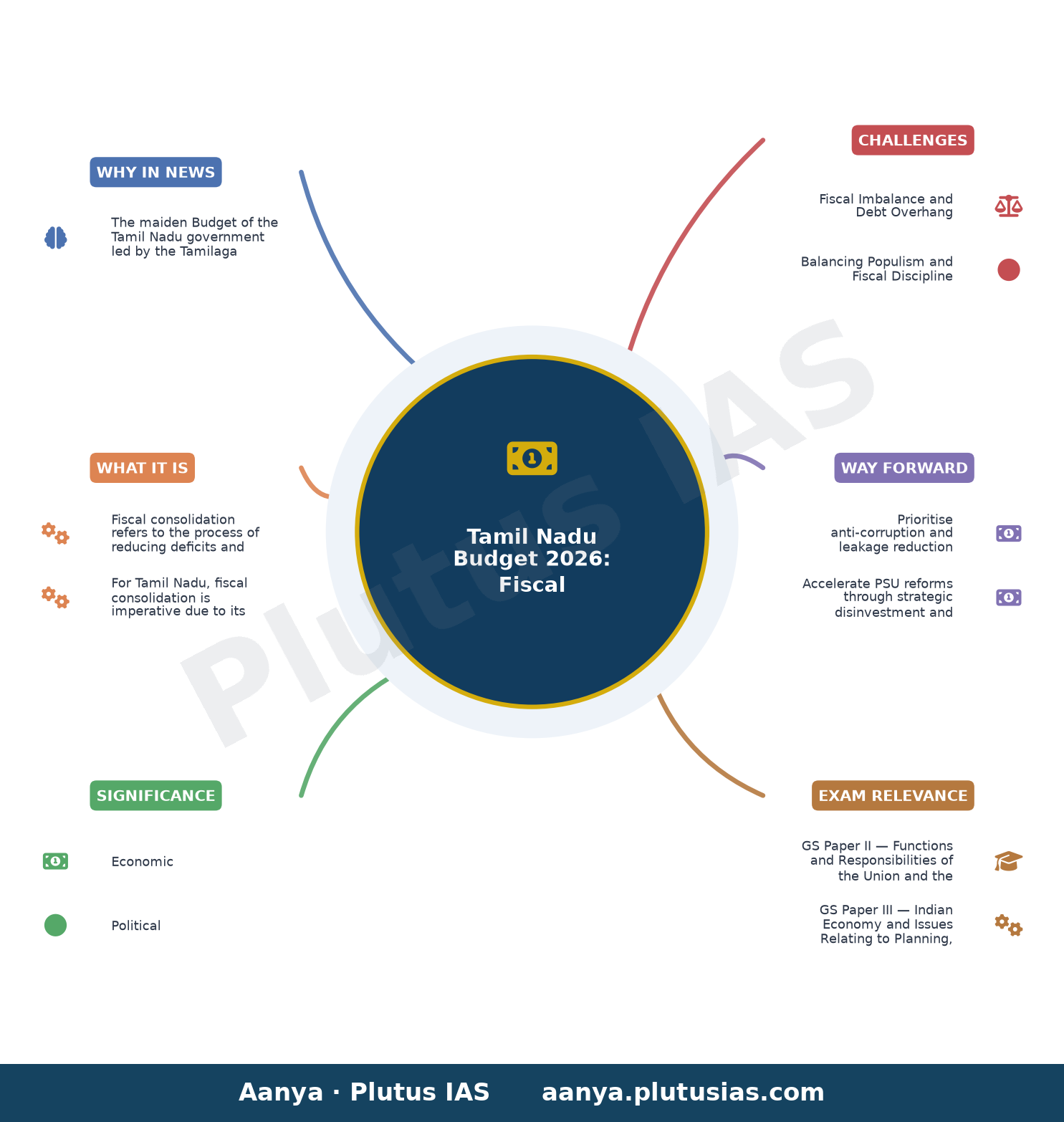
- GS Paper II — Functions and Responsibilities of the Union and the States, Issues and Challenges Pertaining to the Federal Structure | GS Paper III — Indian Economy and Issues Relating to Planning, Mobilisation of Resources, Growth, Development and Employment | GS Paper III — Government Budgeting
- Prelims: Fiscal consolidation, Revenue deficit, Public Sector Undertakings (PSU) reforms, Debt management, Resource mobilisation, White Paper on State Finances, Direct Benefit Transfer (DBT), Inter-district bus services
- Essay: The paradox of fiscal discipline and social welfare: Balancing development with economic prudence, Federalism in India: Fiscal autonomy vs. fiscal discipline in state budgets
Quick Revision: Tamil Nadu’s fiscal consolidation must prioritise plugging revenue leakages, rationalising non-developmental expenditures, and reforming PSUs while ensuring that social welfare commitments do not derail long-term fiscal sustainability.
Why is this in the news?
The maiden Budget of the Tamil Nadu government led by the Tamilaga Vettri Kazhagam (TVK) presents a critical case study in fiscal governance, as it seeks to reconcile ambitious electoral promises with the imperative of fiscal consolidation. The Budget reflects the government’s recognition of a deteriorating fiscal position, marked by high debt levels and sub-optimal revenue generation, while attempting to address pressing social welfare demands such as enhanced honoraria for women and improved educational infrastructure. This juxtaposition of fiscal constraints and developmental aspirations underscores the challenges inherent in state-level budgetary policymaking in India.
Background
- The Tamil Nadu government, led by the TVK, assumed office following the 2026 Assembly elections, inheriting a fiscally strained state economy with a significant debt burden and revenue deficits.
- The TVK’s electoral victory was attributed in part to its promises of enhanced social welfare measures, including a ₹2,500 monthly honorarium for women and free inter-district bus travel for women, as well as commitments to improve educational and healthcare infrastructure.
- The state’s fiscal deterioration has been exacerbated by long-standing issues such as leakages in public expenditure, suboptimal revenue mobilisation, and inefficiencies in public sector undertakings (PSUs).
- The Budget follows the release of a White Paper on State Finances, which outlined a multi-year strategy for fiscal correction, emphasising revenue enhancement, expenditure rationalisation, and PSU reforms.
- Industry bodies and chambers of commerce have welcomed the Budget’s focus on growth and industrial development, though concerns persist about the pace and feasibility of reforms amid fiscal constraints.
What is Fiscal Consolidation and Why is it Critical for Tamil Nadu?
- Fiscal consolidation refers to the process of reducing deficits and debt accumulation through disciplined fiscal management, including revenue enhancement, expenditure control, and debt reduction strategies.
- For Tamil Nadu, fiscal consolidation is imperative due to its high debt-to-GSDP ratio, which has eroded fiscal space for developmental expenditures and increased interest liabilities, crowding out other priorities.
- The state’s revenue deficit, driven by stagnant tax collections and rising committed expenditures (e.g., salaries, pensions, and subsidies), necessitates urgent corrective measures to restore fiscal health.
- The Budget’s emphasis on plugging leakages, improving tax administration, and reforming PSUs aligns with standard fiscal consolidation frameworks, though implementation challenges remain significant.
- Social welfare commitments, such as the proposed ₹2,500 monthly honorarium for women, pose a direct trade-off with fiscal consolidation goals, requiring innovative resource mobilisation or prioritisation.
- The state’s reliance on market borrowings for financing deficits further complicates fiscal consolidation, as rising interest rates and debt servicing obligations strain future budgets.
- Effective fiscal consolidation in Tamil Nadu must balance short-term austerity with long-term growth-enhancing investments, particularly in education, healthcare, and infrastructure, to ensure sustainable development.
Key Features
| Feature | Significance |
|---|---|
| Fiscal Consolidation Commitment | Acknowledges inherited fiscal imbalance and outlines a multi-year strategy to reduce debt and leakage, ensuring long-term macroeconomic stability. |
| Revenue Mobilisation Focus | Emphasises correcting revenue underperformance through anti-corruption measures and efficiency reforms rather than immediate tax hikes. |
| Public Sector Undertaking (PSU) Reform | Proposes structural reforms in state PSUs to improve financial discipline and reduce fiscal burden. |
| Expenditure Management | Highlights the need for prioritisation of expenditures to align with fiscal constraints while addressing electoral promises. |
| Debt Management Strategy | Recognises the overburdened debt position and commits to phased reduction over a minimum two-year horizon. |
Why it Matters
Economic
- The Budget signals a pragmatic shift from populism to fiscal prudence, balancing electoral promises with macroeconomic stability.
- Revenue mobilisation through anti-leakage measures aligns with the Union Government’s emphasis on GST compliance and formalisation of the economy.
- PSU reforms could enhance efficiency and reduce fiscal drag, though implementation risks remain due to vested interests.
- The two-year fiscal repair timeline reflects realism but also underscores the urgency of structural reforms to avoid a debt spiral.
Political
- The Budget reflects the TVK’s attempt to reconcile populist expectations with fiscal realism, testing its governance credibility.
- Failure to deliver on key promises (e.g., ₹2,500 honorarium, free bus travel) risks eroding public trust and electoral support.
- Industry stakeholders’ cautious optimism suggests the Budget is seen as a step toward growth-oriented policies, but implementation will be critical.
Social
- The Budget’s focus on women’s welfare (e.g., honorarium and transport) and education infrastructure addresses socio-economic disparities in Tamil Nadu.
- However, the minimal fiscal space may constrain the scale of social sector interventions, potentially disappointing marginalised groups.
Administrative
- The emphasis on reducing leakages and corruption aligns with the Union Government’s anti-corruption drives (e.g., PM-KISAN, GST reforms).
- PSU reforms will require bureaucratic capacity and political will to overcome resistance from entrenched interests.
Challenges
1. Fiscal Imbalance and Debt Overhang
- Tamil Nadu’s debt-to-GSDP ratio is among the highest in India, limiting fiscal manoeuvrability.
- Servicing debt crowds out developmental expenditures, exacerbating socio-economic inequalities.
- The two-year repair timeline is ambitious given the scale of the challenge and potential political pressures.
UPSC Link: Economic Survey: State Finances
2. Balancing Populism and Fiscal Discipline
- Electoral promises (e.g., ₹2,500 honorarium, free bus travel) create immediate fiscal pressures.
- Failure to deliver risks alienating key voter segments, particularly women and youth.
- Industry expects growth-oriented policies, but populist measures may deter private investment.
UPSC Link: Government Budgeting
3. Revenue Mobilisation Constraints
- Underperforming tax collections (e.g., GST, stamp duties) limit resource availability.
- Anti-leakage measures require institutional reforms and may face bureaucratic resistance.
- Expanding the tax base without burdening citizens is a delicate balancing act.
UPSC Link: Taxation: GST and State Finances
4. PSU Reform Bottlenecks
- State PSUs often operate with inefficiencies and political interference, hindering reform.
- Privatisation or strategic disinvestment faces legal and political hurdles.
- Reforms may face opposition from labour unions and vested interests.
UPSC Link: Public Sector Undertakings
5. Expenditure Prioritisation
- Competing demands from social sectors (health, education) and infrastructure strain fiscal resources.
- Capital expenditures may be deferred, impacting long-term growth.
- Monitoring and evaluation mechanisms for expenditure efficiency are critical but often weak.
UPSC Link: Public Finance Management
6. Public Trust and Governance Credibility
- Delayed implementation of key promises risks eroding public confidence in the TVK government.
- Transparency in Budget execution and anti-corruption measures are essential to maintain legitimacy.
- Media scrutiny and opposition criticism can amplify governance failures.
UPSC Link: Good Governance
Challenges — UPSC Perspective
| Issue | Concern |
|---|---|
| High Debt-to-GSDP Ratio | Limits fiscal space for development expenditures and increases interest burden. |
| Populist Pressures | Electoral promises create immediate fiscal pressures, risking fiscal slippage. |
| Revenue Underperformance | Underperforming tax collections constrain resource mobilisation. |
| PSU Inefficiencies | State PSUs act as fiscal drags, requiring structural reforms. |
| Expenditure Leakages | Corruption and inefficiencies reduce the impact of developmental expenditures. |
| Implementation Risks | Reforms may face bureaucratic resistance or political interference. |
Way Forward
- Prioritise anti-corruption and leakage reduction measures to improve revenue mobilisation without tax hikes.
- Accelerate PSU reforms through strategic disinvestment and performance-based incentives for management.
- Implement a phased rollout of electoral promises, starting with high-impact, low-cost initiatives (e.g., digital infrastructure in schools).
- Strengthen fiscal monitoring through independent audits and real-time expenditure tracking.
- Enhance transparency in Budget execution by publishing detailed expenditure reports and performance metrics.
- Engage with industry stakeholders to align growth-oriented policies with fiscal consolidation goals.
- Build public trust by communicating fiscal constraints transparently and setting realistic timelines for reforms.
- Leverage technology (e.g., e-governance, AI-driven tax compliance) to improve administrative efficiency.
UPSC Value Addition
Keywords for Mains Answer-Writing
Tamil Nadu Budget 2026 · fiscal consolidation · resource mobilisation · State finances · public sector undertakings reform · debt management · women’s welfare schemes · education infrastructure · taxation policy · fiscal federalism · expenditure management · corruption control · Tamilaga Vettri Kazhagam (TVK) · Dravida Munnetra Kazhagam (DMK) · AIADMK
Concept Flow
Inherited fiscal imbalance (high debt, underperforming revenues) → Electoral promises (populist measures) → Fiscal consolidation commitment (multi-year strategy) → Revenue mobilisation focus (anti-leakage, efficiency) → PSU reform (structural changes) → Expenditure prioritisation (development vs. debt servicing) → Public trust erosion risk (if promises unmet) → Governance credibility test (implementation challenges).
Prelims Practice Questions
Q1. Consider the following statements regarding the Tamil Nadu Budget 2026 presented by the TVK-led government:
1. The Budget emphasizes fiscal consolidation while honouring key election promises.
2. The Finance Minister acknowledged a fiscally strained treasury with high debt and sub-optimal revenue.
3. The Budget proposes a significant increase in the monthly honorarium for women to ₹3,000.
4. The Super Clean Super Campus scheme has been extended to all government schools.
How many of the above statements are correct?
- Only one
- Only two
- Only three
- All
Answer: Only three — Statements 1 and 2 are correct as per the report. Statement 3 is incorrect (the honorarium is ₹2,500, not ₹3,000). Statement 4 is incorrect (the scheme has not been extended to all schools).
Q2. Assertion (A): The Tamil Nadu Budget 2026 prioritizes industrial development and growth-oriented policies.
Reason (R): Industries and chambers of commerce have described the Budget as progressive with a focus on economic expansion.
Options:
A. Both A and R are true, and R is the correct explanation of A.
B. Both A and R are true, but R is not the correct explanation of A.
C. A is true, but R is false.
D. A is false, but R is true.
Answer: ? — Both the assertion and reason are factually accurate. However, the reason does not directly explain the assertion, as the Budget’s focus on industrial development is a stated objective, while the positive feedback from industries is a consequence of that objective.
Q3. Match the following schemes/initiatives mentioned in the Tamil Nadu Budget 2026 with their respective objectives:
Column I (Scheme/Initiative)
1. Super Clean Super Campus scheme
2. Increase in monthly honorarium for women
3. Free travel for women in inter-district bus services
4. Public sector undertakings (PSU) reform
Column II (Objective)
A. Enhancing education infrastructure
B. Women’s welfare and empowerment
C. Fiscal consolidation and debt reduction
D. Social inclusion and mobility
Choose the correct match:
- 1-A, 2-B, 3-D, 4-C
- 1-B, 2-A, 3-C, 4-D
- 1-D, 2-C, 3-B, 4-A
- 1-A, 2-D, 3-B, 4-C
Answer: 1-A, 2-B, 3-D, 4-C — 1-A: Super Clean Super Campus scheme is aimed at improving school infrastructure. 2-B: The honorarium increase targets women’s welfare. 3-D: Free travel for women promotes social inclusion and mobility. 4-C: PSU reform is a tool for fiscal consolidation and debt reduction.
Mains Practice Question
✍ Critically examine the fiscal challenges faced by the Tamil Nadu government in balancing fiscal consolidation with the implementation of election promises in the Budget 2026. Also, discuss the potential implications of these fiscal constraints on the state’s developmental agenda. (15 Marks)
Approach: MODEL-ANSWER SKELETON:
1. **Fiscal Challenges**:
– **Fiscal Deficit and Debt**: High debt burden and sub-optimal revenue streams as acknowledged in the Budget speech and White Paper.
– **Election Promises**: Key promises such as increased honorarium for women (₹2,500/month) and free inter-district travel for women, which require significant fiscal outlay.
– **Resource Mobilisation Constraints**: Limited fiscal space due to leakages, corruption, and sub-optimal PSU performance.
2. **Balancing Act**:
– **Fiscal Consolidation Measures**: Emphasis on PSU reform, debt management, and expenditure rationalisation as outlined in the White Paper.
– **Trade-offs**: The need to prioritise fiscal discipline while addressing social welfare commitments (e.g., women’s empowerment, education infrastructure).
3. **Implications on Developmental Agenda**:
– **Short-Term vs. Long-Term**: Potential delays in large-scale infrastructure projects or social welfare schemes due to fiscal constraints.
– **Investor Confidence**: Positive signals to industries (as noted by chambers of commerce) may boost investment, but fiscal prudence is critical for sustained growth.
– **Federal Relations**: Fiscal federalism dynamics—balancing state-level priorities with central fiscal policies and GST compensation issues.
4. **Way Forward**:
– **Revenue Enhancement**: Exploring non-tax revenue streams (e.g., monetising PSU assets, improving tax compliance).
– **Expenditure Rationalisation**: Targeted subsidies, plugging leakages, and adopting best practices in financial management.
– **Stakeholder Engagement**: Involving civil society, industry, and academia to design sustainable policies.
5. **Conclusion**:
– Acknowledge the government’s pragmatic approach in acknowledging fiscal constraints while attempting to address electoral promises. Highlight the need for a multi-year fiscal consolidation roadmap to balance immediate welfare goals with long-term sustainability.
Source: The Hindu
Generated by AanyaAi for educational purpose.


No Comments