


10 Sep Telangana launches ₹240 crore Employees Health Scheme for 12.91 lakh staff
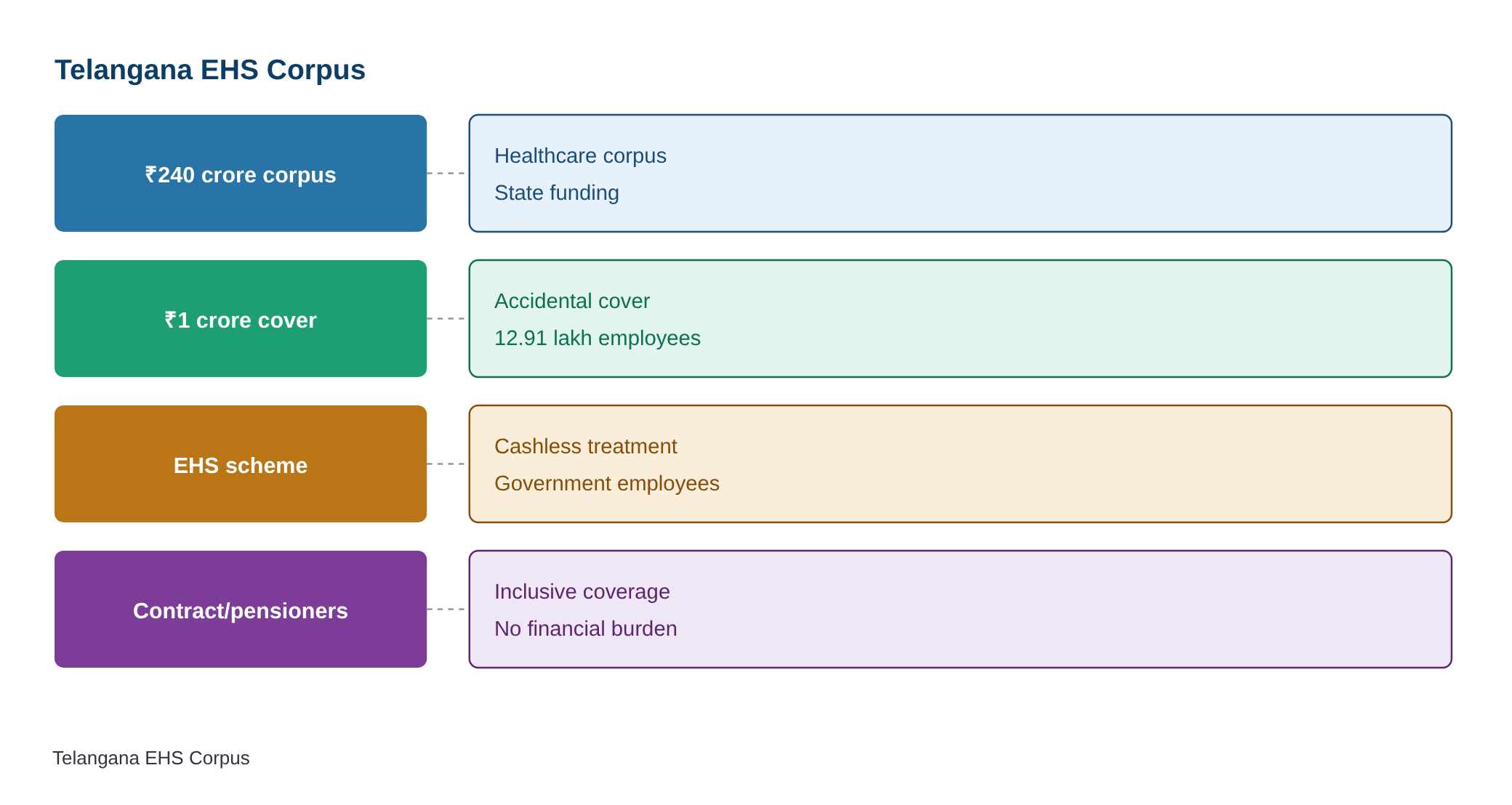
✎ The Employees Health Scheme in Telangana institutionalises cashless healthcare for 12.91 lakh public employees through a ₹240 crore corpus and a ₹1 crore accidental cover, financed via salary-linked banking agreements…
Subject Relevance — Where This Topic Fits
- GS Paper II — Governance, Transparency and Accountability | GS Paper III — Issues relating to Employment and Human Resource Development | GS Paper IV — Ethical Governance and Institutional Integrity
- Prelims: Employees Health Scheme (EHS), cashless treatment, CGHS empanelment, social security for government employees, contributory corpus, institutional monitoring committees, accident insurance cover, empanelment of hospitals, claim settlement mechanisms, public sector insurance models
- Essay: Social security as a pillar of inclusive governance: Balancing fiscal prudence and welfare delivery, The role of institutional mechanisms in ensuring equitable access to healthcare for public employees
Quick Revision: The Employees Health Scheme in Telangana institutionalises cashless healthcare for 12.91 lakh public employees through a ₹240 crore corpus and a ₹1 crore accidental cover, financed via salary-linked banking agreements, eliminating direct costs to employees or the exchequer while ensuring structured empanelment and claim settlement mechanisms.
Why is this in the news?
The Telangana Government’s announcement of a ₹240 crore corpus for the Employees Health Scheme (EHS) and the concurrent implementation of a ₹1 crore accidental cover for 12.91 lakh employees—including regular, contract, and pensioner categories—underscores the state’s institutional commitment to institutionalising social security mechanisms for public sector workforce. This initiative is notable for its scale, coverage, and the innovative financing model that eliminates direct financial burden on either the exchequer or employees, thereby exemplifying a governance approach that integrates welfare delivery with fiscal sustainability.
Background
- The Employees Health Scheme (EHS) in Telangana is a state-specific social security measure designed to provide comprehensive healthcare access to government employees and their dependents, addressing long-standing demands for cashless treatment and structured medical coverage.
- Prior to the EHS, government employees in Telangana relied on ad-hoc medical reimbursement systems, which often resulted in delayed settlements, limited hospital choices, and out-of-pocket expenses despite formal entitlements.
- The scheme’s evolution reflects a broader trend in Indian public administration towards institutionalising welfare delivery through structured programmes, moving beyond discretionary relief measures towards rights-based entitlements.
- Telangana’s initiative follows the model of the Central Government Health Scheme (CGHS), which provides similar benefits to central government employees, but adapts it to state-level administrative and fiscal realities.
- The inclusion of contract, outsourced, and work-charged employees—categories often excluded from traditional social security frameworks—demonstrates an inclusive approach to public employment welfare.
- The scheme’s financing model, leveraging salary-linked banking relationships to secure insurance premiums, represents a governance innovation that aligns private sector incentives with public welfare objectives.
What is the Employees Health Scheme (EHS) in Telangana?
- The Employees Health Scheme (EHS) is a state-funded social security programme designed to provide cashless medical treatment to government employees, pensioners, and their eligible dependents in Telangana.
- The scheme operates through empanelled hospitals, including both public and private facilities, and follows CGHS-package-based reimbursement norms to standardise treatment costs and quality.
- A corpus of ₹240 crore has been constituted to ensure the financial viability of the scheme, covering both routine and high-cost medical treatments without imposing direct costs on employees or the government.
- The scheme extends to 12.91 lakh beneficiaries, encompassing regular employees, contractual staff, outsourced workers, and pensioners, thereby addressing gaps in traditional employment-based social security frameworks.
- A ₹1 crore accidental cover is provided to all covered employees, with claims processed through an institutionalised mechanism that has settled 24 of 33 claims filed since inception, including high-value settlements exceeding ₹15 crore in the Energy Department alone.
- The scheme is monitored by a high-level committee chaired by the Chief Secretary, with representation from employee associations, ensuring transparency, accountability, and responsiveness to beneficiary feedback.
- Financing is secured through agreements with banks where employees’ salaries are credited, utilising the banking sector’s vested interest in employee welfare to cover insurance premiums without additional fiscal strain on the state exchequer.
- The EHS represents a shift from reimbursement-based models to a rights-based entitlement framework, aligning with constitutional principles of welfare governance and the Directive Principles of State Policy (Articles 38, 39, and 41).
Key Features
| Feature | Significance |
|---|---|
| Corpus of ₹240 crore | Ensures financial sustainability of the Employees Health Scheme, enabling cashless treatment in empaneled hospitals without immediate budgetary strain on the exchequer. |
| ₹1 crore accidental cover | Provides comprehensive financial protection to 12.91 lakh employees, including pensioners and dependents, without direct cost to beneficiaries or the government. |
| Cashless treatment mechanism | Facilitates immediate medical care for employees through empanelled hospitals, reducing out-of-pocket expenditure and improving healthcare access. |
| CGHS-package-based services | Standardises medical reimbursement rates and ensures quality care by aligning with Central Government Health Scheme (CGHS) benchmarks. |
| Banking sector collaboration | Leverages salary disbursement infrastructure to integrate premium payments, ensuring seamless and cost-neutral implementation of the insurance scheme. |
Why it Matters
Public Health Governance
- Demonstrates a proactive approach to employee welfare by addressing healthcare access through structured institutional mechanisms rather than ad-hoc measures.
- Sets a precedent for other states in designing scalable health insurance models for government employees, including contractual and outsourced staff.
- Enhances employee productivity and morale by reducing financial stress related to medical emergencies, thereby contributing to administrative efficiency.
Fiscal Management
- Showcases innovative financing where the burden of premiums is externalised to banking partners, aligning public welfare with market incentives.
- Illustrates the use of a dedicated corpus to prevent fiscal shocks, ensuring long-term viability of welfare schemes without recurring budgetary allocations.
- Highlights the role of public-private partnerships in delivering social security without increasing the fiscal deficit.
Inclusive Coverage
- Extends benefits to a diverse workforce, including regular, contractual, and pensioner categories, ensuring equitable access to healthcare.
- Covers dependents of pensioners, addressing intergenerational health needs and reducing vulnerability among retired employees.
- Achieves near-universal coverage for government staff, demonstrating scalability in welfare delivery.
Administrative Efficiency
- Establishes a monitoring committee with senior officials and employee representatives to ensure transparency and responsiveness in scheme implementation.
- Streamlines claim settlement processes, as evidenced by the settlement of 29 out of 33 claims within a short period, reflecting operational effectiveness.
Challenges
1. Sustainability of Corpus
- The long-term adequacy of the ₹240 crore corpus must be assessed against rising medical costs and inflation, particularly in tertiary care.
- Dependence on external financing (e.g., banking sector) introduces risks if partnerships are not renewed or renegotiated periodically.
- Actuarial assessments are required to prevent underfunding, especially as the scheme expands to cover additional employee categories.
UPSC Link: GS-II: Social Sector/Health
2. Equity in Healthcare Delivery
- Ensuring uniform quality of care across empanelled hospitals, particularly in rural and remote areas, remains a challenge.
- Preventing exclusion of marginalised employee groups (e.g., contract workers) due to administrative barriers or lack of awareness.
- Addressing disparities in claim settlement timelines between departments (e.g., Energy vs. SCCL) to maintain fairness.
UPSC Link: GS-II: Governance
3. Operational Bottlenecks
- Maintaining real-time coordination between government agencies, empanelled hospitals, and insurance providers to avoid delays in cashless treatment.
- Ensuring seamless integration of the scheme with existing health infrastructure, including CGHS and state-run hospitals.
- Managing the administrative overhead of processing claims, especially for high-value cases (e.g., ₹15 crore settled for Energy department claims).
UPSC Link: GS-II: Public Administration
4. Financial Viability of Accidental Cover
- The ₹1 crore accidental cover, while comprehensive, requires periodic review to ensure its actuarial soundness amid increasing claim volumes.
- Potential moral hazards, such as over-reporting of accidents or collusion with hospitals, must be mitigated through robust verification mechanisms.
- Balancing the cost of premiums (borne by banks) with the benefits accrued to employees and the government over time.
UPSC Link: GS-III: Disaster Management
Challenges — UPSC Perspective
| Issue | Concern |
|---|---|
| Corpus adequacy | Risk of underfunding due to inflation in healthcare costs or unexpected claim surges. |
| Geographical equity | Ensuring equitable access to cashless treatment in rural and underserved areas. |
| Administrative delays | Potential bottlenecks in claim processing and hospital empanelment. |
| Dependence on external partners | Reliance on banking sector for premium payments may introduce financial risks. |
| Awareness among employees | Ensuring all eligible employees, particularly contractual staff, are aware of scheme benefits and processes. |
| Quality control | Maintaining consistent healthcare standards across empanelled hospitals. |
Way Forward
- Conduct periodic actuarial reviews of the ₹240 crore corpus to assess financial sustainability and adjust contributions if necessary.
- Expand the empanelment of hospitals to include high-quality tertiary care centres in Tier-2 and Tier-3 cities for equitable access.
- Strengthen the monitoring committee by including independent healthcare experts to evaluate service quality and claim settlement efficiency.
- Develop a grievance redressal mechanism for employees to report delays or denials in cashless treatment, ensuring accountability.
- Launch targeted awareness campaigns for contractual and outsourced employees to ensure universal enrolment and utilisation of benefits.
- Integrate the scheme with existing state health databases to enable real-time monitoring of claim volumes and expenditure patterns.
- Explore partnerships with national health schemes (e.g., Ayushman Bharat) to harmonise benefits and reduce duplication.
- Establish a dedicated helpline for employees to facilitate seamless claim submission and settlement.
UPSC Value Addition
Keywords for Mains Answer-Writing
Employees Health Scheme · cashless medical treatment · Corpus Fund for Health Schemes · Government Employees Insurance · Social Security for Government Staff · Accidental Insurance Cover for Employees · CGHS Package-based Medical Services · Fiscal Management of Welfare Schemes · Public Health Infrastructure · Labour Welfare Policies · Employee Benefit Schemes · Healthcare Financing Models
Concept Flow
Government employee welfare demand → Policy formulation of Employees Health Scheme → Financial corpus creation (₹240 crore) → Accidental cover integration (₹1 crore) → Banking sector collaboration for cost-neutral implementation → Cashless treatment mechanism → Claim settlement and monitoring → Expansion to all employee categories → Assessment of sustainability and equity.
Prelims Practice Questions
Q1. Consider the following statements regarding the Employees Health Scheme in Telangana:
1. The scheme provides cashless treatment to employees in empaneled hospitals.
2. The corpus fund for the scheme is ₹240 crore.
3. The scheme covers only regular government employees and excludes contract employees.
4. The accidental cover under the scheme is ₹1 crore per employee.
How many of the above statements are correct?
- Only one
- Only two
- Only three
- All four
Answer: Only three — Statements 1, 2, and 4 are correct. Statement 3 is incorrect as the scheme covers regular staff, contract staff, outsourced staff, and pensioners along with their dependents.
Q2. Assertion (A): The Employees Health Scheme in Telangana is funded entirely by the government without any contribution from employees.
Reason (R): The Telangana government has entered into agreements with banks to cover the premium costs, ensuring no financial burden on employees or the government.
Options:
A. Both A and R are true, and R is the correct explanation of A
B. Both A and R are true, but R is NOT the correct explanation of A
C. A is true, but R is false
D. A is false, but R is true
Answer: ? — Both the assertion and reason are true. The scheme is funded through a corpus of ₹240 crore and agreements with banks cover the premium costs, ensuring no burden on the government or employees.
Q3. Match the following components of the Employees Health Scheme in Telangana with their respective descriptions:
Column I
1. Corpus Fund
2. Accidental Cover
3. Cashless Treatment
4. CGHS Package-based Services
Column II
A. ₹1 crore per employee
B. ₹240 crore for scheme implementation
C. Medical services based on Central Government Health Scheme packages
D. Treatment without out-of-pocket expenses in empaneled hospitals
Options:
A. 1-B, 2-A, 3-D, 4-C
B. 1-A, 2-B, 3-C, 4-D
C. 1-C, 2-D, 3-A, 4-B
D. 1-D, 2-C, 3-B, 4-A
Answer: ? — 1-B (Corpus Fund is ₹240 crore), 2-A (Accidental Cover is ₹1 crore per employee), 3-D (Cashless Treatment is treatment without out-of-pocket expenses), 4-C (CGHS Package-based Services are medical services based on CGHS packages).
Mains Practice Question
✍ The Employees Health Scheme of Telangana represents a significant advancement in social security for government employees. Critically examine the scheme’s design, financing mechanism, and coverage, while also evaluating its potential to serve as a model for other states. (15 Marks)
Approach: MODEL-ANSWER SKELETON:
1. **Scheme Design and Objectives** (3 Marks)
– Cashless treatment and CGHS-package-based services: Explain the significance of cashless treatment in reducing out-of-pocket expenses and improving healthcare access.
– Coverage: 12.91 lakh employees including regular, contract, and pensioners — highlight the inclusivity of the scheme.
– Empanelled hospitals: Discuss the role of empaneled hospitals in ensuring quality and accessibility.
2. **Financing Mechanism** (4 Marks)
– Corpus fund of ₹240 crore: Explain the purpose and sustainability of the corpus.
– ₹1 crore accidental cover: Discuss the rationale behind the high accidental cover and its implications for employee welfare.
– Bank partnerships: Analyze how agreements with banks (where salaries are credited) enable premium coverage without burdening the government or employees.
3. **Implementation and Monitoring** (3 Marks)
– Monitoring committee: Discuss the role of the committee headed by the Chief Secretary and employee association representatives in ensuring transparency and effectiveness.
– Claim settlement: Cite data on claim settlements (e.g., 24 out of 33 claims settled) to evaluate the scheme’s operational efficiency.
4. **Comparative Analysis and Potential as a Model** (3 Marks)
– Compare with national schemes like CGHS, Ayushman Bharat, and state-level initiatives (e.g., Rajasthan’s Bhamashah Swasthya Bima Yojana).
– Discuss the scheme’s strengths (e.g., inclusivity, cashless treatment, bank partnerships) and challenges (e.g., sustainability of corpus, scalability).
5. **Conclusion** (2 Marks)
– Summarize the scheme’s potential to serve as a model for other states, emphasizing its design, financing, and implementation.
– Conclude with a balanced view on its replicability and areas for improvement.
Source: The Hindu
Telangana PCS (TGPSC (TSPSC)) — State PCS Practice
Prelims: Under the Telangana Employees Health Scheme (EHS), the State Government has recently created a corpus fund of ₹240 crore primarily to:
- A. Provide cashless medical treatment to all government employees and pensioners
- B. Subsidize private health insurance premiums for employees
- C. Establish new government hospitals in rural areas
- D. Fund research in Ayurvedic and traditional medicine
Answer: A. Provide cashless medical treatment to all government employees and pensioners — The ₹240 crore corpus is specifically created to ensure cashless medical treatment for all government employees and pensioners under the Employees Health Scheme (EHS).
Mains: Explain the significance of the ₹240 crore corpus fund created by the Telangana Government for the Employees Health Scheme (EHS) in the context of healthcare reforms for government employees and pensioners. Discuss its potential impact on the state’s public health infrastructure and employee welfare.
Generated by AanyaAi for educational purpose.
Related guides on our sites
- Best PSIR optional coaching for upsc
- Best PSIR optional teacher for upsc
- Best teacher of PSIR optional for upsc
- Best PSIR optional coaching in delhi for UPSC

- INS Mysore reaches Lumut for 4th ‘Samudra Lakshmana’ naval exercise - September 10, 2026
- UPSC Civil Services (Main) Examination 2026 — Economics Optional Paper II: Questions with Model Answers | Plutus IAS - September 10, 2026
- यूपीएससी/पीसीएस: महाराष्ट्र में बहुभाषी एआई कार्यशाला से डिजिटल शासन में क्रांतिकारी बदलाव - September 10, 2026

No Comments